

Despite arriving to Salamanca on a Saturday (9th of February), we didn’t go partying – an important hobby for both of us -, as we experience a drawback of staying in “El Camino” albergues. Many of them close their doors at 10 or 11 PM and don’t let you get out. It makes sense though, otherwise they would certainly risk their purpose, which is not other than offering shelter to pilgrims walking – not drinking-.
So we pretty much skipped the hangover of Sunday, and we managed to pay a good visit to Salamanca’s main landmarks. We saw a sweet city panorama from “Torre de la Ciencia” and hit the road south with a terrible wind. The direction of the wind? South, of course. Going downhill at 10 km/h is pretty frustrating.
After crossing multiple fields full of pigs, cows and of course bulls – some of them certainly oriented for bullfighting, judging from their musles and incredible dimensions-, we arrived to Fuenterrobles de Salvatierra, where we stayed in a Church albergue. It’s difficult to explain how nice the people there were. They were totally oriented to help pilgrims and you could see they really lived and loved “El Camino”.
Monday 11th started rainy and windy, but soon we reached a mountainous area, quite well protected from the wind. We had the chance of checking how, some times, the “search tab” called “asking in a local bar” works much better than the search tab of Google. Some locals in Sanchotello, one of the lat villages in Castilla, recommended us to follow the old train rails, which had been refilled with sand and were suitable for bikes. Since old trains could not handle slopes of more than 1%, the way was incredibly flat, and we easily avoided 300m+.
We finally left the “Autonomous Community of Castilla y Leon” and made it to the second one of our trip: Extremadura. The border between these two regions is so green and hilly! It certainly looks like the north of Spain. Curiously, most the towns in the area (Béjar, Hervás, Plasencia) are known for having well preserved “Juderías”, or old jewish neibourhoods. Apparently, during the Middle Ages, it was a region with quite respectful religious laws, which attracted lots of jews (until they were kicked out of Spain in 1492 by the Catholic Kings).
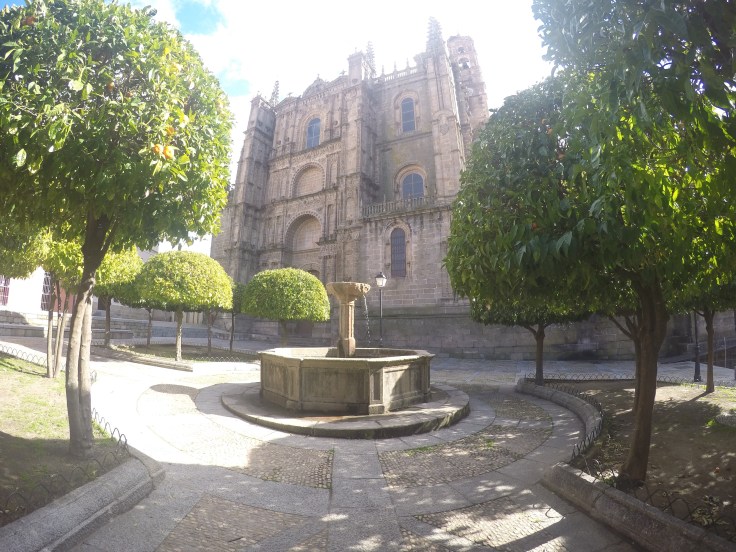
In contrast to Castilla, in Extremadura there are fewer towns and villages but they are more populated and less abandoned. Tuesday 12th we passed through Plasencia and Cáceres, and Wednesday 13th we arrived in Mérida. Again, all the towns were connected by beautiful “Dehesas”, full of “brave” bulls and Iberian pigs, although the landscape turned progressively drier and flatter. It was quite amazing to see the living conditions of these animals, they must be thousand times better than the conditions of the animals being raised in industrial environments, without any freedom. It was a good reminder of the difference that buying local, biological and certified products can make.
In relation to the towns, we found Cáceres an extremely well preserved medieval Town. One could really feel he was in the middle of a “Games of Thrones” recording. Mérida, however, used to be the capital of Roman “Hispania”, and consequently was full of Roman ruins. The Anphiteatre was unreal.
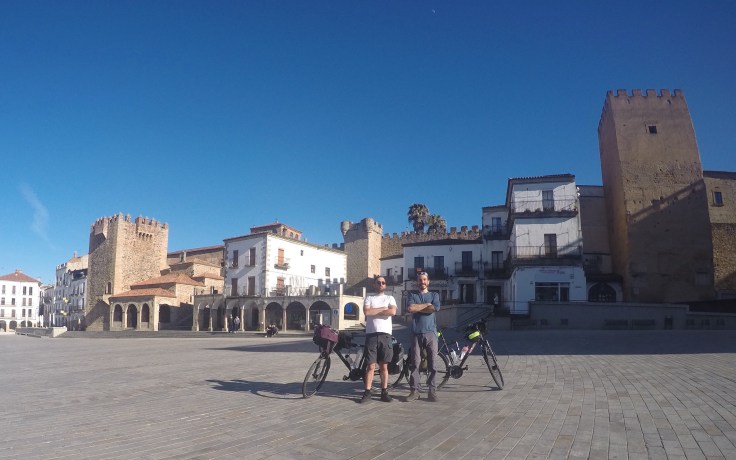
Plaza Mayor of Cáceres

 Cycling Pirates
Leave a comment