
Day 58: Guelmin – Tan-Tan (1st of April)
After a fantastic night getting bitten by the mosquitos, we let Lysiane and Patric have breakfast a bit earlier than us so we can split and not find each other again on the way all the time. We have been told that “there is pretty much nothing” until Tan-Tan, a quite big town in the Moroccan Sahara. The landscape is now finally desertic, similar to the one of Arizona or New Mexico- actually I have never been there but I guess that Hollywood and Breaking Bad have done its job here -.

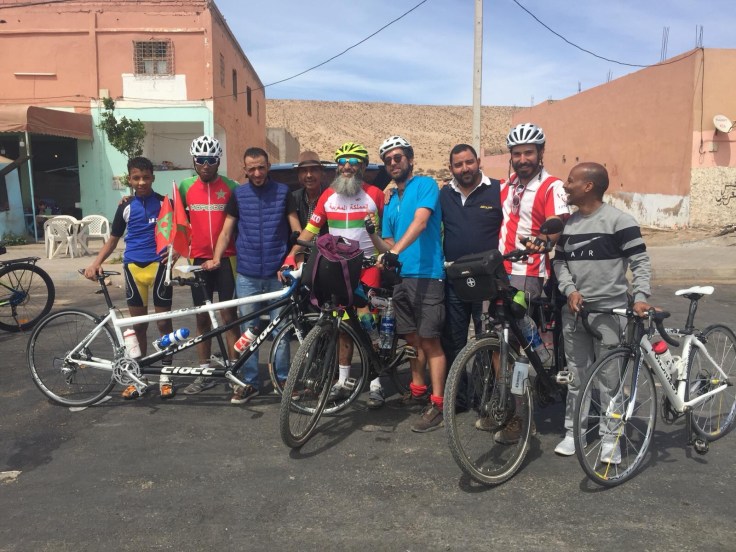
We stop for lunch in a semi ghost town on the way and we encounter a whole crew of Guelmin Cycling Club – the town we passed by yesterday-, supporting their local 17 year-old hero on his challenge of going to Dakhla, a West Saharan city 1’000 km away. They are cycling the first days with him, including a tandem bike with the blind, 60 year-old president of the club, who for obvious reasons goes in the back seat. They go nuts when they see us, including a live interview on their facebook page and the bearded president praising Allah and kissing the ground to give us good luck. So much fun.
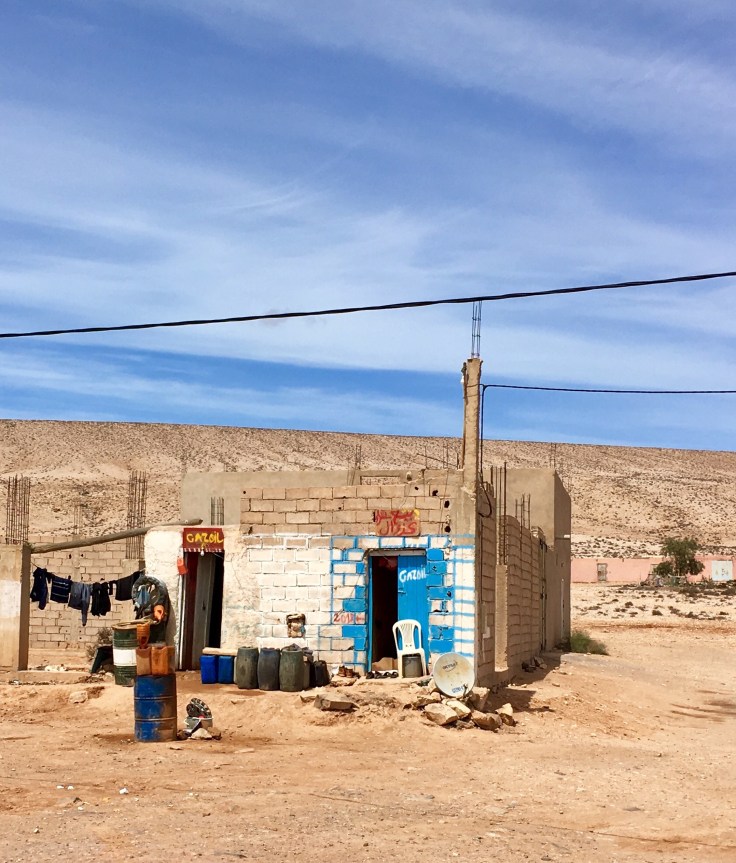
Just before entering Tan Tan, a police officer asks us for a passport copy, which is going to become a habit during our journey through the Sahara. Due to the terrorist attack in December, in which two pieces of rubbish killed two Scandinavian girls, police has political orders to make sure that this does not repeat, among other reasons, to keep the touristic industry growing in Morocco. For that, they control the moves of tourists, specially the moves of people camping in remote areas, like us.
Additionally, we are very close to the Western Sahara, a former Spanish colony that Morocco occupied illegally in 1976. 20% of Western Sahara remains in control of the Saharaui Republic, which is recognised by more than 80 countries. Exactly 0 countries recognise Western Sahara as Moroccan. Consequently, the region is politically convulse, which means a lot of Moroccan police everywhere, pretty much.
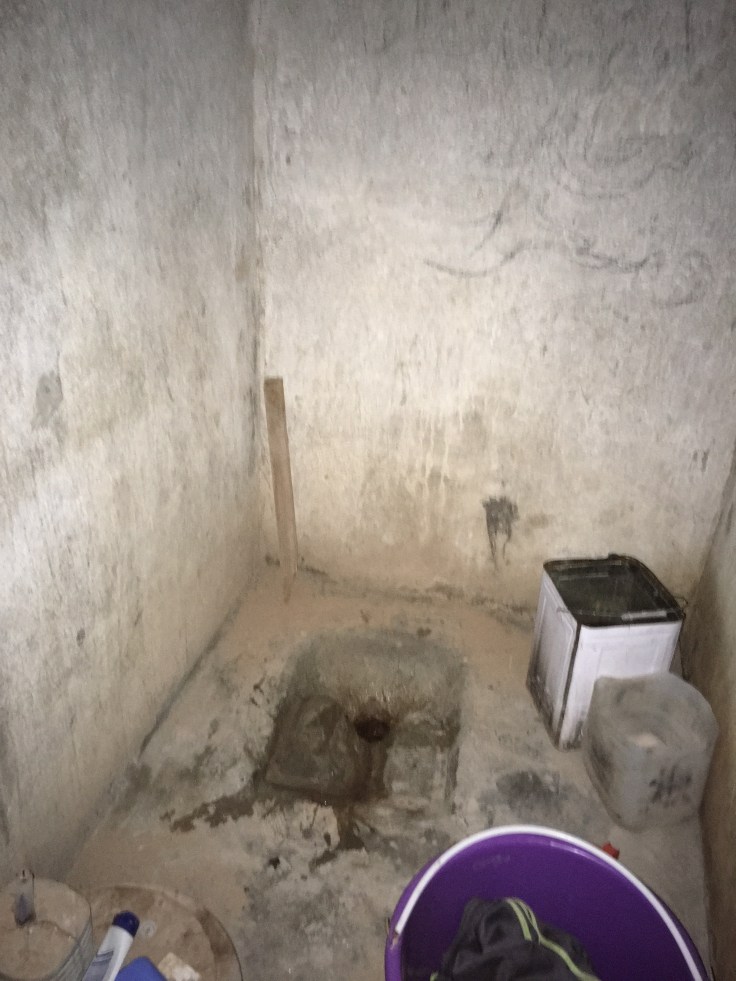
In Tan Tan we stay in what is going to be the worst hotel by far in our trip. Hotel Texas, we will never forget you. The smell, the toilet, the insects… why bother you guys with details.
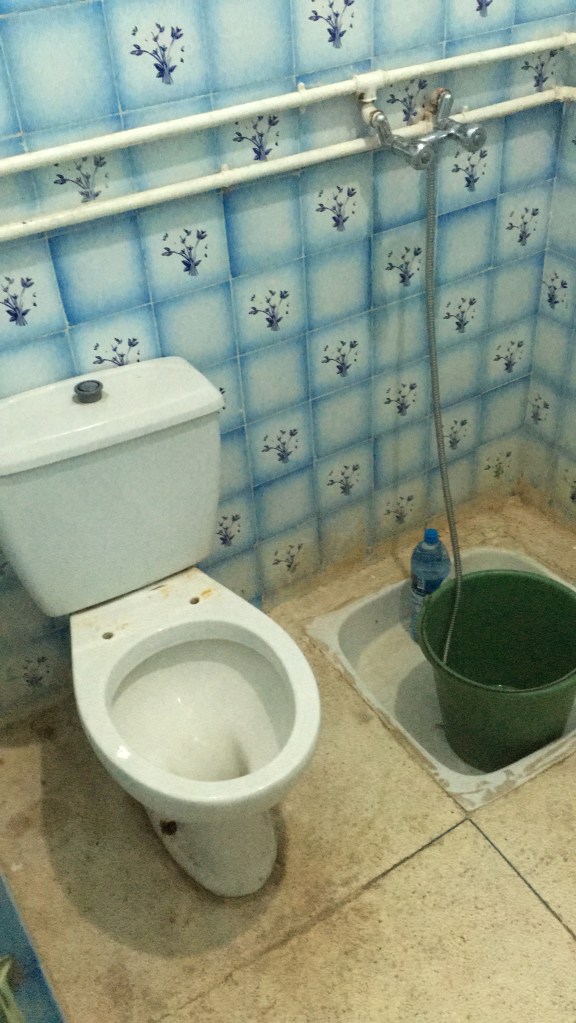
Too bad the police kind of forced us to stay in a hotel and prohibited us to camp. Javi tries to shower but the hot water is a joke, so they offer us another room. Javi gets lost on the way to the new room (room number 6): just imagine him, naked with the towel, knocking doors of surprised military soldiers staying also in the hotel. So awkward. Gaspard then heard “Joder you gave me the wrong room number”. The hotel has two rooms number 6 next to each other, Javi went to the wrong one. We go out for a night walk and we are surprised with how much night activity there is. It is 10:30 and the market is full of people buying, selling and chilling. What a different timing to Europe.
Day 59: Tan-Tan – Akhfenir
we look for someone from the hotel to pay our night. After some research we found him sleeping on the floor below the desk.

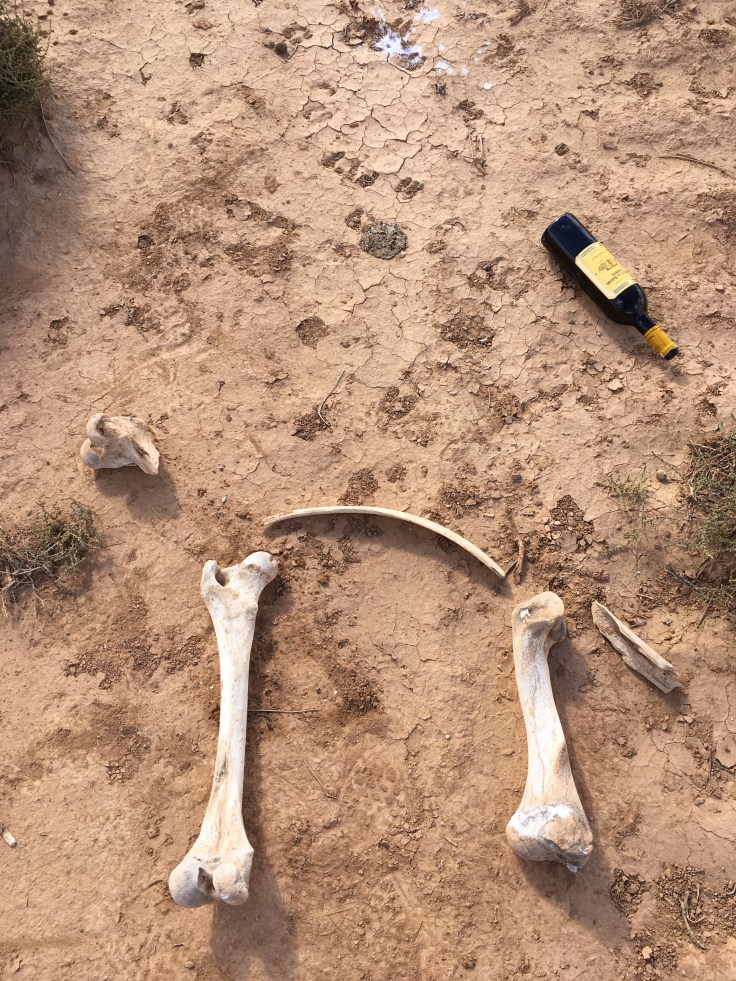
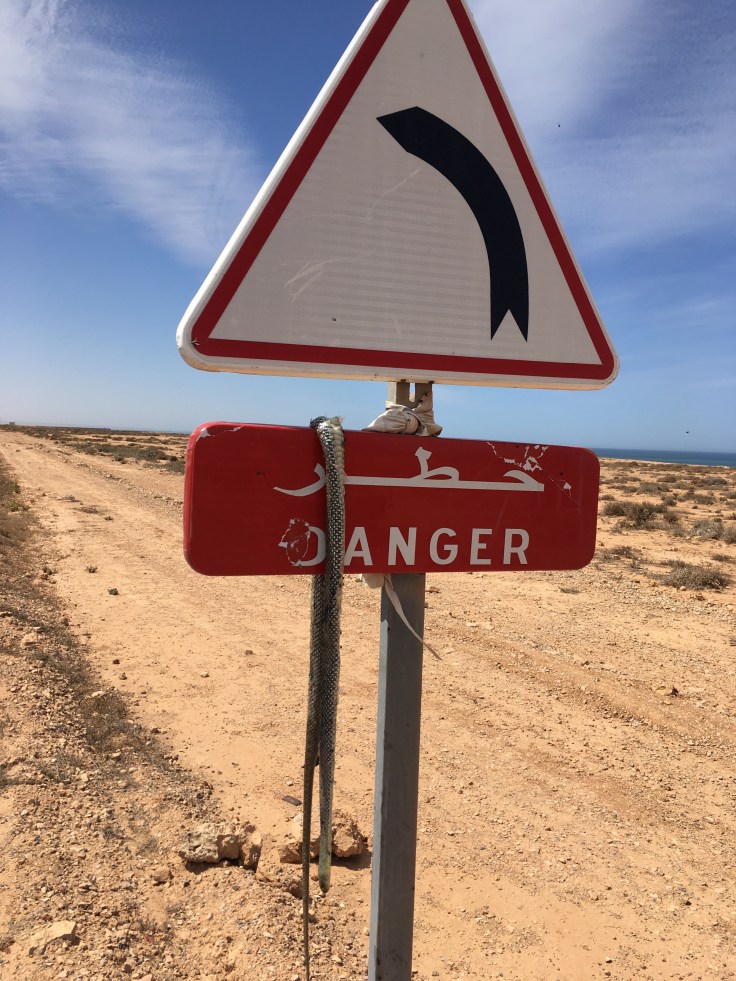
We get emotional when we see the first traffic sign indicating Dakar – wrongly, with 400 km less but still cool-. We don’t get so emotional when we see the first dead snakes on the road. Apart from snakes, there are multiple camel bones, croaches… Camping in the desert looks suddenly less pleasant.
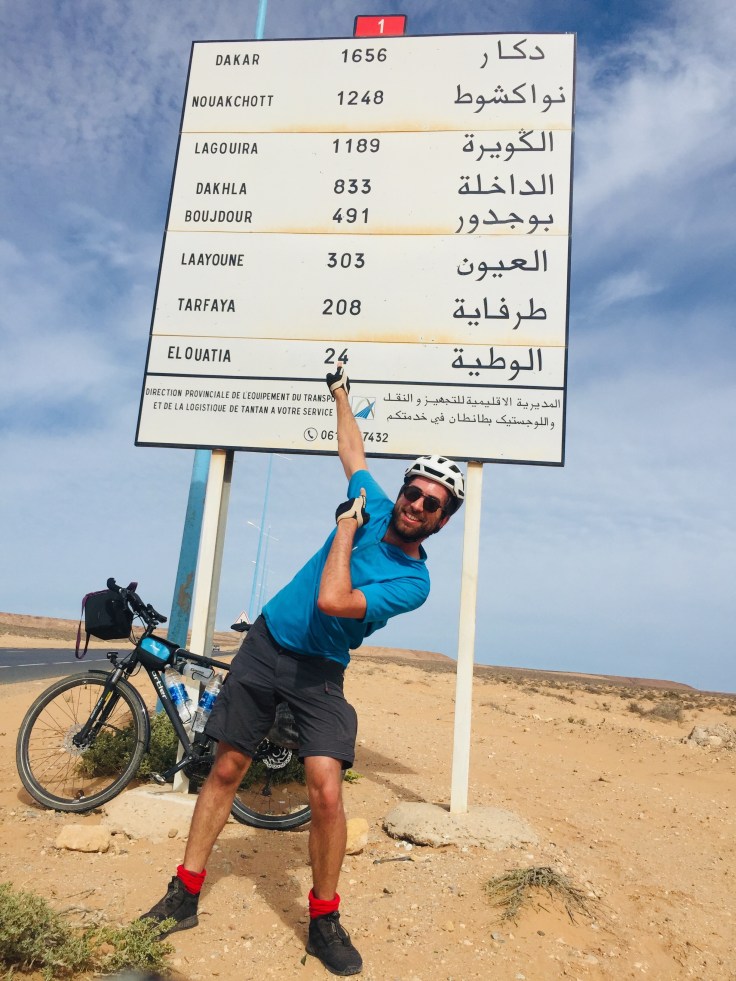
National road 1 connects finally with the sea. N1 is full of trucks heading to El Aaiun, Dakhla and Central Africa. Some of them are nice and cheer to us, while others are really aggressive and push us out of the road so they don’t need to decelerate when overtaking us. A van even hits slightly Javi’s rear mirror, which is not so cool. We decide that we will step out of the road every time it is necessary.
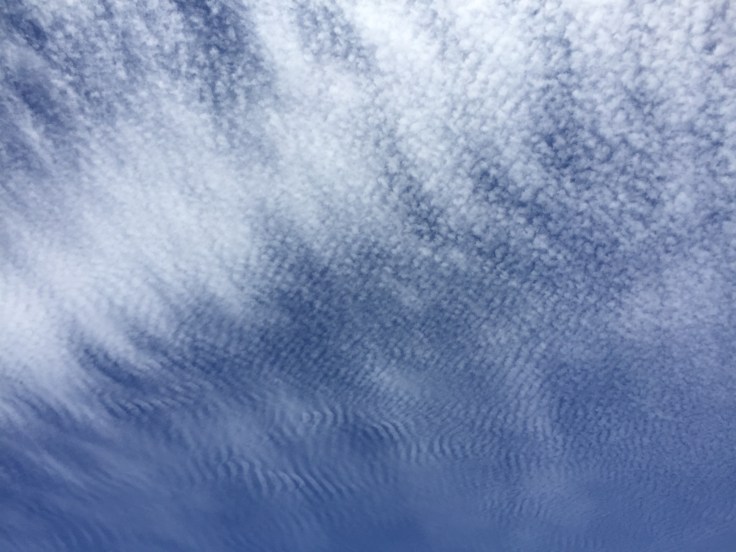
The landscape loses its Wild West touch and sand dunes pop out. Along the road, some dry rivers merge with the sea around beaches full of dunes, creating unreal lagoons full of beauty buy sadly surrounded by rubbish thrown away by truck drivers and fishermen. We want to explore those Oued (river) meeting the sea but they are all used by the royal navy force and protected by a guardian. Luckily one of them let us pass to see the view and it was amazing. The clouds draw weird geometrics shapes.
During our lunch break we run into Patric and Lysiane, which was a matter of time. But, surprise! Salah from Guelmin is also having lunch with them. And, surprise! Another two moroccan cyclists, that have nothing to do with Salah, are also there. Mohamed, a 60 (!) year-old man and Said, a young man from the atlas. They met on the way, and they are going together to Dakhla. Their material is a bit poor, and their skin is totally burned, up to the point that they have bandages protecting the injuries of the sun. Hardcore guys.
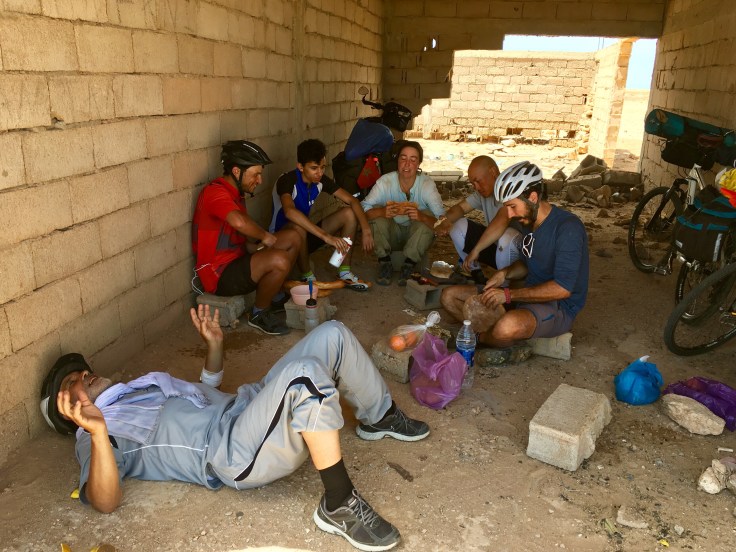
A bit weirdly we start cycling all together. We are a bit reluctant because it is just one day after separating from Lysiane and Patric to go a bit more on our own. And now we are 7. Funny enough, we run into Arnaud, a very friendly French cycling to Dakar with the objective of getting into a boat to South America and continue cycling there. So many nice people, but such a big group. We feel the urge of separating and going a bit more free. We step out of the road many times to enjoy the marvelous cliffs, transformed into art pieces due to the erosion of the wild sea. Local fishermen wait patiently for the next catch by them. After some influencer photo shooting we continue our journey.
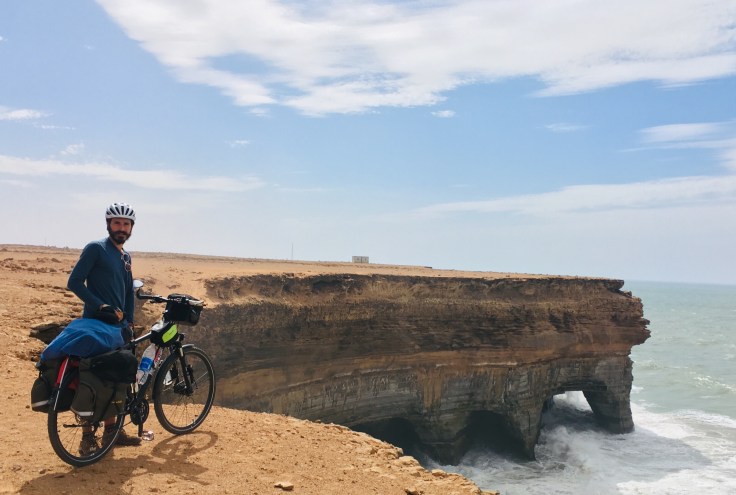
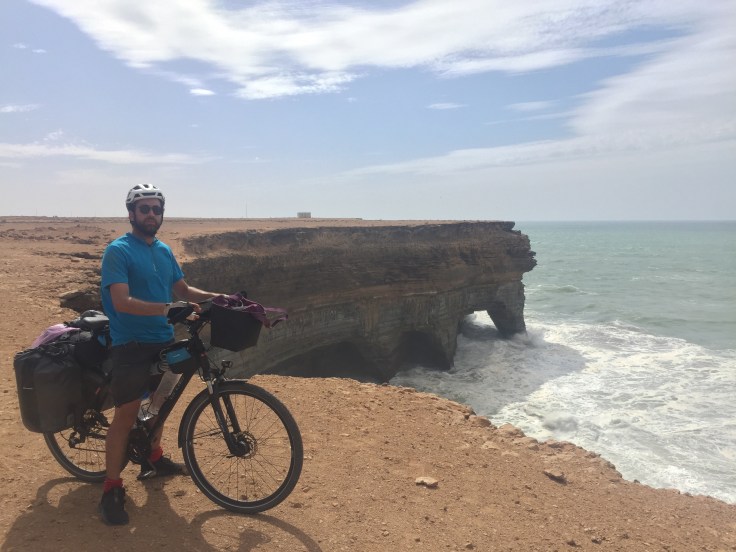

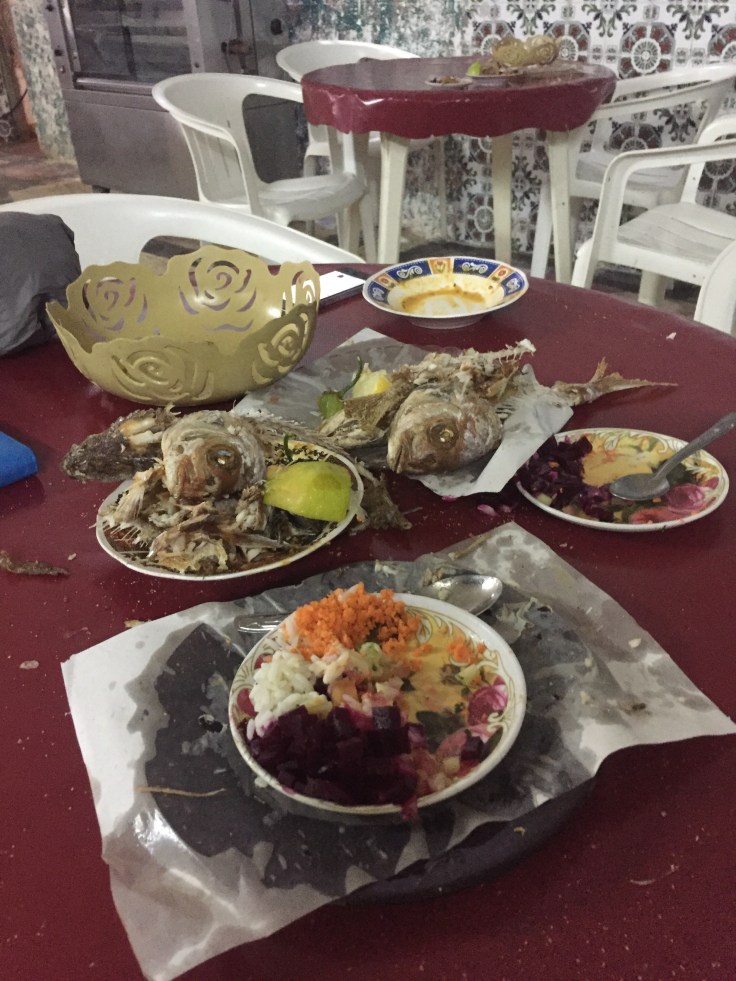
After 120 km ride, we finally arrive to Akhfennir, a small fishermen town usually chosen as a sleeping stop by drivers. We say bye to the other groups, and we treat ourselves with delicious sepia and dorade in a local restaurant after enjoying the view the sun melting in the sea. The 5€ hotel is much nicer this time. Gaspard is in love with the village as it looks authentic, not surprisingly. A good chess game in the iPad farewells the day, with Javi winning, as usual, hehe.
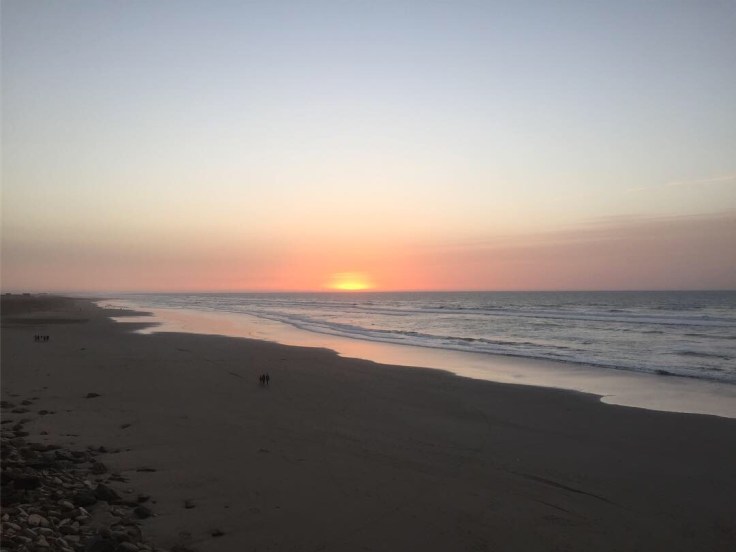
Day 60: Akhfenir – Tarfaya
A morning swim in the sea during sunrise kicks off the day. Gaspard cannot have Nescafé coffee for breakfast -“it’s disgusting!” and looks desperately for a cafe with coffee machine. This will repeat during all our trip, with Gaspard inspecting the coffee machines of multiple bars to see if he approves or not, with petrified bar owners staring at him. He succeeds and now we are ready to go. We had coffee, eggs, jam and “cheese” for less than 1€ each. What morrocan people call cheese is “vache qui rit”.
Today the wind is exactly against us and the ride is quite miserable. But we need to make it to Tarfaya, the next village, 120 km away. Kislik, as moroccans would say, which means kind of “it’ life, deal with it”. We see a breathtaking dry salty lagoon on the way and after that the road goes parallel to a new auxiliary traffic line under construction, quite ugly. We cook some delicious emergency pasta by a cliff as we were completely dead (as the spanish would say acabando pidiendo la hora).
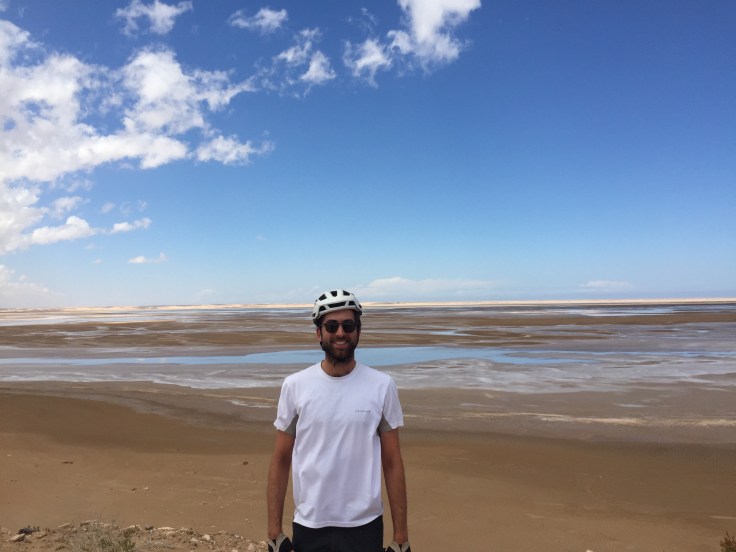

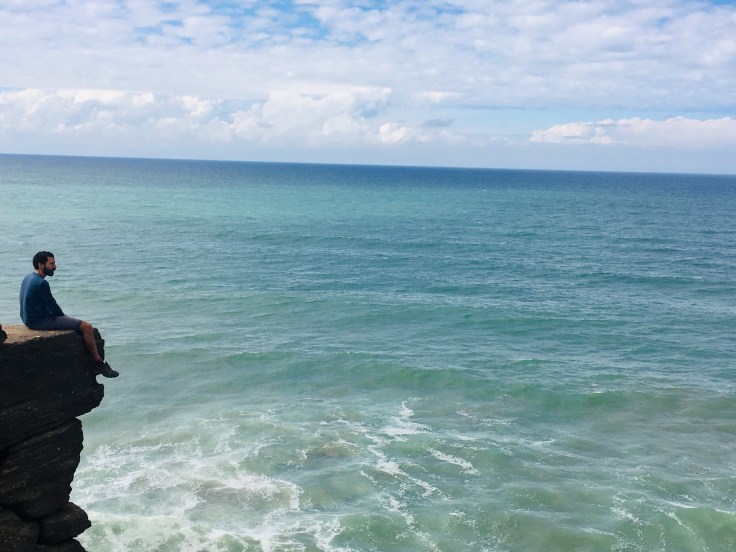
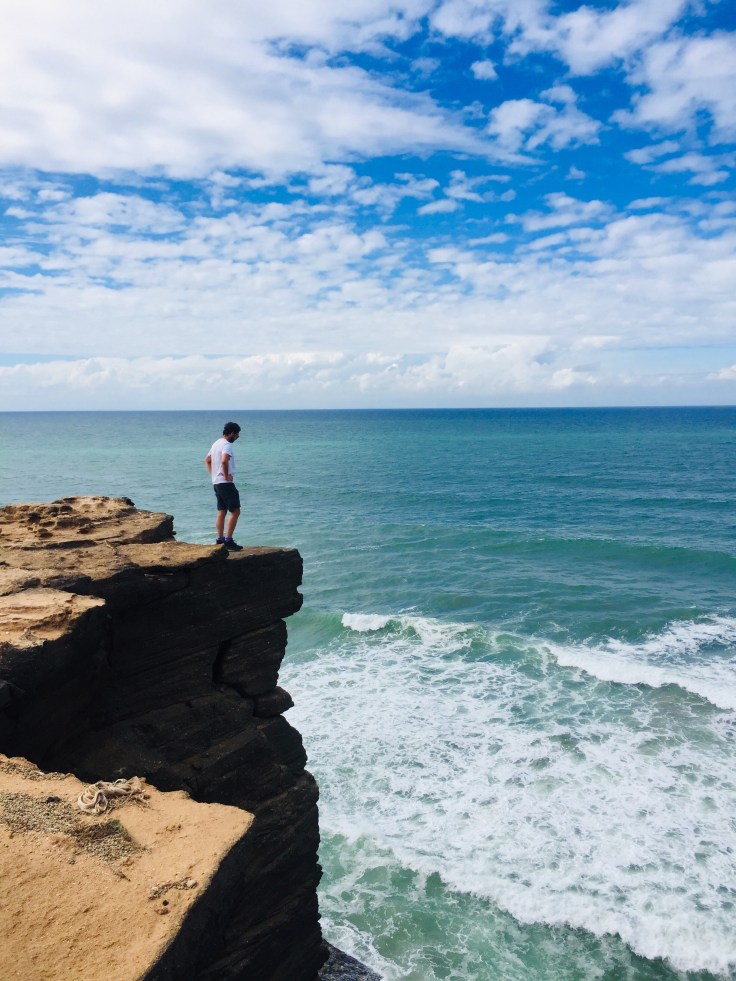 We stop for coffee at a gas station 2 km further, totally exhausted, specially Javi, who has some trouble adjusting his bike. Gaspard goes into some crazy dreams -imagining crazy histories with the clouds- and rides much more confortably against the wind. We use the resource of playing motivating techno music to keep up with the huge physical effort and eventually we arrive to a beach 10 km before Tarfaya, where we enjoy another astonishing sunset. You dont get tired of this. Salah appears and we go to Tarfaya, with police escorting us to a hotel for our safety. At least they show their police lights which is somehow cool, like if we were someone important or something. Being super tired we barely haggled the price of the hotel and went to treat ourselves with a tajine. Later that night, a guy in a car stops by us and asks to see our passport. He is telling us that he is from the morrocan FBI but doesn’t show any badge or such like. This would be so weird in Europe but as he knows a lot about us and some other cyclists we have met we obey without discussing.

Day 61: Tarfaya – Fouem el Oued
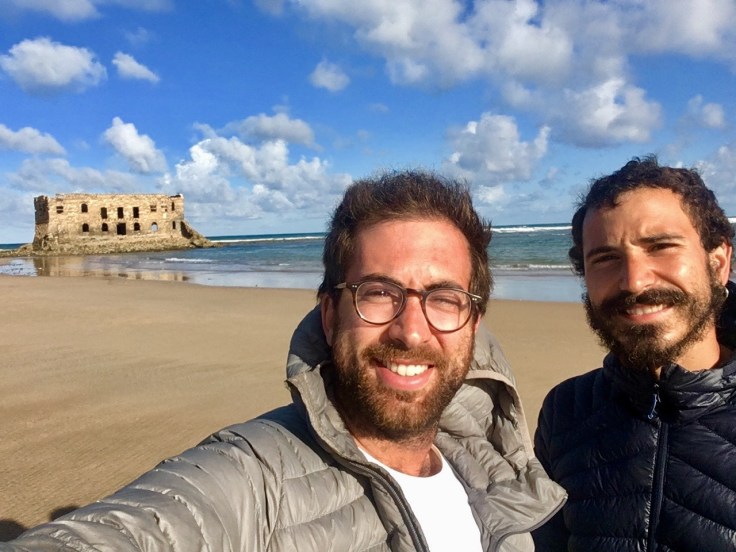
Another morning swim for breakfast. This time in front of Tarfaya’s “Casa del Mar”, the former commercial building of the British Company of West Africas. It was assaulted by bereber tribes in early XX century, the British crew got killed and since then the house has been progressively swollen by the sea.
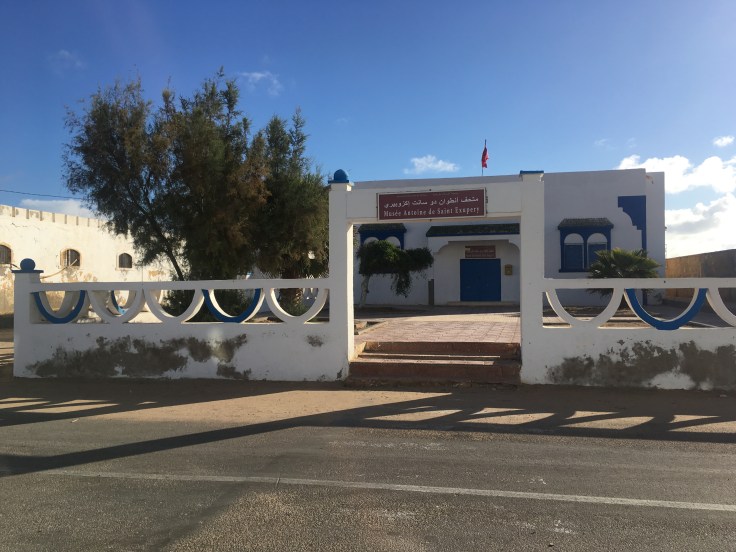
Tarfaya has a museum dedicated to Antoine de Saint Exupery as he was working for the post as a plane pilot and was very often in Tarfaya. Apparently he still has family and relatives living there.
Tarfaya is the last town in Moroccan Sahara. We look for some fruits and vegetables to buy and ask shop owners around. In return they try to sell us their tajine – at 9 am- as it contains vegetables. This kind of silly situation happens all the time. We enjoy a huge breakfast for 2€ and decide to take the sea road, which deviates from the national road, so we enjoy the sea view and avoid the road construction and the rest of the cycling groups. Sounds a bit asocial but we just want to enjoy solitude for a bit. We are normal people, we promise.
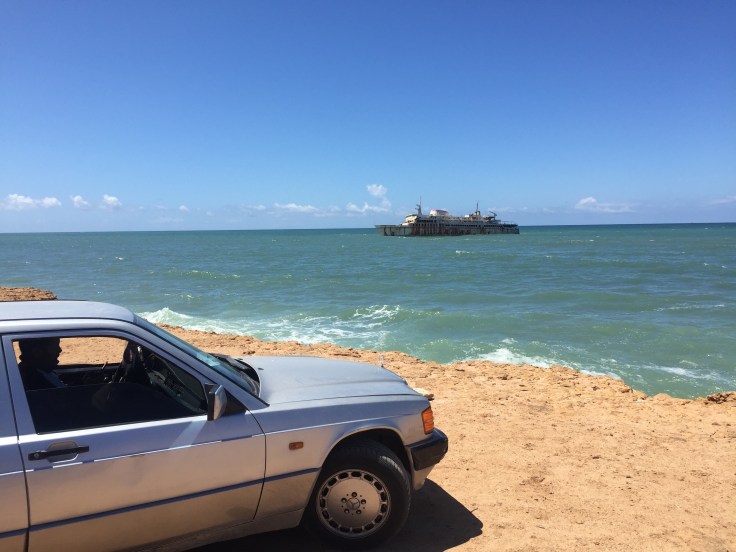
5 km after the start, we see the sunk ferry that used to connect Tarfaya with Spanish Canary Islands, 70 km away. We thought it was active and thought about crossing for some days, since Javi’s grandmother was born there and he has relatives living there. Next time. We cross the non-existing border between Morocco and West Sahara – remember, the latter is occupied by the first-, and voila, it starts raining. In the middle of the desert, surrounded by dunes. It’s magical. The wind pushes us and no more than 20 cars per hour pass. It feels like freedom. Another pasta lunch in the cooking stove. Another sunset.
We arrive at dusk to Foum El Oued, a village 20 km west of El Aaiun, the 200 thousand people capital of Western Sahara.
The protective and a bit annoying police – we are asked for our passport 5 times in one night- escort us for dinner to a market where we meet a Moroccan that just had finished serving sentence in a Spanish prison. We get the feeling that W. Sabara is kind of a Wild West for Moroccan, a kind of new land where you can start a new life and forget about your past.
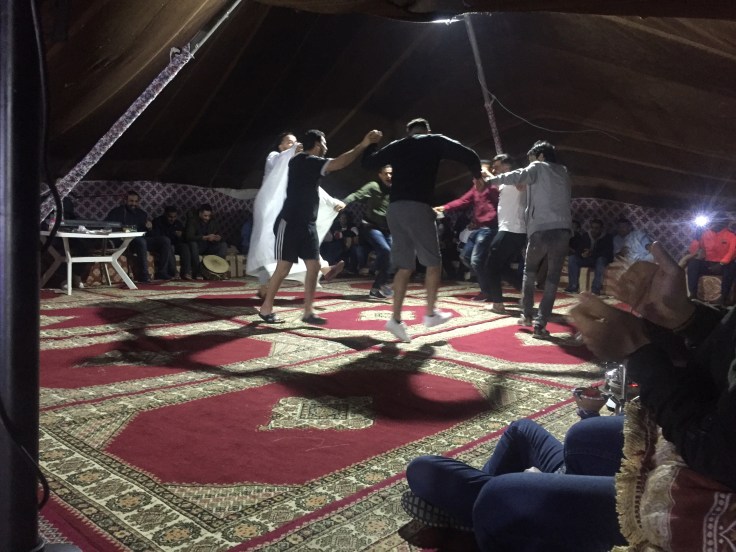
The police also escorts us to a camping -“no free camping, messieur”!-, where we meet the german folks of Drive To Help, a NGO run by very young people collecting donations of vehicles, medical and technical equipment and bringing them to Gambia. Such a cool project, check it out. The treat us with beers and wine and we are suddenly invited by some saharaui people to the bachelor party of a local man, which is happening in some huge jaimas in the camping too. They give us sweets, milk and juice. There is fantastic live music and they invite us to dance with them in the bubu, the saharaui man dress. Imagine Gaspard and Javier dancing hypnotic music from the desert in a jaima full of men clapping. Magic. Four Porsches Panamera stop in front of the entrance of the jaima, all lights on and let us wonder what is happening? After some long seconds the man to be married arrives, which makes us suspect that we are partying with the elite of W. Sahara. Most of them are fluent in Spanish and keep saying “Bienvenidos!” (welcome) in a very sweet accent. At some point we feel incredibly tired and we go to sleep with the biggest smile in our face. What a night.
Day 62: Fouem el Oued – Dahkla
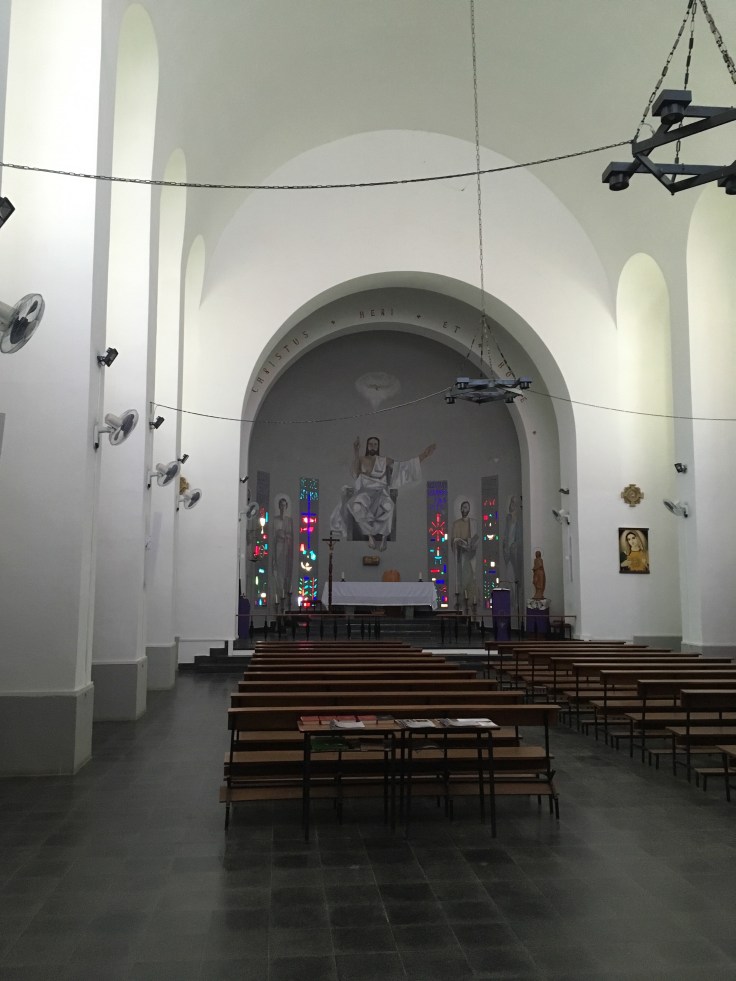
We wake up a bit hangover -at least in the case of Javi, Gaspard seems to be inmune to hangovers-. The sun is on fire and we sweat a bit to make the 20 km that separates us from El Aaiun. We are a bit hesitant to cycle all West Sahara – there are not more than 15 inhabited places on its 1100 km shore. We want to have more time in Mauritania and Senegal, so we decide to take the bus between El Aaiun and Dakhla (600 km), and cycle the rest to the border with Mauritania. We visit the local church, from the Spanish colonial times, where father Chicho gives us great info about the situation and the history of El Aaiun and Sahara. Morocco has incentives for Moroccans to settle here and that has substituted partially the local population. The main square is ready for a massive political event of a Moroccan nationalist party. We spend the rest of the day having tea waiting for the bus in the evening. While drinking tea we saw two car accidents in front of us making us a bit scared of cycling to the bus station at night.
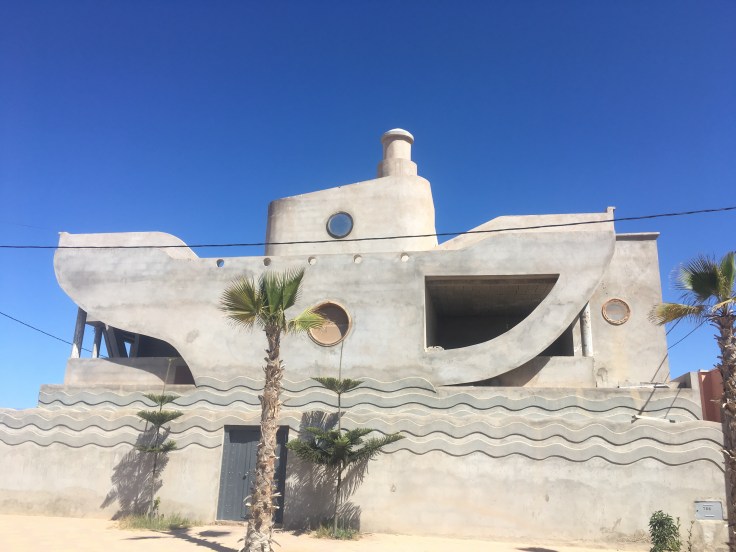

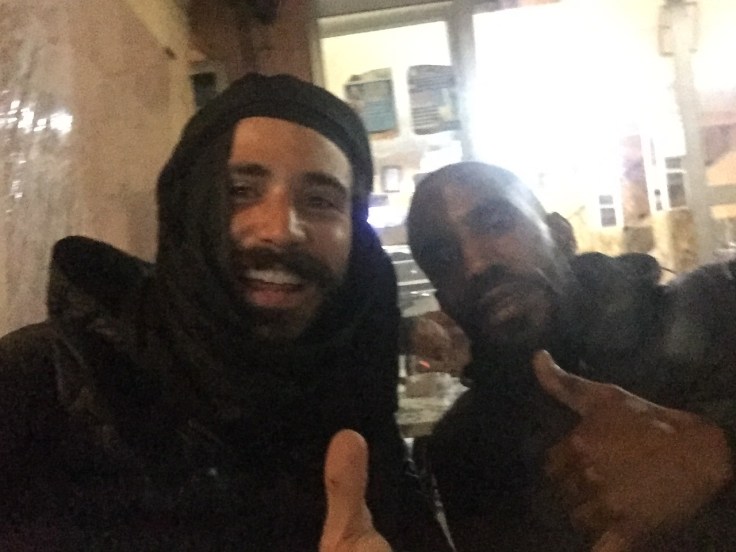
Just on our way to the station, we see a cafe called Vitoria, in honor of the birthplace of Javi. Zidat, the proud saharaui owner, invites us to a cafe, gives us Saharaui turbants and tells us great info, all in a perfect Spanish. We are in Colomina, the main saharaui neighbourhood of El Aaiun, which even has a Spanish School called Cervantes. The old men of the hood speak Spanish natively with Canarian accent. We feel like witnessing a mysterious reality and piece of history dying, which is sad, but sadly beautiful. We make it to the station and after dissasemblying the bikes we are told that the bike will leave tomorrow, then that there is no space for the bike. After paying extra for the bikes, we convince the driver to let us put the bikes. That was a stressful time. We fall sleep with a deep feeling of gratitude towards the Saharaui people, with Moroccan police officers waking us up constantly to ask for passport copies, as usual.
Day 63: Rest day in Dahkla
Within the first hour two shop owners told gaspard to be carefully with his solar panel -chillig in the sun on the bike- as a lot of african people are stealing in Dakhla. The owners of the hotel later advises us not to let our clothes dry at night as (african) people might still them. We do not if they are being racists but we prefer to follow their advise.
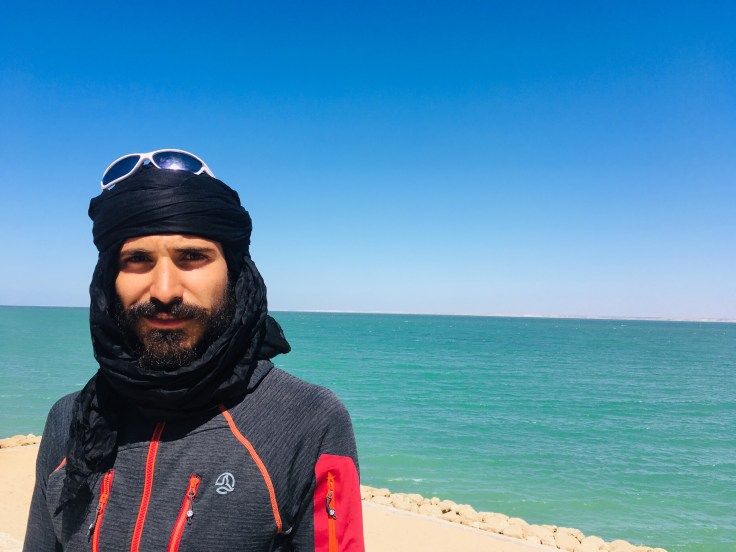
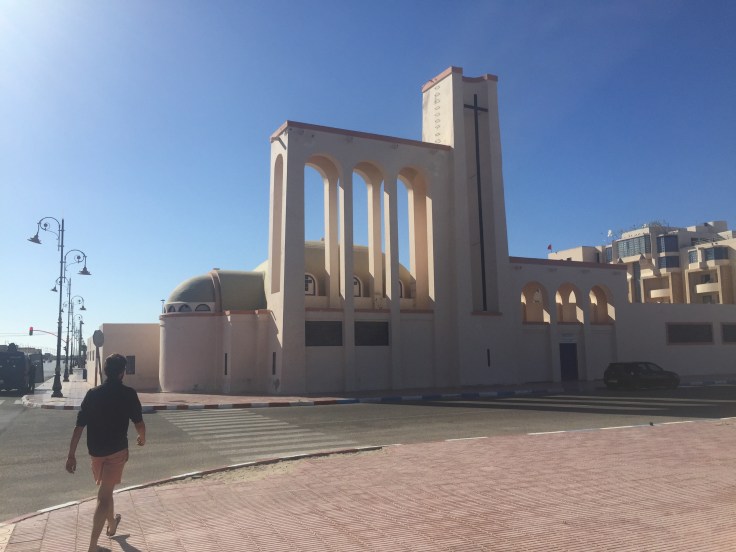
We meet with Moha, a amazigh man that hosted Javi in Amellagou in the Middle atlas back in day 40. He works as a fisherman in Dakhla in a Norwegian boat that catches sardines. He is a simple man full of honesty and goodwill. We visit together the Spanish Cathedral, where Valerio, a congolese priest, explains how proselitism of any religion but Islam is prosecuted in Morocco. They just serve the local subsaharian inmigrant community of christian origin. Moha asks the priest in we can sleep in the church which makes us laugh and feel a bit uncomfortable.
Dakhla is a fishing town with great kitesurfing due to its lagoon and powerful north wind. Apart from that, there is not much more. The kite lessons are damn expensive so we forget about that. We meet a mysterious man from Mauritania, and we spend the rest of the day drinking tee in one of the multiple cafes full of men drinking tee or coffee and smoking lots of cigarettes. Gaspard loses against to chess.
Day 64: Dahkla – Dragon Island
A certain feeling of uncertainty takes over. The information about the supply spots on the way to the Mauritanian border are confusing and we don’t know what to expect. To leave Dakhla, we need to exit the peninsula, which means fighting the wind. Luckily we find on the way a local hidden restaurant that grows oysters -Talhamar. It is superb. We want to camp in the White Dune, a kite surfing spot. The police stops us and makes us return 5 km to a beach camping. “No free camping, messieur!” Kislik,again.
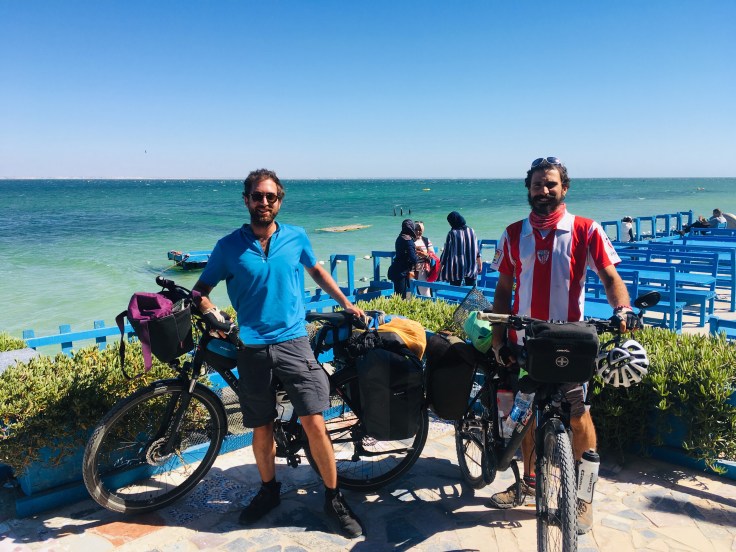

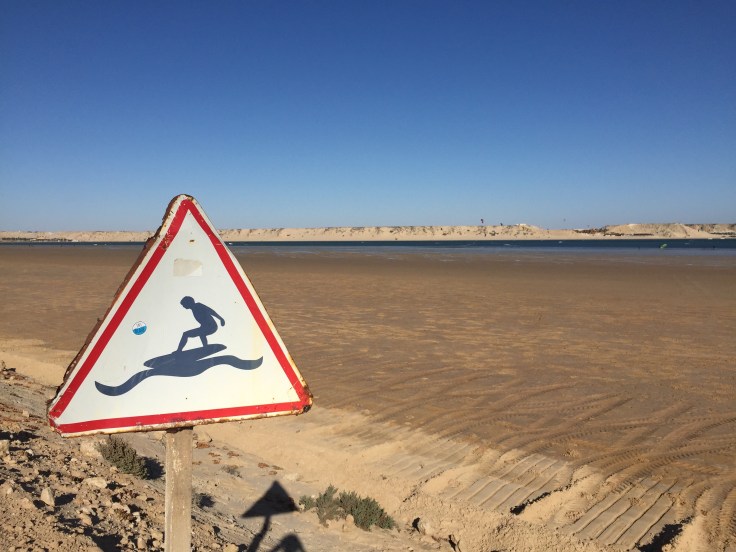

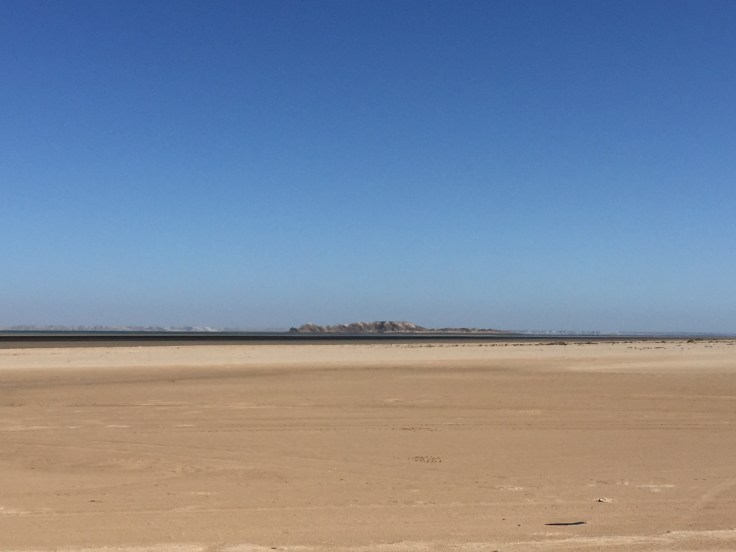
In the beach camping, full of caravans, we meet Rachid and Ahmed, two saharaui kite surfers that first try to sell us kite lessons. Then they see that we are broke and Javi spends the night with them talking and playing music in their jaima. Gaspard is too tired snoaring like a lion. They are a curious mix of hippies and surfers, with cool muslim and african matices. The sunset in front of Dragon Island, an island which surprisingly has a dragon torso shape makes us wonder.
Day 65: Dragon Island – Imlili
We finally take the north wind and we start to fly in the void. We ask the police the location of the next villages and gas stations to know when we can refill water but do not get any sensible answer. They indicate things we already past or 5 km ahead. They gave us a bottle and we continue our journey.
There is nothing but a flat desert. It is a wild feeling. Few trucks pass in direction to Mauritania. We see the White Dune of the Dakhla Bay on the horizon, surrounded by water. It is only reachable by 4×4 jeep so we will have to conform with the view from the distance. We didn’t even bother asking for prices, probably more than our budget for a week.
We do a small stop in Argoub, the first village 80 km from Dakhla, to eat in a butchery with the sheep hanging dead in the entrance. It’s impactful but somehow visibilices the part of meat eating that the eater does not want to see. Makes us think a bit, but the fear of losing the tail wind does not let us think too much. According to many people this is the last place to buy food and water for the next 210 km (until Bir Gandouz) so we fully load our bikes with almost two days of food and drink supplies.
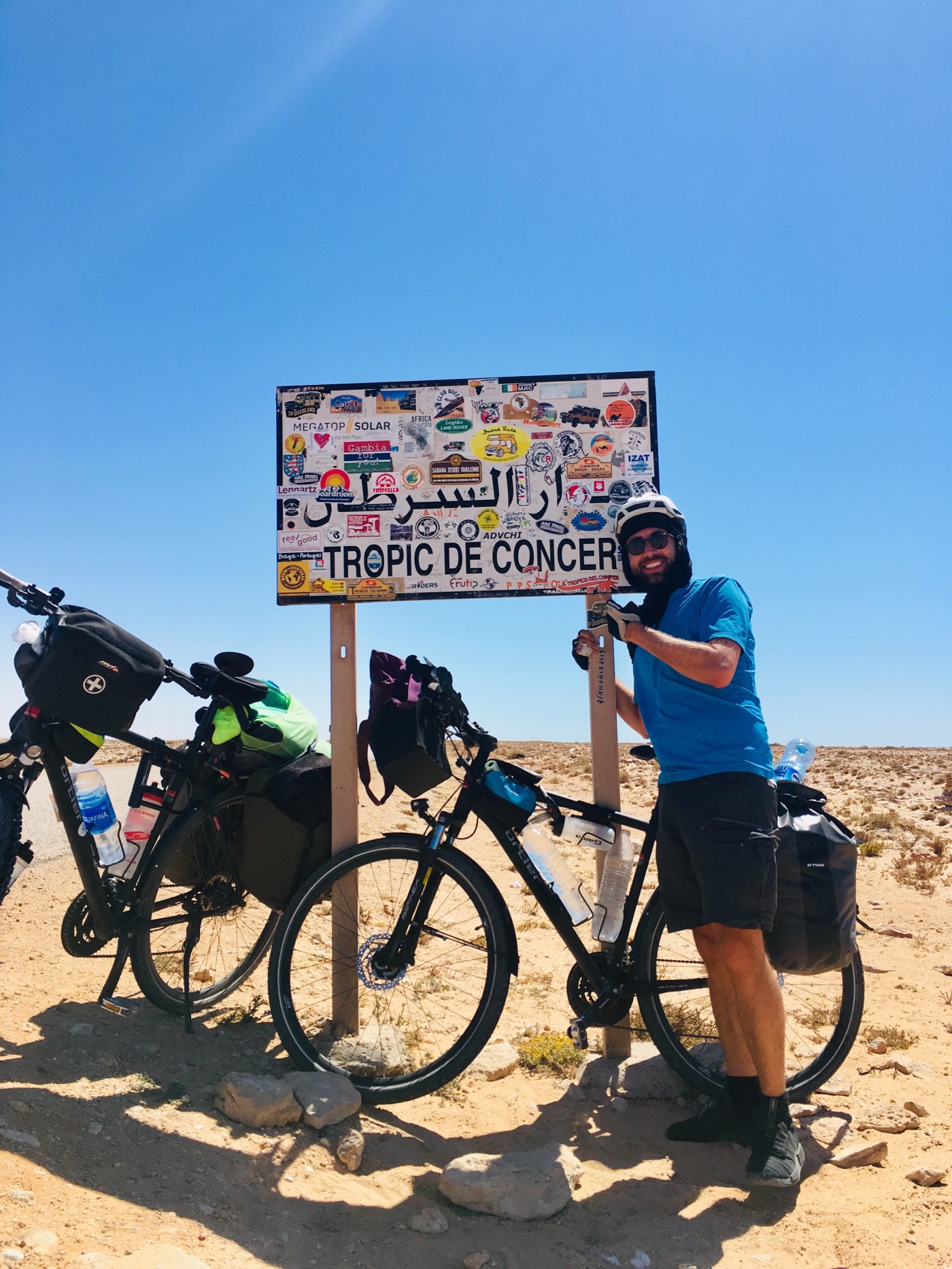
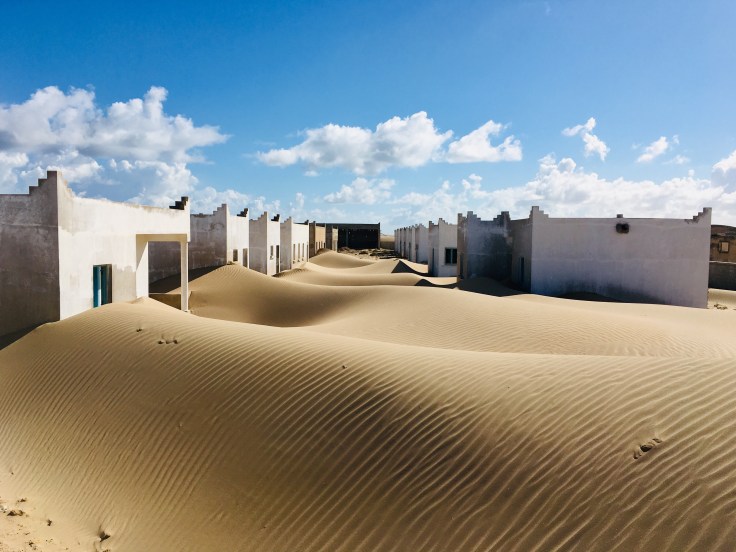
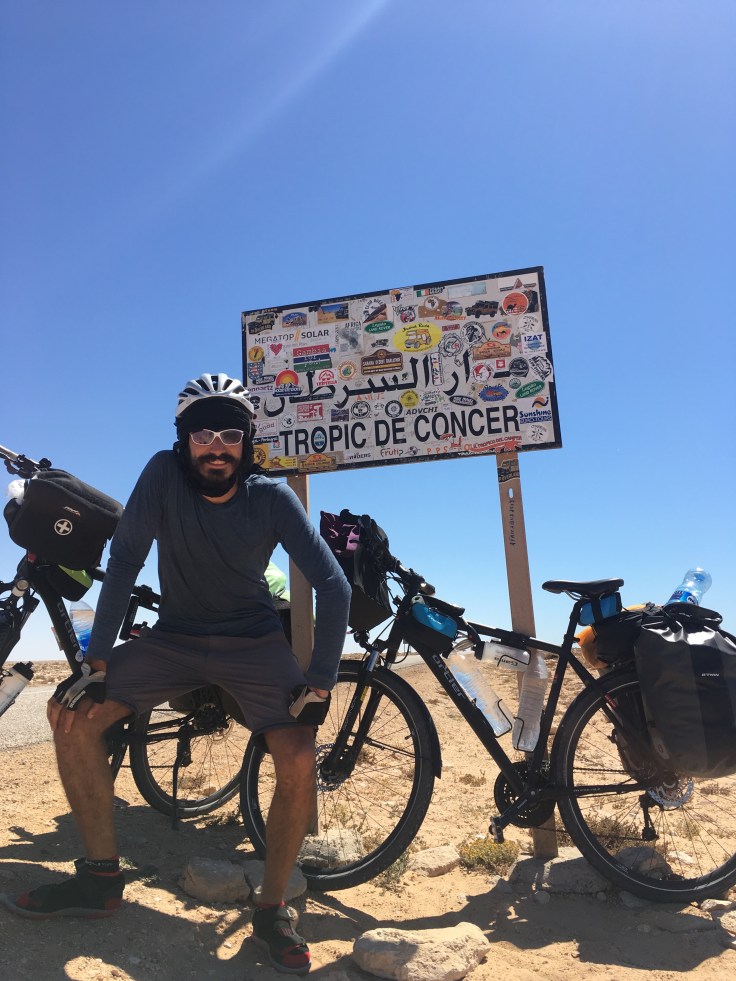
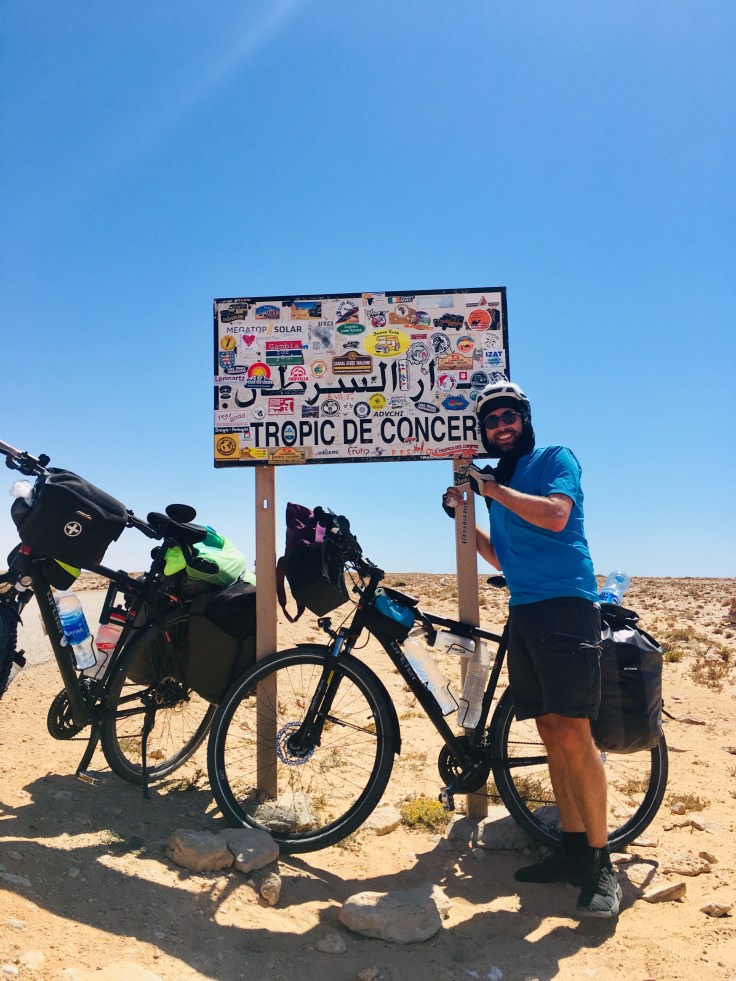
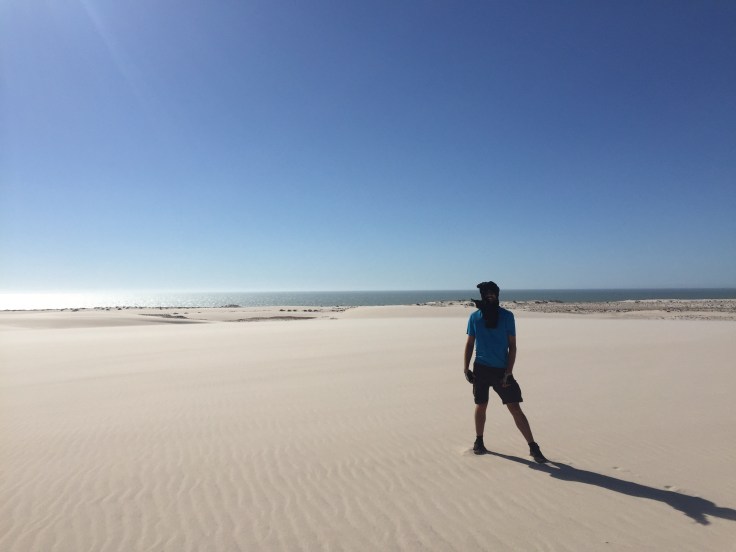
We cross a big sign that announces that we are crossing the Tropic of Cáncer, wohou! It is full of stickers of other cyclist, motorbike, backpacking or jeep adventures. We are not the only crazy ones in the globe, ah? A bit further we stop in the ghost town of Imlili, a failed plan of Moroccan government to populate the area. You can hear the doors hitting the walls push by the wind, and papers and plastics rolling on the empty streets that connect houses full of sand inside. The Wild West. We climb a enormous white sand dune nearby, from which we can see the sea. The area is full of fossils, quartz and other mysterious rocks. We have heard stories about how many people get deep in the desert with pneumatic hammer in search of gold. It is true that the road is surrounded by small excavations, so who knows, it might be true.

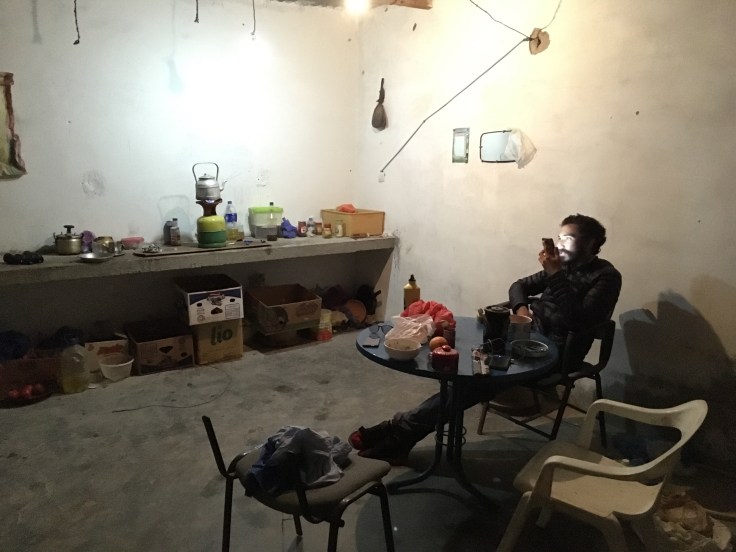
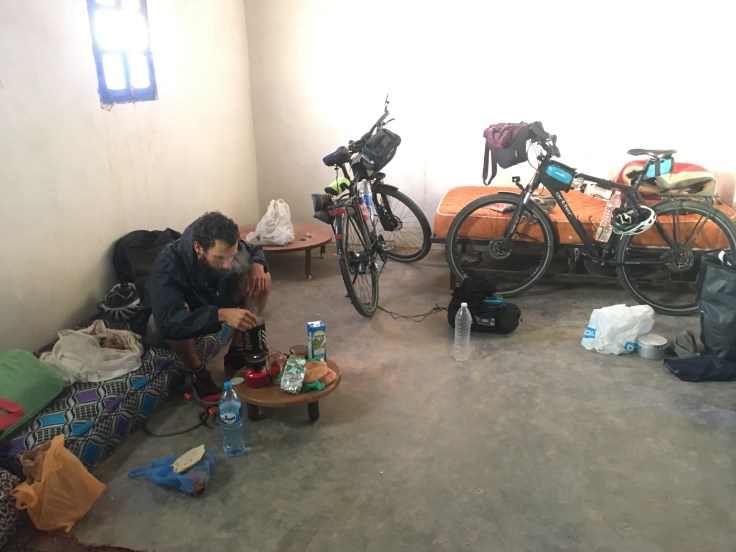
“to guarantee our safety”, The police stops us and forces us to sleep in the house of a man that takes care of a communication antena. We still don’t know what danger they refer to. When we ask we always get one of the three following answer: “Wild animals can attack you”, “Migrants can rob you”, “you don’t need to know”. We have dinner together with the man. His name is Youssef and he is smoking a lot of hashish. Ironically, he insists on us reading the Quran when we finish our trip. He has a slight radical vision of the world, and a feeling of guilt for being “a bad muslim”. He the tells us that he spent 3 years in jail for cutting the two Aquiles tendons of a man that cut his face. He indeed has a huge scar that crosses his face diagonally. Although Youssef is a good man -“I don’t speak a lot of French, sorry, but we can talk with our hearts”-, we find funny how moroccan police guarantees our safety.
Day 66: Imlili – Bir Gandouz (9th of April)
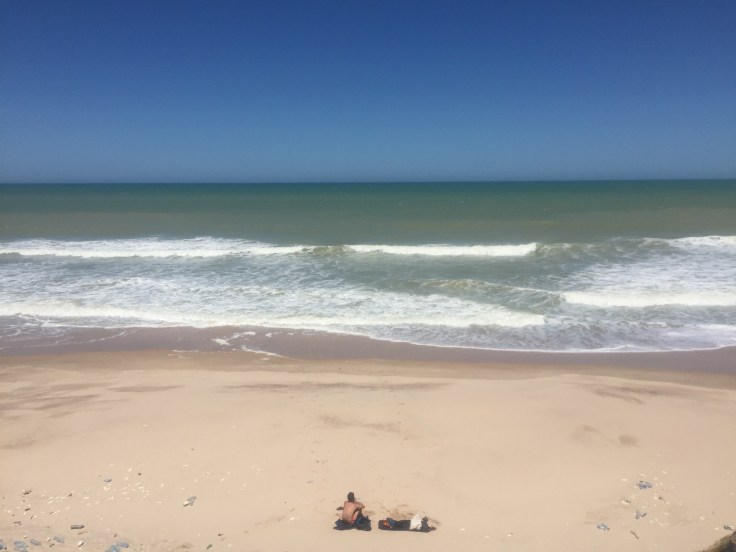
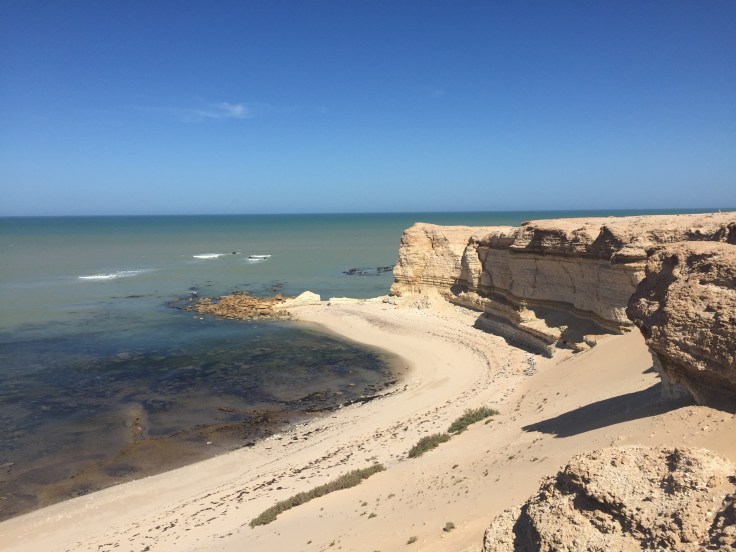
We leave Youssef and thank him for his deep hospitality. The tailwind keeps us going really fast. The road keeps leaving the sea and coming back to it. We find a marvelous sea side and we decide for a bath, but we disagree where. Gaspard prefers the open sea with white sand, but Javi wants a corner where we would be protected from the wind. Such a stupid discussion, so we flip a coin. Gaspard wins, Javi accept it and both enjoy playing chess while getting sunburn after tasting the fresh waters of the Atlantic.
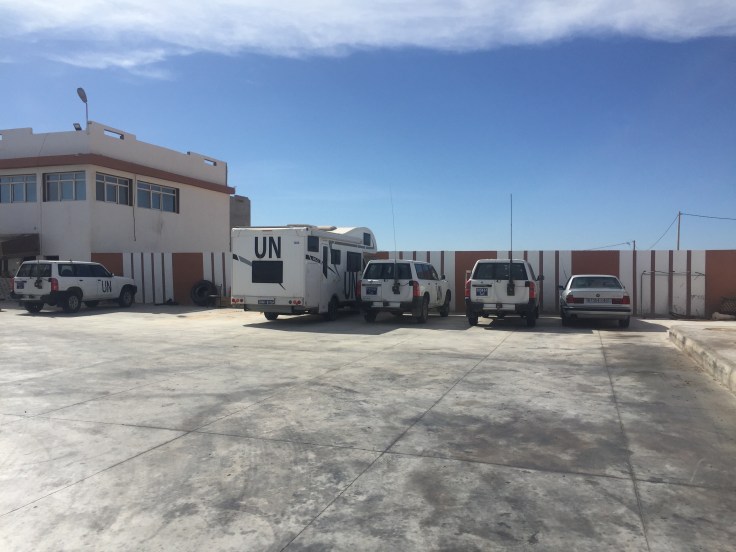
Apart from Gaspard’s slipping off the pedals, trying desperately to balance the bike, while running with the bike in between his legs nothing else happened during the 140 km ride until Bir Gandouz. We camp for free in the gardens of a hotel, following the indications of the police. This time we didn’t complain. Bir Gandouz hosts part of the UN members that supervise the ceasefire between Morocco and the Polisario Front, and we engage with one of them. We talk about Mauritania, the infamous border that we need to cross the day after -“no man’s land”, and of course we ask about the conflict. It seems there might be room for a self determination referendum in Western Sahara, which was actually the main commitment of UN when they landed in the area in 1991. We hope so, saharaui people deserve it. During dinner a man comes to ask us for our passports. Being used to it we gave them to him without any hesitation being caught in a very interesting conversation with Sven -from the UN. When we realized that our passports were not coming back we had to look all around to find the guy. Which color was his shirt, how does he look like? We finally find him but he refuses to give our passport back: “i will give them back tomorrow”. After 5 minutes discussing with him he finally accepts to give them back now -he was simply lazy to go and get them. We can go to rest and prepare ourselves to cross he border with mauritania tomorrow.
Distance cycled: 3670 km
Total altitude climbed: 29300 m
 Cycling Pirates
Leave a comment