
Song Playing: La Musique – Star Feminine Band
25/07: Dar Es Salaam airport – Morogoro 6AM
”Fuckk!!!” Javi was half-awake, half-asleep, in that weird subconscious state in which you review random things. Particularly if you are a bit nervous because you arrived to a new continent for a cycling adventure. And yes, he just realized he didn’t check if the skewer (the axis that fixes the wheel to the bike) was still in the bike box.
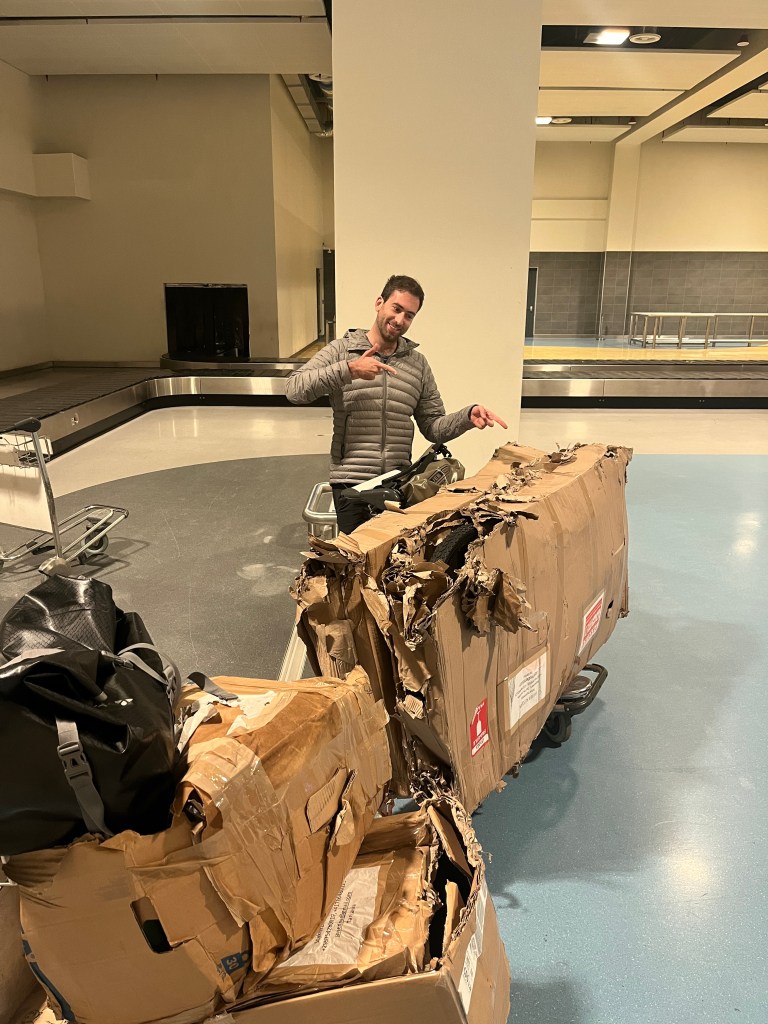
Our luggage boxes arrived to the airport of Dar Es Salaam in a catastrophic state. A quick review told us that everything was still there, but Javi didn’t check the skewer that he attached to the rack.
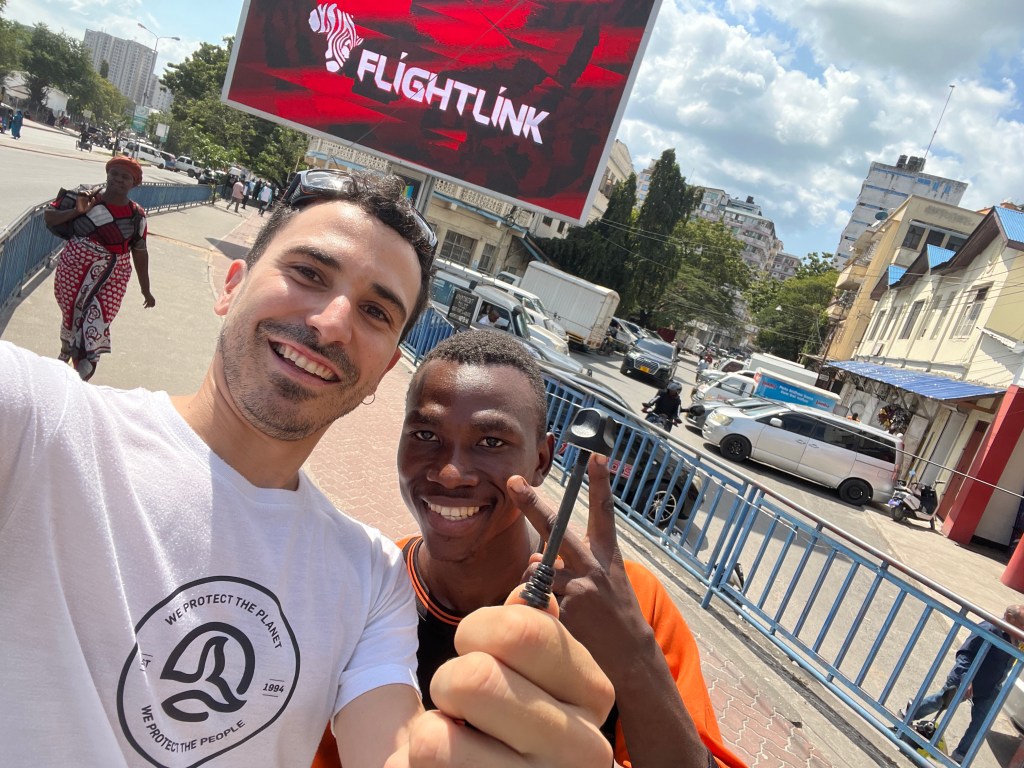
After a bit of swearing in different languages, we decided that Javi would go with a boy from the hostel to the city to try to find a replacement, while Gaspard would assemble the bikes and get them ready to rumble. It took Javi 4 hours and a visit to around 10 bike shops to find the goddam skewer. He found it in a bike shop run by Indian-origin people, who run a big deal of the businesses in Dar. We would learn later that most of them were “brought” by the British already 200 years ago to Zanzibar, including Freddie Mercury’s family, who was born there. Javi was happy, and the boy of the hostel even more, after a tip for the valuable help. It was a good idea to go with a local, since our impression so far is that English knowledge in Tanzania is significantly lower than French in West and North Africa. In fact, the boy didn’t know English either, but he knew what to look for. And we made it!
The incursion in Dar-city-centre confirmed that this area is no place for cyclists, as we suspected. So, as planned, we drive towards the Bus Station of the West Road to Zambia, 20 km away from the hostel. Our objective is to get to Morogoro, a 2nd tier city where we want to kick off the actual cycling. The hostel owner warns us against going so late, but something inside us wants to get away from traffic and crowds as soon as possible. If we only knew what was coming…
First pedalling sensations are quite fine, altough gaspard forgot to drive on the left side. Shortly after we leave the small streets to arrive in very busy ones with motorcycles, tuktuks and small buses graviting around us in all direction: enough to make us forget to eat for a few kilometers -until the stomach started roaring. All we could find was grill chicken with fries, and surprisingly enough, this would be like this for quite some days.
We cross a busy market that stresses us a bit and, in the middle of the sunset, we make it to the bus station. The gatekeeper redirects us to a local hussler, who finds the bus for us, arranges the place for the bikes, and most definitely takes a big cut on the process. Still, we are on our way to Morogoro. The bus is full of locals and blasted Tanzanian R&B hits from the 90’s to today for 4 hour long.
We arrive in Morogoro Bus station at 10:30 PM among a huge crowd of people trying to get us a taxi, carry our luggage or God knows what else. A friendly guy helpsus get a bit out of the crowd and throw away theannoying service providers, and we cycled towards the hotel that Gaspard looked while on the bus. It is beautiful and quite cheap (Mama Pierina, if you are ever around). On top of that, it has another chicken and fries place in front. After a lot of explanations, they offer us “Rollu” a Tanzanian-millet-based soup. it’s actually super tasty, and we will start asking for it from then on.
In the hotel, some Germans ask us what the heck are we doing with bikes around, as they are having already enough stress with the car. They give us some good tips for after Mikumi, which will prove useful. The clock marks 12.00 AM and we are destroyed, time to hit the bed.
26/07: Admin day in Morogoro (24km, 736m+)
Another day starts with a cold shower. The terrible knacki type sausages of breakfast remind us that we are not in our confortable europe anymore. We spend the morning searching for Kerosene, which we need to be able to cook. Again, after lots of ping-pong – every place telling us to ask next door – we find it in a gas station. Seeing how difficult it is to find, we stock 2 liters up. Just In Case. We also buy food, water and toilet paper – we are now ready to cycle but it’s too late to start.
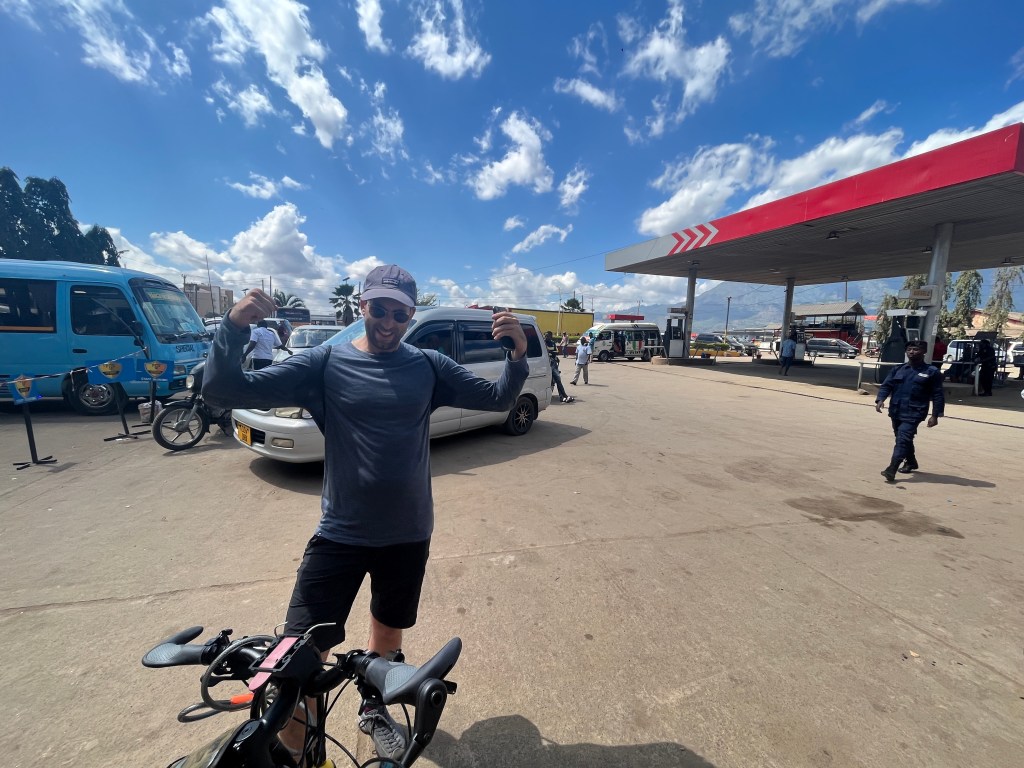
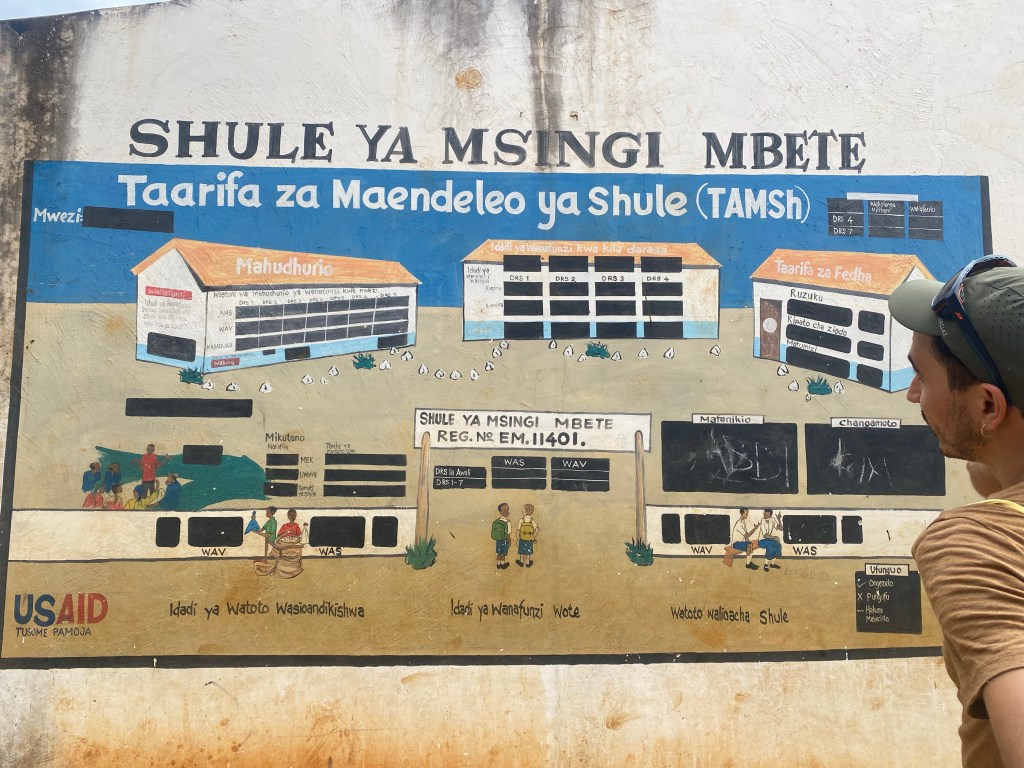
Every other tourist we meet is telling us about the beauty the Uluguru Mountains, so we head up there with our bikes for a hike. We end up pulling our bikes to Edelweiss Hotel, a premium Swiss Hotel featuring swiss fondue in its menu. The local crew offers us to store the bikes while we hike, and we hike to a waterfall, crossing loads of villages.
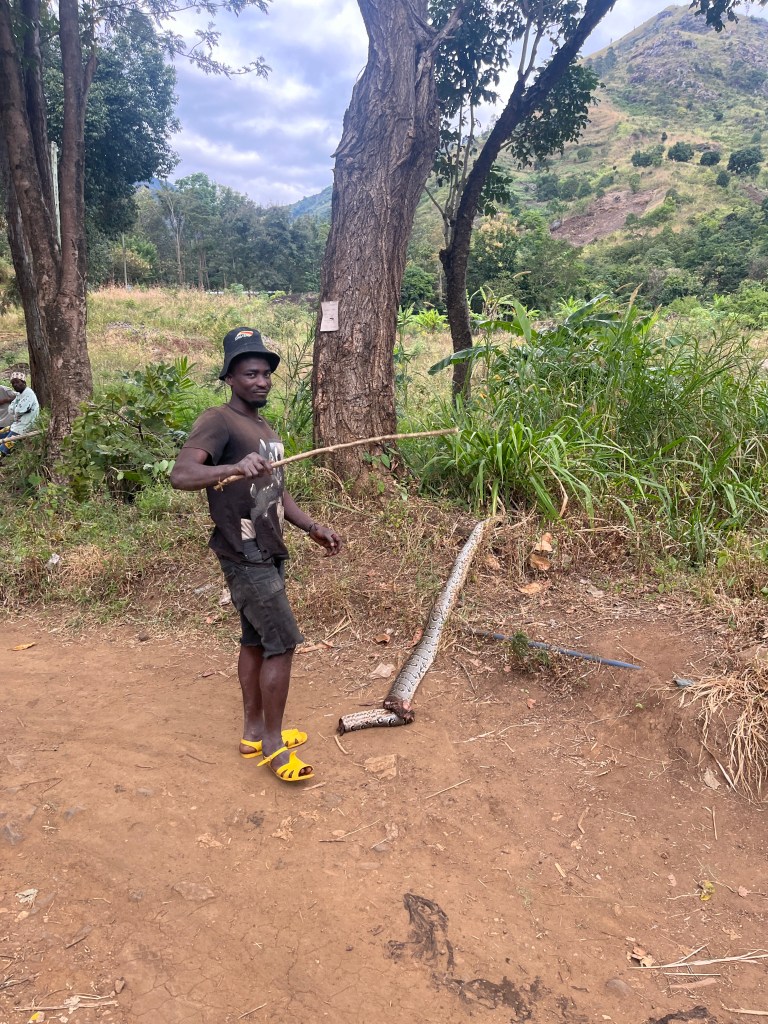
Villages are full of crops, kids and friendly people. It is surprisingly much easier to buy vegetables here, so we stock up again. Tomates & oranges for the win. The “funny” moment of the day is when some random dudes chilling on the road and asking donations for something that seems like a bridge but looks pretty much like a scam, throw a dead snake of a solid 10 cm diameter to the road to scare us. They start laughing, but Gaspard turns a bit pale, as he was first in line. Funny-not-fuunny!
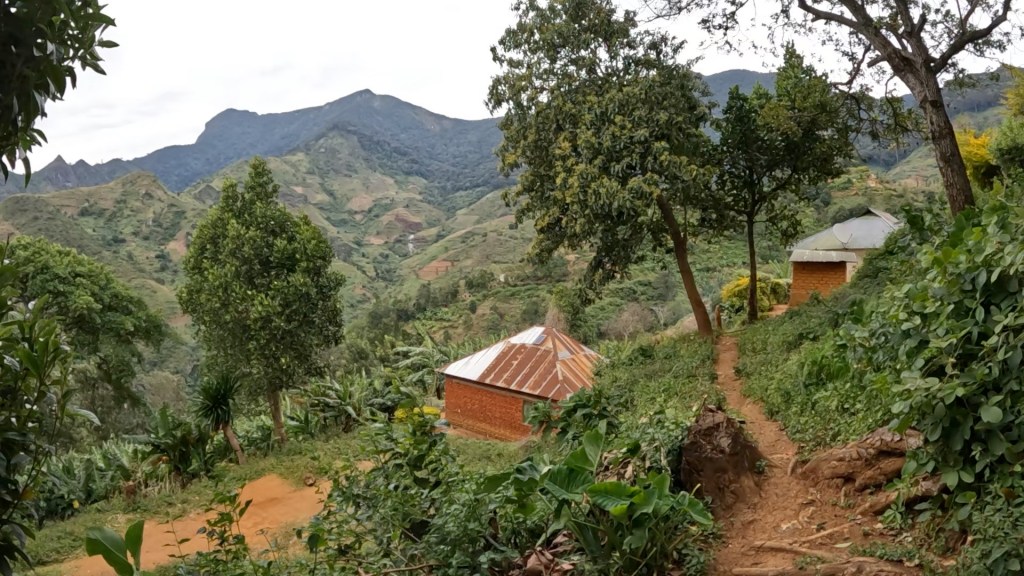
Annyways, the area is gorgeous, but it’s geting late, so when we arrive to the waterfall – which we can’t see, as a local guy doesn’t let us pass (“the way to the bottom of it is too dangerous”)-, we start going down to the Eddelweiss Restaurant to enjoy a fresh juice while enjoying a beautiful sunset.

27/07: Off we go! Morogoro – Doma. 67km, 425m+)
By 8:30 we are already cycling. We plan to reach the last inhabited place before entering Mikumi National Park, which has a national road crossing through it. Unfortunately, as soon as we join the national road we swope the motorcycles from the city for intense and truck-heavy traffic- Yes we start missing the tuktuks and motorcycles. After 10 km, we don’t find it fun anymore. We start brainstorming and decide to try to reach a “parallel” local road going through villages. But in the middle of the proccess, “crang cran crang!!”The bike of Javi is in trouble!
Javi courses again in multiple languages, particularly when Gaspard starts recording the disaster. The derrailleur hanger has broken again (it broke twice in 2019), and the derrailleur has gotten in the wheel, breaking the chain and a spoke.
At this point, Javi gets the feeling that the trip might be over, as it’s not sure the derrailleur is broken too, and that would be impossible to find in Tanzania.
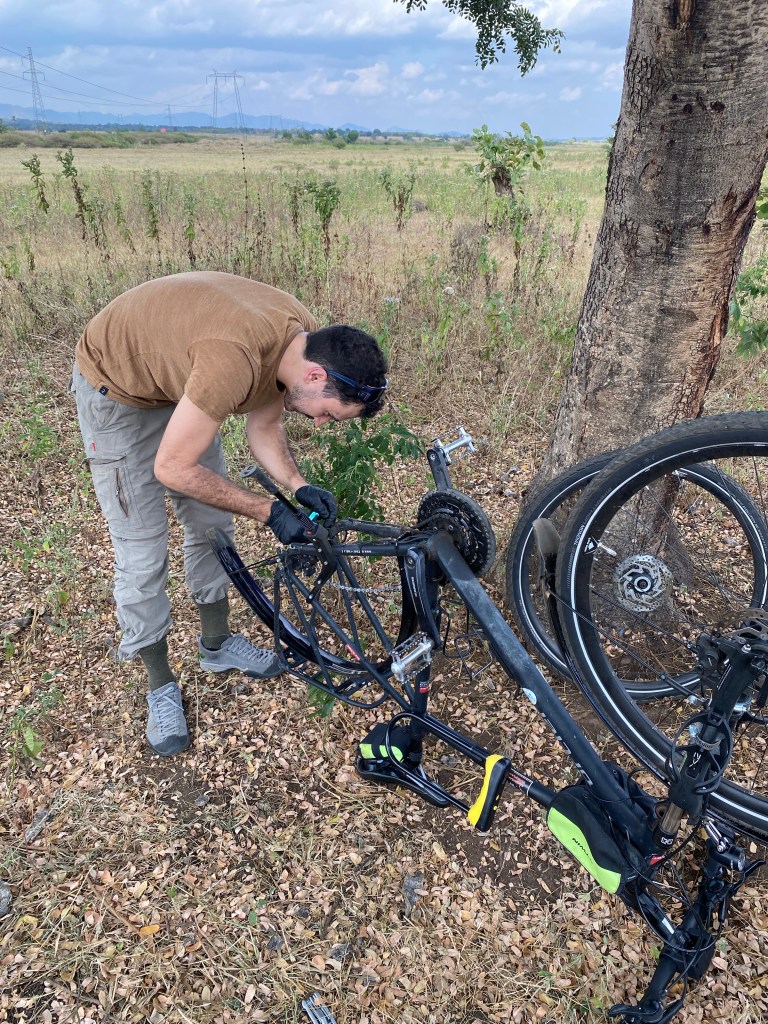
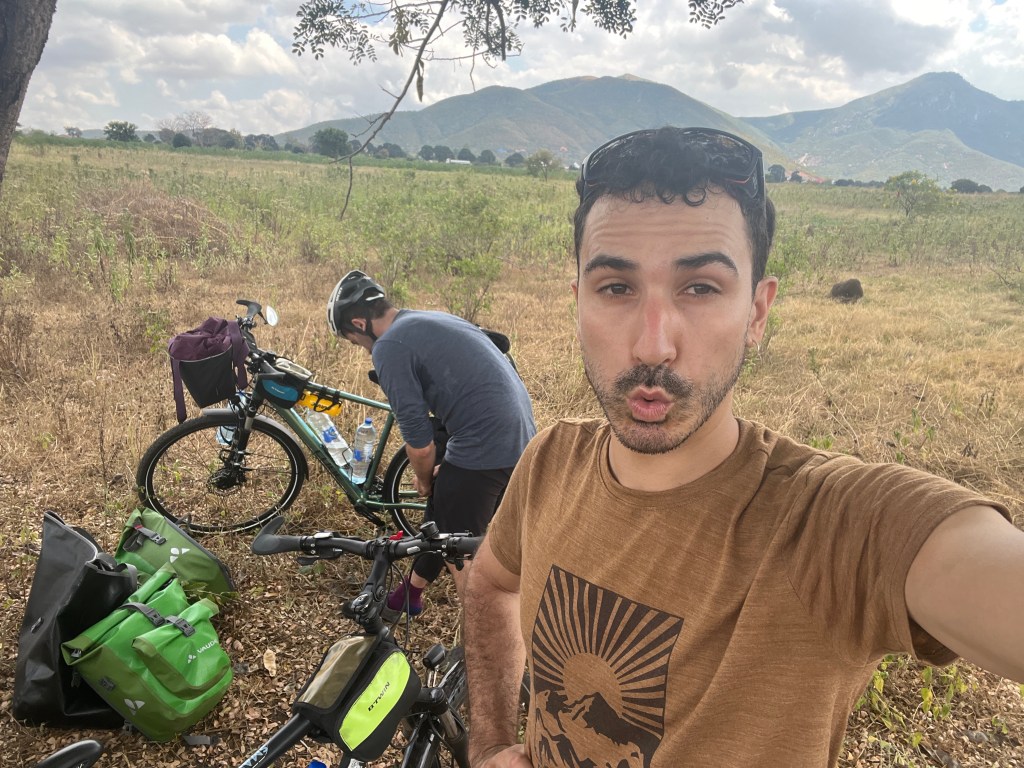
We go to the shadow of a tree because if we try to repair that in the middle of the sun of the savannah, we are going to collapse. With a bit of patience, we repair the chain, replace the hanger, and check the other parts, which seem to be ok. We check the bike and it goes surprisingly smooth. What a close save!
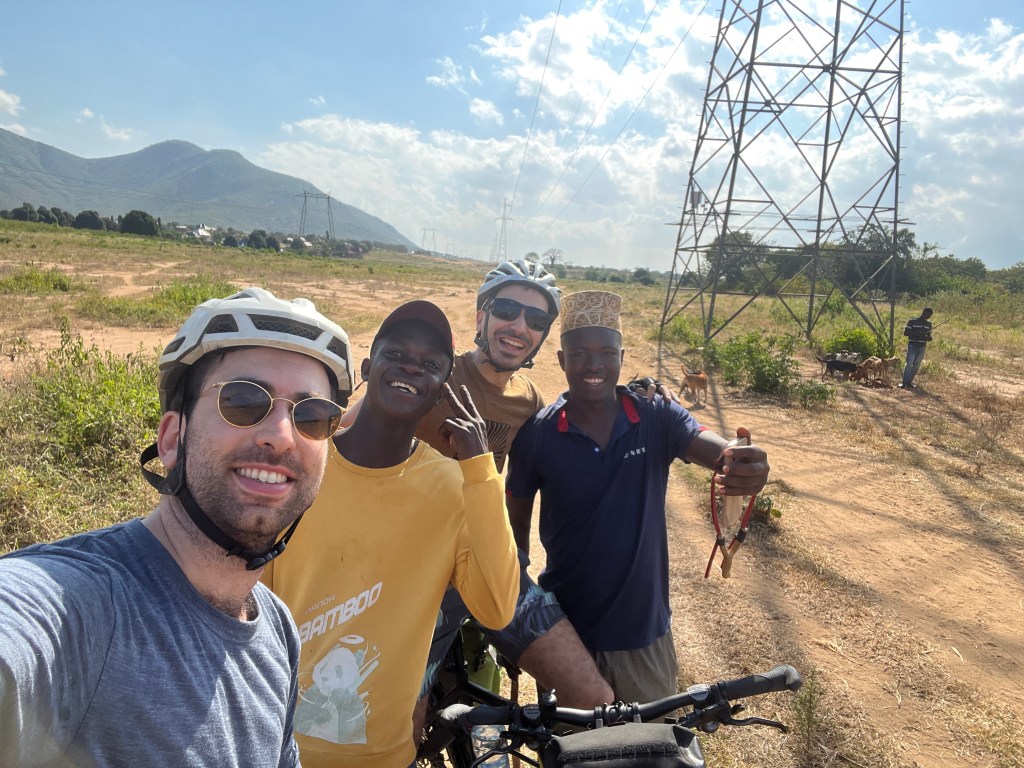
So we continue, very cautiously, but we don’t manage to connect to the local road. A group of young sepherds (which are followed by 10 dogs), tell us that we have no chance and that we have to get back to the road. Bummer.
We do so, and start getting used to the heavy traffic. Sometimes, the roadside is good and safe enough, other times, it gets sketchy. But we don’t seem to have an alternative.
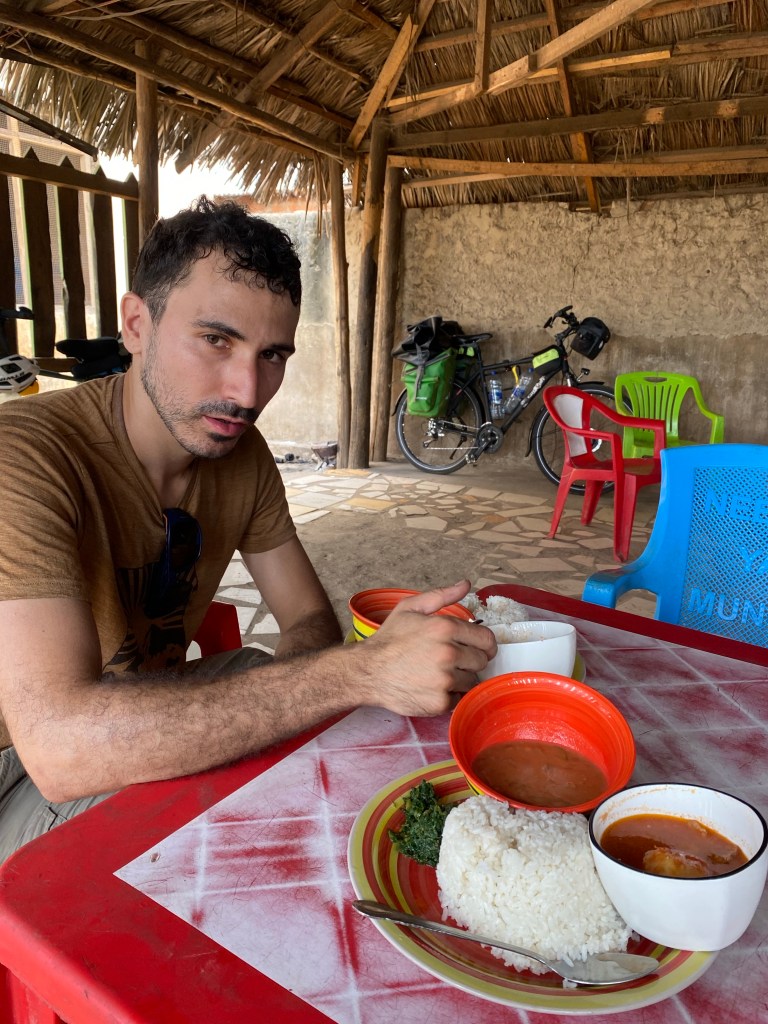
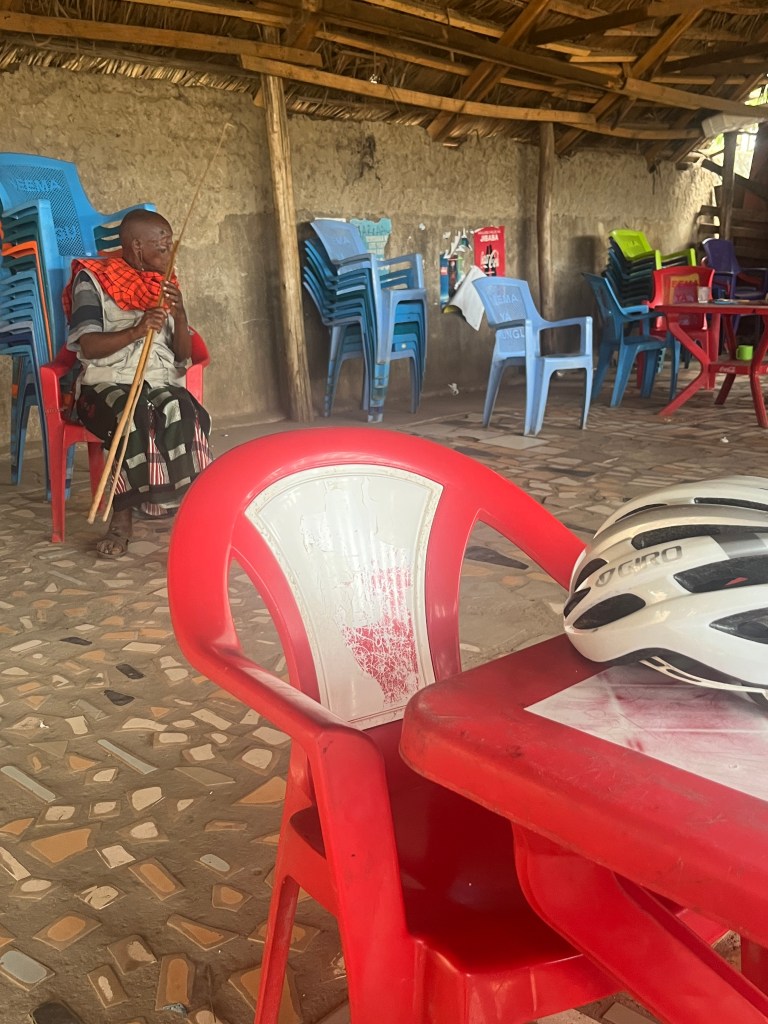
We do a stop for lunch at a place that seems to live from serving food to truck-drivers. We see some Masaai people there too, they look amazing with the earrings and their clothes. We eat an amazing rice with beans and meat for just 1 CHF per person. Javi is destroyed after the bike shock, so he gets a Pepsi as a luxury. We stock up water and we continue.
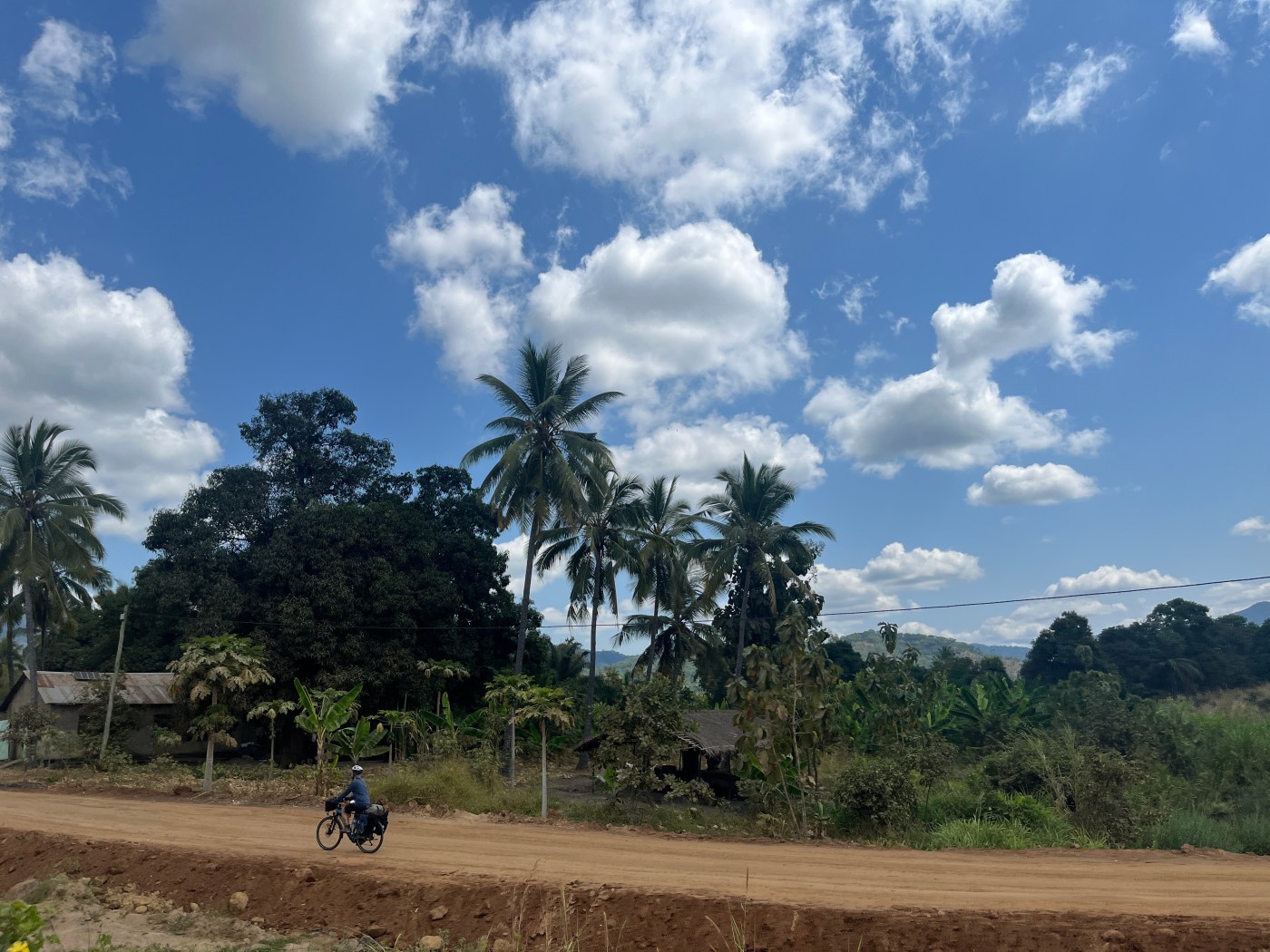
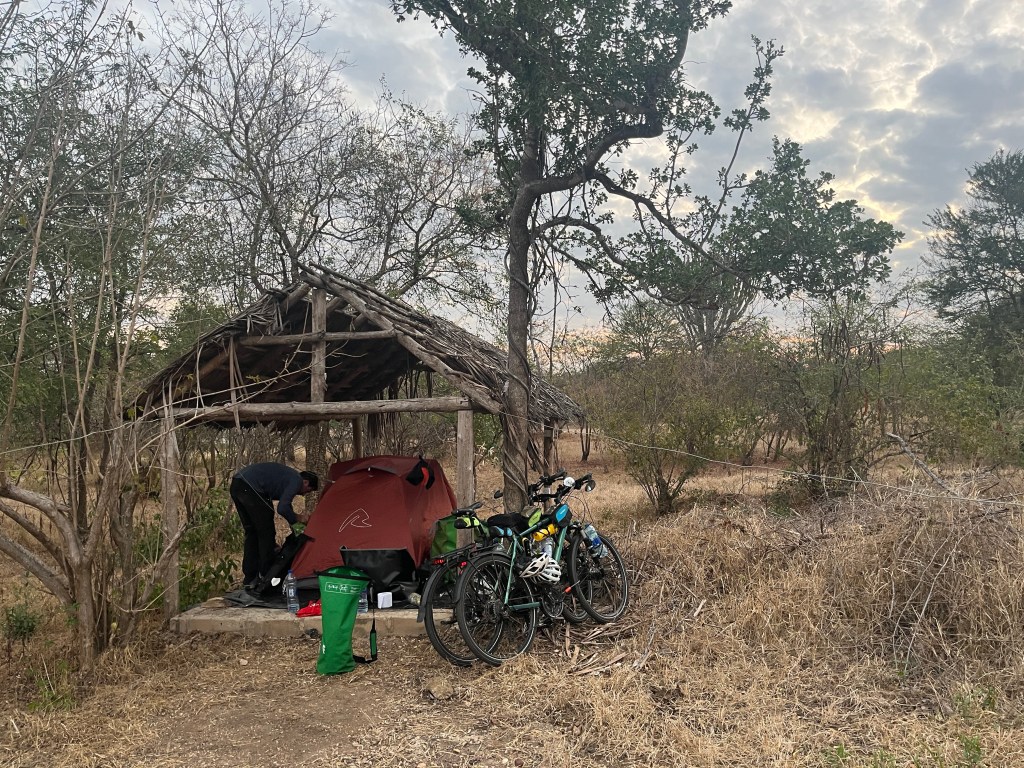
The mountains disappear from the landscape and now everything is savannah, all around. At 4 pm we arrive at Doma, and we go ask for a camping spot in a tourist camping. The camping is literally empty (it looks like a ghost town) and the guy taking care of it (who is chilling with what he pressume to be his wife, who wears Masaai clothes and garments, and carries her beautiful kid in the back), asks us for 20 CHF to put the tent. We manage to negotiate to 7 CHF, as the place is really decadent and there is no services to be offered (power, toilet).
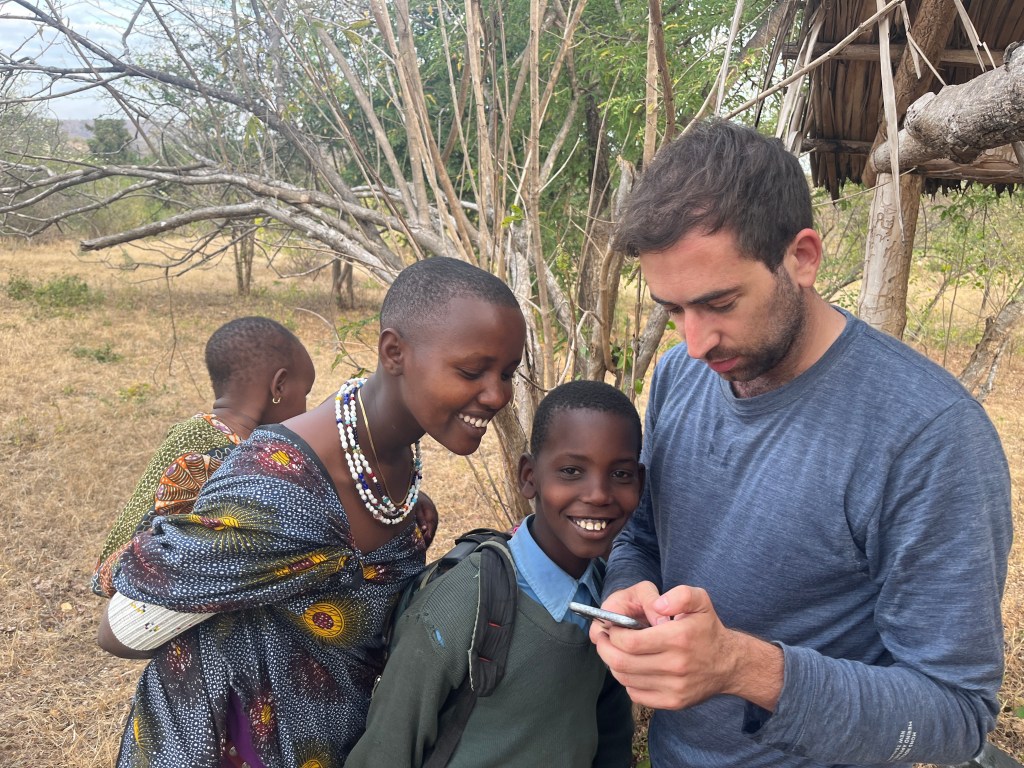
We place the tent and we get a group of spectators. The woman mentioned before and lots of kids. Communication is imposible until the advanced student of the family arrives, a 9 year old kid who is learning English in school. We have a lovely interaction, in which they ask us to show pictures of our wives and mothers. They are super curious about our body hair and all our gadgets. We give the baby a portion of our noodle soup, and the other kids some fruits. They seem happy, and they are very respectful. We say bye and we get in the tent when the sun gets down (at 6.30), as we are scared about mosquitos and snakes.
28/07: From Doma to Mikumi .
Wildlife and trucks. 55 km, 240m
We wake up at 6:30 with the sun, pack and eat just some bananas to get on going. Still, we need 1:30 h for the whole process. Gaspard thinks there is room for improvement, Javi doesn’t.
After 5 km, we enter the National Park, which as mentioned is crossed by a proper national road, with a lot of trucks. A big banner saying “Danger, wild animals” welcomes you. On top of that, all the land around the road is burnt, we wonder why. But the park is of a proper size, with a lot of deviations to high-end lodges.

That’s however not our plan. We start getting impatient to see animals, but the souther we go, the more we see. We start with monkeys, who chill on the road, collecting leftovers among the plastic that drivers throw to the road sides. Slowly, group of antilopes start running in parallel to us. Then, we both see the first jiraffes of our life. Zebras, Gnus… We are having the time of our life, if we forget the traffic which is still annoying enough. Quite a dicotomy, to be honest. Many truck drivers give us slack when overcoming us, and cheer us up with some claxon noises. Others force us to jump to the road side. With our rear mirror, we slowly understand the patterns and act in advance.

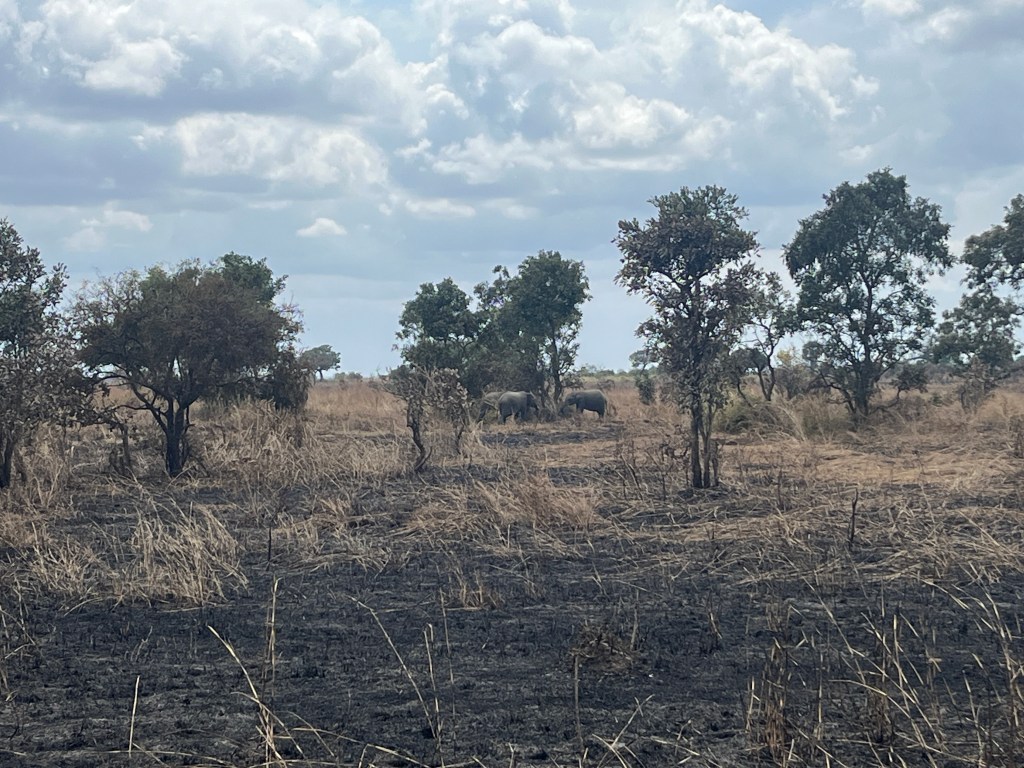
When we are almost are leaving the park, we get our last-minute surprise. A group of elephants is stralling around 100 m away from us. Two of the younger ones are fighting. We see the impressive tusks of the group leader so well. The traffic suddenly stops. The moment is magical.
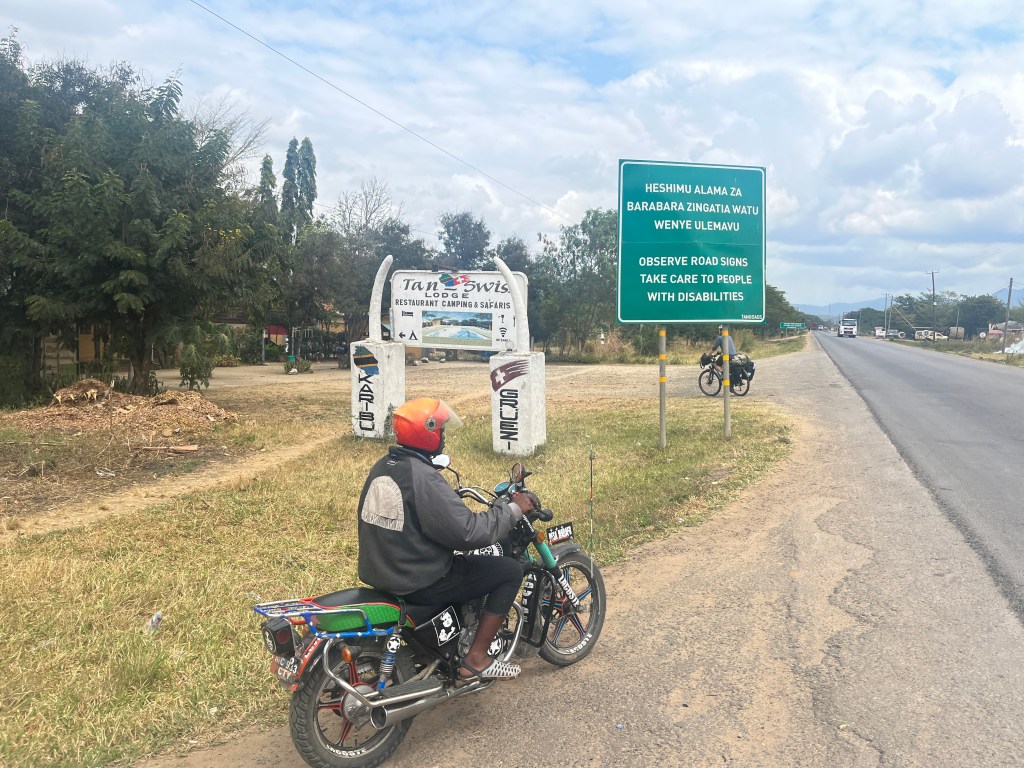
We leave the park and we make it to Tan-Swiss Camp, a recommendation of a hindu trader in Morogoro. The camp is really beautiful and is run by Joseph, a 60 year-old Swissman from Muotathal, Schwyz, who lets us camp for free and use his proper swimming pool. He says one has to support adventurers like us. He explained us that the curent governement is opening a lot its border for business leading to trucks going from dar’s harbor to tanzania, malawi and zambia. They in most part carry raw materials and large machines for the all the mines. Joseph has spent the last 22 years in Tanzania, is married to a local woman and he has 3 kids, that run around the camp interchanging Swiitzer-Düütsch and Swahili. What a world we live in. Danke, Joseph.

29/07: From Mikumi to Udzwunja NP.
THIS is what we signed up for! 70km, 350m+
We are done with traffic. But we are short in alternatives, as the main road is surrounded by valleys, and the roads that divert don’t go even close to where we are going, Malawi.
We heard from the Germans in Morogoro that the Kilombero Valley south of Mikumi was very beautiful, but everyone tells us it has no exit and to take the main road. But that’s not an option for us.
We start brainstorming and Javi realizes that the Lonely Planet book shows a train line crossing the valley and exiting on the opposite side, Makambako. We ask a couple of people and tell us it should be possible. We have a plan!
After having a top breakfast at Joseph’s Tan-Swiss, we start cycling and can’t be happier to leave the truck packed road, direction South. The police is making all trucks get weighted, which is generating a retention of multiple kms. Great moment to leave. Tschüss!!!
We start entering in the Kilombero valley and we can’t be happier. We are surrounded by nature, the road is very good and traffic is a joke compared to the national road. THIS IS WHAT WE SIGNED UP FOR!!!
Surprisingly enough, the more we advance, the more people we see. People are really surprised to see us. Joseph already told us that there is very few “wazungu” (white people) making it there. But Gaspard is very committed and doesn’t leave a local without greeting. “Jambo! Jambo!” (Hi)
After a bad lunch experience, in which the brother of the cook demanded extra money from us in a rather unfriendly way, we continue with some mixed feelings. Unlike the other trip, in which we discovered Africa progressively, after 3 weeks riding in Spain, this time we have landed in the middle of deep Africa. Language is a huge barrier and although most of Tanzanians we are meeting are very nice, this is not Gambia, in which every second person invited us to their home with a huge smile on their face. We decide to give some time to getting used to it. Let the flow come to us!
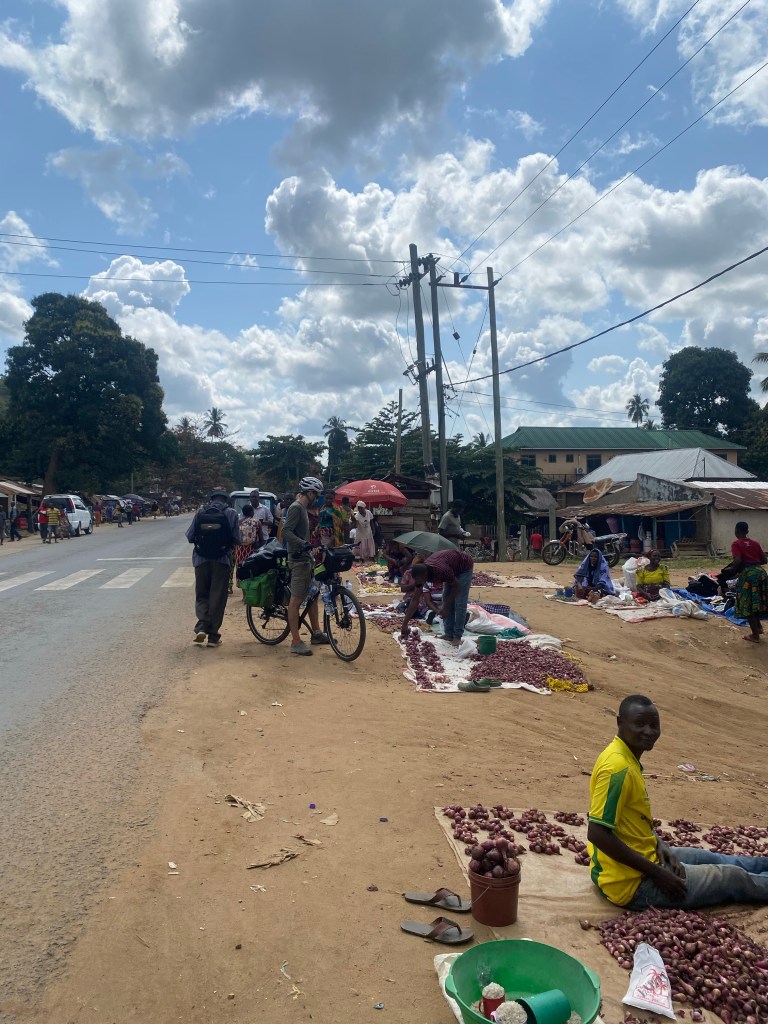
Anyways, the valley is very particular, with imposing, tree-packed mountains to one side, and an endless plateau full of rice, sugar and rubber fields to the other.
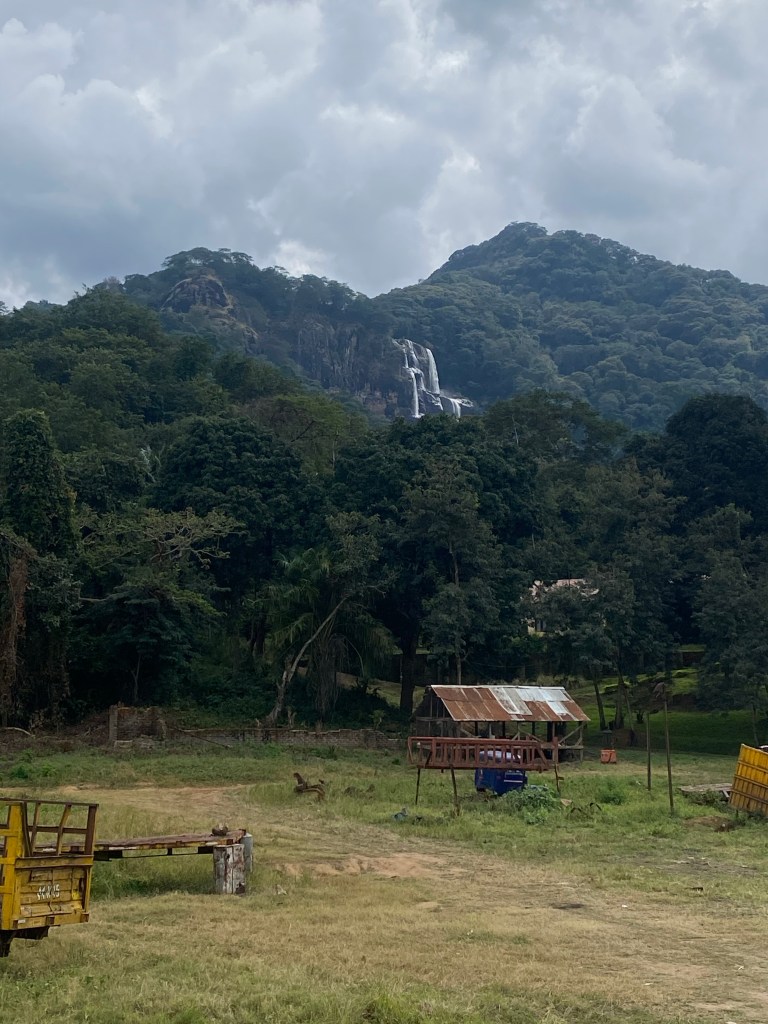
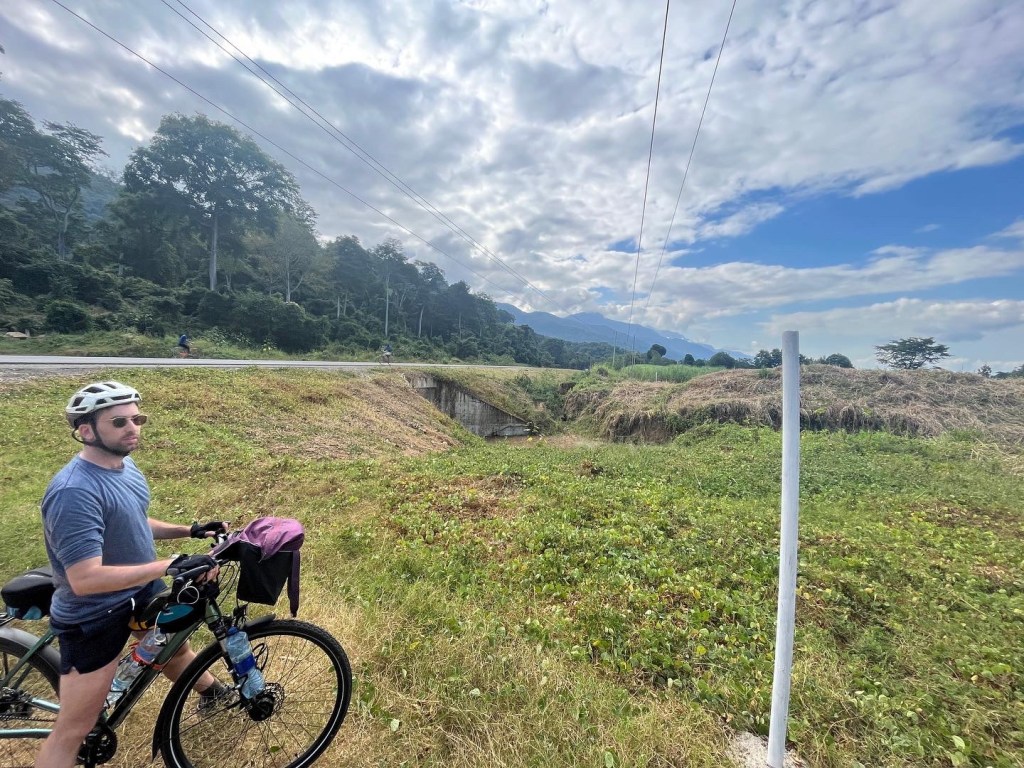
The mountains are part of the Udzunwja National Park, and there is where we want to make it. We start looking for a camping spot after completing the 66 km we had in the plan, and a post comes to our attention. “STEP: Southern Tanzanian Elephant Program”). We ring the bell of the property and a smiling man welcomes us.
Jeradi doesn’t speak English, but Google Translate makes the magic “Can we camp here?” . Jeradi answers in Swahili, which we suspect he thinks we understand. We only understand “boss”, and with a big smile he calls him (We understand for permission). 5 minutes later, the boss comes in a motorbike. He speaks good English. We explain him the proposal, and he also says he has to call his boss. He puts Joseph on the telephone for us. Joseph gets our situation and easily accepts to let us camp. He also helps us understand that it should be possible to get out of the valley in the TAZARA train, and to take the bikes with us. Good news.
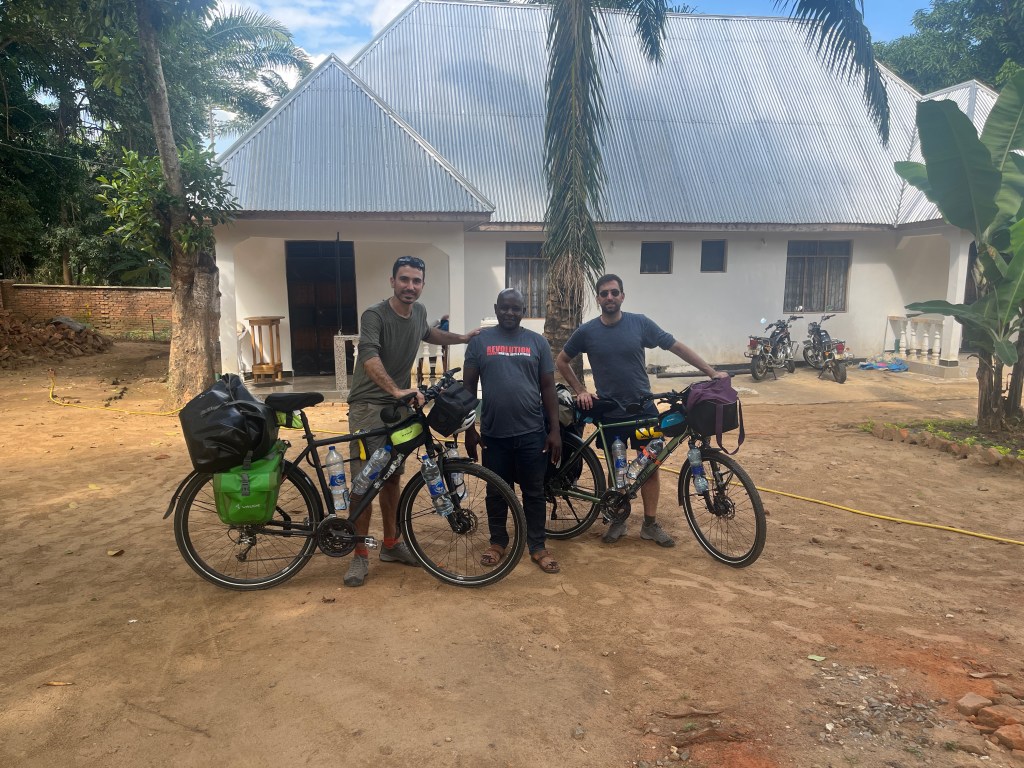
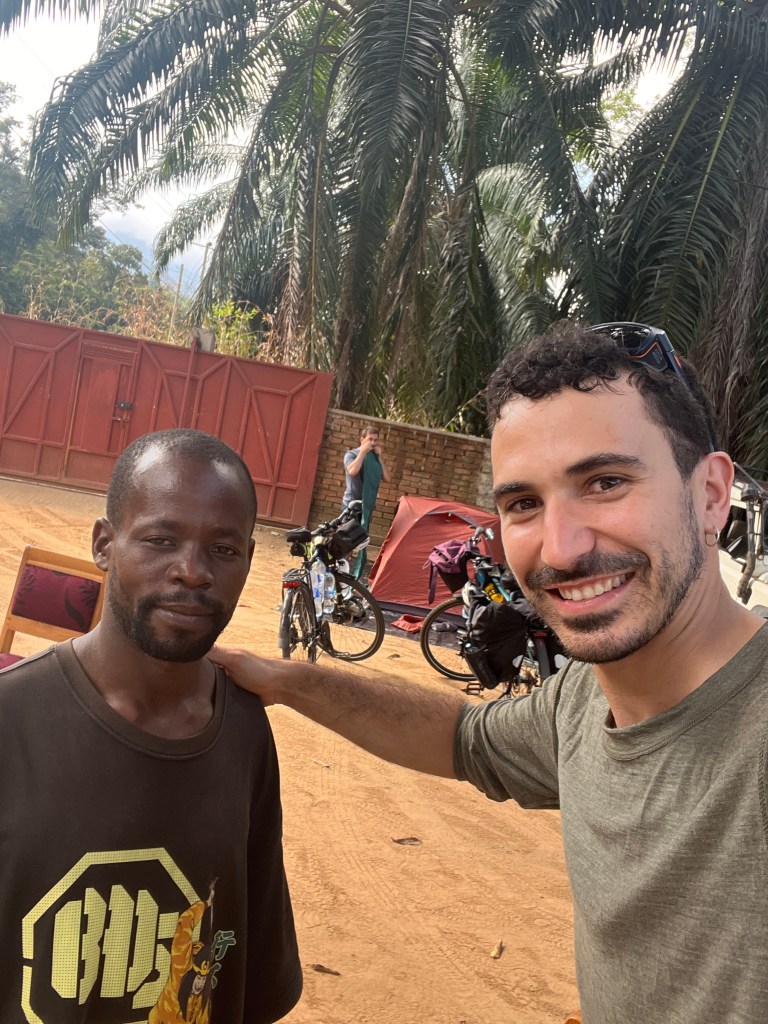
The intermediate boss leaves and we stay with Jeradi, who is taking care of the facility during the night. Despite the huge communication barrier, we have a beautiful evening with him, full of laughs and empathy. Those exchanges are truely magic and are one of the main reason we are doing this. Thanks Jeradi, Joseph and STEP.
30/07: From Udzwunja to Ifakara.
Are we in the flow already? 79km, 730m+
Joseph told us that the train to exit the valley (to Makambako), passes Ifakara on Monday the 31st at 13:00. So we have buffer time, which we decide to spend visiting the National Park that lies continuously on the right side of the road: Udzwunja Mountains. The ranger post is just after STEP. We arrange a guided hike with two ranger apprentice young men, Mosha and Emmanuel. They are both from the North (Arulha area). Mosha is a Masaai and Emmanuel a Meru. It looks like Tanzania has a strong tourism education program, in which students do internships all around the country.
Because of time constrains, we have to conform ourselves with the shortest hike, the Njokamoni trail. They already warn us that the chances of seeing mountain elephants are extremely low. The park is the only place in the world to count with mountain elephants and is special for its great amount of endemic species.
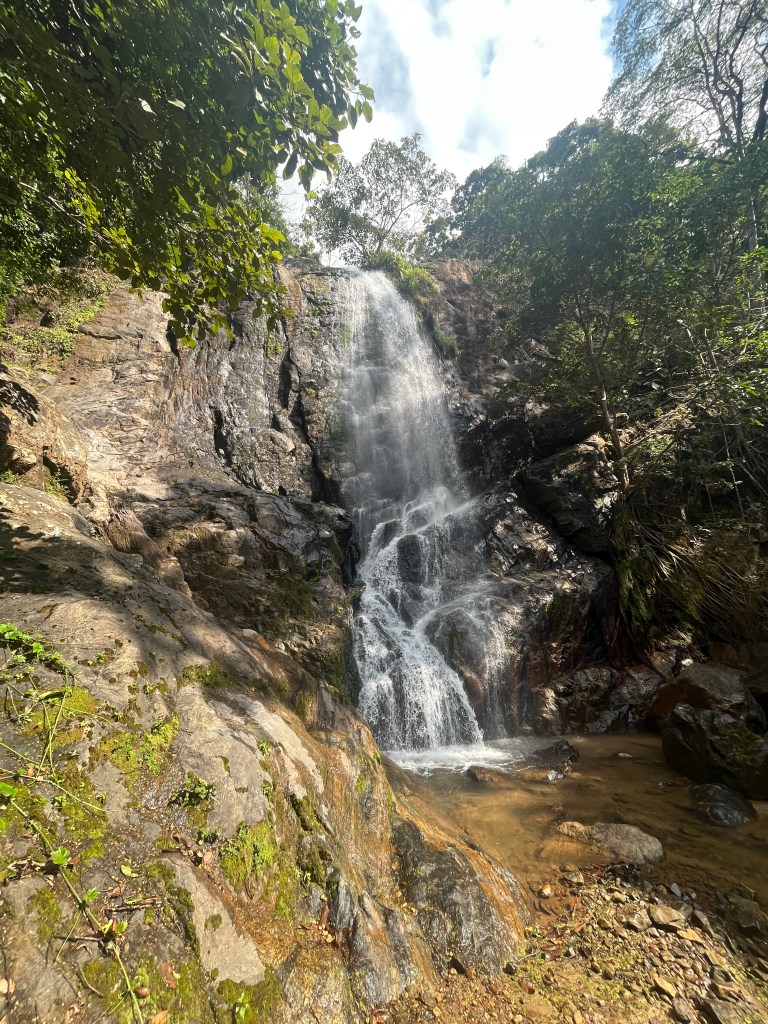
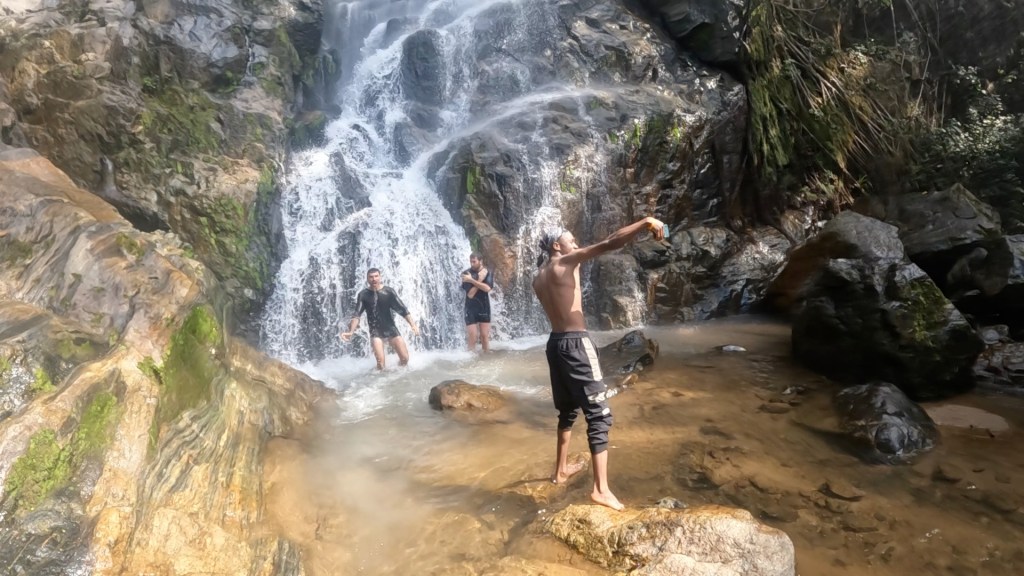
We complete the hike relatively fast, and see a variety of endemic monkey species, plus mountain antilopes. One monkey species is called the “blue balls” monkey. Guess why in the comment section for a beer prize. The hike perk is a shower in a waterfall, which helps us feel more fresh and wakes us up. From the waterfall, we have a majestic view of the valley, which extends itself for hundred of kilometers, full of plantations, until it reaches the vast Selou Game Reserve, which makes it up to the coast of Tanzania.
We learn a lot from Mosha and Emmanuel. They tell us that Kilombero Valley is the first place in Tanzania where they have seen women riding bicycles, motorbikes and cars. In fact, we even saw a woman in a niqab riding a bike (learn from this one, Saudi Arabia). They also tell us about the Masaai culture and its polygamic practices. Woman are a sign of wealth and power: the more the merrier. In contrast with the muslin religion where all the wifes live under the same roof in the Masaai culture each wife has its own house. The houses are arranged in a circular shape with at its center the house of the husband. Mosha and Emmanuel are both Christians and they have gone to mass before the hike. They can’t imagine not going to church on a Sunday. They combine it with a love for American Gangsta Rap, including Snoop Dogg and 50 Cent. They are full of joy and lust for life: “We are looking for a life before looking for a wife”.

We say bye to our new Rafikis (yes, the name of the Baboon of Lion’s King actually means friend in Swahili. Simba means lion, and Hakuna Matata something like “No worries, enjoy life”). We get going to Ifakara, the capital of the valley, a 200K people city, where we plan to take the train. The road is under construction, which complicates things. We make it to the train station at around 3pm, extremely hungry. The station is in quite poor condition and there is a handful of travellers who seem waiting for a train. There is no permanent office, and we manage to learn from a local that the ticket master will come in 30 minutes.
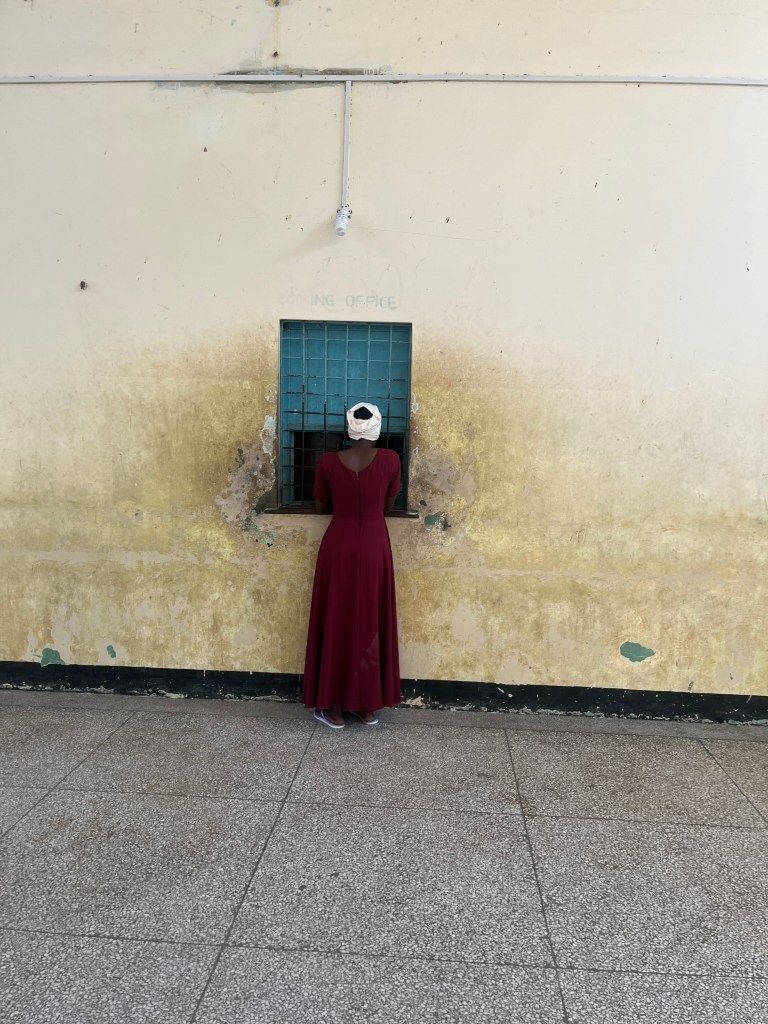
He comes late and we let everyone go first, as we expect some back-and-forths in the ticket purchase process. However, it goes surprisingly smoothly. It’s possible to bring the bikes for just 5 Eur. However, the train to Makambako is only arriving on Tuesday, not Monday. And at 9pm. Which basically means that we have 48h to spend in Ifakara. We have to arrange the tickets the day after with another ticket master (We would like a bed cabinet, so we can use the night to properly rest). We get his phone number and pray for him speaking English.
It’s time to look for accommodation. The day is extremely hot and makes us want to find a good hotel, so we can rest properly and spend time taking care of logistics and the next steps in a nice area. We go to the best rated hotel in town, with just 3.7 starts in Google. A look to the comments explains us why: Most of comments giving 3 stars mention that the hotel is amazing. So, Africa Tip #1: Don’t trust star ratings, they are not used like in Europe. An also fun fact is that Google Maps points of cities and other important landmarks are used by locals to upload pictures of themselves. We suspect it may act as a kind of Tinder.
We ride 10 km to the only hotel in town that has a swimming pool, to find out that there are 2 locations of the hotel in Google Maps for the hotel, and we are obviously at the wrong one. We had past the correct one long ago. So 20 km extra for the day.
We make it to the hotel, which is incredibly clean. The swimming pool area is really nice and food and beers are just a bit more expensive than on the road. Great. For EUR 22 both, breakfast included, it’s a pretty good deal. What is not so great is the ambience. It’s full of rich locals that are far from friendly. They look suspiciously to us. Some laugh among them looking at us. We seem to be the only wazungu 50 km around. The clients dress rapper-like clothes and don’t take their eyes out from their phones. They take selfies constantly, and they have parked huge pick-ups on the entrance. A guy is learning to swim in the pool, while he constantly stares at us. So random.
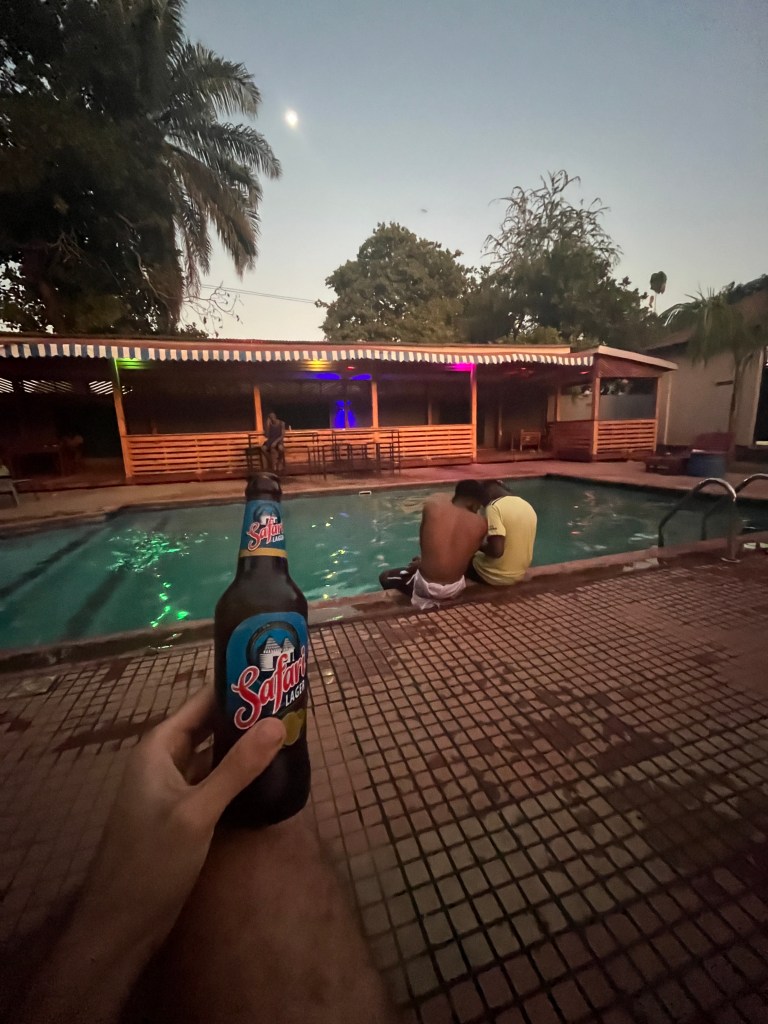
We feel a bit uncomfortable, and we start discussing if it’s us, who are not yet used to the hardships of such a trip, or if the area is just rough. Part of us wants to anticipate our arrival to Malawi, which we have heard is famous for its friendliness. But we want to give another chance to this fabulous country, and we design a route that avoids the national road, starting in Makambako, crossing Njombe town and Kitulo National Park, and ending in the frontier with Malawi. Let’s go for it.
Days on the road: 6. (Total) Distance cycled: 318km. Accumulated elevation: 2’632m+

 Cycling Pirates