

Song playing: Jux ft. Diamond Platnumz – Enjoy
31/07 & 01/08 – The long wait in Ifakara
We wake up at 8 AM. Given that sunrise is at 6:30, we will say it,s late. The breakfast of the hotel is solid: pasta, pancakes, omelette, toasts and fresh juice. We spend the morning writing the blog and taking care of the logistics for our trip in Namibia with the “wives”, at the end of the bike adventure.
We obviously do this at the swimming pool, which is much calmer than the evening before – no mafiosi this time. At 2 pm we go to the town to look for a lunch of better quality than the one a the hotel, since the chicken of the previous evening was harder than the sole of a shoe (translating directly from Spanish hehe) and we ended up giving it to the cats living there. We settle in one of the many bars around, they can host lots of people and seem to serve food and a lot of alcohol too. They seem sponsored by the different Tanzanian beer brands: Safari, Serengeti, Kilimanjaro…
After lunch, we buy food for our next part of the journey. Javi has made a good experience getting energy out of Snickers bars, and after over an hour of going from shop to shop we find them – despite Gaspard’s low hopes. Some people around town stop us and ask us what are we doing here. When we tell them about our plans, they ask for our phone so they can call us and track our progress.
We go back to the hotel and do a maintenance session with our bikes, under the attentive watch of the hotel crew. Slowly, communication with the hotel crew eases and we smile at each other and exchange more words. We feel much more comfortable the 2nd day at the hotel.
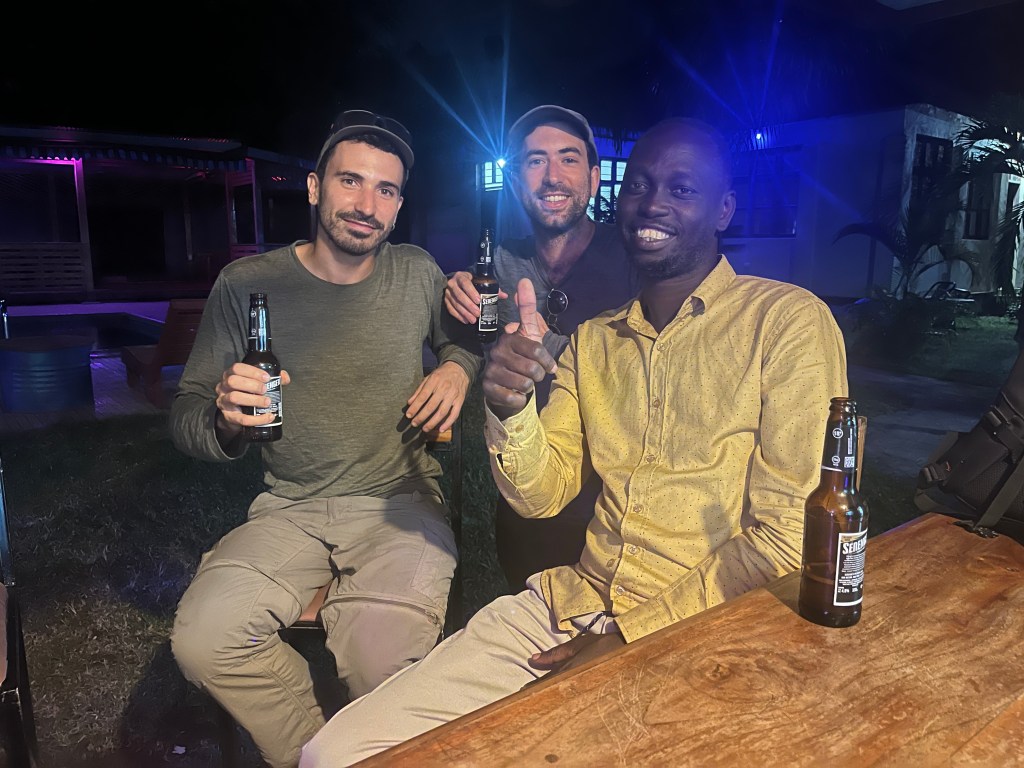
In fact, our social life doesn’t stop to improve, as we meet Davis at the bar, the IT manager of the biggest hospital in town, St. Francis Hospital. We spend some good 2 hours talking about Europe, Tanzania and life in general. We insist on paying rounds to each other and we end up pretty tipsy, as expected.
Davis gives us some great tips on what to do in Ifakara the day after (01/08), since our train will only arrive at 22:00. We meet at the Hospital where he works and we take a tuk-tuk to the river that crosses the valley. It’s extremely wide, and he tells us that now is very narrow compared to the rain season. He tells us the story of how recently -during the rainy season- an hipopotame came to visit the hospital and was shot by a government official. The meat was cut and shared with everyone there. The river nurtures the fields of the valley, and provides fish year-round to the population. One can see it plays a major role.
We jump in a canoe with a friend of Davis, and he brings us around for 1 hour. Birds of every colour fly around us, and the pelicans and other fishing birds stroll in pieces of grass that flow with the river. We decide to call them grass-bergs (aren’t we funny).

Things get serious when we are told to check the hyppos. Our mouths open wide when we see them opening their jaws, and our brains start thinking if we are far enough. According to our sailor, we are. We hear the sailor speaking to some other people in swahili where can we go to watch some crocodiles. He is either crazy or our swahili is not as good as we believe.
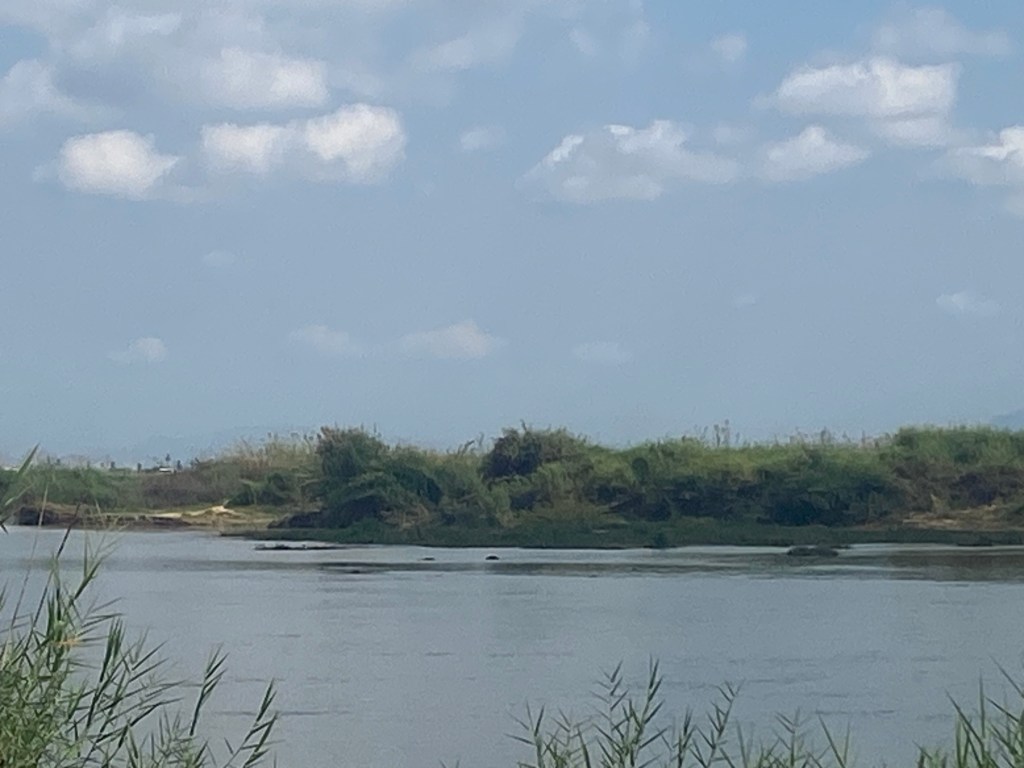
We return while we see some European scientists also heading to the hyppos. The difference is that they are carrying a guy with a rifle in the canoe. Just in case. We didn’t have that!
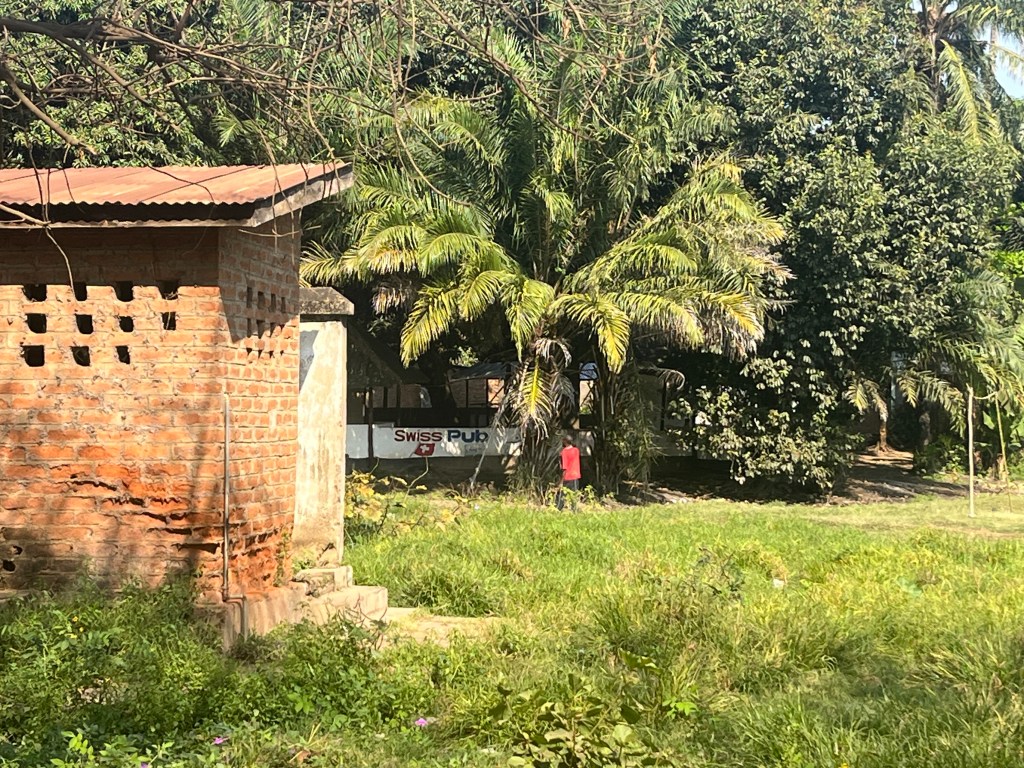
We return to the hospital for lunch with Davis and get impressed by the facilities. The canteen has even a swimming pool. This one and the one of our hotel are the only ones in the valley. the hospital is full of references to Switzerland, and Davis tells us that our host country is a main donor in the area. He also mentions that many Swiss professors do field research here and come often. He really seems to be thankful to Switzerland and admire it.
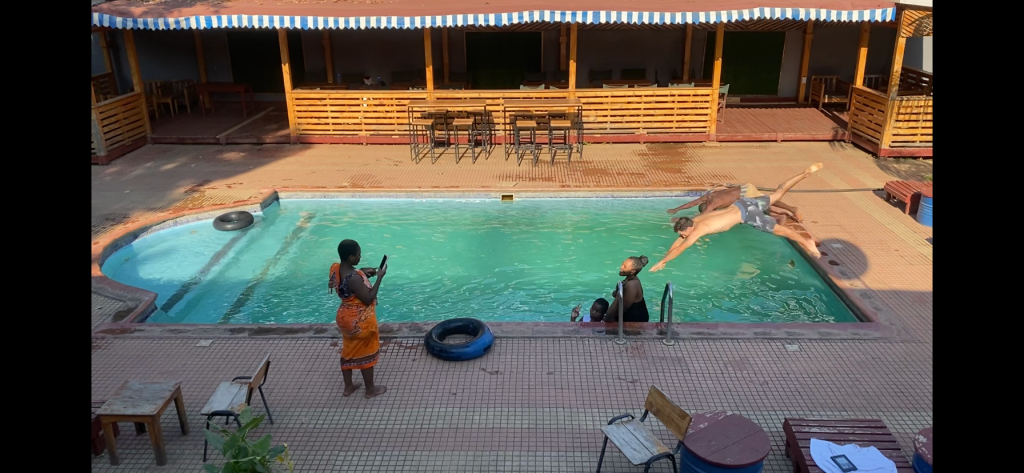
We go back to the hotel, and spend the afternoon chilling in the swimming pool. Some local girls are practicing swimming and we help them with some tips, despite we are far from pros. One of the facility guys challenges Javi to a swimming race. Javi accepts doubfully, since the guy is “jacked”. However, Javi’s depurated head-jumping technique gives him the edge for the win.
Time goes slow so we decide to play a chess game, as we did in th previous trip. We end up spending 2 hours, fully focused, and after many come-and-forths, Javi ends up winning. We are exhausted. Gaspard is not happy and demands a timer for next game. Bad loser (you can guess who is writing this part :-P).
As agreed with the ticket officer, we arrive at the station at 9:30 pm to get our tickets. The station is pretty crowded. There is a big tribe variety, judging from the clothes and the physical features. People cooking and selling food, a guy playing the guitar upside down. Women in traditional clothes dance around him and shout beautifully, as if they were invoking the train to come. However, we get a call from the ticket officer, who tells us that it will only arrive at 1am. Damn.
We park our bikes in a corner, and despite the huge noise, Gaspard manages to sleep. Javi stays awake attentively, as public transport stations are always a sensitive point for theft. After a one hour nap javi looks at gaspard and says he can’t hold his eyes open anymore. It is 23:30 ñ, well passed our usual 8-9pm bed time.

The time arrives and we call the ticket officer, Anton. Anton is actually the station manager, and welcomes us to his office. As any other place, it has the portrait of the current president (a female Muslim), and Nyerere, one of the first presidents of Tanzania and considered a national hero.
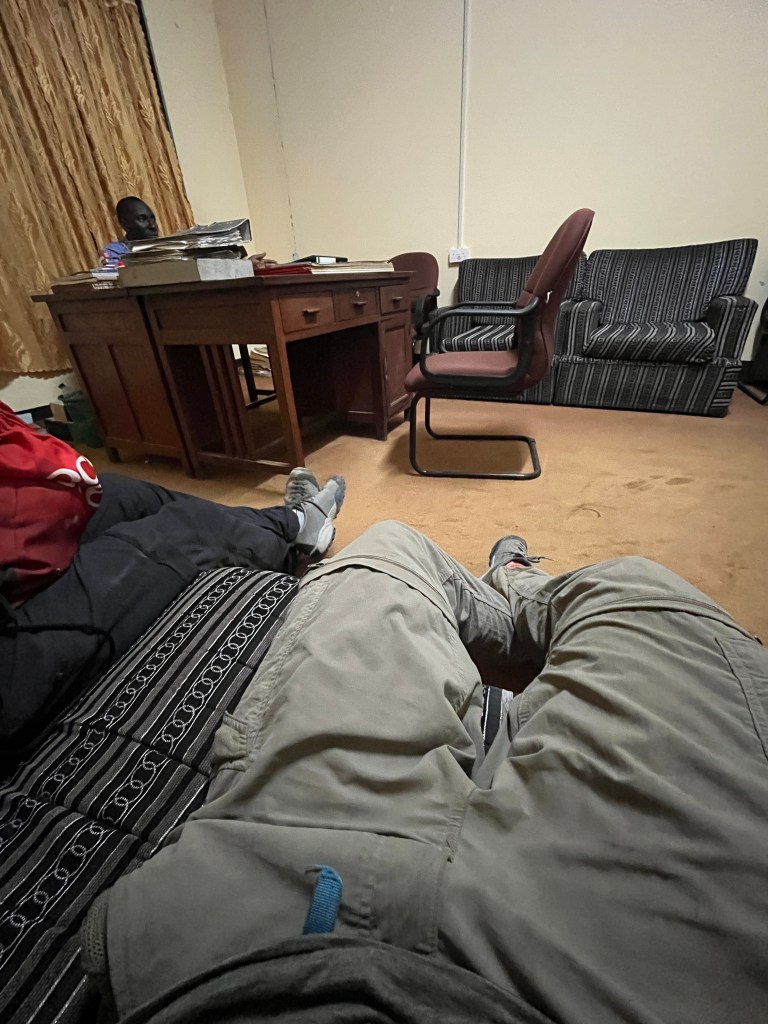
Anton is very helpful and gets that we need some help, as we need to pack our bikes in the wagon for goods. That relaxes us big time. He tells us he managed to get 2nd class tickets for us, with bed. We really wanted a bed to be able to rest and cycle the day after. When the train arrives, the station becomes even more hectic. Noise and smoke everywhere. It’s pitch dark and people go and come running. Anton escorts us diligently to the wagon of goods, where we pack the bikes. They don’t have anything to identify them (that’s apparently a responsibility of the client), so they come with a pen and ask us where can they write on the bike its destination. We continue to be surprised by the processes here, but somehow it ends up working.
We then go all the way to the other end of the train for our wagon. We see the 3rd class wagons, with people standing everywhere. They are packed like sardines in a can. We don’t regret our decision for bed tickets at all, particularly costing only 5 EUR for a 8 hour journey.
A quite “dry” waitress brings us to our cabinet. We are full of bags and hit everything around. The cabinet is small but we manage to pack the bags using every available space. 2 other people are sleeping, and we take the up beds. They are extremely tiny but whatever. It’s 01:40 AM and we are on our way! Success 🙂

02/08 – TAZARA train + Makanbako – Njombe, 60 km, 480m+
We try to sleep but the shocks of the train stopping every half an hour wake us constantly up. We are sleeping using our bags of instant noodles as pillow (as confortable as it sounds) with the lights on and someone speaking in the loudspeaker regularly.
At 7 AM, we realize that the train is struggling to restart for the last hour. Asking people around it is normal for the train to stop 1:30 or more in big station in order to load/unload goods. Only problem is that the toilets are locked while the train stops. Only option is to run to the toilet of the train station and hope that the train doesn’t leave without you. Least enjoyable pee you could imagine. It sounds only like more delays.
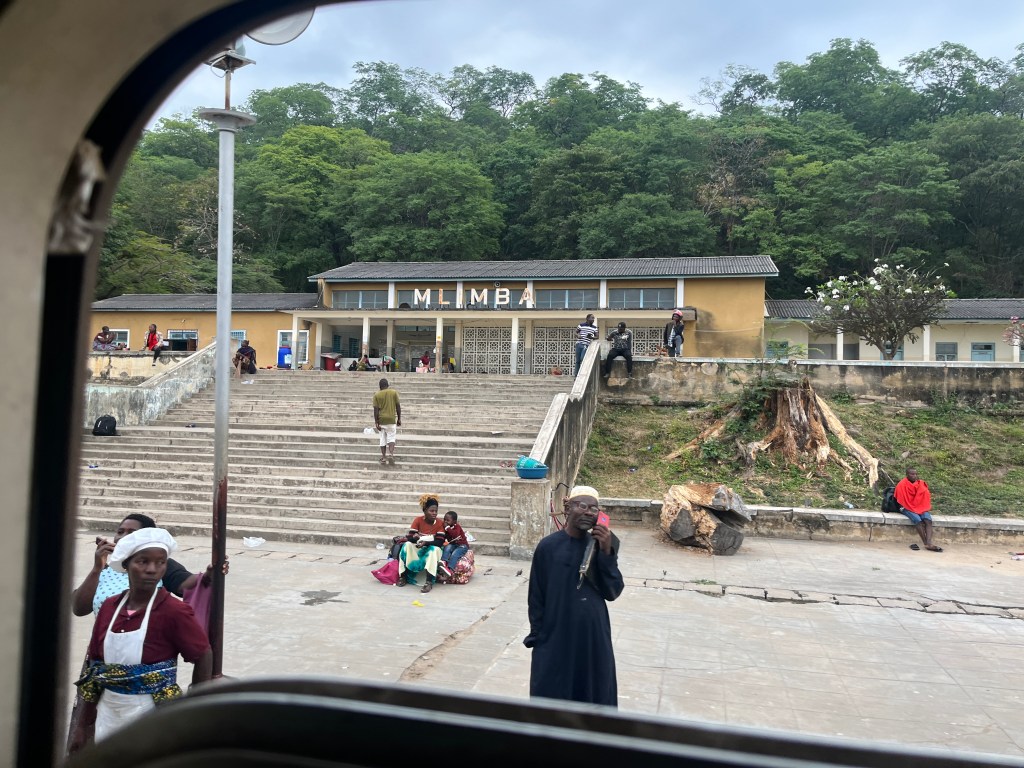
We spend the long journey looking through the window. The train is crossing a quite isolated region. There are absolutely no roads, but still, we see small villages now and then. It looks like the train is the only connection to the outside world for these people. The landscape consists of a hilly savannah, which makes the train takes turn constantly. We get to see the train moving in those curves, what evoques a beautiful view. It’s beautiful.

We go for breakfast to the restaurant wagon, and realize that the train wagons are chinese and part of the ChinAid program. We get another breakfast for sportsmen: omelette, pasta, bread and sausage. There is a nice back-and-forth of passengers, chatting, eating and laughing. We observe there are two other foreigner: a guy with a Miami t-shirt who looks definitely American and a Japanese-looking guy.
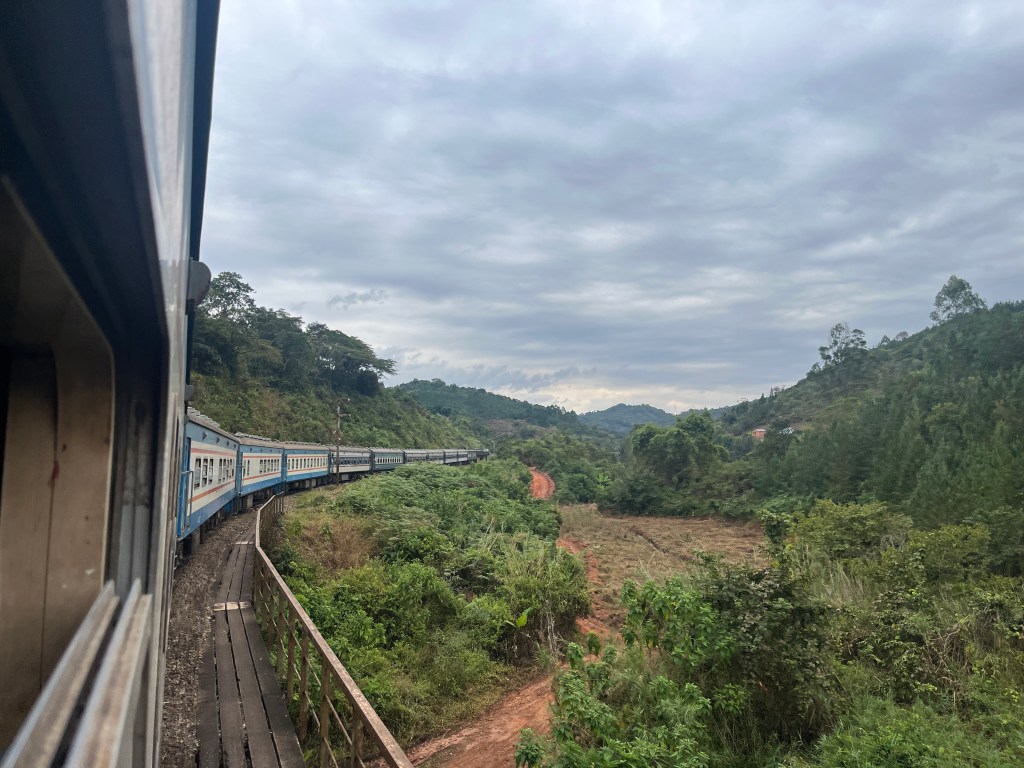
The more up we go, the more pine forests take over the surroundings. We are getting close to our end destination, Makambako, so we get ready to exit with all our luggage. Makambako station is however smaller than we think, and we easily reach the goods wagon to pick up our bikes. Luckily, they look in good shape. By the time we pack our bags and get ready, it still looks that the train has a long time before leaving.
We are in Makambako and it’s 13:00. Our plan was to at least reach the next town, Njombe, so we get going without having lunch, since we are running late. While buying water, a man in his 60s comes to us, speaking perfect English. His name is Albert (but calls himself Albert the great) and he is a Catholic Priest in a village belonging to the National Park we want to visit. We exchange numbers and he offers himself for any question or help needed.
The road to Njombe is nothing particular, except for the fact that is quite cold, even for us. Everyone is suited in winter clothes around us. We see people making bone fire to stay warm. we didn’t expect to see this. The traffic is however moderately good, and the shoulder of the road wide enough. The bitter part is the 30 kmph wind that blows against us.

We substitute a lunch break for snicker bars and we make it to Njombe tired and hungry, among huge tea plantations. We guess that the altitude and the British colonial past of Tanzania explain the origin of the plantation.
We decide to not look for a camping spot, since we should get proper rest after the poor sleeping in the train. So we arrive at Birdnest Hotel, conveniently located at the top entrance of Njombe, what saves us cycling down to town (and cycling up the day after). The hotel is fantasmagorically empty, and there is just a tiny woman called Tuli to attend us. When we request a shared room, she surprisingly says “Not possible, only boys and girls”. We get our first taste of homophobia in Eastern Africa, and we are not even gay. Every room has a holly bible in it which might explain this. In any case we see no point in discussing, and we take a single room each. The weather is only getting colder, so we both get a proper warm shower, before going to the Hotel restaurant for a well-deserved dinner.
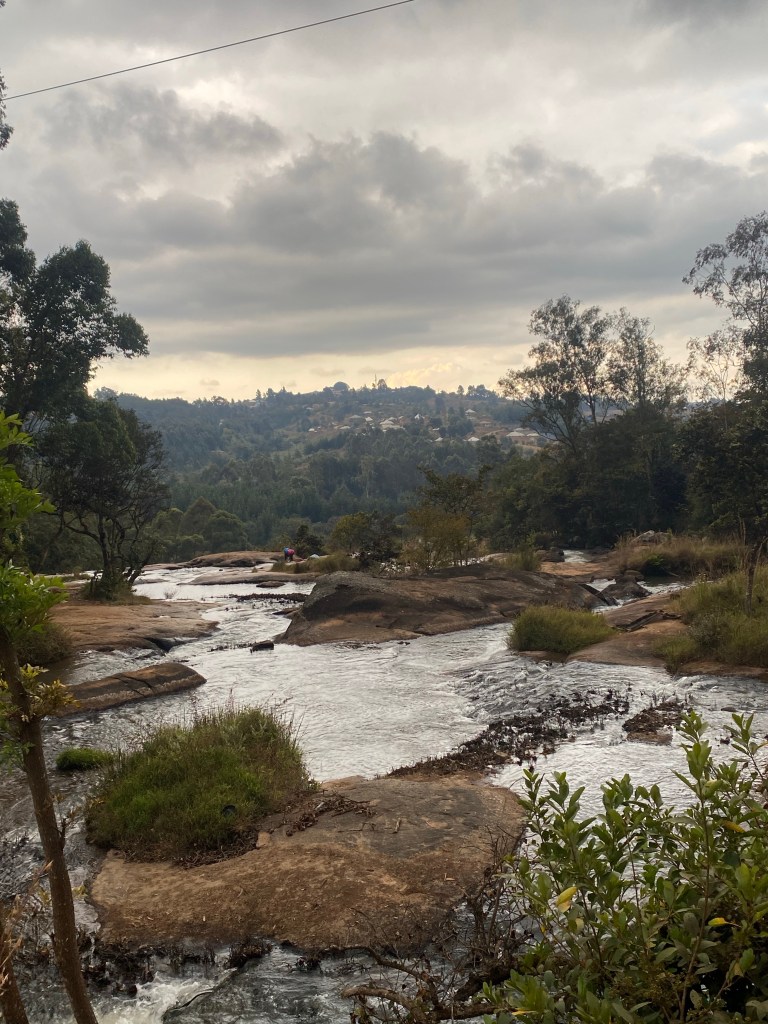
We check the menu but half of the things aren’t available. Tuli recommends us the chicken, but we are committed to avoid meat, specially in places with so low-traffic of clients like this empty hotel. We end up eating (surprise!) rice with a sauce, and hit the bed to engage in a 10 hour non stop sleep. Good night!
03/08 – Njombe – Mang’oto. 70km, 1350m+
We go for an early start, since we have a lot of elevation to do. To our enjoyment, the hotel breakfast is also huge here: fries, pancakes, omelette, sausages, bread with pesnut butter and some fruits. This generous food portions contrast with the scarce variety in dishes and food places out of hotels. When we camp, we struggle to find a breakfast place, and we will continue to do so.
While charging the bike with our bags to leave the hotel, we notice the gardeners water the plants using bucket of water from a source. For such a big gardens, the job seems insane.
At 8:00 we are already cycling, and the first set of slopes hit us hard. The day will consist of and endless stream of ups and downs, with more ups than downs. On the other hand, the road quality is superb, and the volume of traffic very low. Additionally, we have a bit of tail wind that makes thins more enjoyable.
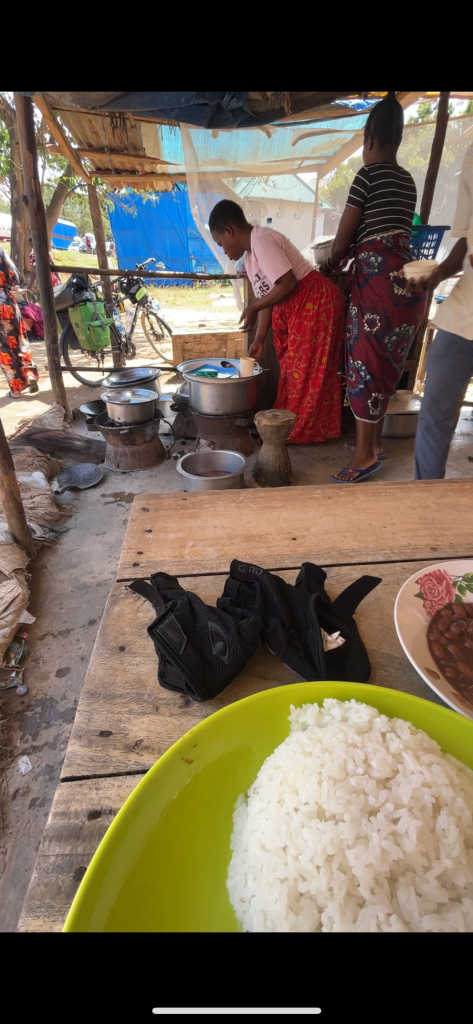
The day is a cloudy one, and some drops make us get our rain clothes. Obviously, as soon as we put them on, rain stops. Murphy’s law as usual. Despite the sweating of the uphill parts, we are feeling quite cold, and during the lunch break (rice with sauce again) we check that it’s only 8 degrees Celsius. And it’s only 12:00 pm. As in most places we visited coal is the most common fuel for cooking. The stoves consist of a large cylinder with coal on the top and some opening below for air circulation.
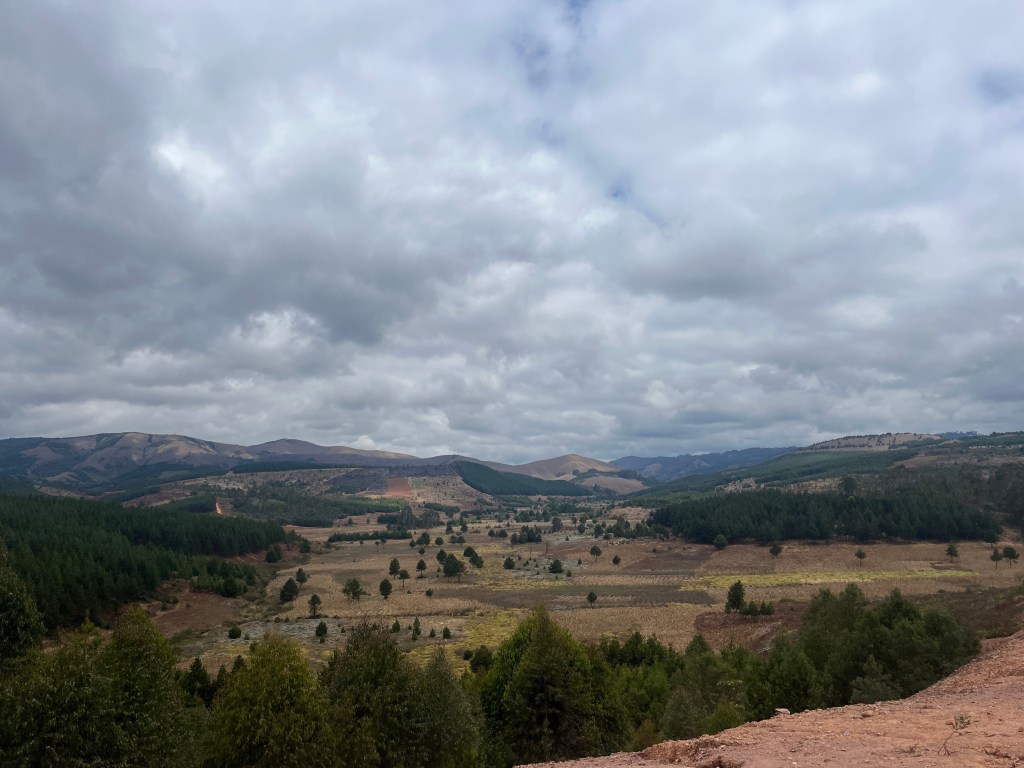
While cycling, we realize that the whole area is full of corn crops, and pine forests, that don’t look endemic at all. Cows however have dissapeared from the landscape. The big amount of processed wood trunk piles on the road suggest that lumber is the main economic activity of the area. The landscape resembledany hilly European region, such as Northern Spain or the Balkans.
Despite the cold environment, people are quite friendly, which makes things easier. This includes the truck drivers, who are giving us much more slack than in the beginning of our trip. The strong religious feeling we got from the hotel is also visible on trucks and motorcycle, most of which have a photo of Mary, Jesus, or sentences such as “god a plane”.
By 2 PM, we have completed 65 km and an astonishing 1’200m+. Gaspard wants to continue, so we compensate the very hard day that waits for us tomorrow, but Javi insists on taking a drop of precaution, since we could easily get injured by starting so strong. We are unfortunately short on flat camping areas, and end up camping in a parallel dirt road, partially visible from the road. We cover a couple of directions with some leaves, and start preparing dinner. It’s 5 pm and it’s damn cold!

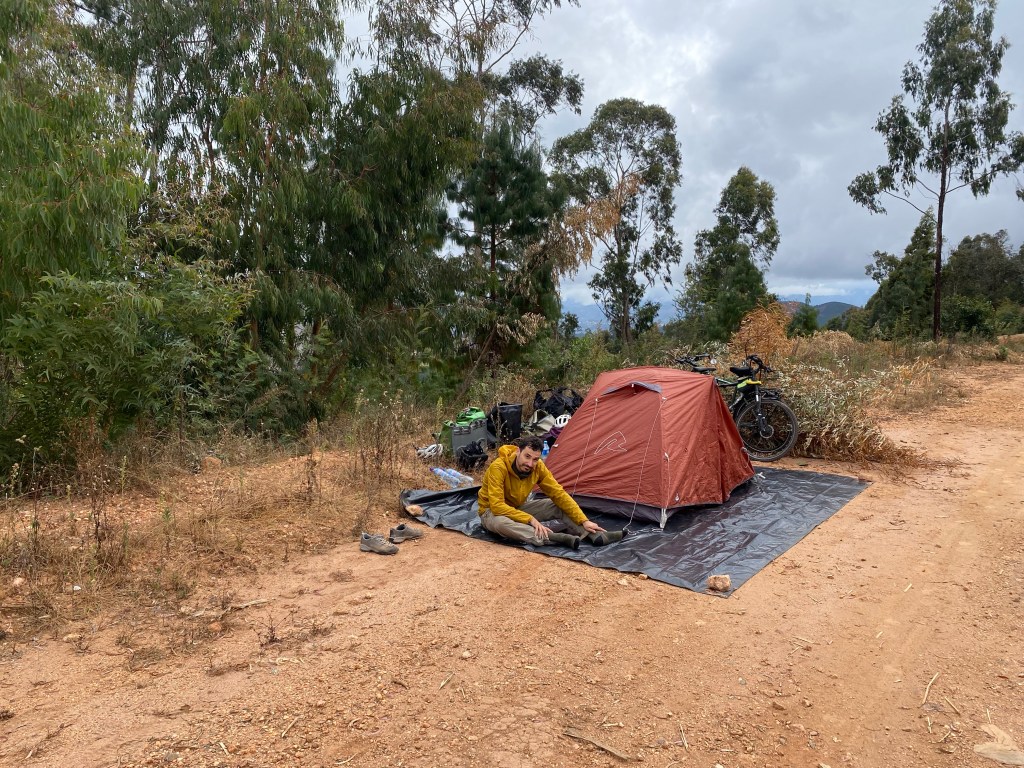
Some kids see our tent from the other side of the road, and start shouting at us. In a frankly pathetic way, we stay silent in the tent, looking through the edge of the tent if they are leaving. We are so tired that the last thing we want is spectators that we have to entertain while cooking. We are sorry, kids of Mat’ambo.
So we cook some noodle soup with tomato and onion, and get in our sleeping bags, partially-prepared for a cold night, and hoping for no disturbances.

04/08 – Mang’oto – Entrance of Tikulo NP. 48km, 1’200m+
We wake up at 6:45, tired of staying in the sleeping bag for the last 12 hours. Although it’s already bright, the cold fastly gets in our bodies while we disassemble the camp. Javi couldn’t be more grateful to have packed gloves in the last second, as recommended by Gaspard.
We get going without breakfast, hoping to find something in the nearby town of Ikonda. Ikonda lies in a road junction, and is one of the reference towns of the Kitulo region. A massive, endless descent under the rising sun brings us to the town, while our bodies start warming up.
To Gaspard’s disgust, it’s not possible to find any other breakfast than egg omelettes. Gaspard dislikes eggs and that’s a problem in Africa. While Javi enjoys an omelette with a loaf of bread and a warm tea (they call it Chai), while Gaspard starts looking for a replacement for his iPhone cable, which has stopped working again while connected to his dynamo charger.
Disclaimer: we use a dynamo-charging converter to generate power while cycling. It is particularly effective in flat areas and enables us to not depend on external power sources that much.
Unfortunately, the visit to the local electric supplies store proves that the issue is not only with the cable but also with the dhnamo charger. Damn. Gaspard hangs the solar pannel from one of his bike bags, while hoping to find a remedy to the dynamo converter in the evening.
The landscape slowly consists of less pines and more native trees. Forests are dense but far from jungle-like ones. The ups and downs only get more aggressive, with the consequent stress for our legs.
Some slopes almost make us fall backwards, due to the 20 kg that each of us carry on the bikes. So we start taking the habit of just pushing the bike in such slopes. There is no rush and there is a long journey ahead of us.
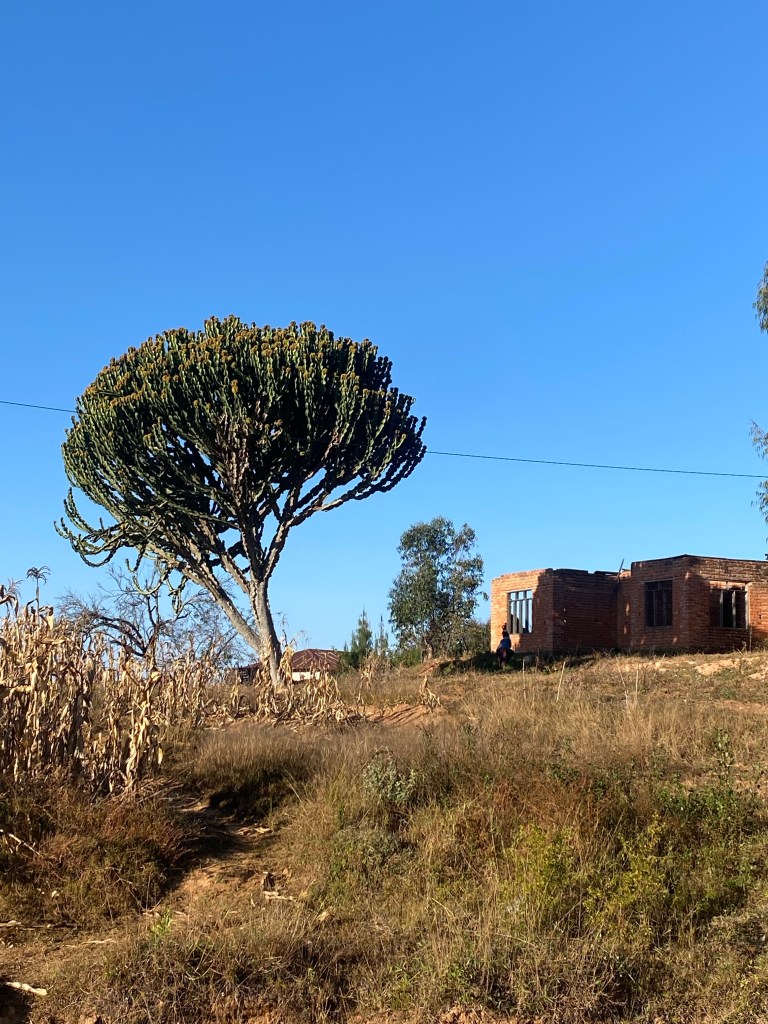
The road continues to be superb and we can’t understand why. We start seeing now and then some asian-looking people on the road, particularly close to material deposits. We look at each other and it’s difficult to say who is more confused to see the other there. We would learn later that the road we were on was built by Chinese companies and that these people are doing some inspections for potential maintenances.
These encounters make us think that this flamboyant empty road is used for some mining purpose or similar, but all we can be is wood exploitations so far. Mystery unsolved
We make it to a road junction, with one road making it to Mbeya, a major city nearby Malawi and Zambia. We take this one assuming it’s going to be in better conditions. Mistake, my friend. After 5 km, the road stops being asphalted and it’s a salad of rocks, dirt and sand. When truck overtake us, we are breathing a bucket of sand mixed with black smoke. Yummy! Locals insist us on taking the other road, who seems to be in better conditions, but this is a big de-tour from our intensions. On top of that, a bit of off-road could be quite enjoyable. But not with these slopes. We would find out later that the alternative road was also a rough road so no hard feelings
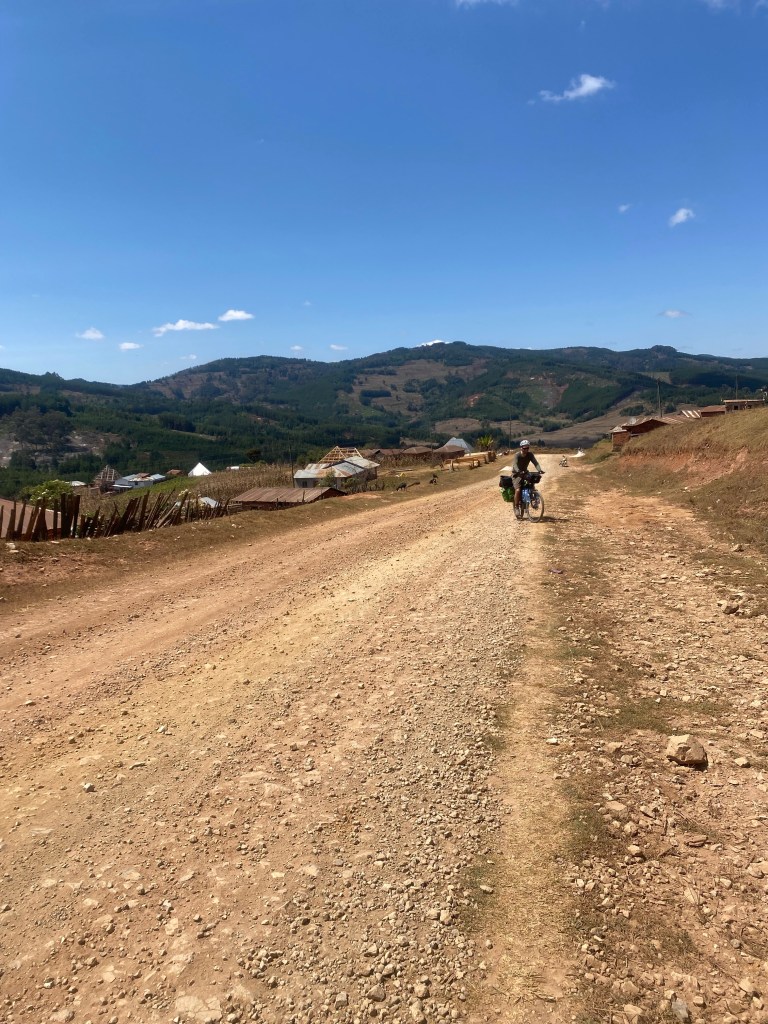
We keep combining cycling and pushing, constantly going from the left side to the right side of the road looking for the optimal path with the least large rocks and not too much sand. From time to time we get excited seeing about 20 m of concrete road. Unfortunately this meant that the road was too steep for cars to go up without it. which often resulted in an attend to ride the bicycle, and finished with us pushing it. Later on we realize that we are off-track the road that Google Maps shows us. We soon realize that actually the Google road doesn’t exist at all, and we start thinking if that changes the forecast of elevation for the day after. We check as soon as we get network, and…. indeed! We only have 900m+ the day after, instead of the forecasted 1’300m+. We explode of joy, and get an extra motivation to end the day. While cycle-touring, one literally survives based on these dopamine shots.
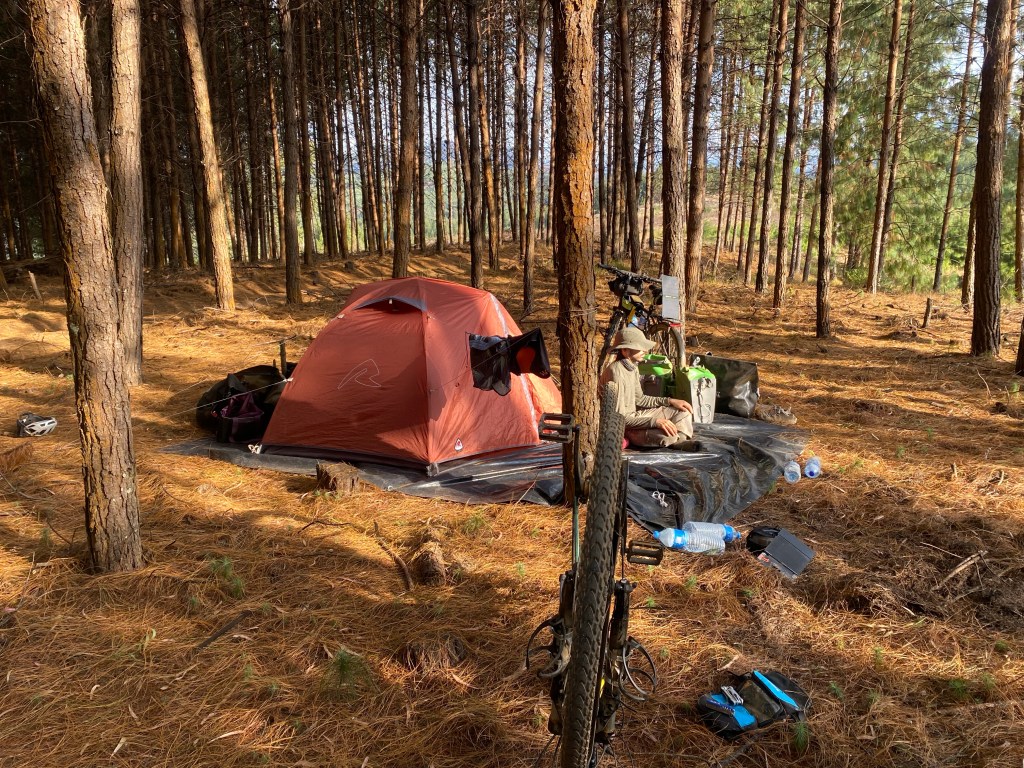
We find a wonderful, flat camping spot in one of the mentioned pine forests, and cook 500g of pasta with tomate soup that should serve both as lunch and dinner. We enjoy a relaxed afternoon, although Gasp concludes that the converter has gone defect. Thus, his dependency on his solar pannel just increased. Dusk is at 18:30, so we get ready for another set of 12 hours in the tent.
05/08 Kitulo NP: 39km, 950m+
The day starts in a bumpy, rough road and is going to be like that for the whole days. In some sections, it’s well set and compressed, in other is just a salad of rocks, and one shakes like if one was inside a laundry machine.

We make it to a major village that is undergoing some road maintenance. The workers of the road speak some English, as they are not from the region, and help us order breakfast. Local people struggle with Swahili already, so imagine with English. They are from a tribe called Kinga and have their own language.
Gaspard continues boycotting egg omelettes and has to content himself with some kind of sweet bread called “mandasia” that, unlike last time, it’s not tasting so well.
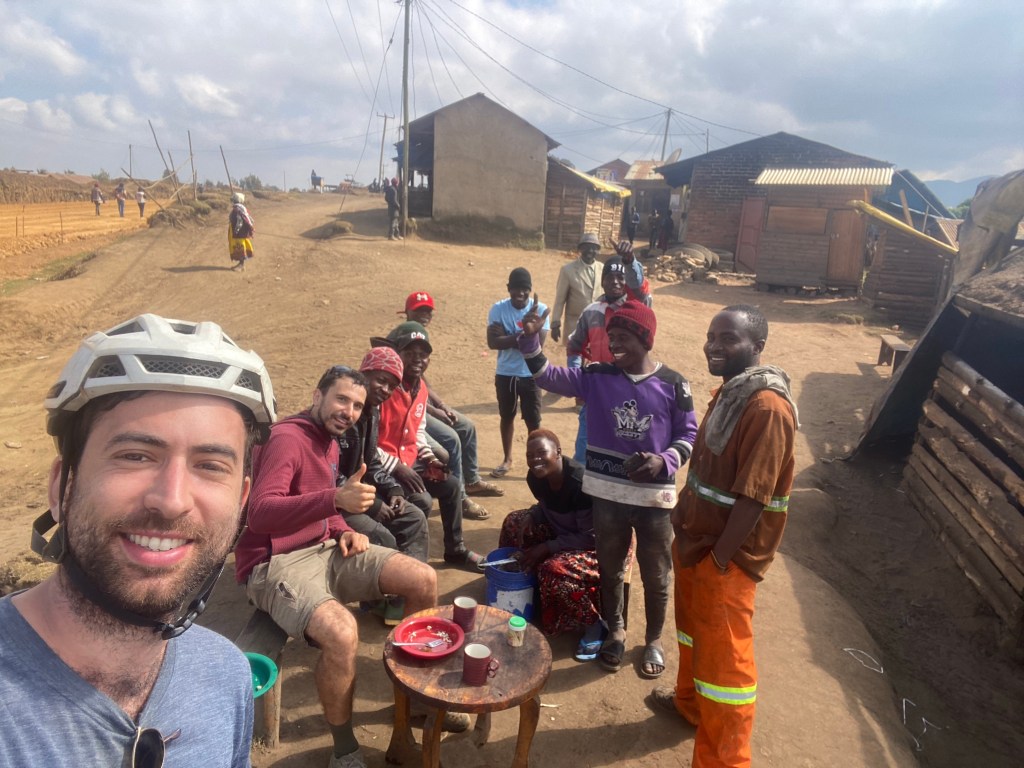
A friendly guy called Michael stops us for a chat. He ends up teaching us some local greeting words that will make people we encounter extra surprised.

After this village, and before entering the actual National Park, the road is in extreme poor condition and we advance like turtles. Vast pastures full of Milka-looking cows surround us, and we have to doubt if we are in Tanzania or in Scotland.
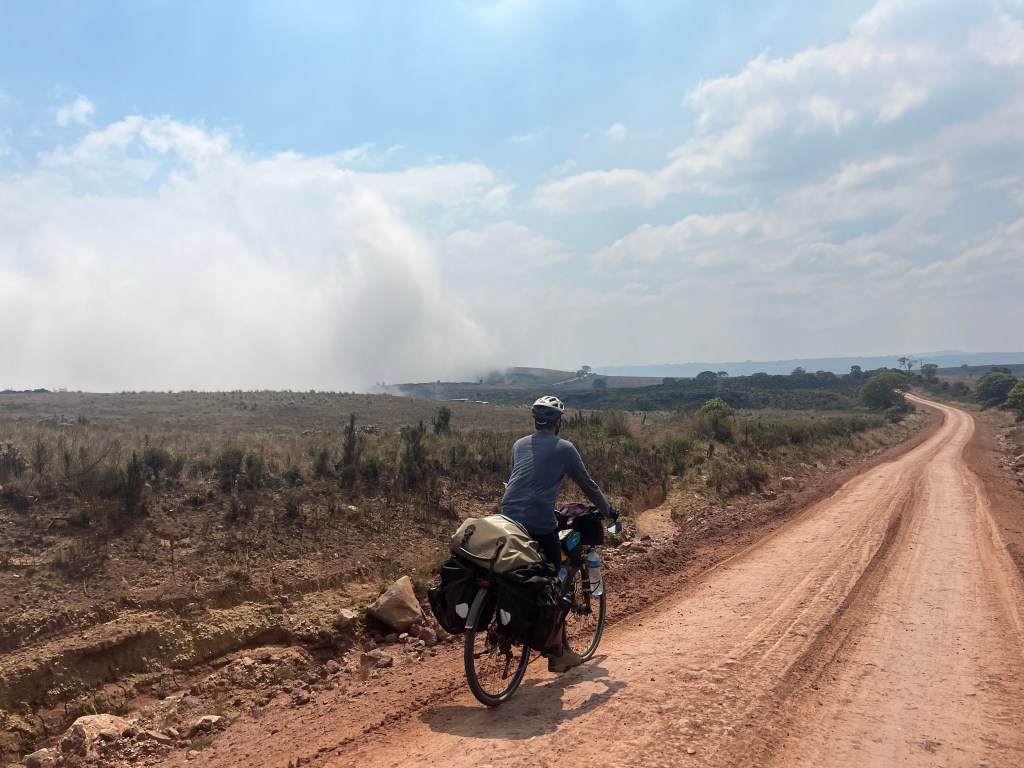
We enter the National Park and we observe the vast plateau with naked grassy hills following the shapes of the clouds. It’s simple yet beautiful. Unfortunately, due to the season, we will not see what makes Kitulo famous: the blossoming of the flowers, which earns the place the name of the “Garden of God”.
In any case, we make it to the first wild camping spot recommended by the app “I-Overlander”. If you dont’ know it and you are into this kind of adventures, be it with car or motorbike, you better note it. It provides peer information by like-minded travellers about campsites, hotels, road conditions in most remote places of the world. Worth a check.
The place is selected at the edge of the plateau, where a drammatic geographic descent up to Lake Malawi takes place. It is suppossed to look at a bamboo forest, as the vegetation changes drammaticallly with the geographic change. However, we can only see a sea of clouds. The spot is still flat and cozy, protected from the road.

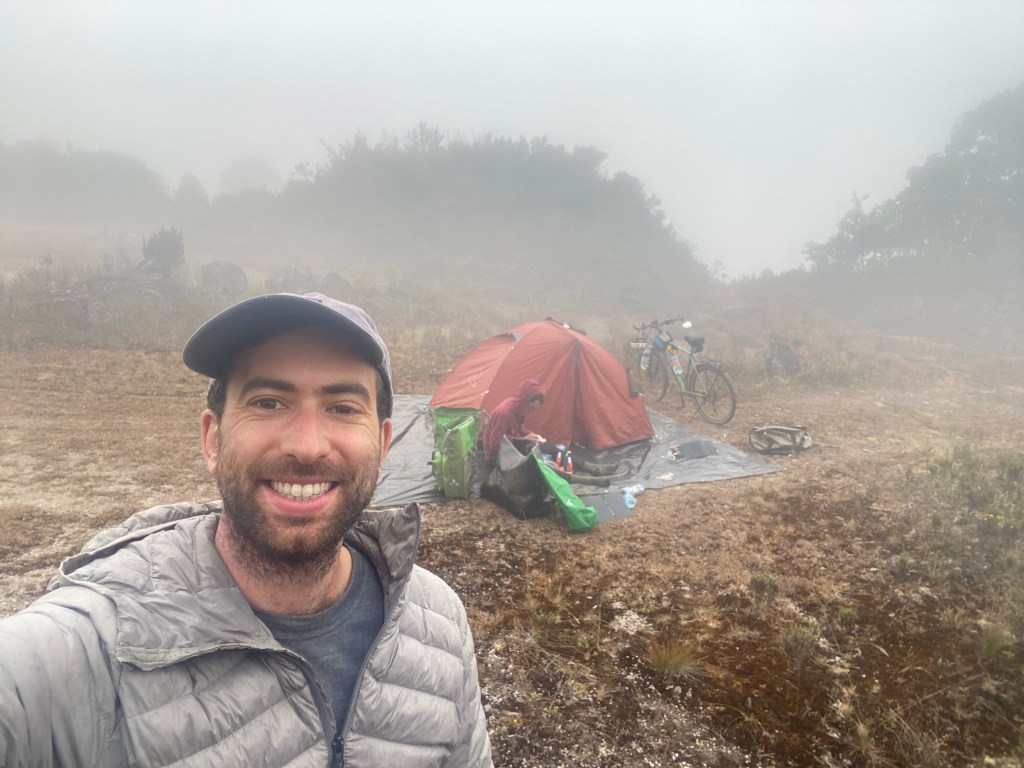
For the sake of completeness, we check the 2nd “Ioverlander” spot, which is much less flat and, as mentioned in the app, there are poo rests of what could be a leopard. These 2 facts are enough for us to return to the initial one and enjoy a double portion of noodles, as we didn’t have lunch. By 6 PM, we are ready for bed and to start the descent out of Kitulo.
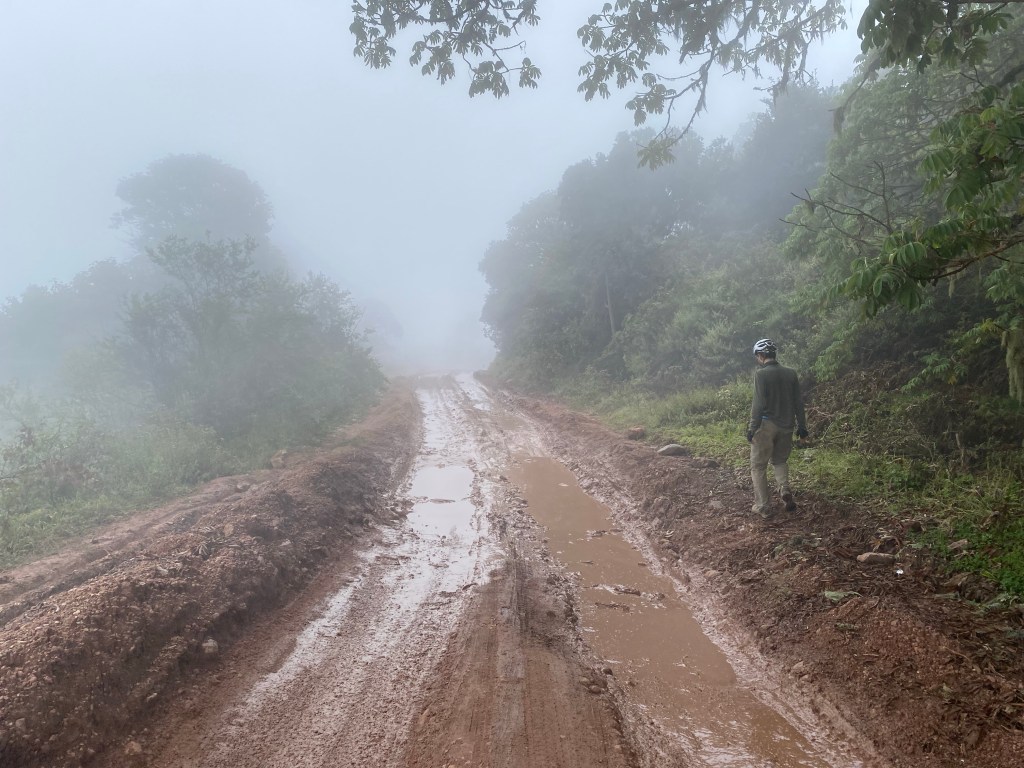
06/08 Kitulo NP – Tukuyu: 77km, 780m+
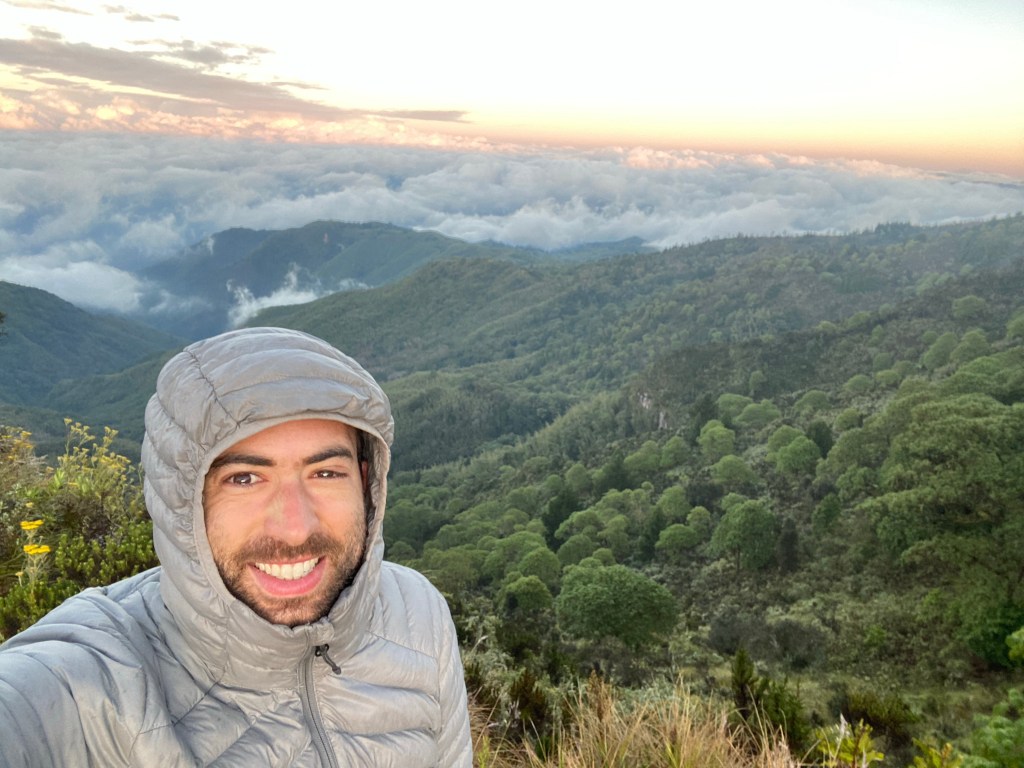
We wake up under a blue sky that invites to re-check the view point. This time we can see more, although low-clouds cover Lake Malawi. It is damn cold (almost freezelevel at night) and it has rained, so the tent and part of the insidde are wet. A strong wind unfolds while we are packing and makes the process quite miserable, including a break to put our pale hands inside our pants to warm them (infallible technique).
We get going and the first sun rays and uphill pushes make us regain the sensitivity in the fingers. The amount of downhill sections start finally to outnumber the uphill ones, and that makes us happy, although the shaking because of the rough road only increases due to the speed.
Apart from some snickers and fruits, we didn’t have breakfast, so we are quite hungry when we make it to the first “big” town on the other side of Kitulo, Isyonje.

A place advertises “Wali” (Swahili for “rice”) and after 5 minutes we are already enjoying the classic rice with bean, spinach and sauce that keeps us going. Some locals start chatting with us and tell us the challenges they face in the work life. The high unemployment forces them to stay creative and seek opportunities to become intermediary in logistics or even “Chinese Jackpot” machine-lots, as it’s the case of Abbass. He believes they are made to fool users, so he doesn’’t play but he manages the local gambling pub. It sounds contradictory but it would be so unfair to demand the guy to introduce a degree of ethics in his source of income.
Anyways, we get going and, when we rejoin the National Road and see asphalt again, we almost cry. A 1100m elevation descent waits for us, transporting us at speeds up to 60 km / hour. The Timber exploitations are very soon substituted by Banana and Tee plantations. To our joy, the traffic is irrelevant compared to the one we faced at the beginning of the trip, so we just enjoy while remaining highly focused, as missing a hole in the road could have fatal consequences.
We arrive at Tukuyu, one of the last Tanzanian towns before the border with Malawi. We find a hotel for 6 euro the room, but to our disgust, we only find out that there is no water after paying. The pump is broken and we desperately ask the manager via Google Translate to warm a bucket of water for us, as we couldn’t feel any dirtier.
After 1 hour of endless waiting, our dream comes true and, no matter how hard it is for you to believe, we almost reach extacy by cleaning ourselves in a stinky bathroom with a bucket. One needs to get dirty to enjoy being clean again.

Another guest arrives to the hotel and we soon engage in a conversation, as he speaks perfect English. He and his brother have arrived from the coast to buy a truck for their cashew transportation business. We ask Hassan to join us for dinner, and it couldn’t be any better. Apart from laughing all the time (Hassan obviously thinks we are crazy for our endeavour), we learn a lot from him and Tanzania. His story is impressive: he was part of a Youth Program that brought him to 1st learn video-making and then to teach it to other students in places like South Africa or Nigeria. He has now started a new business as part of a cashew cooperative. He will be focusing on the transportation part. We can only wish you the best, Hassan!
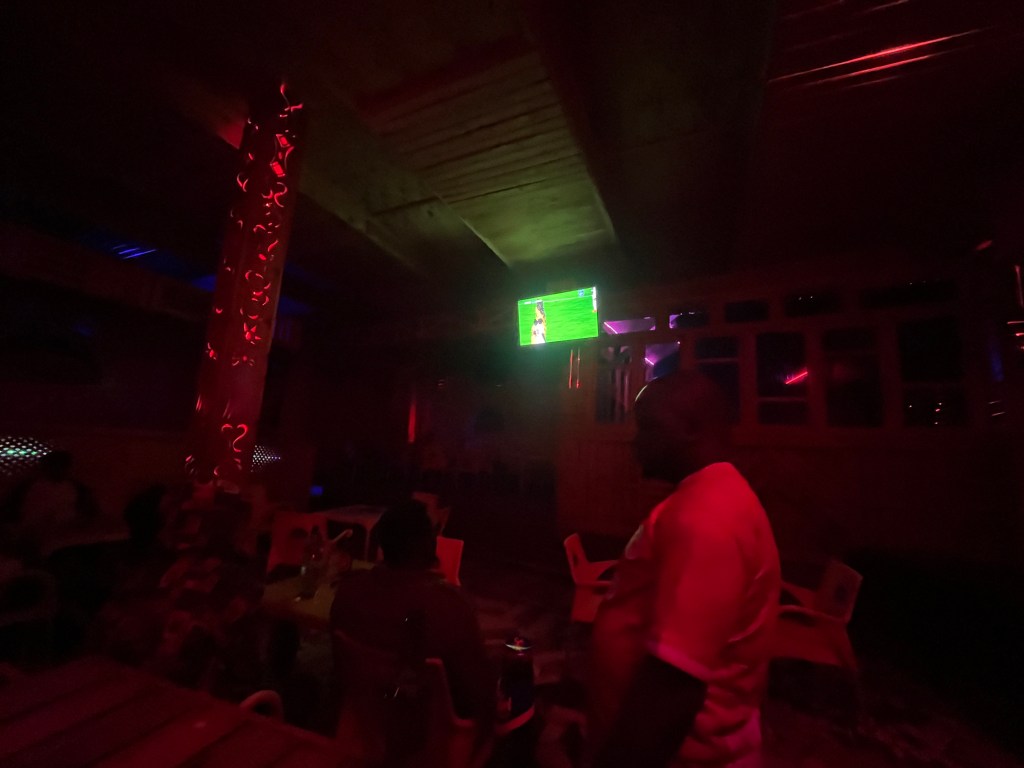
After dinner, we go for a beer to a local pub to watch a football match. Tanzanians are quite into football, particular into Simba Soccer Club, based in Dar and apparently ranking high in the African Champions League.
07/08 Tukuyu – Karonga: 104km, 350m+
A crazy storm wakes us up at 6:30 AM. It doesn’t stop pouring for 30 minutes. If only had it caught us the day before in Kitulo, we would need a full day to dry everything. We got lucky, definitely lucky.
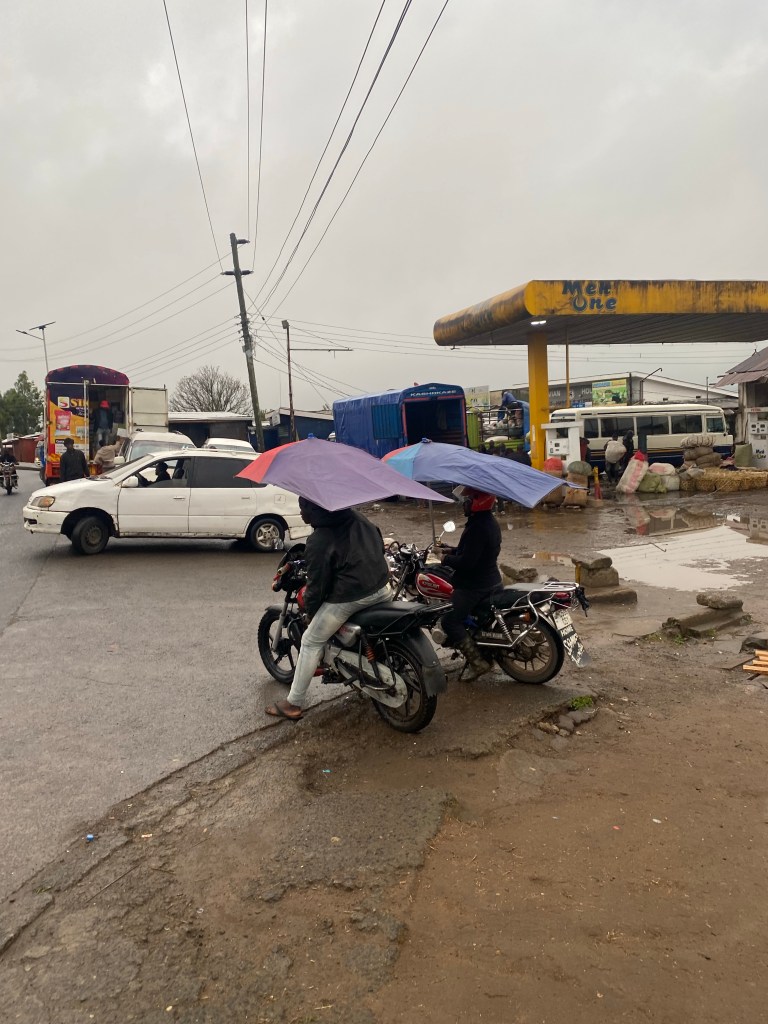
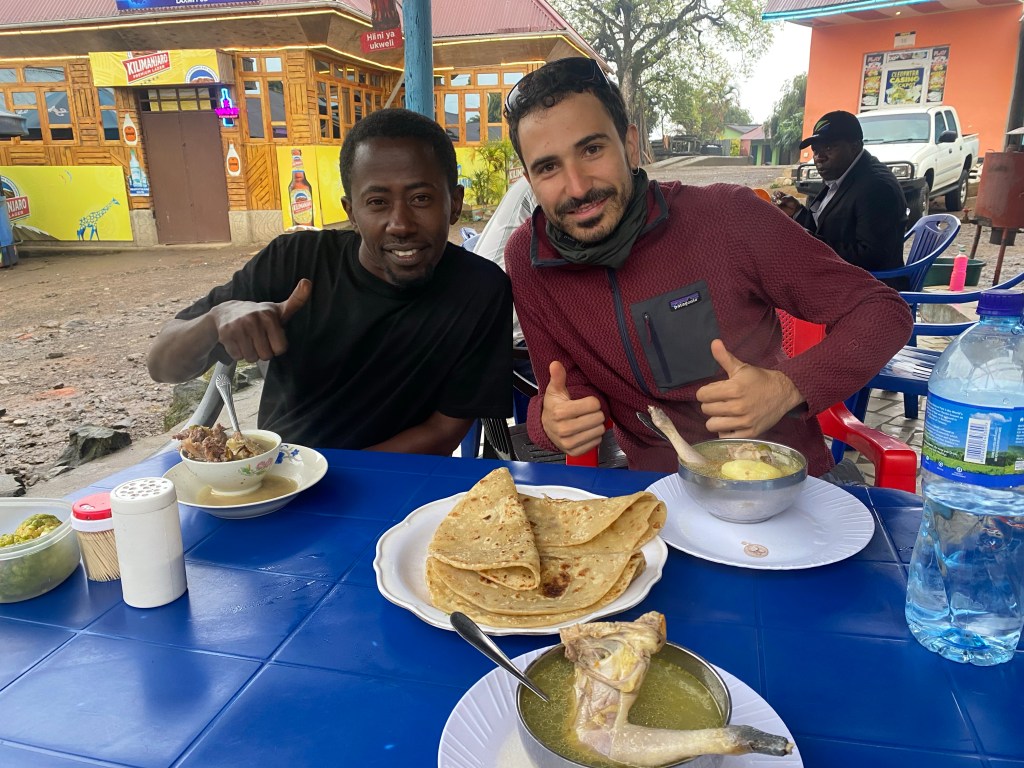
Hassan insisted on waking up early together with us to help us find a breakfast place. So we end up having pancakes and chicken soup (correct, you read right) at the only place available at 7:30. We let the last drops of rain end while Javi repairs his kickstand for the 2nd time, as it’s bending quite often. It may seem unimportant but if your bike falls while standing (be it on a tree or on the kickstand), you could easily damage the discs or the derrailleur and thus ruin your trip, so it’s important to make sure it’s standing properly!
From Tukuyu to the border in Kasumulu is mostly a descent. The population density decreases progressively, up to the point in which we are descending through a crest, with two wide valleys, full of trees and hills, on the sides. It’s a genuinely breathtaking landscape that doesn’t seem to belong to any National Park and doesn’t show in the guidebooks. Hidden gem?

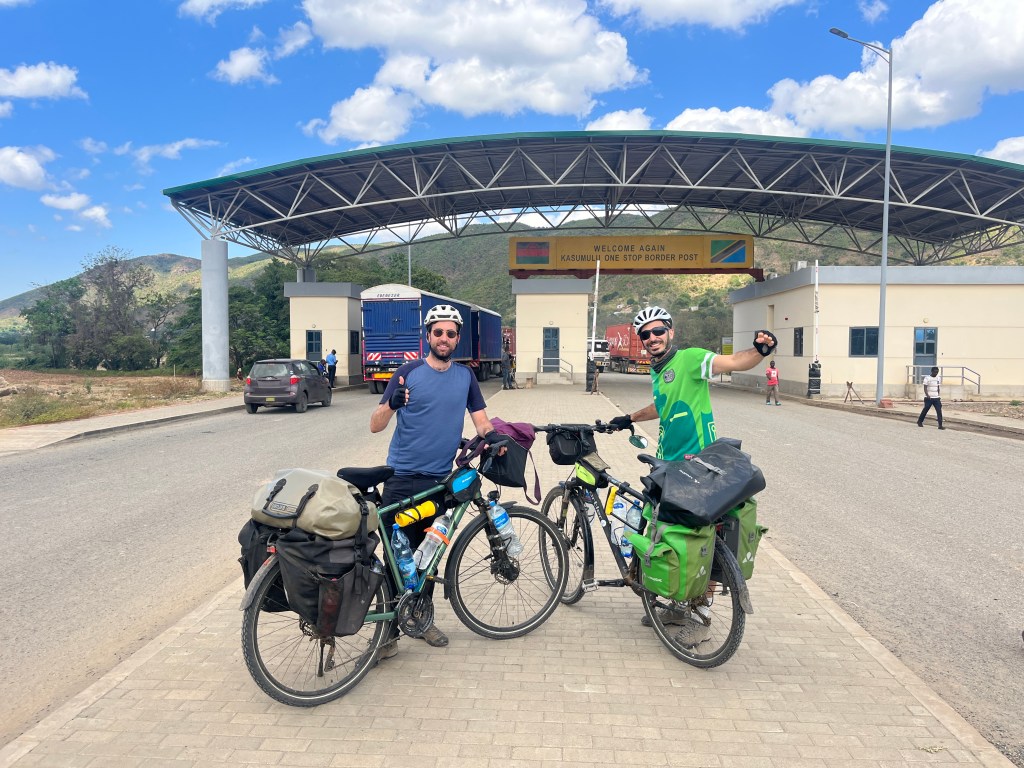
The descend ends calmly in Kasumulu, the border post, where we are forced to select one among the many money changers that ask us for business. We get what we think is a good deal and get new sim cards for Malawi. Getting the exit stamp proves quite easy.
It’s time to say bye to our first country in this trip. The friends we made on the way keep texting us and asking us how are we doing. Tanzania is really full of good people. But our journey continues, and we are just standing impactiently in front of the Arrival row of the Malawi Inmigration bureau in Songwe, waiting for what is next.
Distance since last post: 398 km // Total driven distance: 728 km
Elevation since last post: 5100m+ // Total cumulated elevation: 7800m+
Day since last post: 8 // Total days on the road: 14
 Cycling Pirates