
Song while writing: Dub Libitum – No money no fame
16/08 – Mzuzu – Nkhata Bay. 48 km, 400m+
As expected in an Italian camp, the day starts with espressos and capuccinos. We know we have mostly a descent ahead, so we start relaxed, exchanging words now and then with our friendly Italian hosts. They are continuing their road trip with their visitors and won’t be around when we come back. We are smart enough to leave everything we don’t need, as Nkhata Bay is a detour we are taking to have a final glimpse of lake Malawi. It will force us to cycle back to Mzuzu to continue our journey. A 1200m+ elevation journey back. Our motivation to come back for the delicious pasta should be proof of how delicious it is.
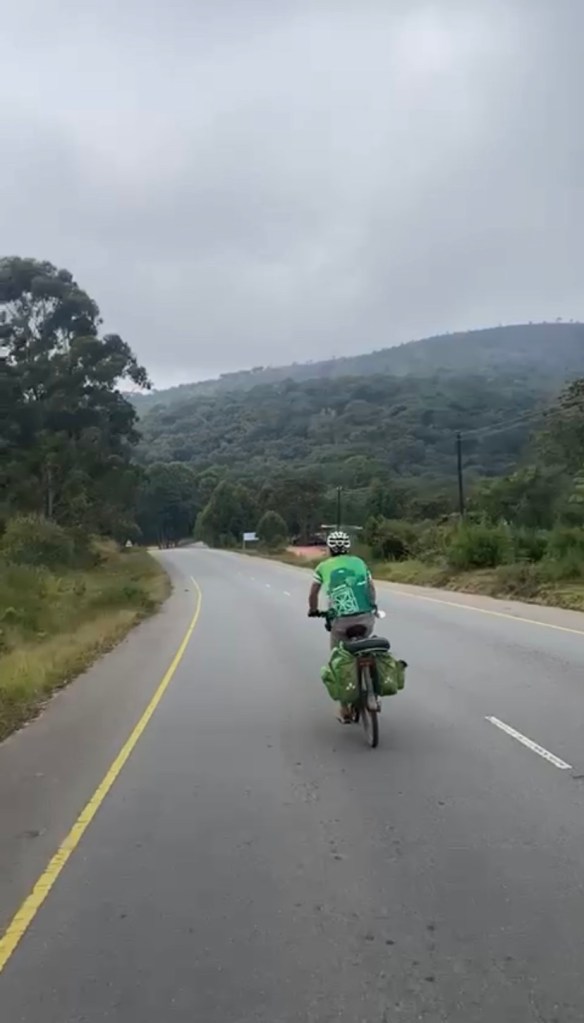
We leave Mzuzu and the fabulous Macondo Camp and head towards the east road. This time, we don’t exactly enjoy the descent, as we know we will have to climb it up at our return. But we reach up to 65 km/h, which gives us the feeling of flying. The road is just superb, as it even has reflecting units on the shoulders. The mountains are surrounded by clouds, which makes us wonder if the weather by the lake will be nice. At this pace, it doesn’t take us long to hit Nkhata.
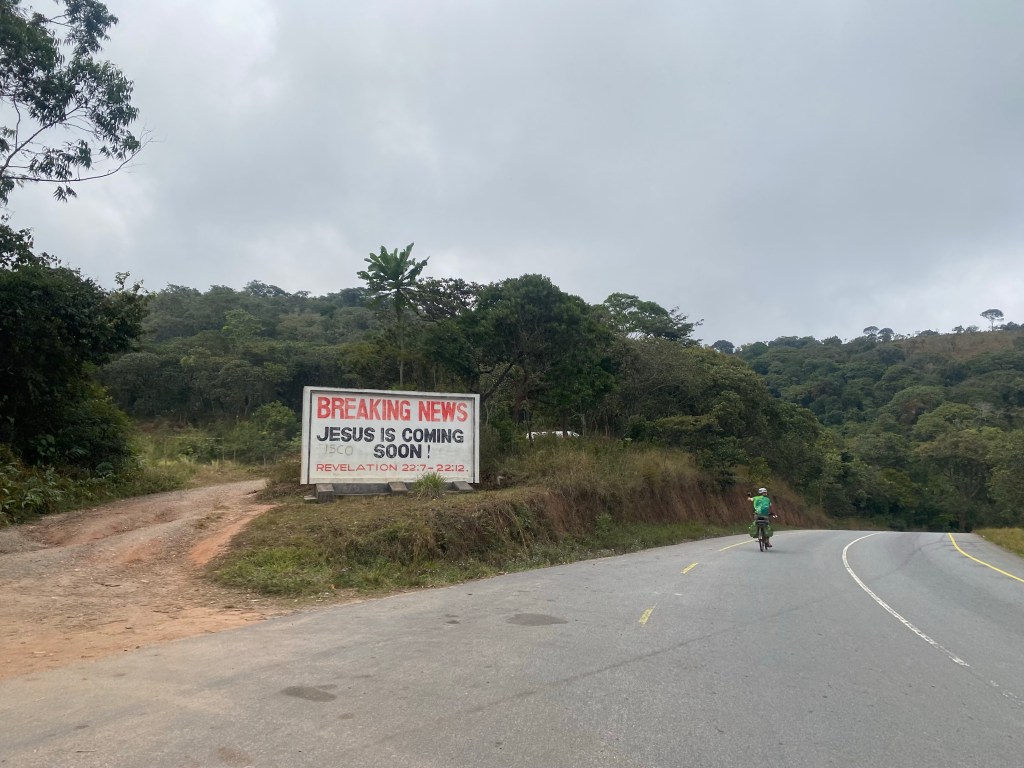
Nkhata is a cozy fishing town known for being a backpacker spot. As we climb to the hostel we have found, (everyone stays either at Butterfly or at Mayora, we decided for the 1st because it was cheaper), two surprises await for us. First, the area is pretty full of Rastas, who have their improvised shops around the street, in which they sell their handicrafts.
The second, a friendly couple stops us saying: “Hey, you are also travelling with the bike!” Michael and Joanna are from the UK and the US respectively, and have crossed the Americas from North to South, US to Patagonia. When they were done after 12 months, they didn’t feel fully accomplished yet and took a plane to Cape Town to now cross Africa. What a journey! We exchange numbers to share a beer later.
Butterfly Eco lodge lies on the top of a hill. It is run by some British women that have also different social projects in the area. from the hill, it descends beautifully towards the lake, where the bar lies.

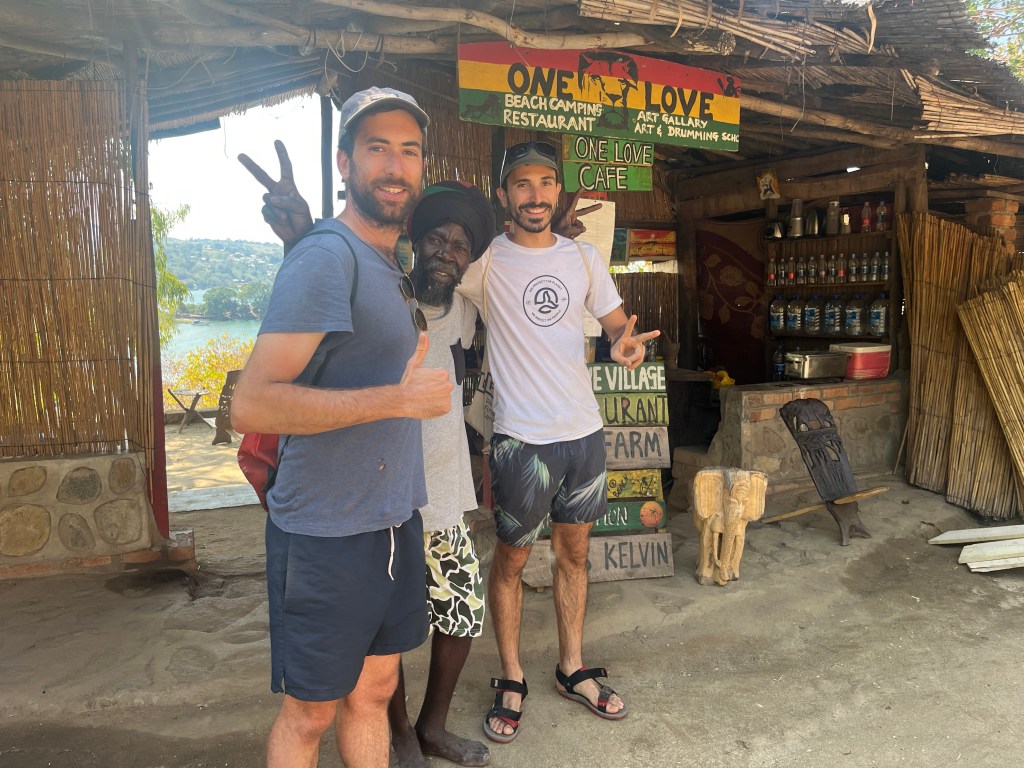
For lunch, we stroll a bit around town, where we find the best chicken we have eaten so far in the trip. We then pay a visit to Rasta Kelvin, as recommended by Luca from Macondo, to enjoy a beer. The view is amazing unfortunately he is also drying his underwear in front of the view.

We are impressed by the big amount of marijuana around, and it doesn’t take long to find out that Malawi is home to one of the most precious marijuana breeds in the world: Malawi gold.
We rent some snorkeling goggles and swim in the refreshing waters that lie literally touching the hostel. There is no beach at all. The lake is full of endemic colorful fishes. Following them proves an entertaining game. The bar is relatively calm, and we open a tab and start putting beers on it.

Our new cycling friends come by and we spend the night eating, drinking, and exchanging bikepacking stories. We exchange useful tips, as they are going towards the north, where we come from, and we are going towards Botswana. The sky is packed with stars, but they tell us that this is peanuts compared to the skies of Namibia, our final destination. That excites us. We pay a visit to Rasta Kelvin‘s bar for the last beer of the day. The beer takes ages to arrive, as Kelvin is out of stock and has ordered it. It will be here any minute ‚ he says. It ends up taking 1 hour. By the time the beers arrive we are almost sleeping on the table and thinking about bailing. Too late Rasta Kelvin is very fast at opening the beers. Our friends tell us: „TIA“. „What does that mean?“. „Oh, you don‘t know? This is Africa“. What a great day.
17/08 – Rest Day in Nkhata Bay
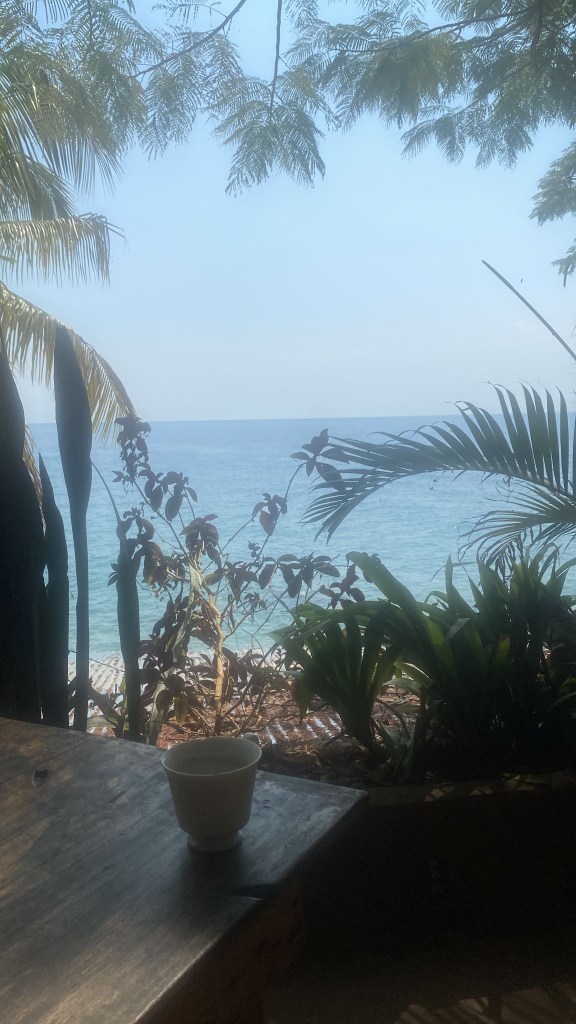
We start the day with a French pressed coffee by the lake and making our to do list of errands. We thought we wouldn’t have proper coffee for a long time… luckily we were wrong. We spend the rest day preparing our next steps in Zambia. We start to consider Zimbabwe as a joker destination in case we have buffer days. But in any case, we decide it‘s time to move towards Zambia and prepare a journey to reach South Luangwa NP, a place highly recommended by multiple tourers. Michael and Joanna skipped that part in bus, but we are not travelling for multiple years and prefer to stick to the bikes.
A walk around the town center discovers us a low-paced population, that seem to leave carelessly from the handful of backpackers to arrive to Nkhata.
Everytime we descend to the town, the rastas try to persuade us to buy their handcrafts and their medicines – including mushrooms-. It is nearly impossible to walk to the center without being politely forced to enter 3 shops. They always greet us by saying „Shalom, Shalom!“, thinking we are Israelis. We find it very funny. Apparently, Nkhata is a popular destination among Israelis in their almost „traditional“ backpacking after their military service. But we don‘t meet any of them. Covid has strongly impacted the economy of Nkhata Bay (mostly relying on tourism). Many people we talk to seem desperate as their sales plumbetted during Covid.
We go back for lunch to the place where we had the best chicken of our trip. Lunch was so good so we decide to take our chance with the chocolate banana pancakes. Again it takes over 1h to prepare the unique pancake. They probably had to buy the eggs and make the dough: TIA !
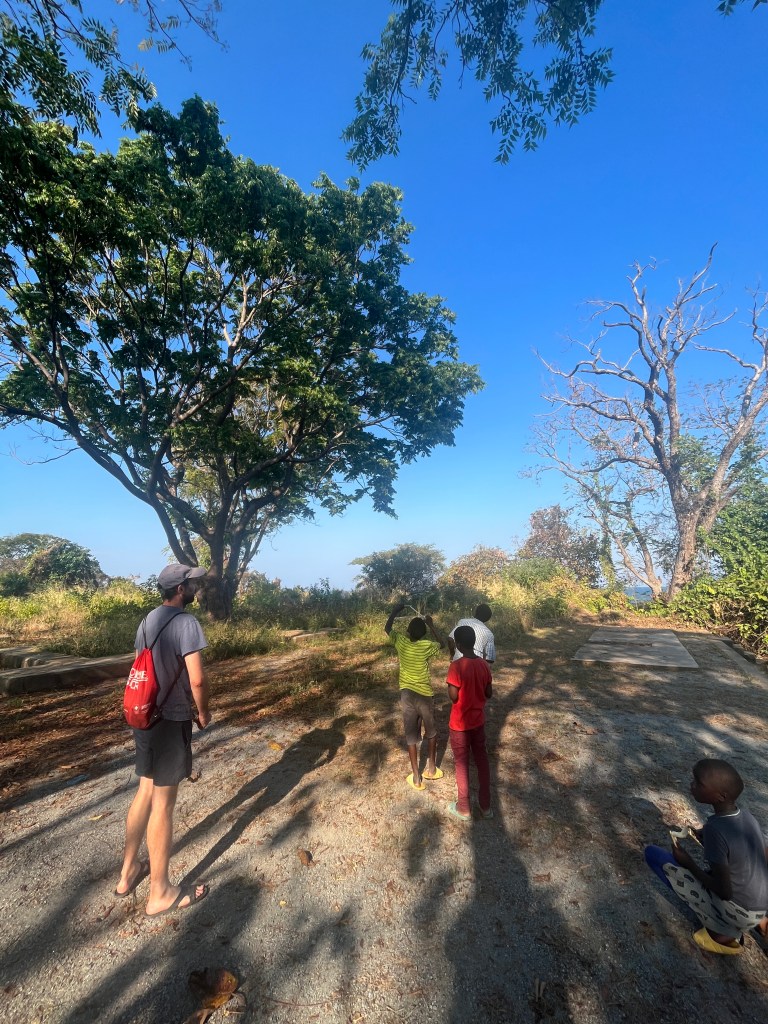
We walk around the peninsula in Nkhata Bay where we get an unbeatable view on Butterfly hotel -as well as the new hotel in construction nearby. We see many kids that have build hand made slingshots (catapult) to try to kill birds in the nearby trees.

Iin the evening, we meet another cycling group, this time from Austria. Isi and Simon are travelling for 2 years and a half, and Isi‘s sister and her boyfriend Manuel are visiting them for some weeks, to make sure they are alive, we guess. They are very relaxed and we enjoy some gin tonic together, again exchanging experiences and tips. The tell us about their time pitching the tent and waking up next to elephants in Botswana. We have a lot of fun, we really enjoy these encounters.
all these groups are going at a slower pace than us, they are staying multiple nights in Nkhata. We don‘t have that luxury, as in the bikepacking world, a 3 month trip is not that long.
18/08 – Back from Nkhata Bay to Mzuzu. 48 km, 1200m+
We collect our clean laundry for 2 euro each and get ready to sweat the 1‘200 m up that await for us back to Mzuzu. The big amount of beers and the beach feeling make us a bit sleepy and start a bit late, something we will regret as we will swallow all the heat of the midday. As we are leaving Mzuzu we are meeting “our friend the English man” from Karonga. He will become the head of a school in Mzuzu and was part of a promotional event. Malawi feels like a small world.
The fantastic road allow us to go to a very consistent pace. We decide not to have breaks and instead have some of these fried bread to give us some energy, what makes us be fast, yet get pretty tired.
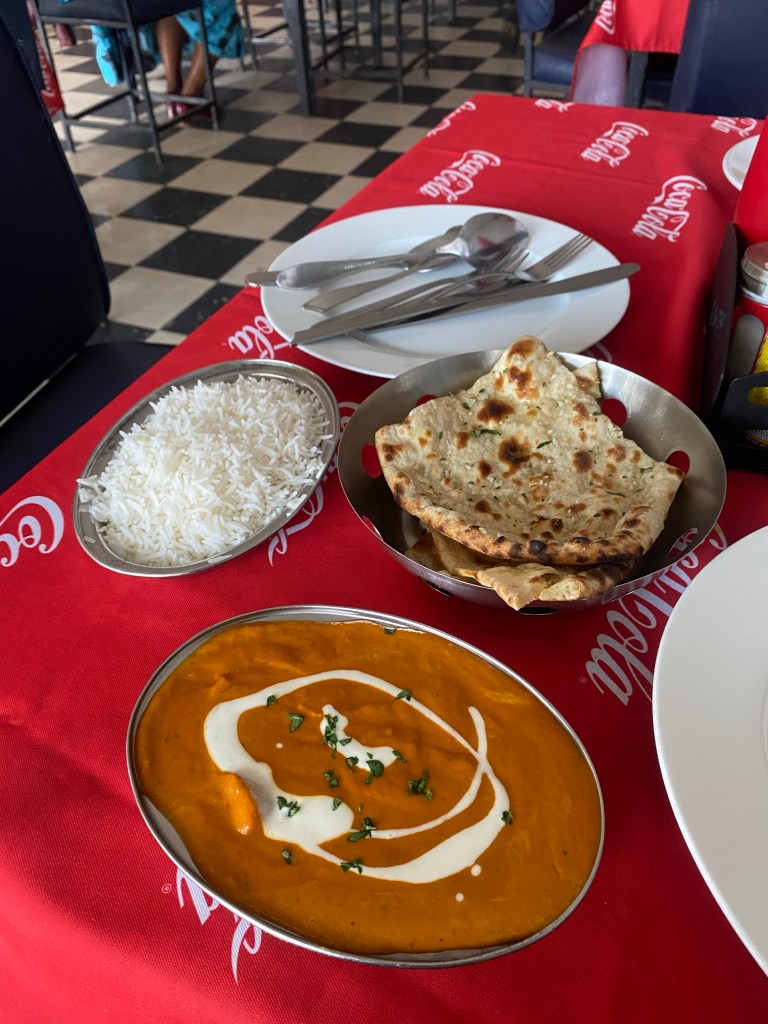
We arrive to Macondo Camp in Mzuzu for lunch, and we decide to check an Indian restaurant (A1) that our British friends from Vwaza recommended us. Leaving the delicious pasta for the evening. „It‘s very cheap“ ‚ they said. It ends up being as expensive as Macondo, but pretty good. We pay another 20 Euro for both, which is just unaffordable for the average Malawian earning 2€ a day.
Our contact from Luca has failed to find binocular to us, so we check some chinese shops in which we find some for kids for 2.5 Euro. However, they do augment around 50%, so we think of giving them a try. While paying, a very joyful middle-aged man comes to us with the classic „Where are you from?“ conversation. This time, however, our new friend Matthews, who is mesmerized by our cycling endeavor, invites us for dinner to his place later in the evening. That makes us very happy, we have been long time awaiting for a first proper local invite.
We exchange numbers and Matthews picks us up later in the day from Macondo to go to his place. His car is far from luxurious, but it‘s very clean and tidy, which already somehow tells us that he is upper middle class. Indeed, he is the Mzuzu branch manager of Ecobank, a bank active in multiple African countries. He arrived only 8 months ago for this assignment, so he leaves in a spacious rental house with his wife and his 8 year old daughter. Again, another coincidence, his daughter studies in the school of the British of Vwaza.
We spend a good hour talking about Malawi and our jobs. He studied business and administration in the US. He is up to date in pretty much all topics, and can give us his view in the energy, economic and political situations. Malawi‘s lack of resources and struggle to produce enough agricultural output is generating a devaluation of the Kwacha, and an additional impoverishment of the already needed population. Many farmers were producing tobacco but the decreased demand is pushing prices down making it impossible to live from it. With less exports, they also struggle to acquire foreign FX. His bank is trying to give access to credits for large projects to stimulate the economy, but the government takes a big part of their financial capability. Matthews has some personal projects to upgrade schools in rural areas.
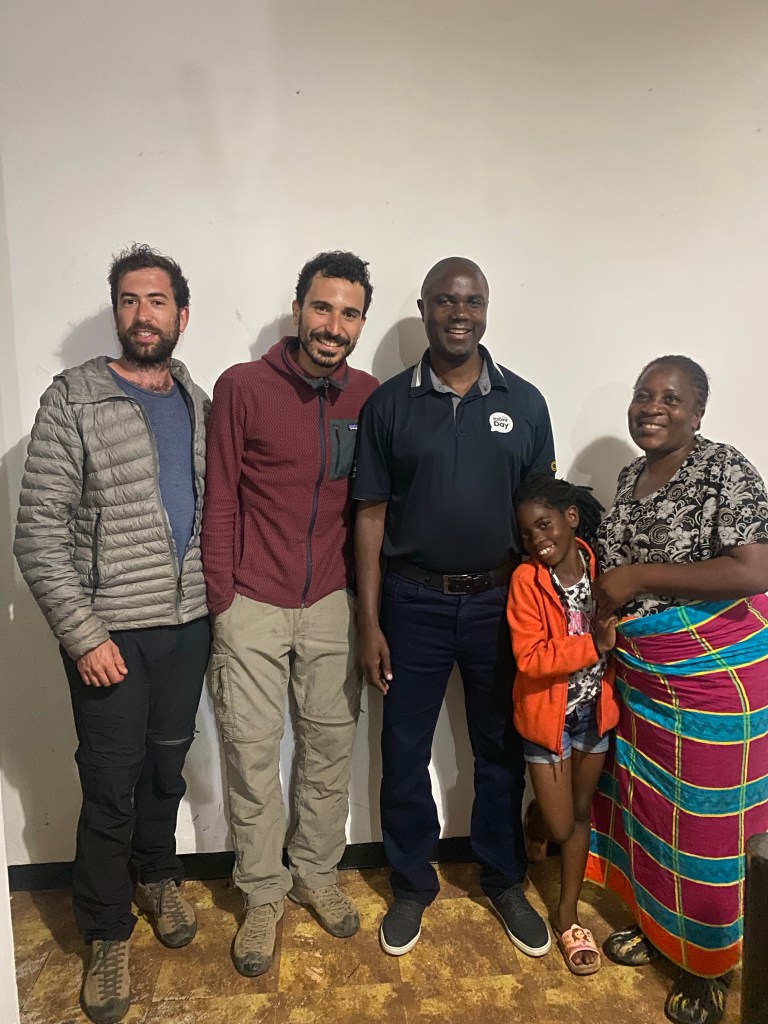
His wife prepares a local dinner for us, excusing herself that she didn‘t have enough time to prepare something more special. After the dinner, we are dead tired so Matthews happily brings us back to the camp, closing up an authentic, very interesting evening.
19/08 – Mzuzu to Raiply. 83 km, 1500m+
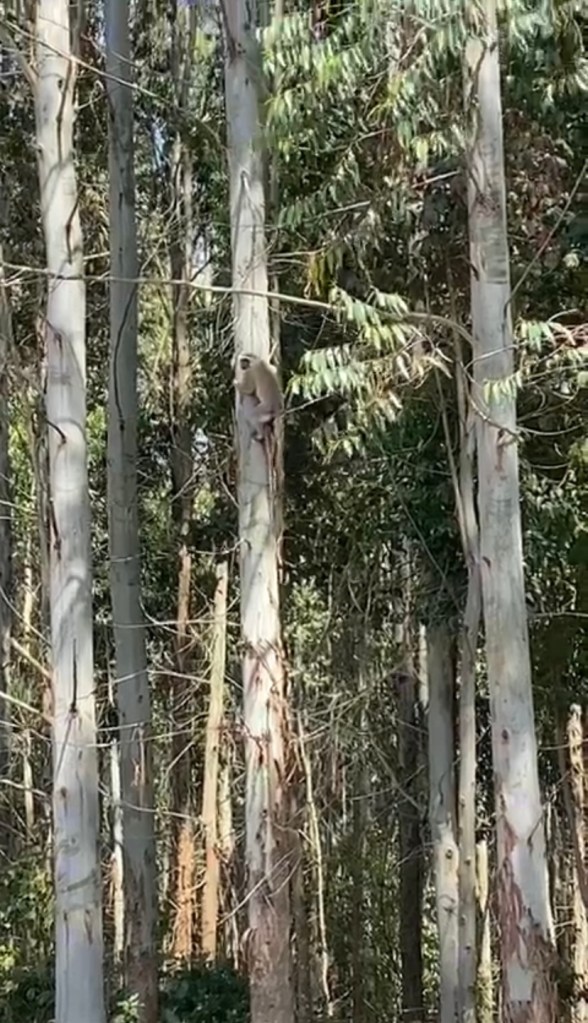
We take the last Italian espresso for a loong while at Macondo, and get going. We leave away the disturbing big amount of coffin and tombstone shops that lie in the outskirts of Mzuzu, and take the road to the capital, Lilongwe. The road is again pretty acceptable, and has a very fair level of traffic with monkeys climbing the trees along the road.
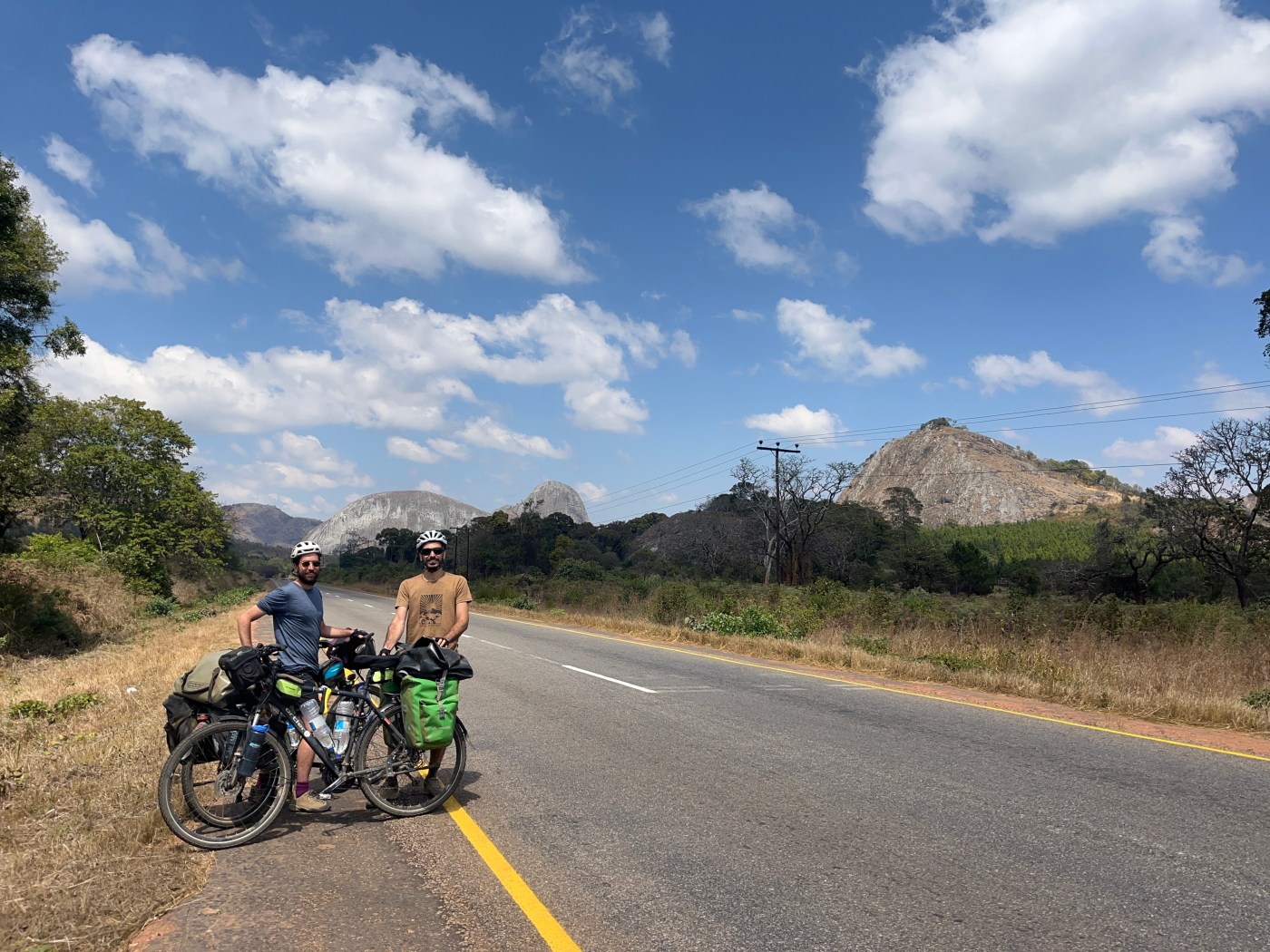
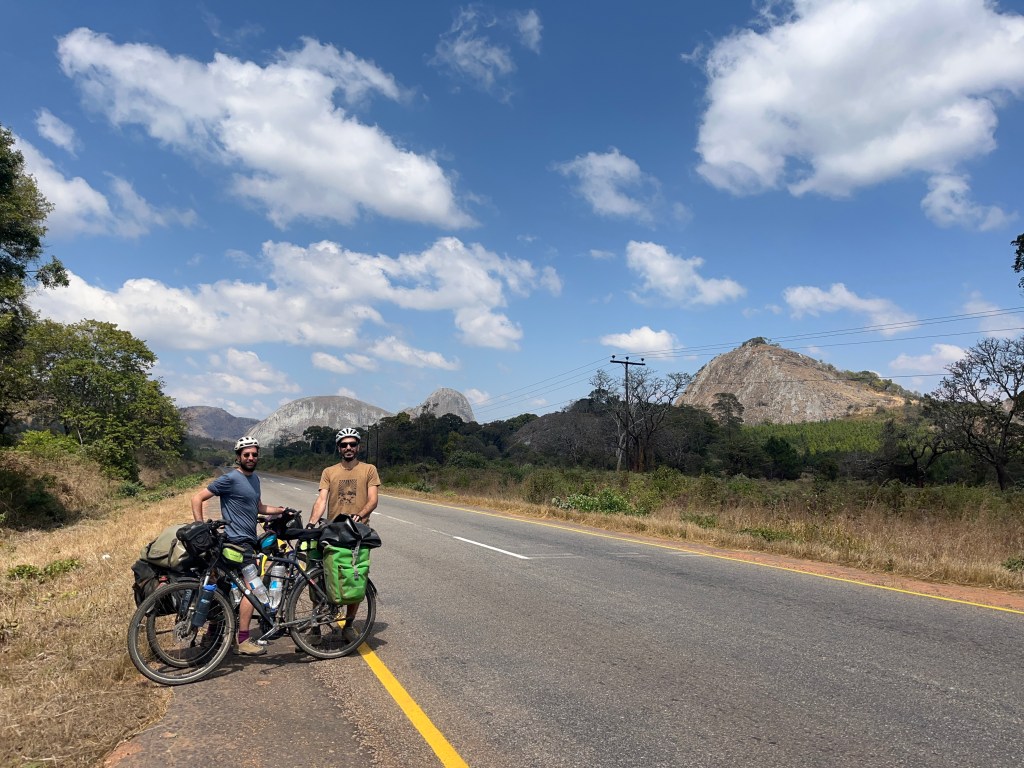
The day starts hilly and, to our surprise, we barely cross any village. The landscape is full of huge boulders that take prominence among the flat savannah. Many of them ressemble physical shapes. In fact, one is called the Elephant rock. We fuel our legs with Oreo cookies, carrots and salty peanuts that we found in Mzuzu.

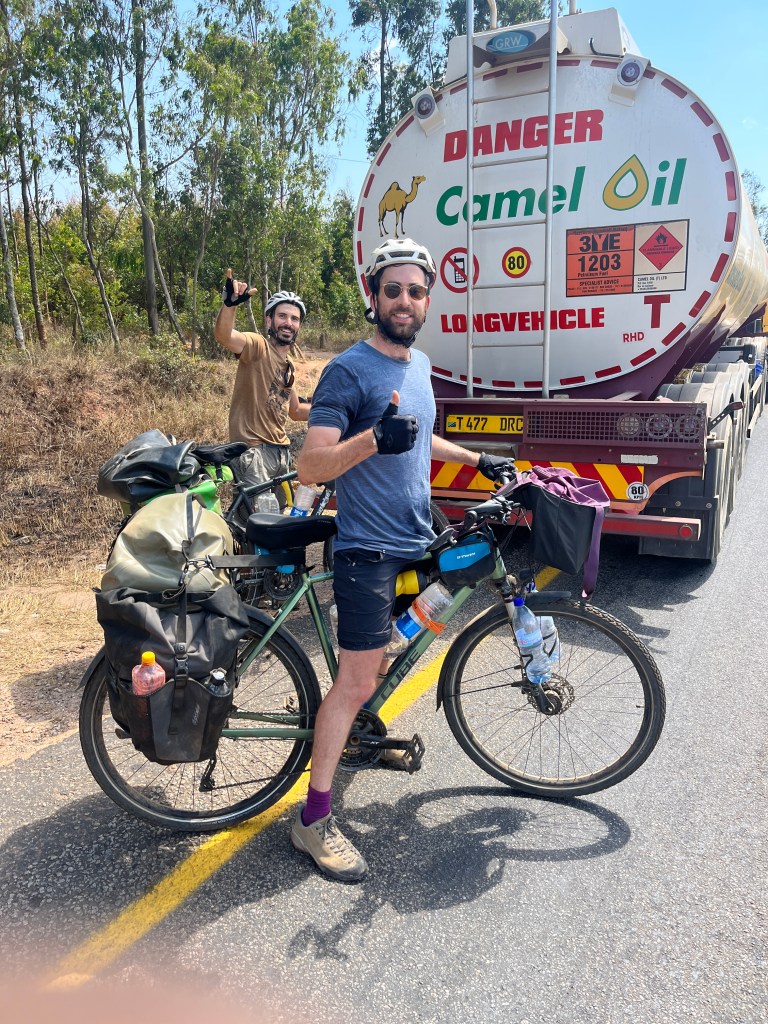
We get stopped by a truck driver bringing kerosene from Tanzania to Zambia. He tells us about his story. He studied computer science in Tanzania (which is very expensive) and unfortunately could not find a job which led him to become a truck driver to pay the bills. So unfair.

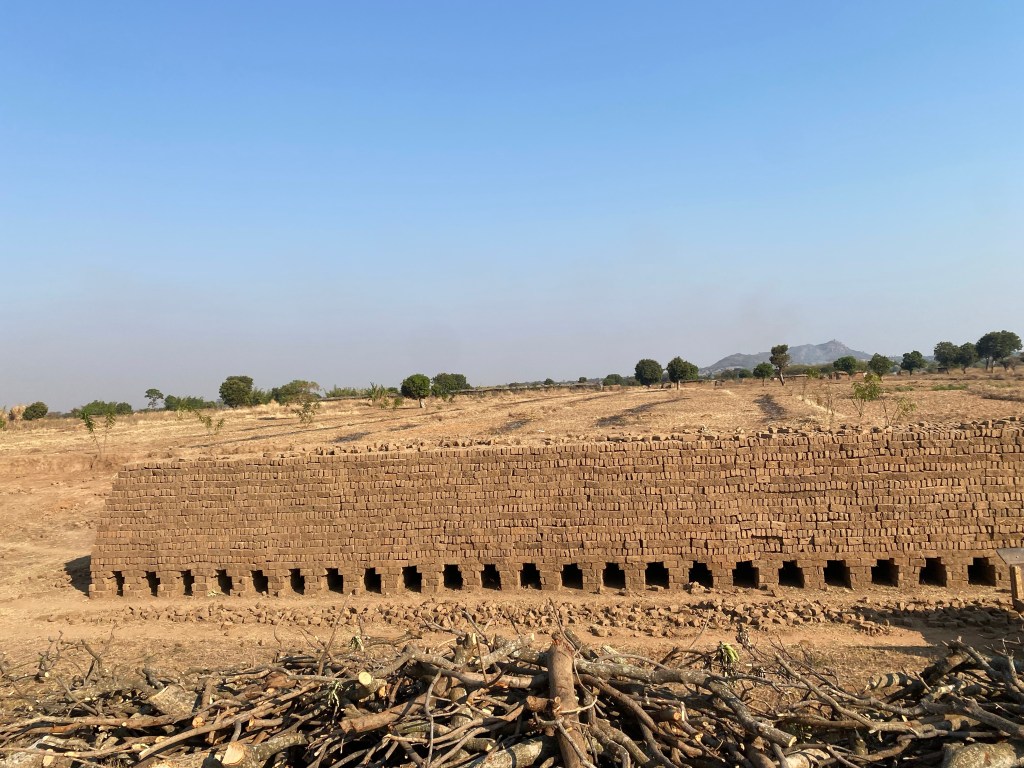
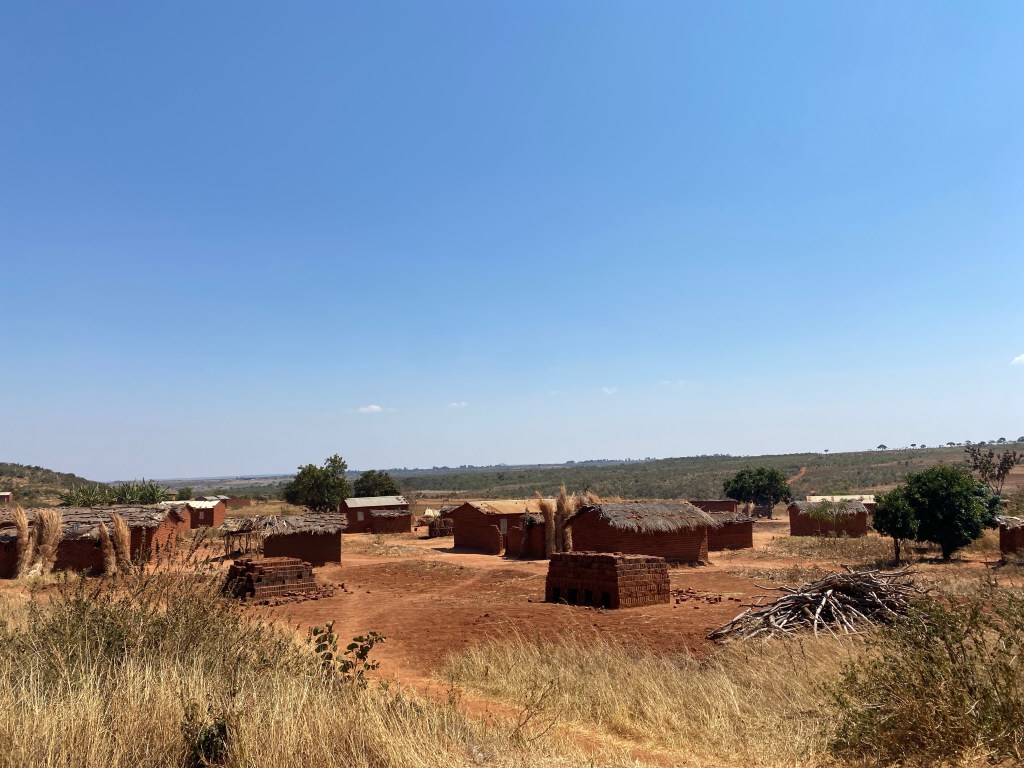
Since we arrived in Malawi we saw many brick making sites. We also realise that many people are building houses to bring their relatives closer to them for a better life.
By the time we have reached 80km, we have failed multiple times to find street restaurants offering rice. They only sell fries and fried chicken which we believe would not be enough to fuel us. So we have to continue, with Javi slowly getting into a sugar down. Gaspard’s belly fat is probably his hidden energy source. Luckily, we make it to a factory who has plenty of restaurants in front of it, and we can get our daily rice and chicken portion.
The factory seems to employ hundreds of people and pretty structured, with all employees leaving their shift carrying corporate t-shirts. We soon find out it is run by Indians, and locals complain that they demand too much output for too little money. The 100 Indians working there live in a fenced complex nearby. Everyone in the village seems to be employed by the Raiply factory.
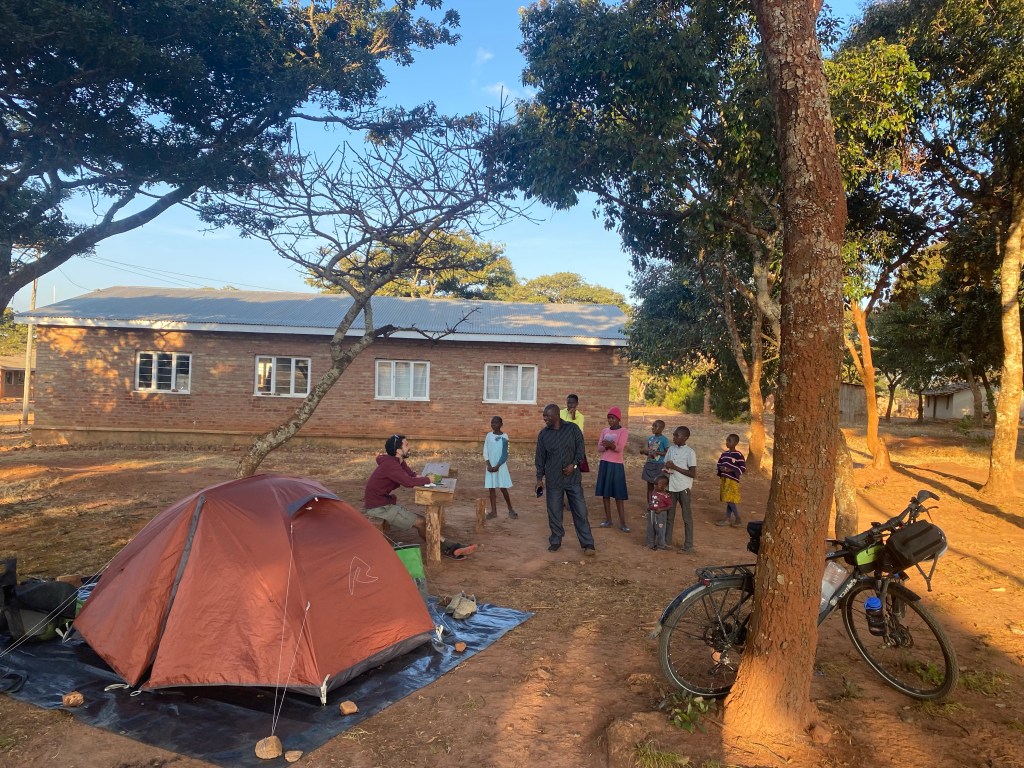
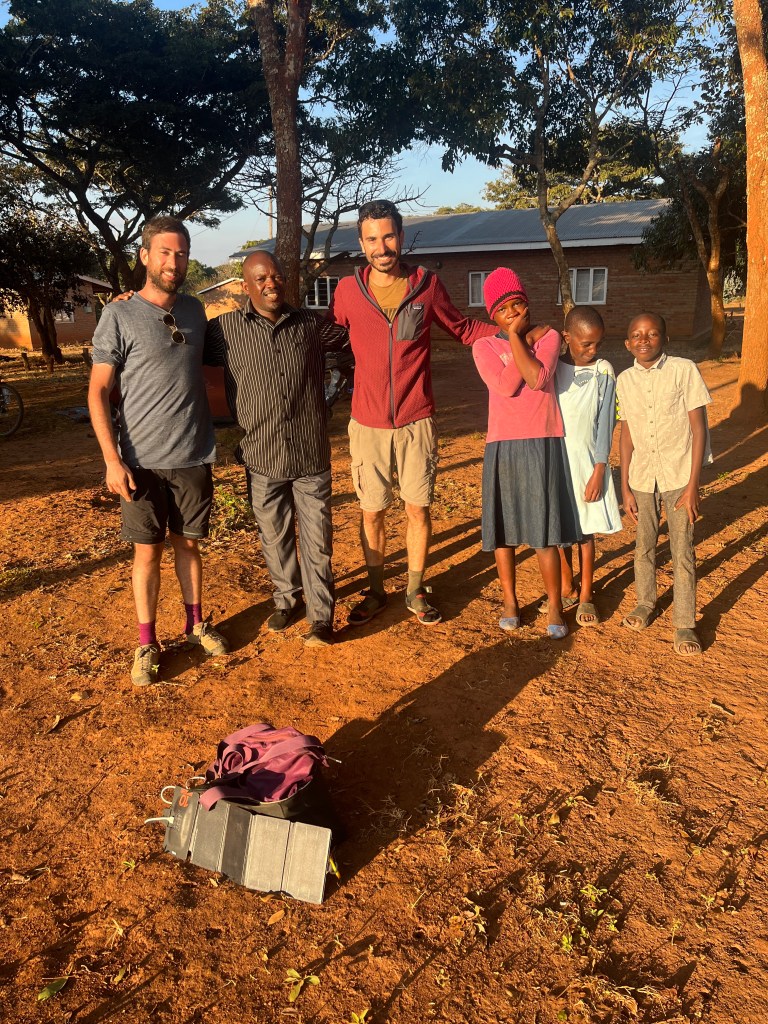
After 80 km and almost 1‘500m positive elevation (our absolute record), we feel pretty done for the day and, as recommended by many other bikepackers, we ask for camping at a school, which is empty as it‘s school holidays. The watch woman calls the deputy, who gladly accepts after we tell her that we only want to stay one night. Teachers seem to live in official houses nearby, and the teacher on duty to check the facilities, shows us where we can camp and where the toilets are.
While we spend the last ours of the day stretching, blogging and drawing, a dozen of kids approaches us shily, curious of what we are doing. After a bit, we are dancing together to Afrobeats and playing games. The smallest one, who must be 2 years, is dead scared of us and starts crying everytime we do eye contact. The others find it hilarious. It must be the beard…

20/08 – Raiply to Boni. 88 km, 800m+
We start early, with the sun, as usual. The landscape slowly flattens, and the big boulders slowly diffuminate. We cycle at a high pace, never seen before in this trip, due to the flat, well paved road, and the lack of head wind.
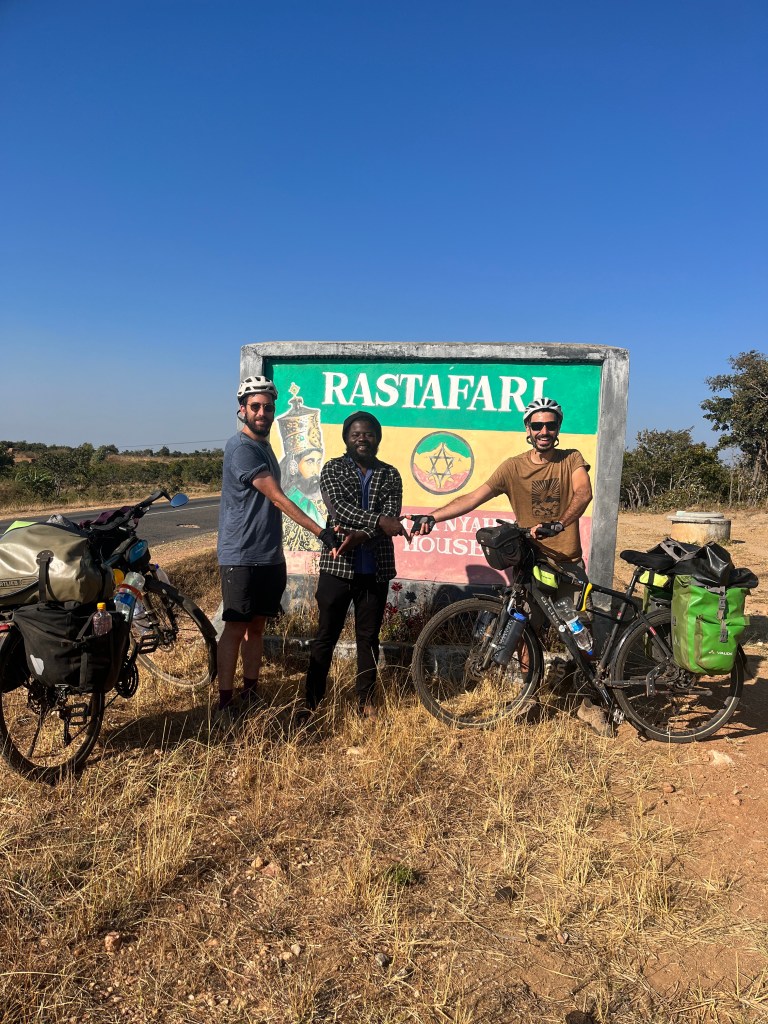
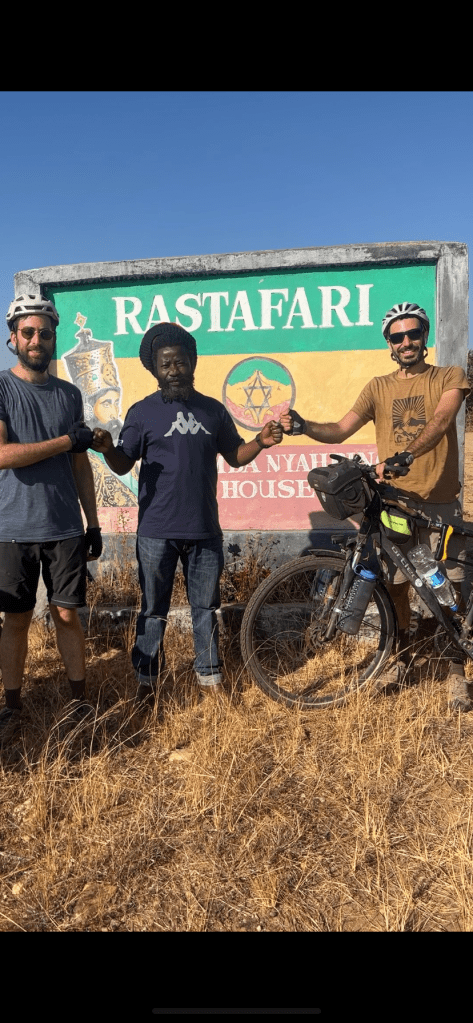
We suddenly see a big road banner to the glory of King Selassiei, prophet of the Rastafarian culture, and we have to stop. Two very friendly rastas welcome us, and tell us that they have a small rasta community in the village, despite their parents are not rasta (unsurprisingly). We take some pictures and exchange social networks, where we discover they travel quite a lot, including plane. Something very unexpected judging from the humble village. They know the main Rasta festivals in Europe, and we are a bit sad we don‘t get to know these guys better.
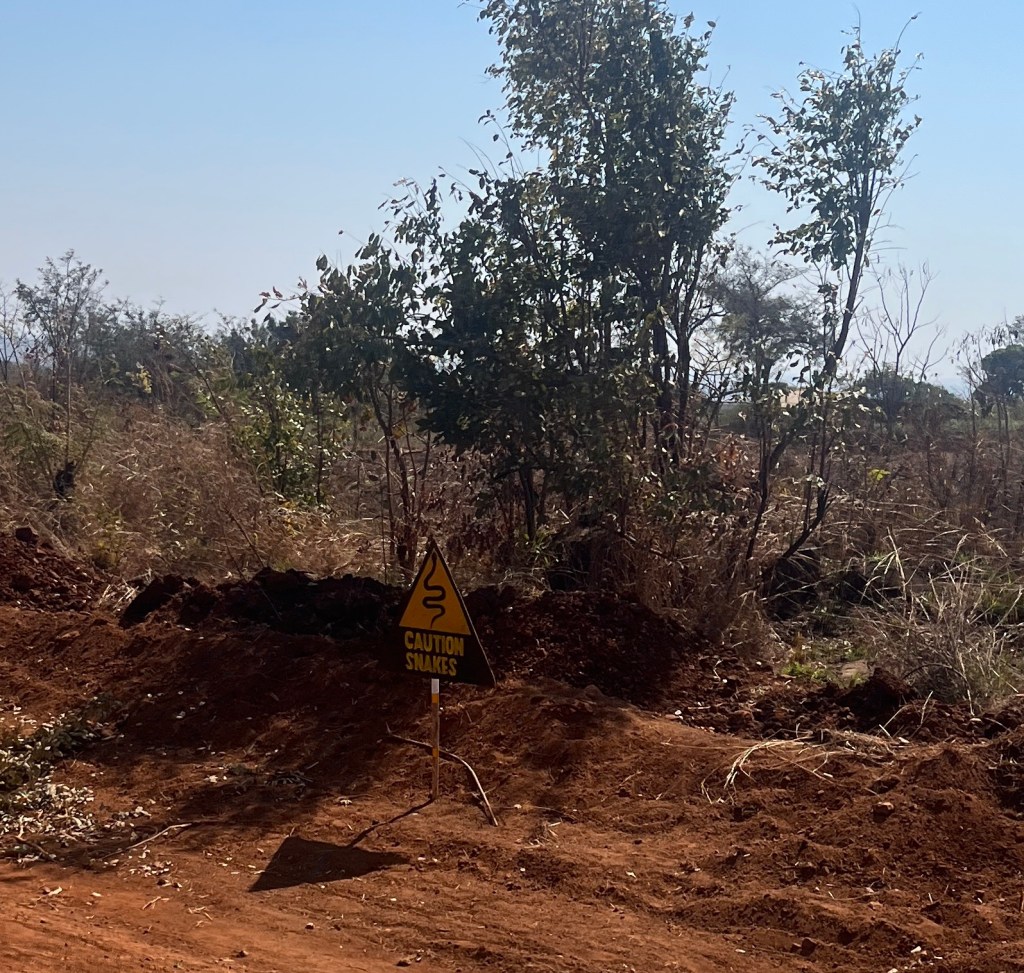
A couple of concerning things take our attention while we ride: 1st, the big amount of „Caution, Snakes“ banners. The 2nd: we see quite some young men selling what looks like fried mice stuck in a stick, ready to be eaten. They are full mice with the head and tail. We are way too disturbed to try to find out if it‘s for animals, for humans, and if it‘s because of the rampant food scarcity in the country. Hard one to swallow.
One the positive side of things, we have to say that the reports we got of the „tremendous“ plastic pollution in Malawi were, in our opinion, a bit exaggerated. the country does have a big amount of plastic lying around, and single use plastics aren’t banned like in many neighbouring countries, but by no means is comparable to what we have seen in other countries, such as Mauritania or Senegal, in which squares in cities pile rubbish mountains of multiple meters, or where we saw camels and cows eat plastic containers like if it was the most normal thing.
We arrive to the 1st border town with Zambia, Jenda. We won‘t take that border cross because we have read reports that the road is bad and it‘s quite packed with lions. So, after some last supply purchase in Malawi, and a decent lunch, we continue our way.
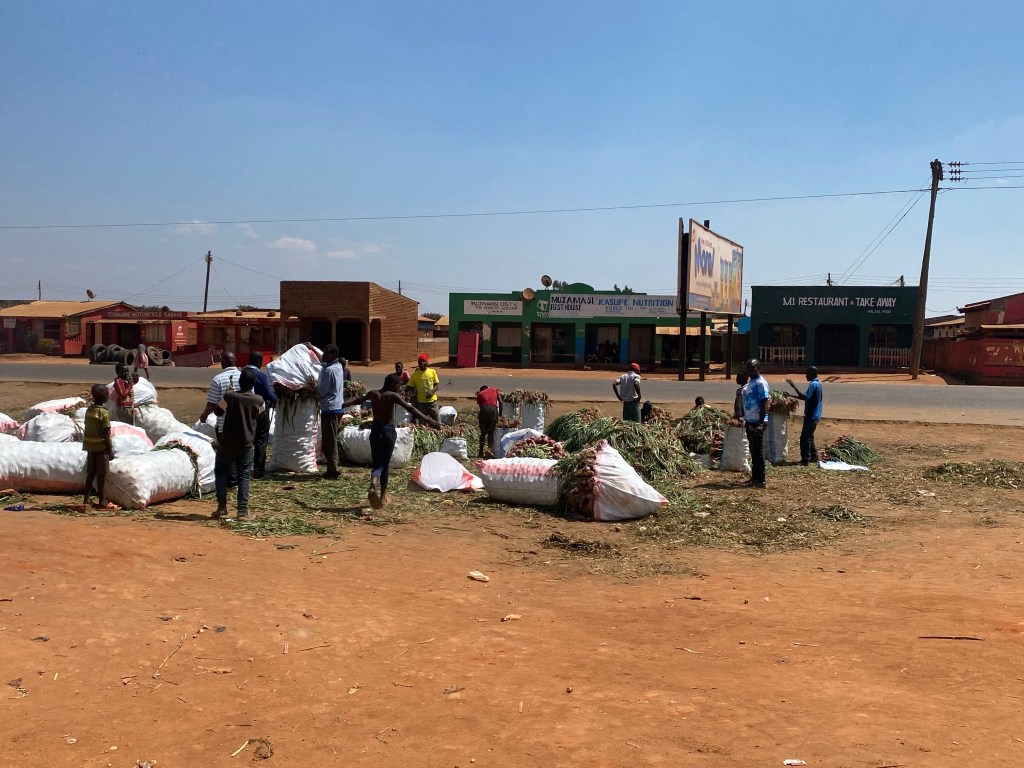
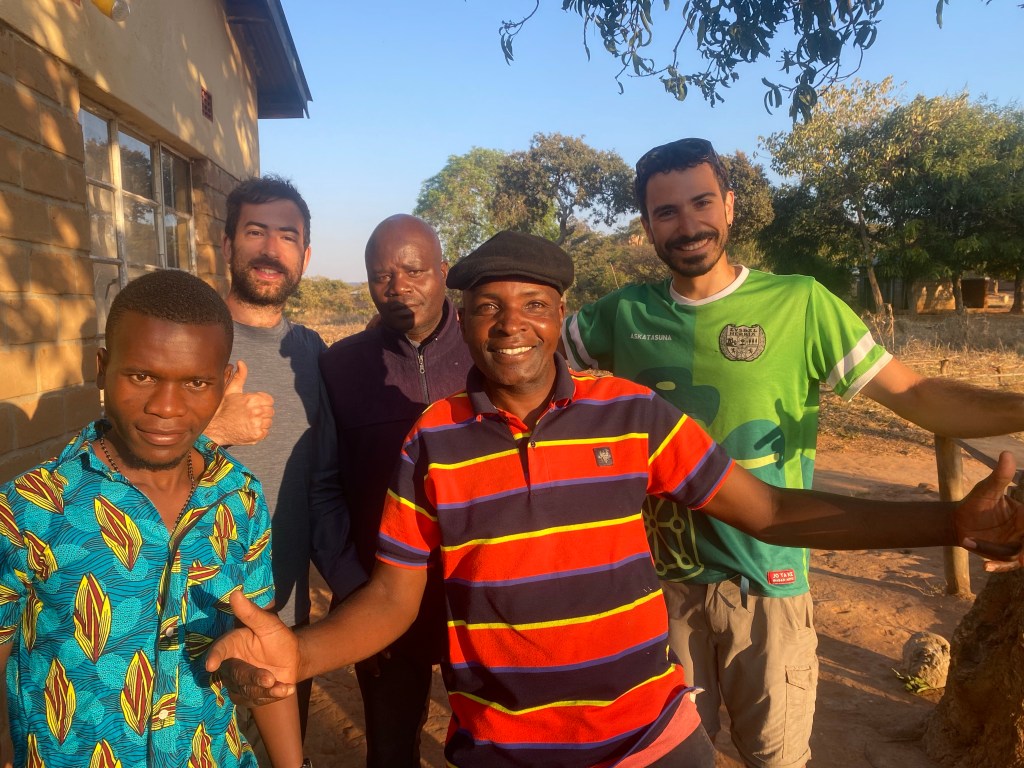
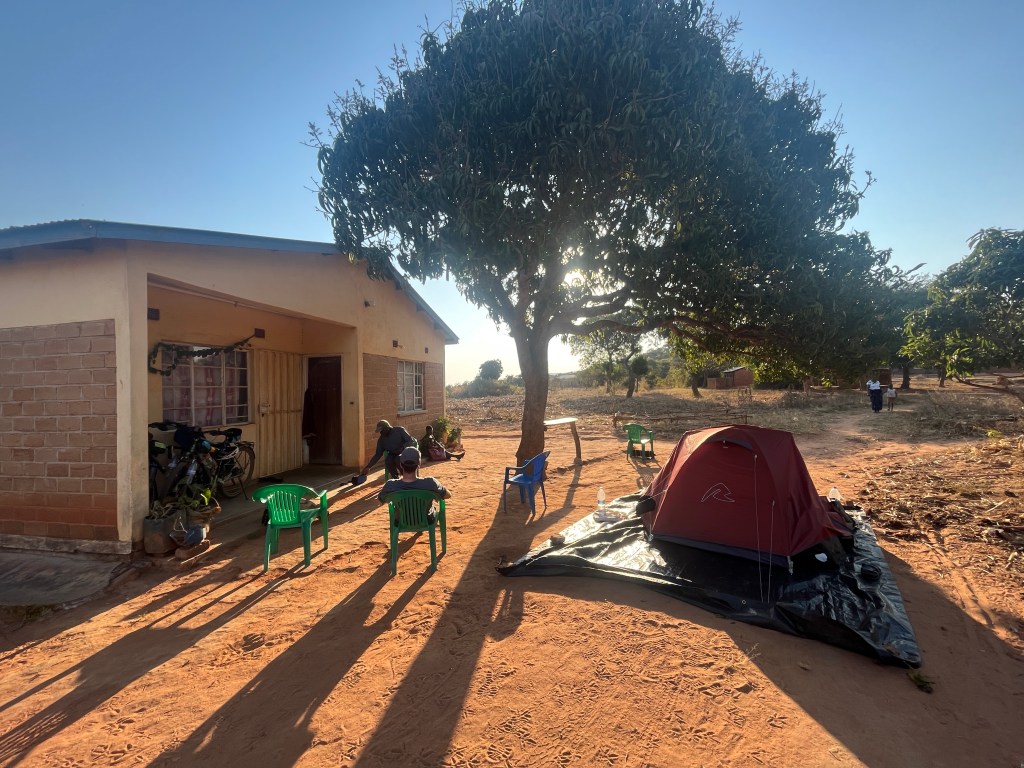
We are relieved to see locals sell home made honey instead of mice, and we decide to buy a bottle for our evening teas. Little after, the road shows us a big school lying on its side, with multiple camping options. After the success of yesterday, we decide to repeat the operation. Some locals point us to the house of the head teacher, who also lives in a house that is part of the school complex. After a bit of perplexity in he beginning, he gets very excited about our presence and decides that we should place our tent in fron of his house, to maximize the security. He brings us to the local bar, so we get to know other teachers and the local chiefs. We decide to pay a round of beers to our hosts out of courtesy, but we soon have to limit the tab due to the big amount of curious people that want to join the invite.
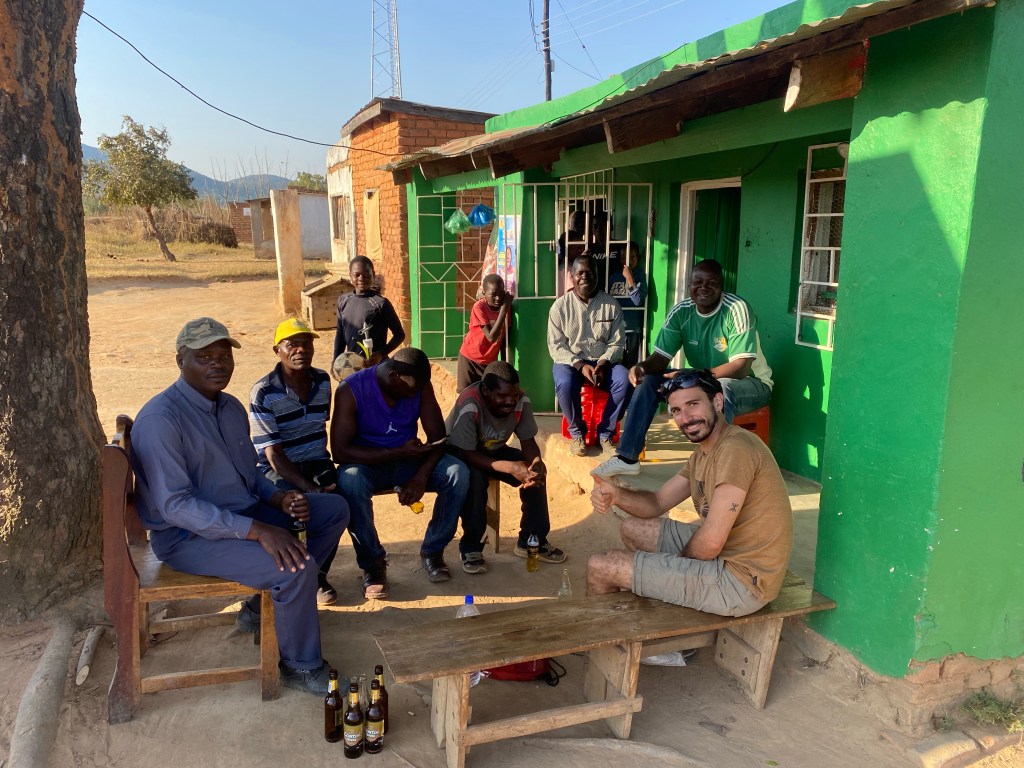
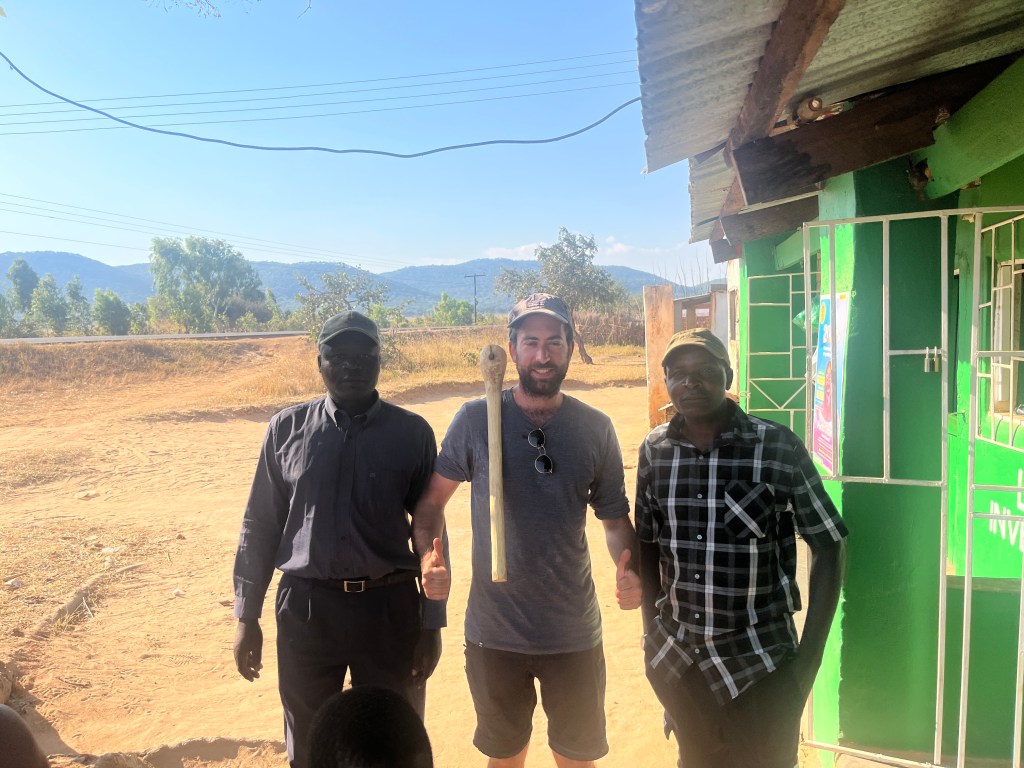
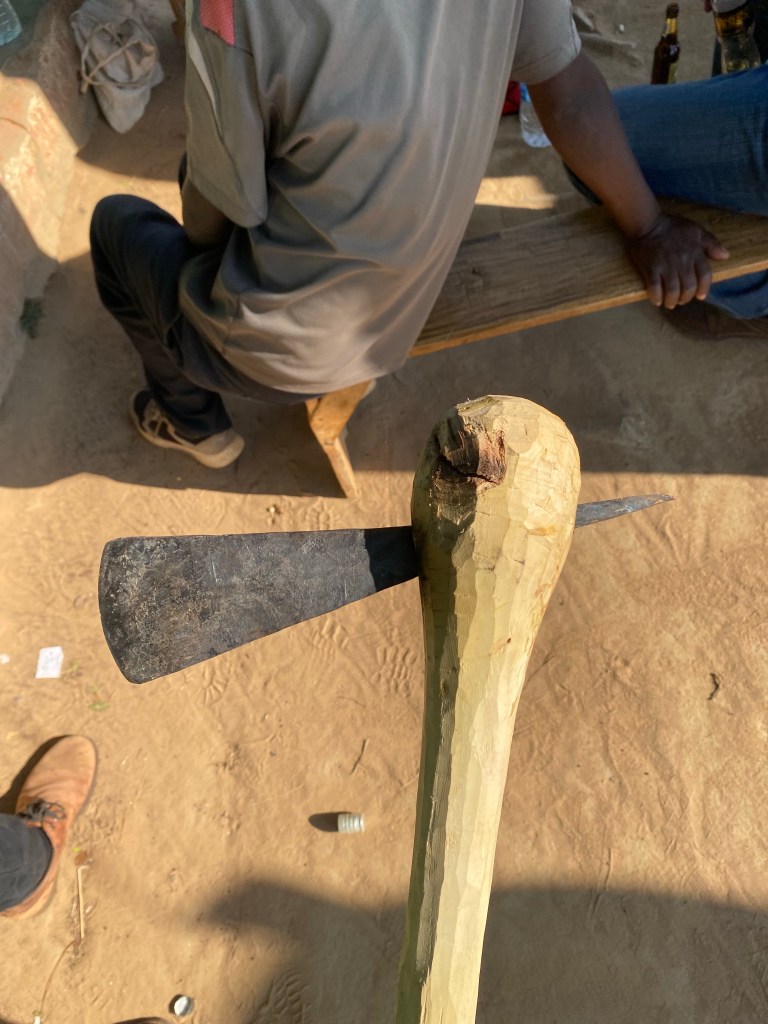
The drinking session with the teachers is full of laughter – they find hilarious our command of Tumbuka language -. They seem to have a very healthy relationship to each other, although some seem to like alcohol too much, particular the deputy, a strong young man that claims that beer does nothing to him and needs a Gin bottle from us. The sons of the local chief will soon bring us the local alcohol: „cashashu“, fermented with sugar and corn. It‘s a bit watery but is still strong, and we drink a shot out of both courtesy and curiosity. We realise that many people have several jobs such as Lonely, a teacher who also owns a shop as well as a farm nearby. He is also a craftsman building his own axes, catapults to kill birds and many more wooden tools.
We return to the house of the head teacher, as we are eager to get some noodle soup. He offers us a warm bath with a bucket (warmed by his wife, interacting with water is unfortunately a female-only business), which we gladly accept. We offer them a ginger tea with the just acquired honey, and we hit the bed, after another lovely encounter with locals.
21/08 – Boni – Santhe, 121 km, 600m+
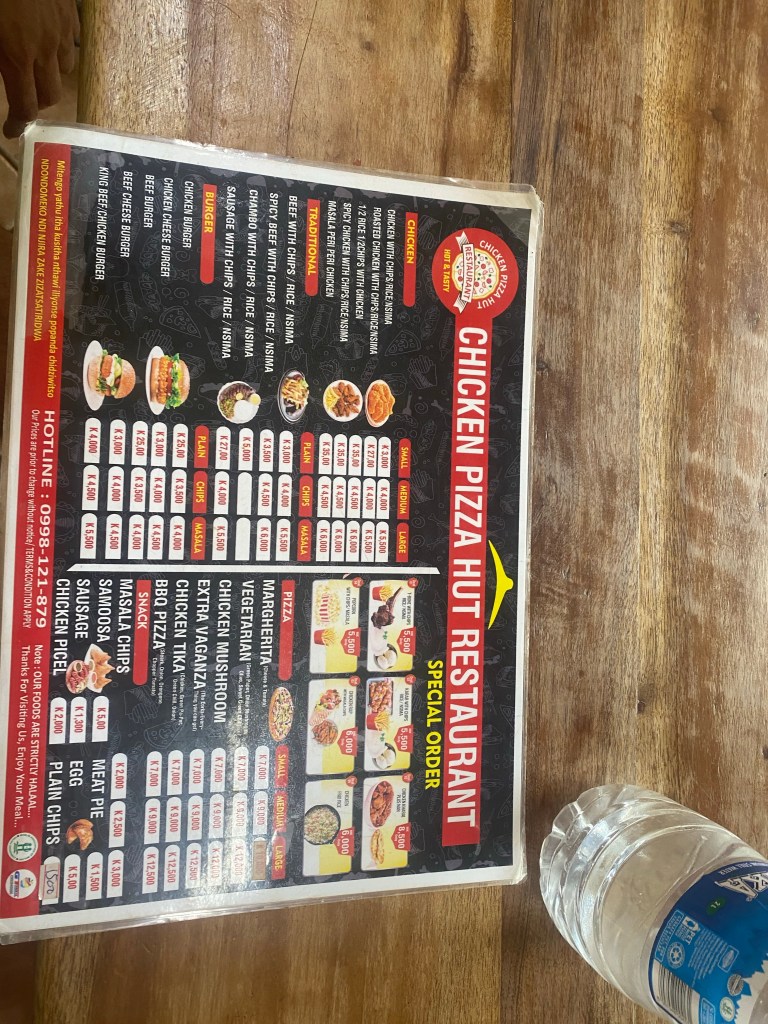
We continue „in the flow“: long distances, no annoying wind, monotonous landscape. Javi starts listening to podcasts and music to dynamics the cycling sessions. We are so fast (or so early birds) that by 10 AM we are already in Kasungu, a major town, and have done 60 km. We were supposed to arrive there for lunch time. As we are too early, we buy groceries first. Javi insists on buying spaghetti and try to cook more elaborate for dinner, with a sauce of pepper, oil, onion and tomato, as he can’t stand noodles a 3rd night in a row. Gaspard finally accepts, probably out of pity. Using ioverlanders we see a chicken Pizza Hut restaurant serving burgers. Worth a try, innit? While washing our hands we notice a cockroach in the bucket. Food should still be fine, we guess and hope.

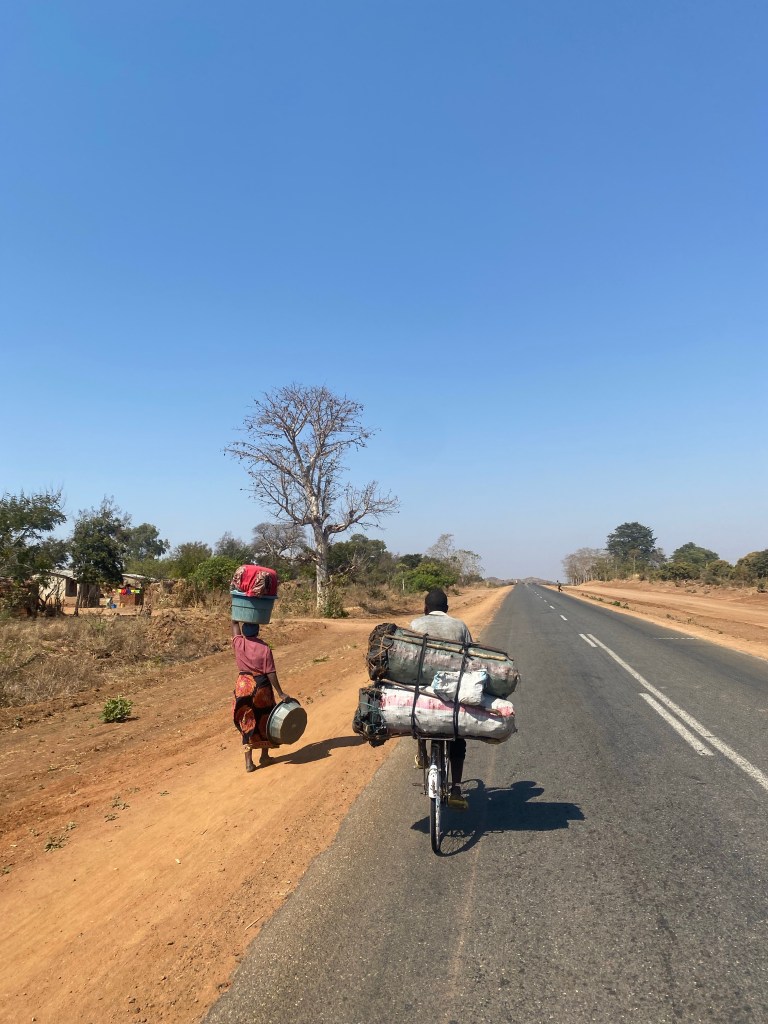
After some western food, we take the road towards the border town, Mchinji, instead of the road to the capital, Lilongwe. This basically reduces the traffic to zero, but that also reduces the amount of villages and thus, schools, our new camping strategy. As usual, on the way we pass many people carrying probably heavier stuff on their bikes than us (charcoal, food, other people, etc).

Sleeping in the bush seems risky, given all the snake warnings we have seen. But there are just no schools, and we are about to hit 120 km for the day. A bit desperate, we make it to a town and ask for the school location. To our surprise, there are some students doing some exams, and our first reaction is not to disturb. But the head teacher, a wonderful man with some physical disability, insists on offering us a classroom, so we don‘t need to pitch the tent.
We are very thankful but, in this case, our evening is going to be far from calm. You can imagine ourselves in a classroom with windows made out of 10 cm diameter holes in the wall. Around us, on the street and on the other side of the wall, more than 50 kids of all ages observe us, laughing and making jokes.
We really don‘t know how to distract them, so we suggest playing a football game. The ball they have is made of plastic bags, with tight plastic bag threads wrapping them around, and is surprisingly good. These kids are artists, really. We break down the teams with Javi and Gaspard as leaders, despite some kids are far better than us (and are less tired). After a good sweaty half an hour, Javi‘s team ends up scoring the final goal, 6-5. We then have to stop them, as we are incredibly hungry. It feels like this football game was harder than the whole day of cycling.

Since igniting the stove inside thet classroom is obviously not an option, we go out, and we soon have a tight circle of 50 kids surrounding us and observing our moves among laughters. One feels like naked, being observed by so many souls. We use our poor Tumbuka knowledge as a joker, and the teachers and the students laugh so much, despite we are not anymore in the Tumbuka region, but in the Chichewa.
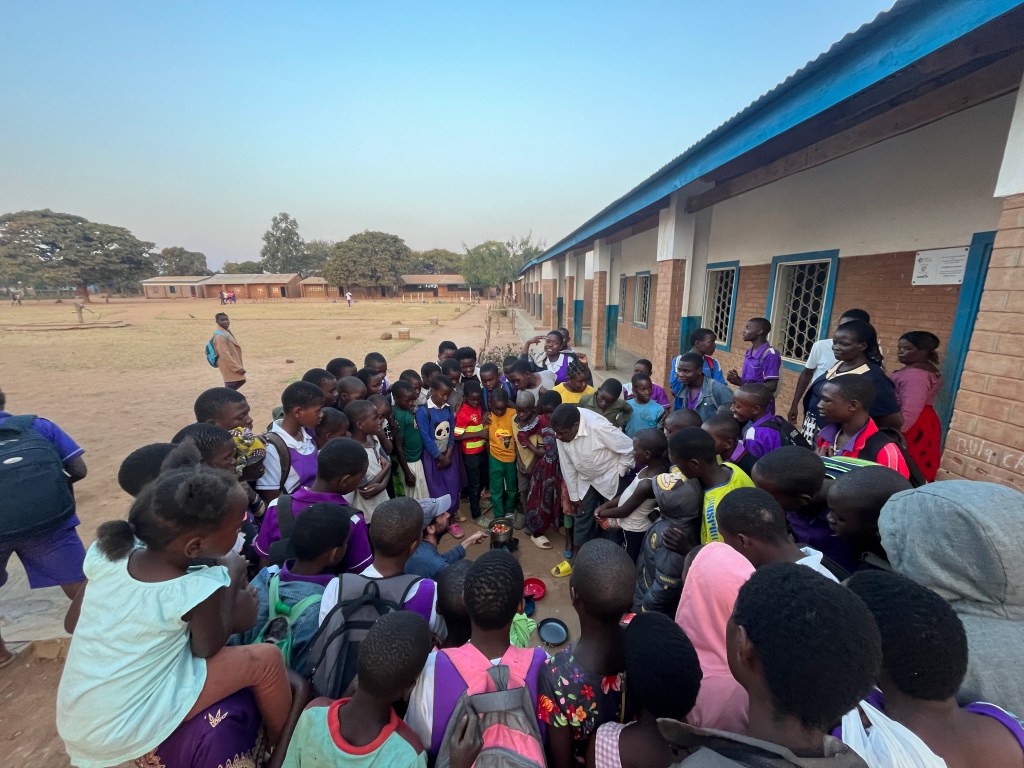
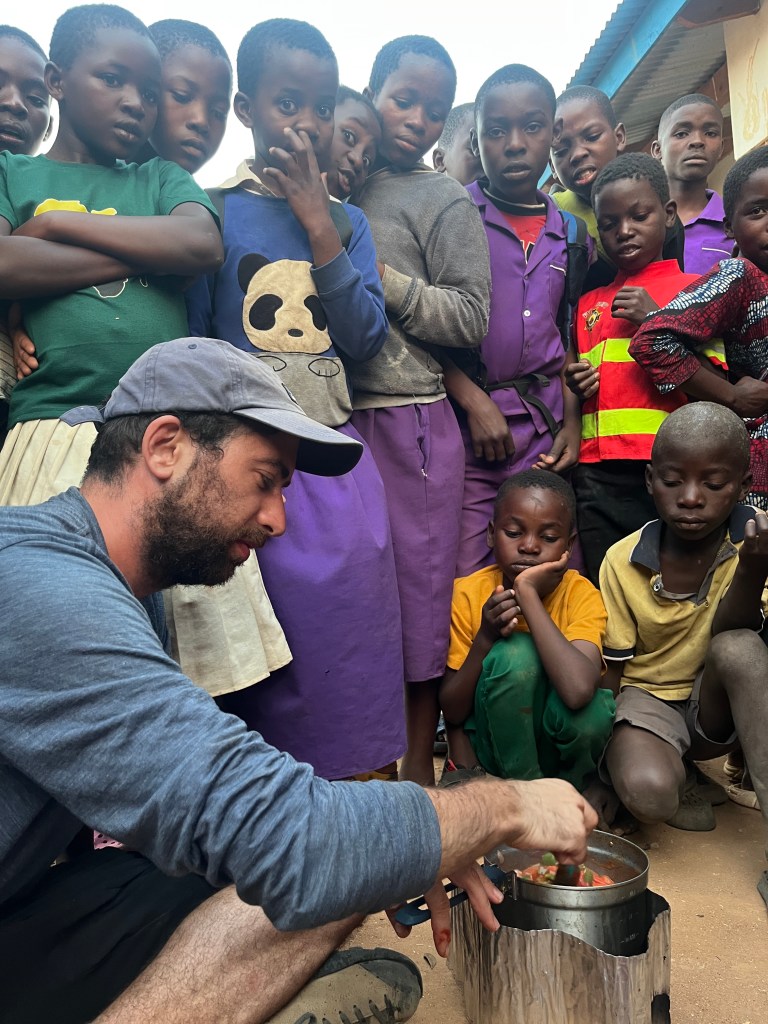
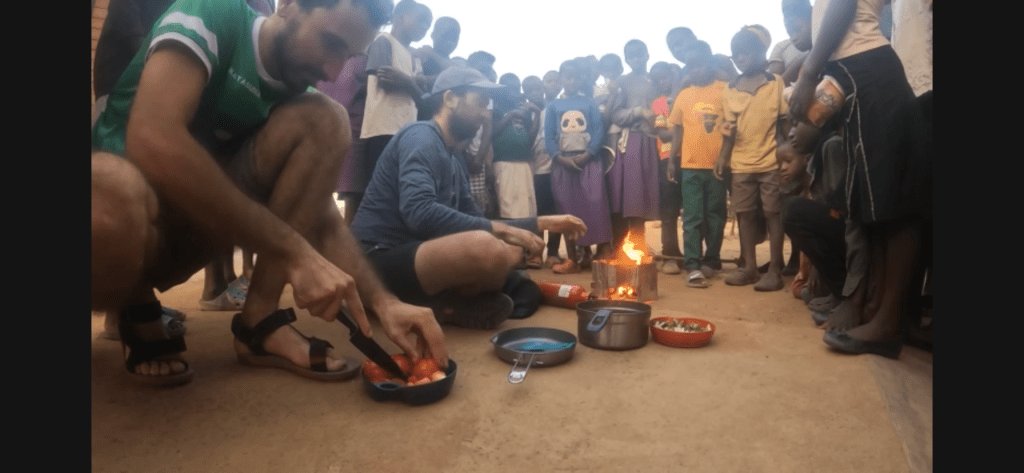
Luckily, the head teacher comes to our rescue when the food is ready and with a couple of words, all kids leave. Gaspard admits that the spaaguetti with the sauce was a good idea, and we get in the bed, under the attentive watch of the last kids that stare at us on the other side of the wall.
22/08 – Santhe – Mchinji 73km, 370m+
In the morning children take turns to clean the school and sweep the communal area (removing leafs and branches from the dirt floor). We have our breakfast inside the class room with the occasional kids watching us -it feels like being a fish in a fish tank 👀.

While starting to bike, we pass nearby the house if many kids we played foodball with the day before and who greet us by our names: “goodbye javi”, “goodbye Gaspard”. So sweet! The way to Mchinji, the main Malawi-Zambia border crossing, offers an off-road shortcut that saves 15 km. We obviously take it and we immediately regret it. We re-pumped our tires in Mzuzu and offroads feel even worse now in bumpy roads. We also have to push the bike quite a lot.
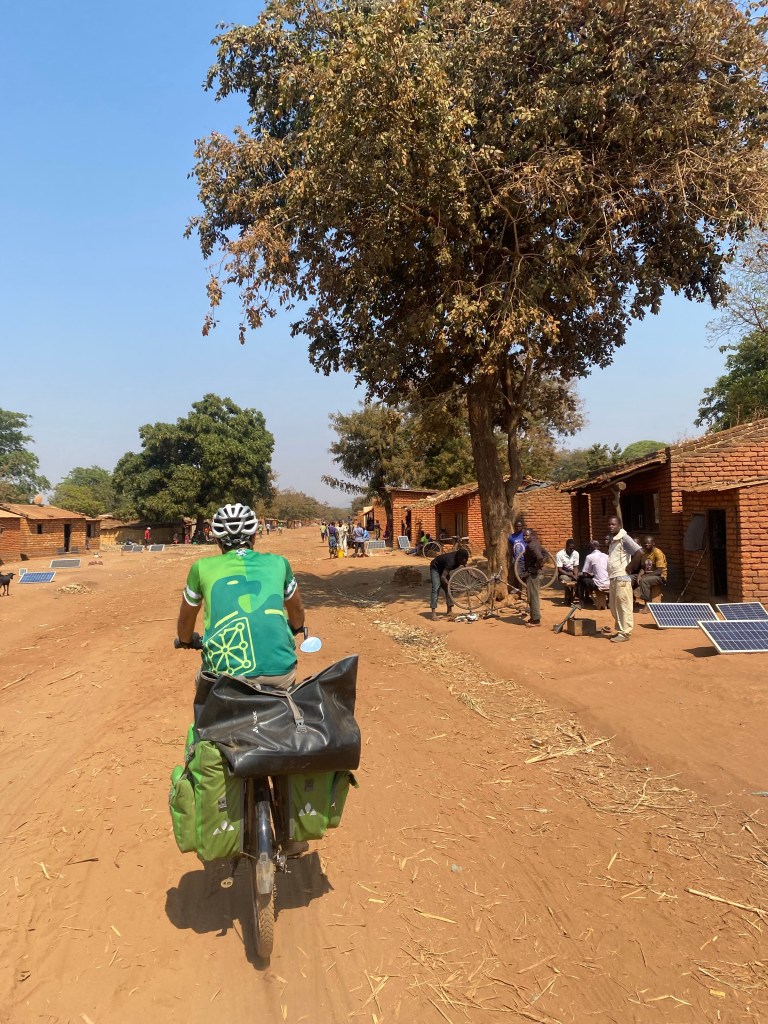
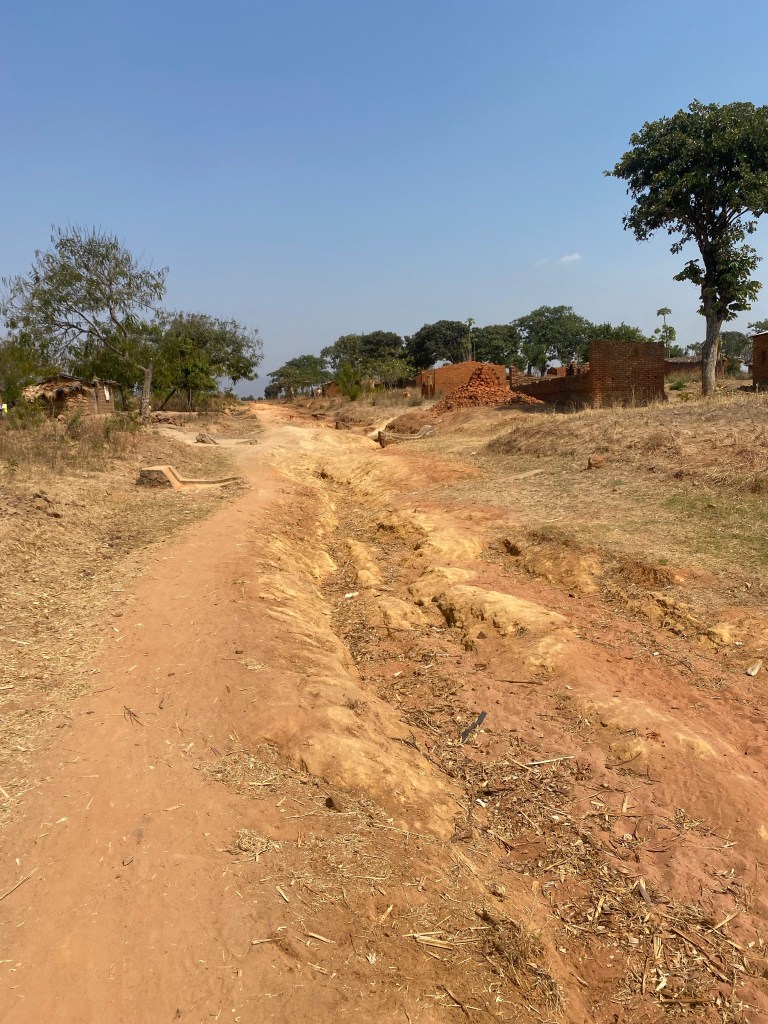
But there is one rule in bikepacking: off-roads always pay off. And this time, as always they did. As we are approaching the town, we arrive to a small settlement where a big crowd seems to observe something. Suddenly, we get surrounded by almost naked men, with their bodies painted in grey. They are carrying masks, sticks and, surprisingly, they start asking us for money in what we perceived a very aggressive way. The initial scare soon vanishes, as they are not really pushy. We even take some pictures of them. It seems like an animist, spiritist tradition, but we won‘t find anyone capable of explaining it to us in more detail.


Mchinji is a classic border town without much to offer. After 4 days of camping, we treat ourselves with a hotel for the bargain of 6 Euro each, including continental breakfast and hot shower. We even manage to bargain to get a room with two double beds for the price of the smaller room. Since we have arrived early, we dedicate some time to blog writing but we will soon discover our Bluetooth Keyboard is malfunctioning. Damn it! We replacce the batteries with the most powerful batteries Gaspard had, bought in Switzerland. But nothing, so we end up a bit frustrated after wasting 1-2h trying to pair it to our phone. Please remember this part of the keyboard for the next post ;-).
The village is very simple consisting mostly of dirt roads. In the evening we see many small fires popping up in the streets. As there is no waste management facilities people normally burn the trash everyday in the streets. While Gaspard talks to his girlfriend, Javi tries to continue the local-meeting spree, and goes to a local bar for a beer. The bar is a bit shady, with people playing pool in the dark (everyone in Eastern and Southern Africa loves pool), and afrobeat music blasting so loud that it‘s impossible to communicate with anyone. Still, all the audience is inside, and Javi drinks his beer outside because of risk of losing his hearing. Fail.
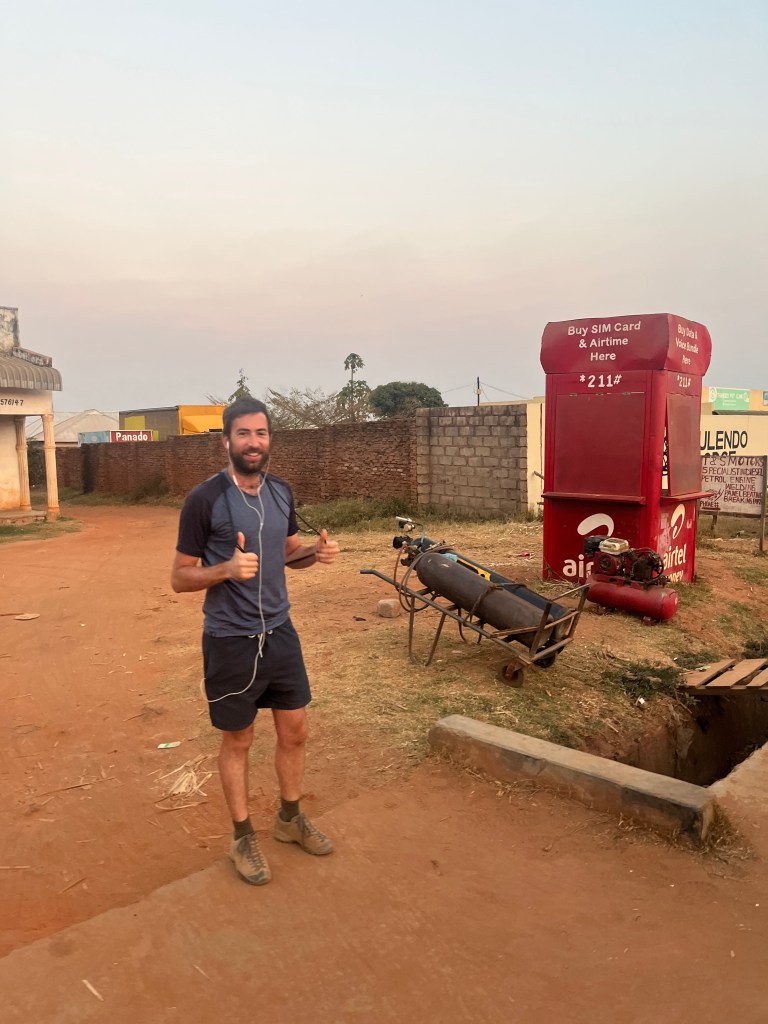
23/08 – Mchinji – border Zambia 14 km, mostly flat
The continental breakfast makes us greedy and we have double of everything we can repeat: coffee, bread and peanut butter. We then realize that we are about to cross a border and that there are a number of things we have to prepare, including changing our Malawian Kwachas into Zambian.
We ask around town but everyone tells us to go to the actual border, 12 km away. When we arrive, we get the usual hustlers offering us to change, but to our surprise, they are offering us a terrible change, 1 zambian for 100 malawi, when the official one is 1 for 155. We think they may be trying to play it to us, but soon we realize it‘s not that…
As in other countries with inflation, there is a black market for the currency. Basically, no one wants Malawian money, -not even the banks- as it loses value every day. So we seem condemned to get a terrible deal for our 150 Euro worth Malawian kwatcha. Dollars, however, are highly wanted. While the official change is 1 dollar to 1100 Malawian, you can get up to 1700 in the streets. 35% more.
This obviously explains why we have found Malawi so expensive, since we have been pulling money from the ATM and thus gotten the official rate. We still don‘t understand how haven‘t we found out this before, given all the people we have met. We will soon realize that our fellow cycling friends didn‘t know either. In any case, we spent 300 Euro per person in Malawi for 15 days, so it‘s not that bad.
We manage to reduce the damage by changing our kwacha for dollars with a friendly German cyclist and a German couple on a Land Rover coming in the opposite direction. We still give them almost the black market rate, but since we make the win of the exchangers, we end up losing only 20 Euro each. There are worse things in life.
Getting the passport stamps goes very smoothly, and we meet some very friendly Zambian border officer women. Already doing small talks about what sport we like. It gives us a positive first impression of the country. The fact that there is no visa fees also helps.
In any case, we have completed our 2nd country of our journey and, despite the last bittersweet surprise, we leave Malawi with a full heart, tired legs, smiley face and lots of memories in the pocket.
Days since las post (in total): 8, out of 30
Km done since las post (in total): 510 km, out of 1612.
Elevation gained: 5240m+, out of 18‘430m+
 Cycling Pirates