
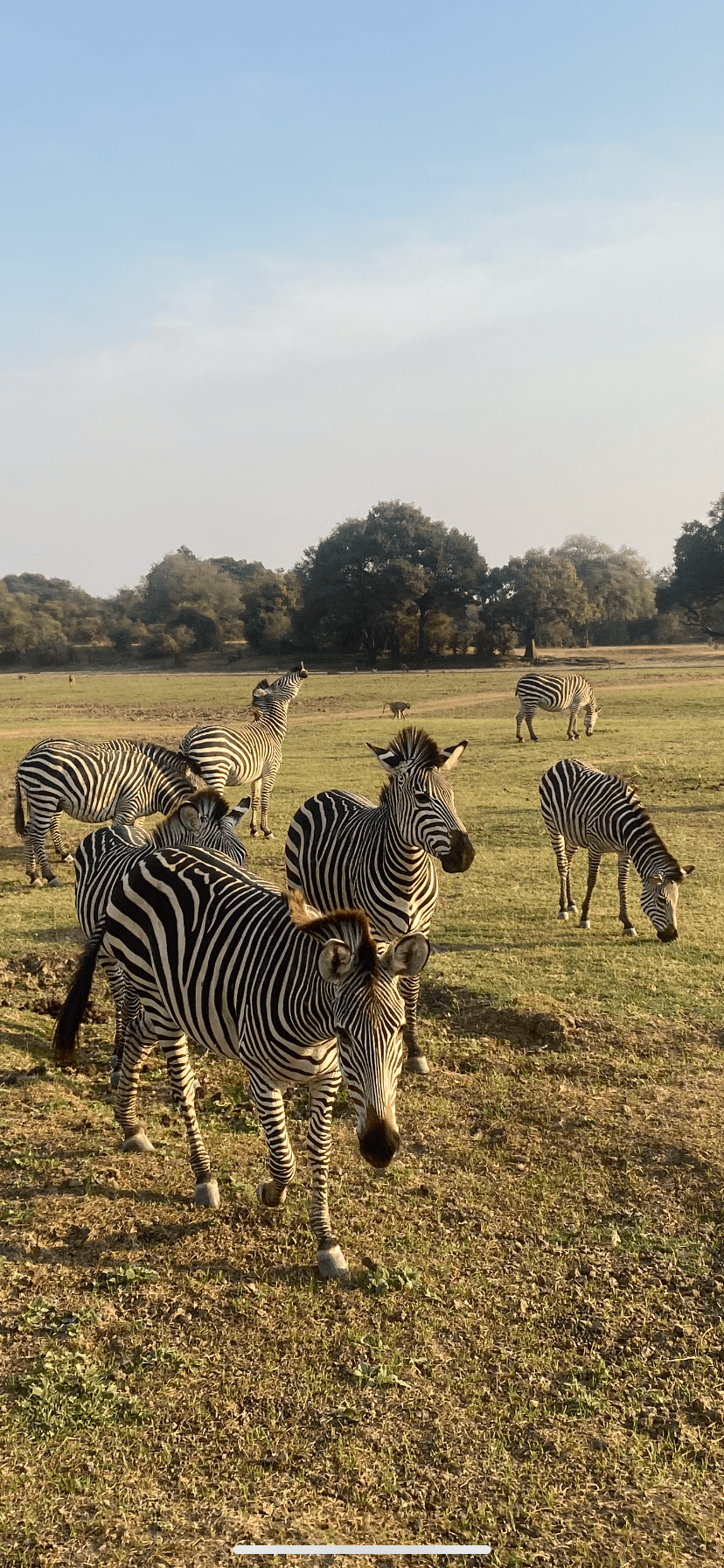
Song while cycling: Yo Maps – Aweah
23/08 – Mchinji border to Chipata, 34 km, 250m+
It doesn’t take long to arrive to Chipata, the main city of Zambia’s Eastern province. We have found a host via Couchsurfing, and we are happy to start making some use out of it now that it became paid.
The first impressions of Chipata are varied: we are shocked by the superb exclusive bike lines on the shoulders of the main street, including a segregation with blocks. There are very imponent Malls and supermarkets, including a Spar (very famous in Germany). On the other hand, it is very difficult to find street restaurants – everyone tells us to go to the take-away of the supermarket. Apart from that, the city doesn’t offer anything particularly worthy experience, so we pull some money and head towards Francis home’s coordinates.

On our way, we see a big group of young muzungus (white people), and we have to laugh of how small this region of the world is: it’s the Dutch Christian group we met in Nyika park (post #3). We are both happy to see each other again, and they tell us they are coming from South Luangwa National Park, our next destination. We get some tips from them and, this time, we manage to get some words out of the girls. Their specific denomination still remains a mystery to us.
We get lost among narrow unpaved alleys on our way to the exact coordinates of Francis’ home. Francis seems busy at work, so we manage to get confirmation from her wife Thelma. We send her a photo of where we are and she comes to our rescue. We follow her through the neihgbour’s garden. At the back, she opens a door made out of leaves to let us in into her garden.
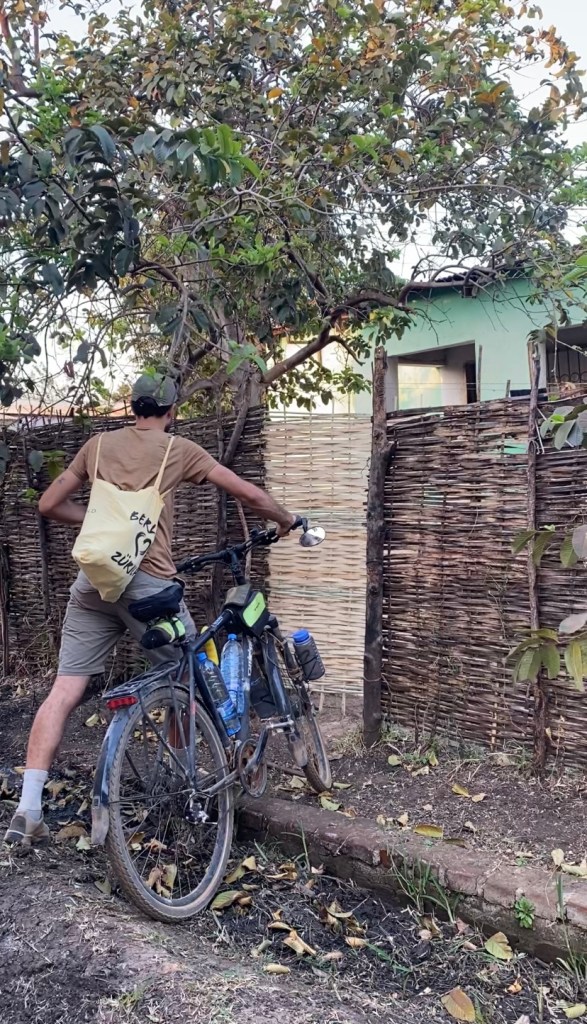
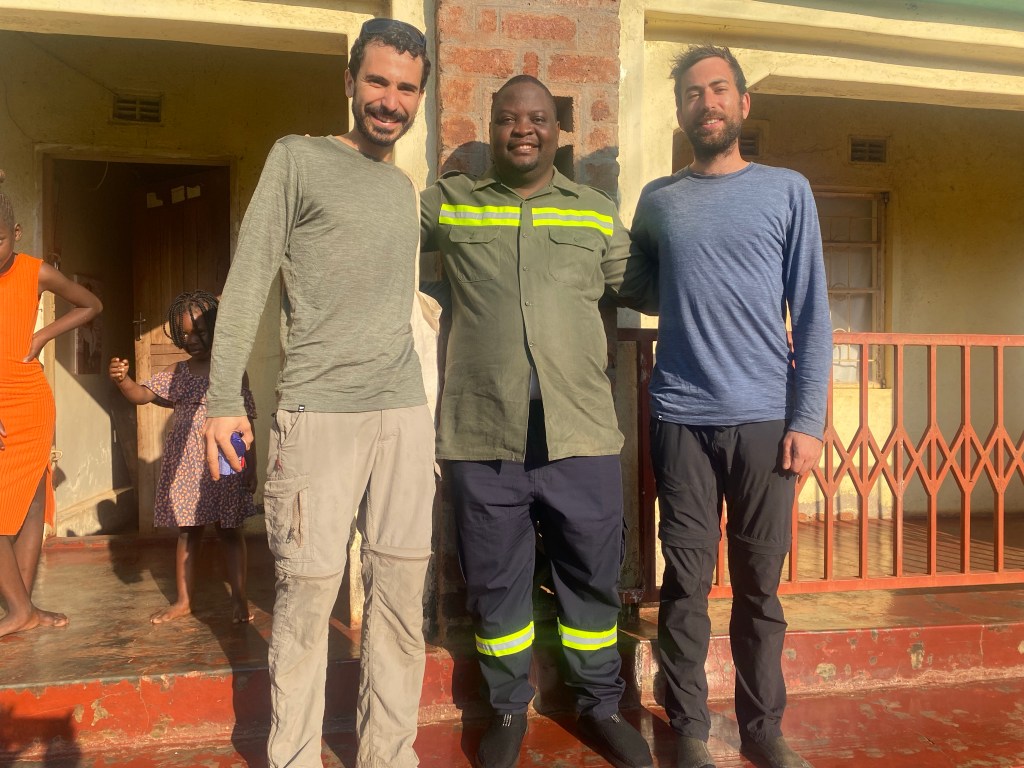
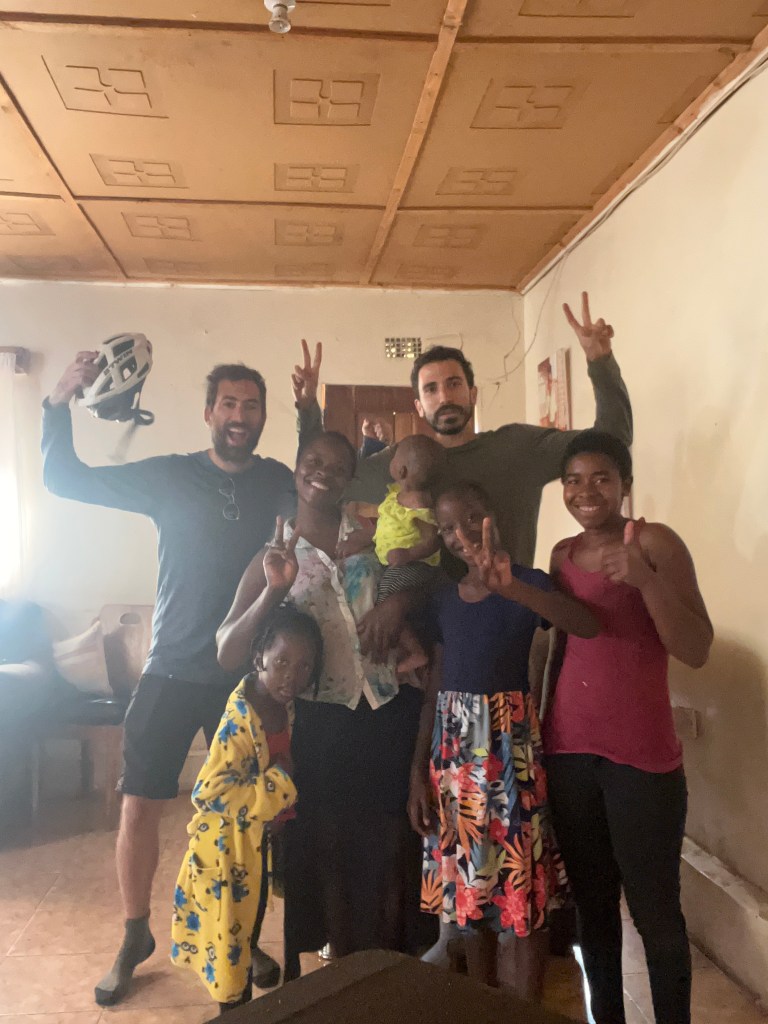
Thelma introduces us to their 3 lovely daughters, aged 1, 5 and 10, and to the maid. The house is very spacious inside, but we feel a bit bad that our room is almost the biggest. The living room is huge and counts an enormous flat screen and a powerful sound system. Although the area in which the house is located is very humble, we get the impression that the family is definitely upper class.
Francis and Thelma are avid couchsurfing hosts, and have hosted people from all around the globe. Francis is still at work, and we enjoy some time with the kids and Thelma, who tells us that she also loves tattoos when she sees Javi’s. A nice lotus flower tattoo shows above her breast, making her the first person we see with a tattoo.
It’s only midday, so we go to town to try to find a lunch place. We find a very nice outdoor area (which seems to be a dodgy party place at night) with restaurant in the shade in a quite area. They only have meat, no carbs nor side. We are starving and end up leaving. On the way out two women that we suspect being prostitutes try to convince us to buy rice at the market and ask the restaurant to cook it for us. TIA. We end up declining the invitation because of the lack of rice at the restaurant (probably the weirdest way to reject a prostitute). After confirming the lack of options, we end up in a restaurant run by a half-Zambian, half-Indian woman. The food is expensive for what we have heard (Max. 2 Euro for a plate in a street restaurant, this one is 5 Euro), but food is good. We enjoy talking to the woman, who has a restaurant, a shop and plans to open a spa. Surprisingly, she talks quite bad about Indian people, and tells us she wants to visit Spain to try the Hash there. We tell her she would better go to Morocco for that purpose.
We get some supplies from the Shoprite supermarket, which has much more supplies than its locations in Malawi. We bring some toys for the kids of our hosts, and some muffins for dessert tonight, as we highly suspect we are going to be invited to a nice dinner.
We go back to the home of our hosts, crossing quite some mosques. We thought Islam stopped extending after Malawi, but that’s obviously not the case. In other order of things, Zambia looks so far significantly richer than Malawi, based on the typical parameters: offer of goods in supermarkets, smartphones of people, road status, density of solid vehicles, buses and trucks.

We try to blog but we fail again, since the keyboard keeps behaving weirdly – it’s impossible to pair it with the phone! So we play with the kids while we await for Francis to arrive.

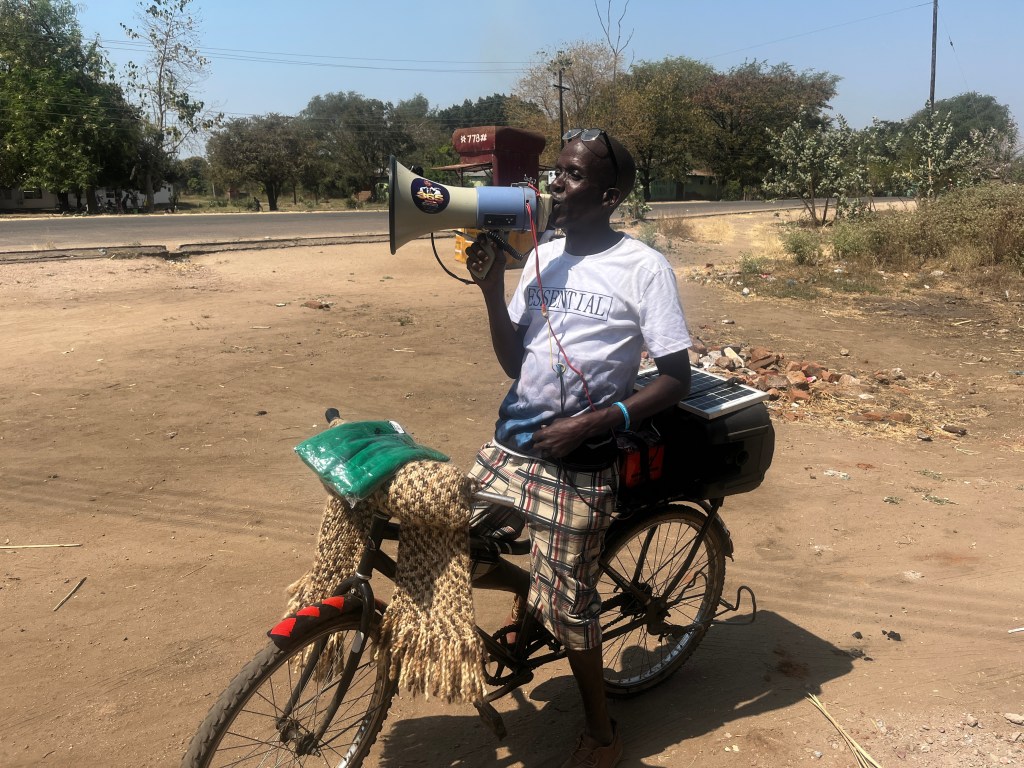
When Francis makes it home, we soon understand why he was so late: he is the founder and manager of a 75-employee solar company. They offer affordable solar lights, panels and batteries to countryside people, instead of sub-standard Chinese products. They also sell energy efficient and more sustainable cooking stoves (instead of using coal from large trees you use small branches which avoid killing trees). Then, with the emissions savings of those products (that substitute mostly charckcoal), they generate carbon credits for companies such as Delta Airlines. Thanks to carbon credits, they manage to sell a product for 2 usd that cost them 10 usd to manufacture. It is very moving to see the happiness of his face when he tells us that some kids were able to pass their exams thanks to his solar lamp. Francis has an impressive professional record, as he was granted the Obama Foundation fellowship, and he met Mr Barack in South Africa some years ago. He has also visited often US, Canada and Europe. Again, all started with a scholarship to study abroad. Not the first time, not the last one, we will hear this cause for similar success stories.
We enjoy very much the dinner prepared by Thelma and the maid Dilma, which consists of fish, nsima (as everywhere in Malawi and Zambia), boiled vegetables and a delicious sauce. It seems that all social classes eat the same in Zambia, the only thing that changes is the quality and quantity of the fish and meat.
Francis gives us many hints about the country and its economic situation: much better than Malawi, but still strongly affected by inflation, which is generating even hunger in the villages he visits for his solar panels. Having a light is a luxury you would only allow yourselves once you can bring food on the table. Many people struggle to make nshima as the price of corn meal (main ingredient of nshima) has skyrocketed. He is curious to see how the new government does, as they still have 2 years of term.
Francis also gives us some tips about where in town can we repair the keyboard, and he is totally OK with us staying one day more: we feel we need to organize ourselves a bit before hitting the road again.
Mosquito density is much higher here than anywhere so far, and there is no net in the beds, so we soak the non hairy part of our faces in repellant (thick beard is our best friend here) and hit the bed for a recovery sleep.
24/08 – Rest day in Chipata
We take our unloaded bikes to go to town to try to repair the keyboard. It may look trivial, but no keyboard means no blog, and this is our main source of communication with family, friends and with our memories of the future.
We visit 5 different phone and electronic shops, but despite some of them disassemble the keyboard and clean the electronics, no chance, the freaking keyboard won’t pair. We have even changed the semi-new batteries to a new set of new batteries, which are performance +++, bought by Gaspard in Switzerland.
We find an electronic shop where they sell an ipad with a similar bluetooth keyboard, but they won’t sell the keyboard separately. The guy takes literally 2 hours to examine with his electronic tools the board, and we are getting desperate by waiting. It’s 12 AM, very hot, and Gaspard is just fed-up.
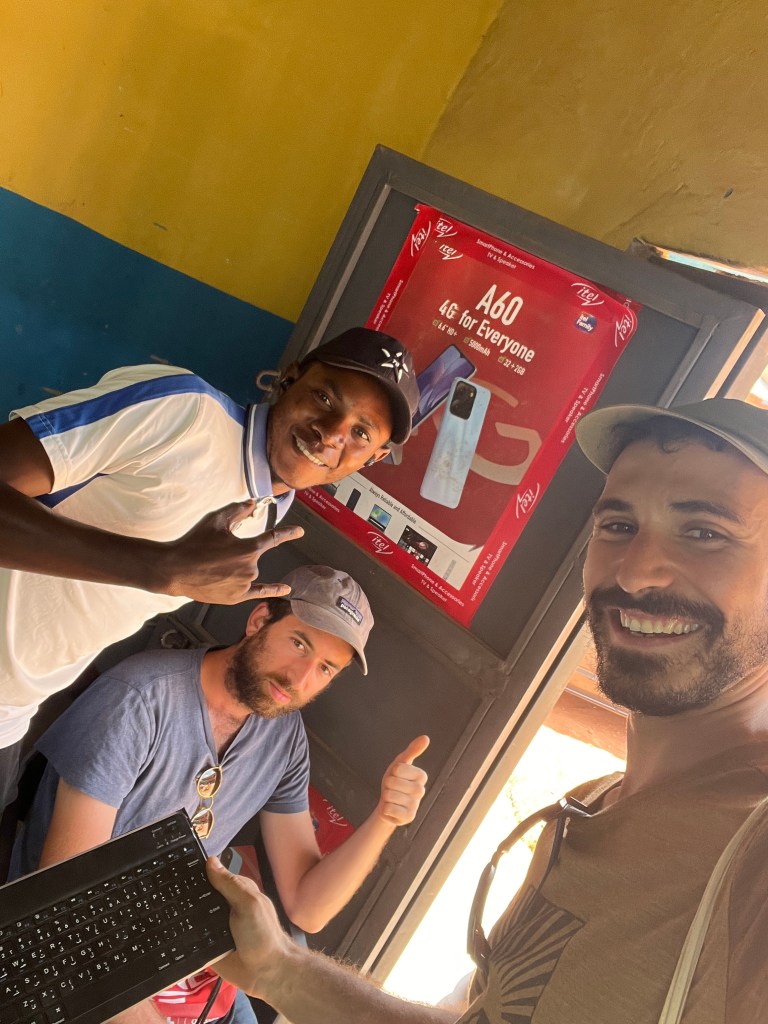
We tell the guy we are leaving and then, obviously, he is OK with selling us the keyboard of the table, for freaking 34 Euro. He has to cut with some scissors the keyboard out of the leather cover of the tablet. We give him the broken keyboard, and we wish him good luck with the repair, which we consider impossible at this point. Javi places the keyboard in his bag saying I will take care of it like the apple of my eyes.
Due to the lack of restaurants, we take some take away from the Shopright supermarket: spaghetti and beans with sauce. We go to the back of the supermarket to eat, and write the blog below the shadow of a tree. It’s then when Javi realizes that things can go South pretty fast: the tupper of the take away has leaked and the new keyboard is covered in beans. We clean it immediately but no chance, the keyboard doesn’t work anymore. We can’t believe our keyboard curse and, saddened, return to the shop were we bought it.
The guy opens the keyboard again and doesn’t take long to discover that the board is damaged by bean soup. While he tries to repair it, we take the old keyboard of us, to keep retrying for a thousand times the exercise, quite out of hope. To our BIG surprise, the old keyboard gets paired to our phone. Totally shocked, like if some black magic was happening we try with another phone and we confirm the new fact: the new keyboard has died, but the old one has returned from the realm of the dead. The shop guy tells us that he changed the extra expensive batteries of Gasp for some extra cheap ones, and voila. We give the guy a tip for fixing the keyboard and leave exhausted by the waiting in the sun and running around.
We don’t know what to complain more about: the ignorance about the malawian black market for dollars, or this freaking keyboard story. Gaspard doesn’t want to talk about it. We take the keyboard and, after a 5 hour loss of time, we go back to Francis home.

The dinner is again superb, and we learn again a good deal about Zambia, but we are a bit tired of Chipata’s lethargy and feel like moving, so we go early to bed.
25/08 – Chipata – South Luangwa Gate, 133km, 515m+
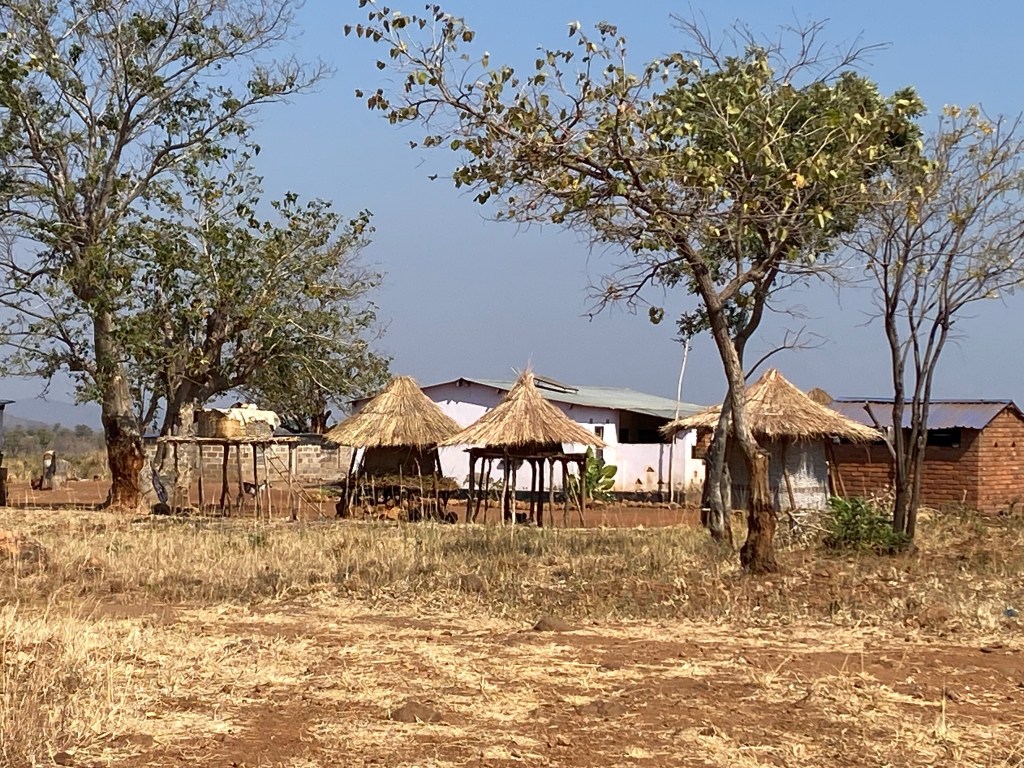
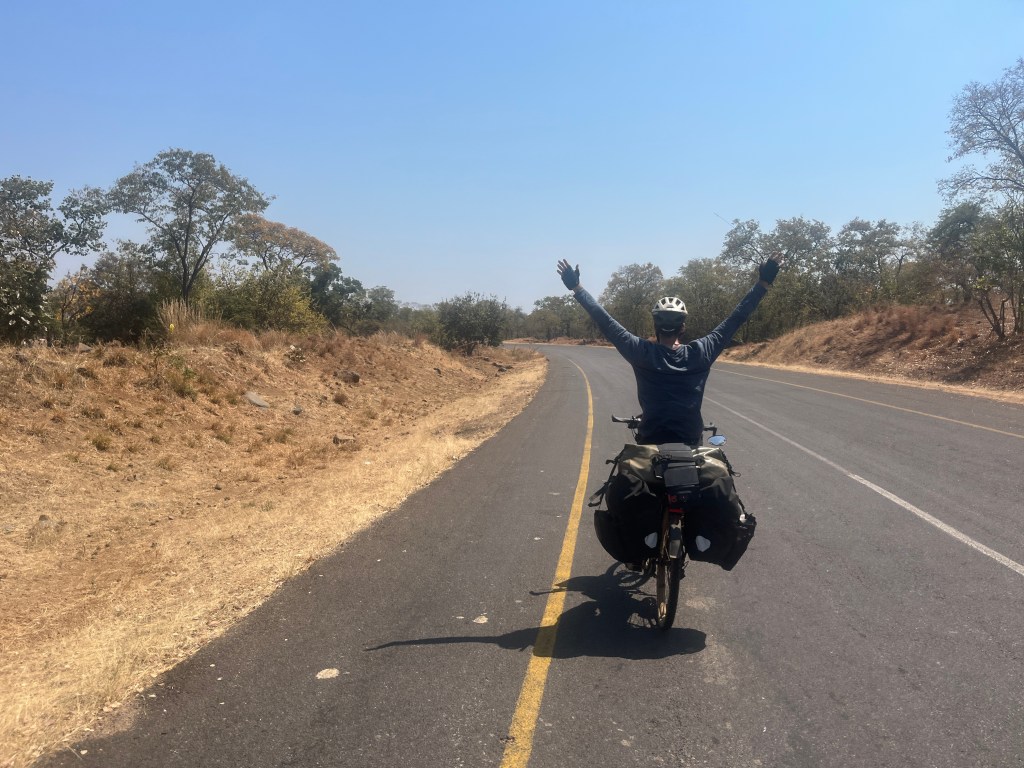
We say bye to this fantastic family, and it doesn’t take us long to hit the road that goes to South Luangwa National park. Wind continues to blow from the East-South-East, so we get a good deal of tailwind. Despite the potholes in the road, the asphalt is compact and the traffic is very low (many white people coming back from south luangwa). By 10 AM we arrive to the place were we planned to camp, 60 km away from Chipata. We feel it’s a bit absurd to stop so early, so we decide to continue. We end up cycling the whole 133 km until the lodge that we got recommended: Marula lodge.

Marula is, together with Croc Valley, the typical lodge were low-mid budget travellers stay. They lie in front of the magnificent Luangwa river, quite dry at this time of the year. Our first view of it is an elephant refreshing himself in the river, and a group of hippos and a crocodile nearby.
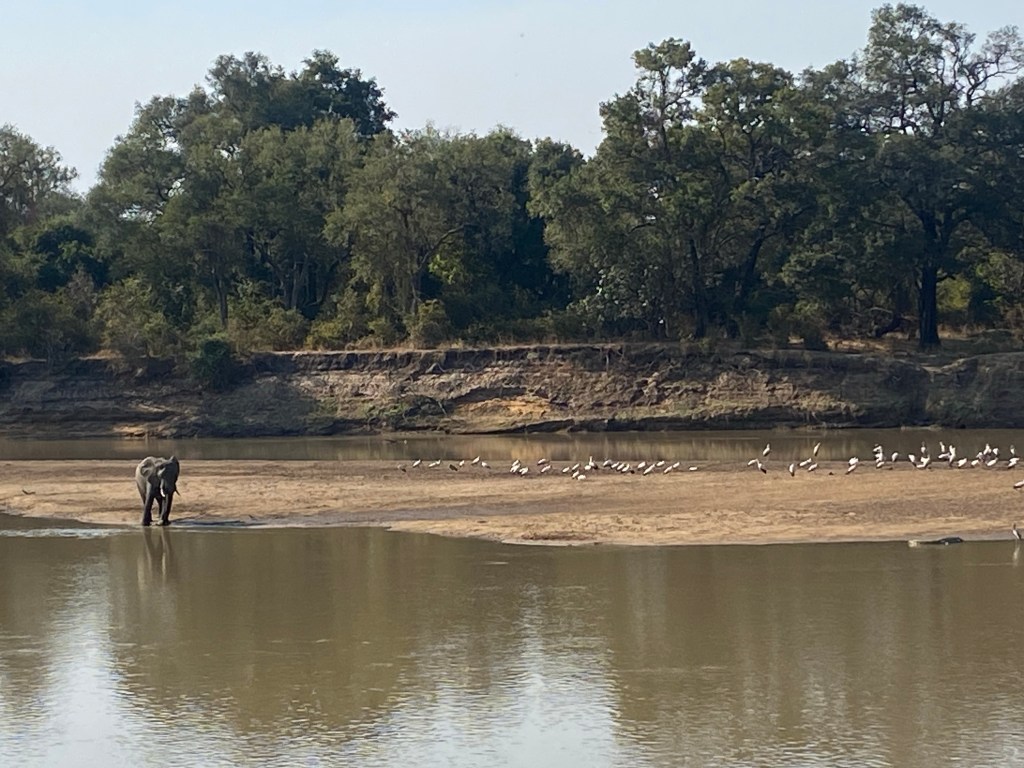
One of the workers warns us about the risks of the lodge: elephants and hippos often walk around, and baboons will steal any food you have visible. It’s mandatory to store all food in the kitchen, and you are under your own responsibility and at your own risk. We noddle shily and attentively, but soon we have the first animal that annoys us: the dog of the owner, who bites us in the ankles playing around, and shows serious intentions of biting the tent.
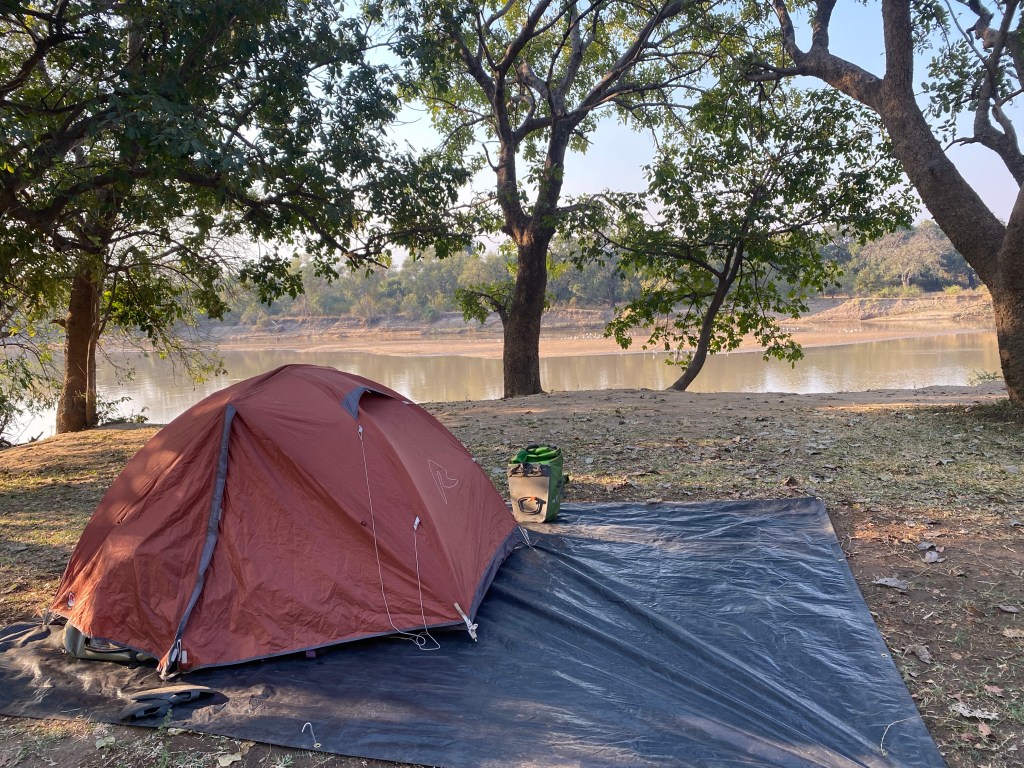
We ask a worker to please control the dog, and, after we are done setting the tent, we enjoy the swimming pool, after what is the longest distance cycled so far in a day.
It’s slowly getting dark and, while we enjoy our recovery beer and some fries, we meet the owner, a German woman of around 60 years old who quit her work in a pharma company and, after doing some safaris in South Africa, decided first to do the guide training and second to buy this resort in Zambia.
Suddenly, during our conversation, Javi has to interrupt her as he is seeing something big in the shadows, around 4 meters away: “What is that??”. – “Oh, that’s a hippo” she responds calmly. We can’t believe that a hippo is peacefully grazing around the camp. After an initial shock and paralysis, the relaxed reaction of the owner, who seems to be totally used to it, calms us down. She starts taking a video, so we follow suit. She does tell us not to use the flash, which we accidentally do and makes the hippo get our attention, which scares again the sh*t out of us. we will most definitely avoid walking to the toilet half-asleep in the middle of the night.

26/08 – Safari day in South Luangwa
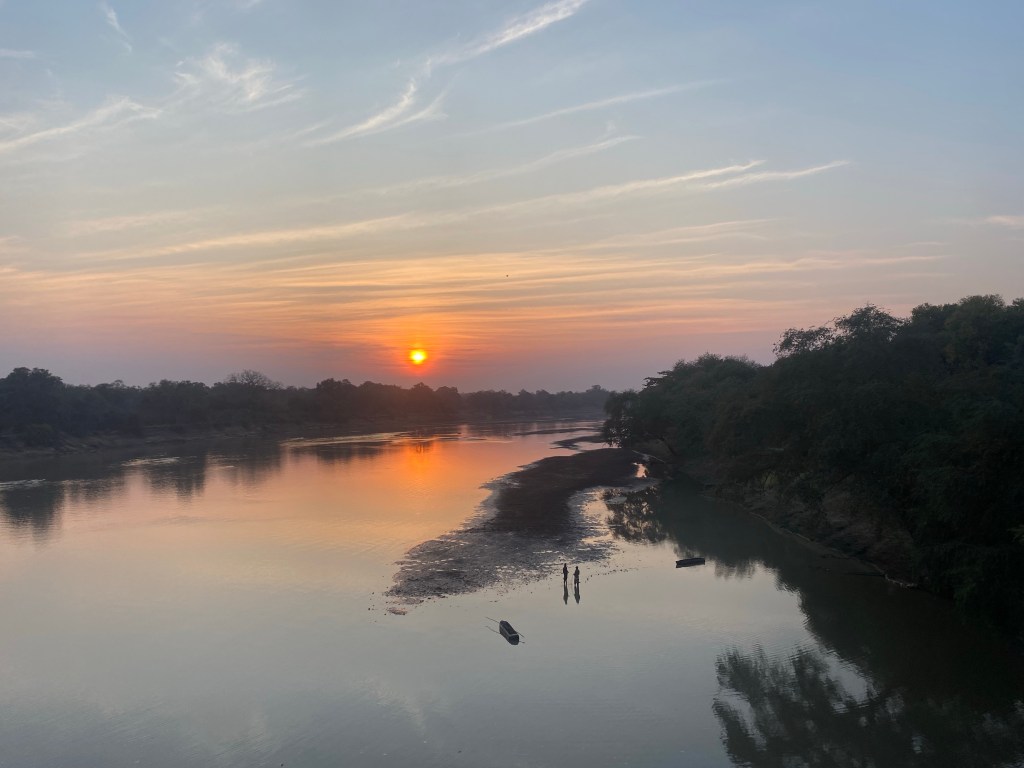
We wake up early to participate in the morning safari organized by the lodge. A yound friendly German couple joins the open 4×4, and soon we are talking about everything with them. The safari costs 50 Dollars per person, plus 25 Dollars for the park entry fee. Our guide and driver is called Safas, and soon as we start and arrive to the bridge that serves as camp border, he stops the car, while we observe the sun shily standing up. “Do you see those fishermen? I used to be one of them. It’s very dangerous here, as you are surrounded by hippos and crocodiles. When it’s rainy season, the currents are strong and falling out of the canoe can imply death. That’s what happened to me. I fell and was pushed under. But I hugged the canoe, hoping it would go up. And it did, just when I was about to run out of air. A guy offered me a hand then, and I survived. That day, I decided I would never get in this river again, and I would fight hard to become a tourist guide.And I made it. Now, let’s continue”. The 4 of us stay silent, realizing once again of our priviledge, and we shily thank him for sharing his story.
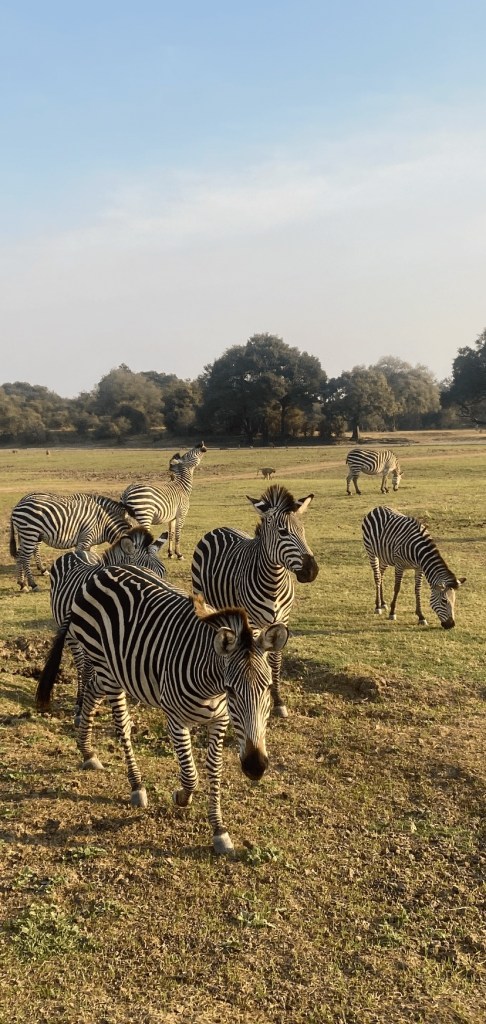
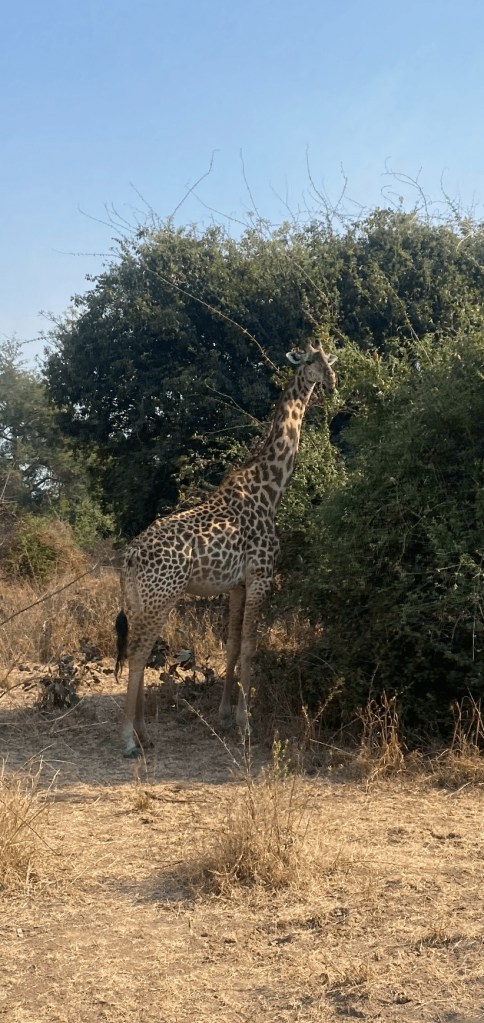
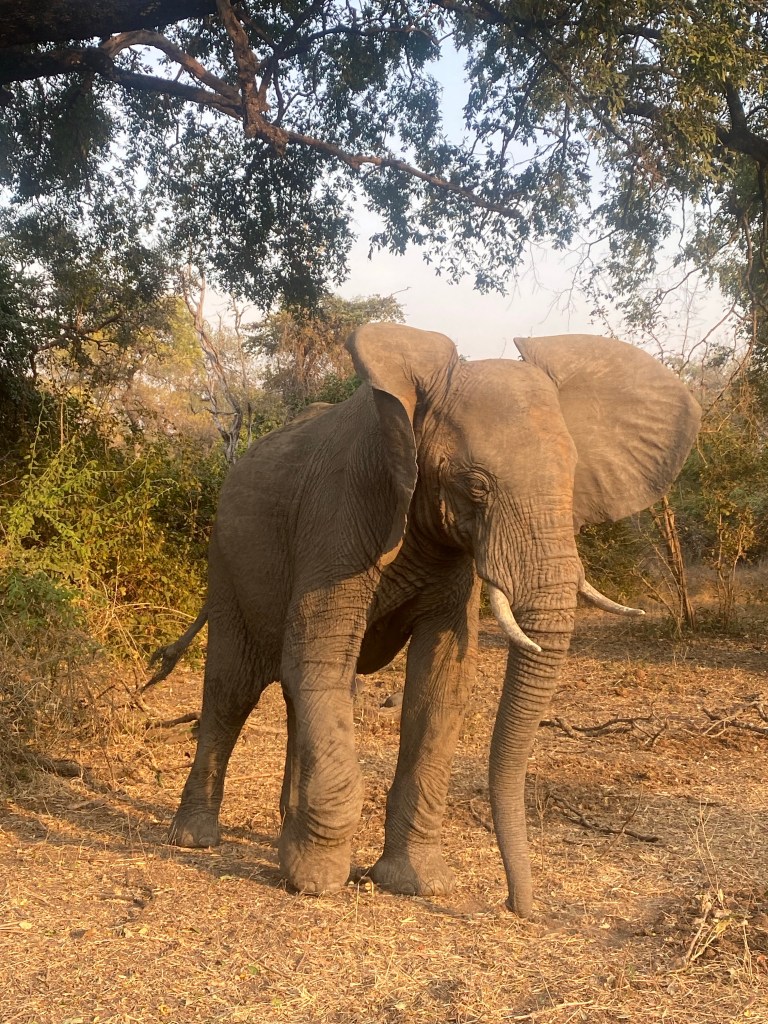
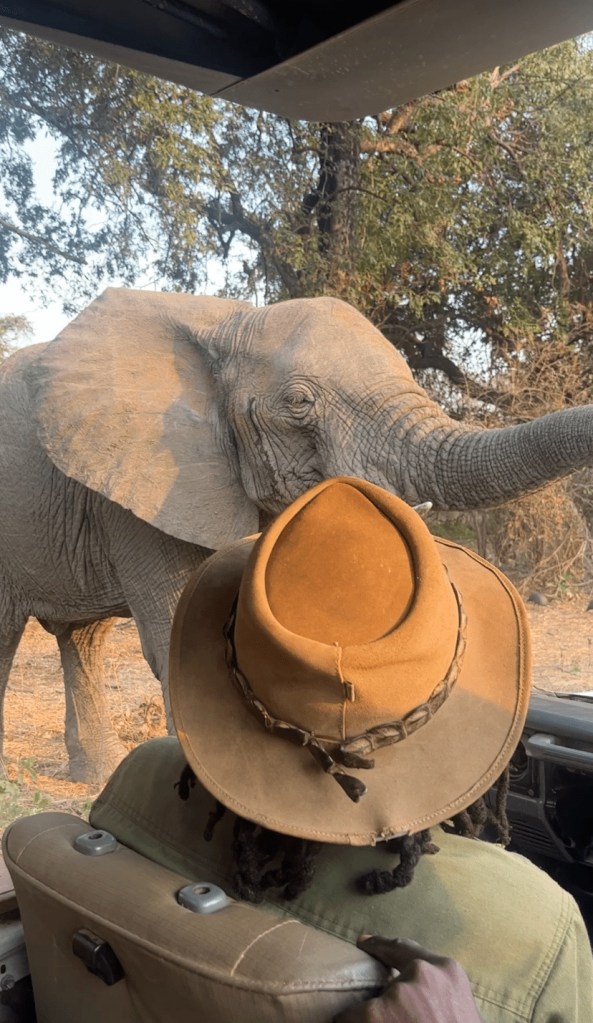
Once in the park, it doesn’t take long to start seeing a symphony of wildlife. Elephants pass so close from our open jeep that they touch it with the trunks. When we find zebras or giraffes, they don’t run away. We also see hyenas, impalas, bushbacks and warthogs. All running around or just relaxing, like if we were not there. We learn from Safas that South Luangwa has been quite successful with avoiding poaching (illegal hunting), so animals tend to be more friendly and less scared here. The difference is just astonishing with the other animals we have seen in Malawi and Tanzania. Safas is an unlimited source of animal knowledge, for example giraffes have a 11 Kg heart to be able to pump the blood from their feet to the head. In addition they have a valve controlling the blood inflow when they drink so they do not pass out.
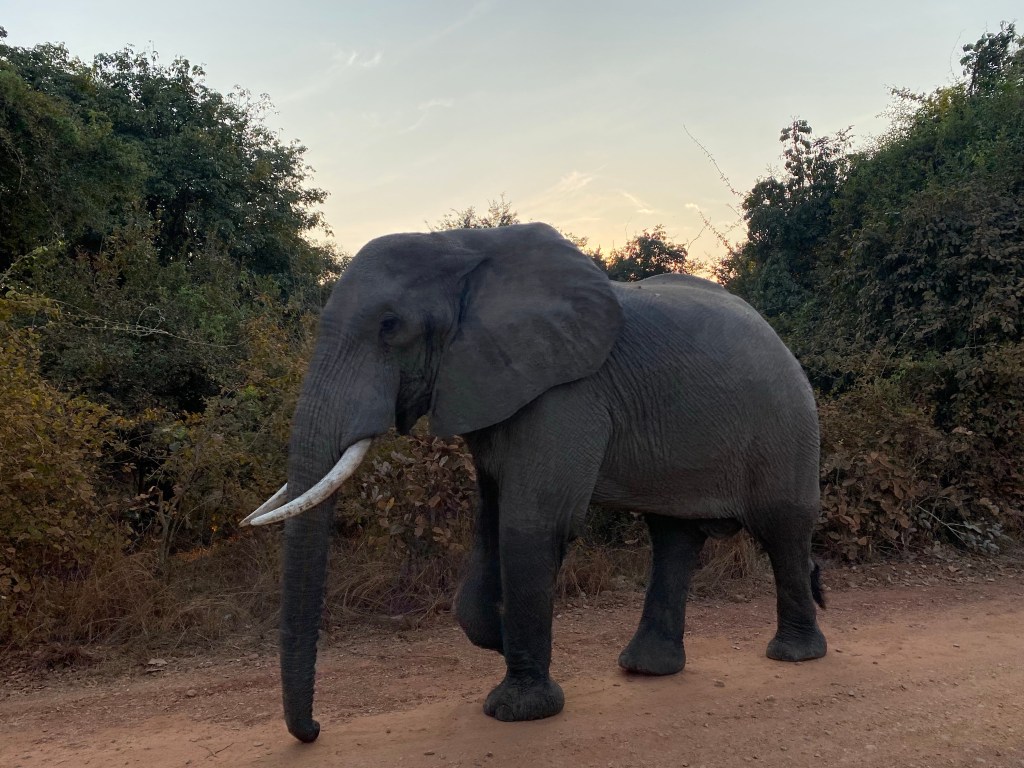
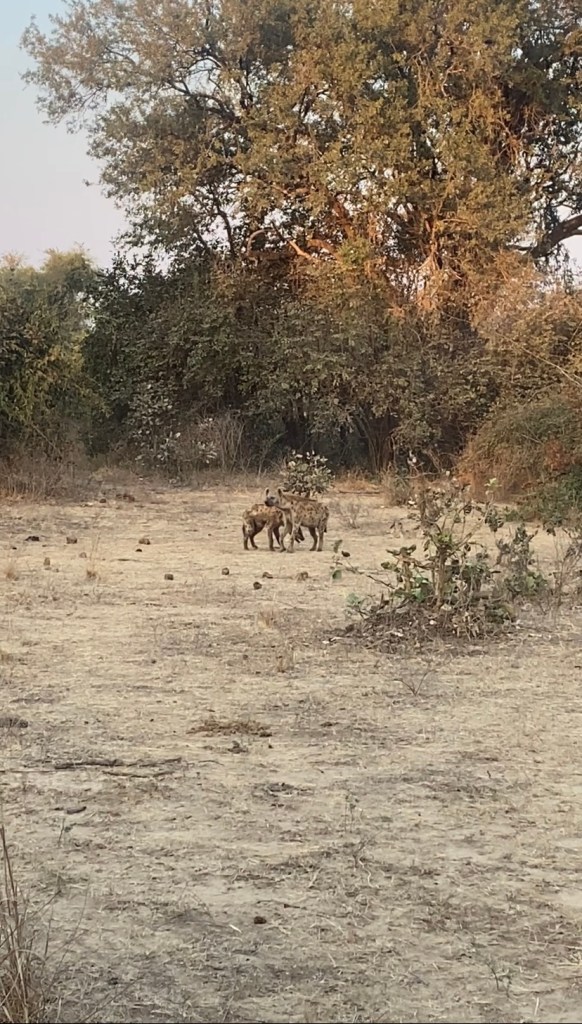
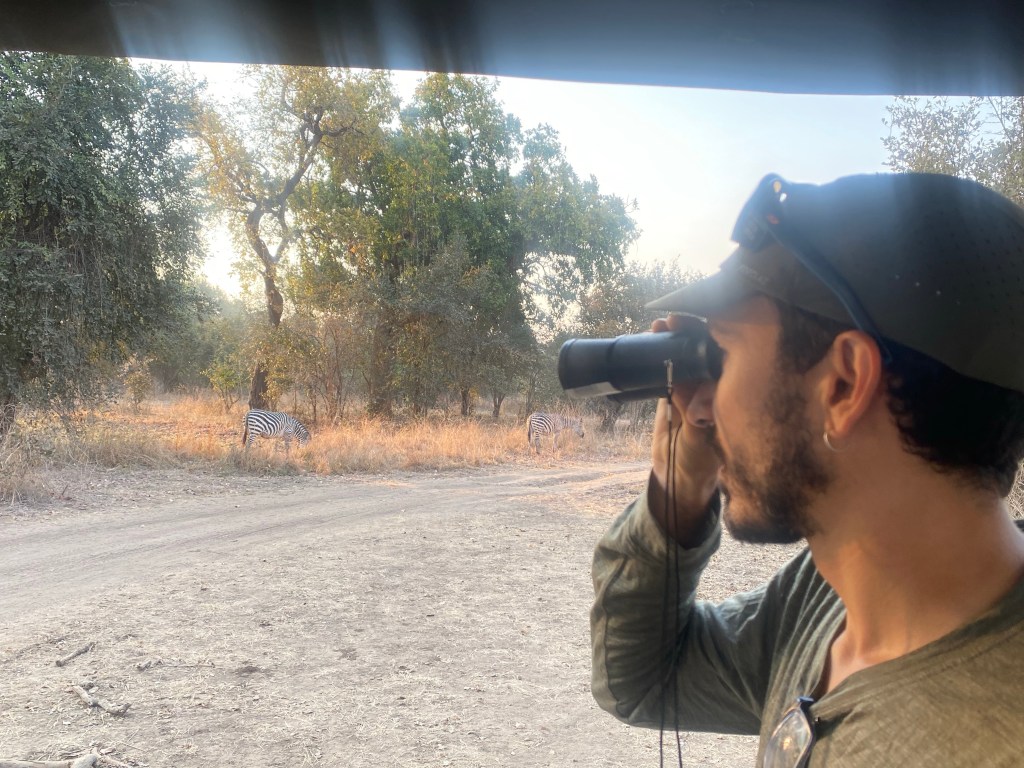
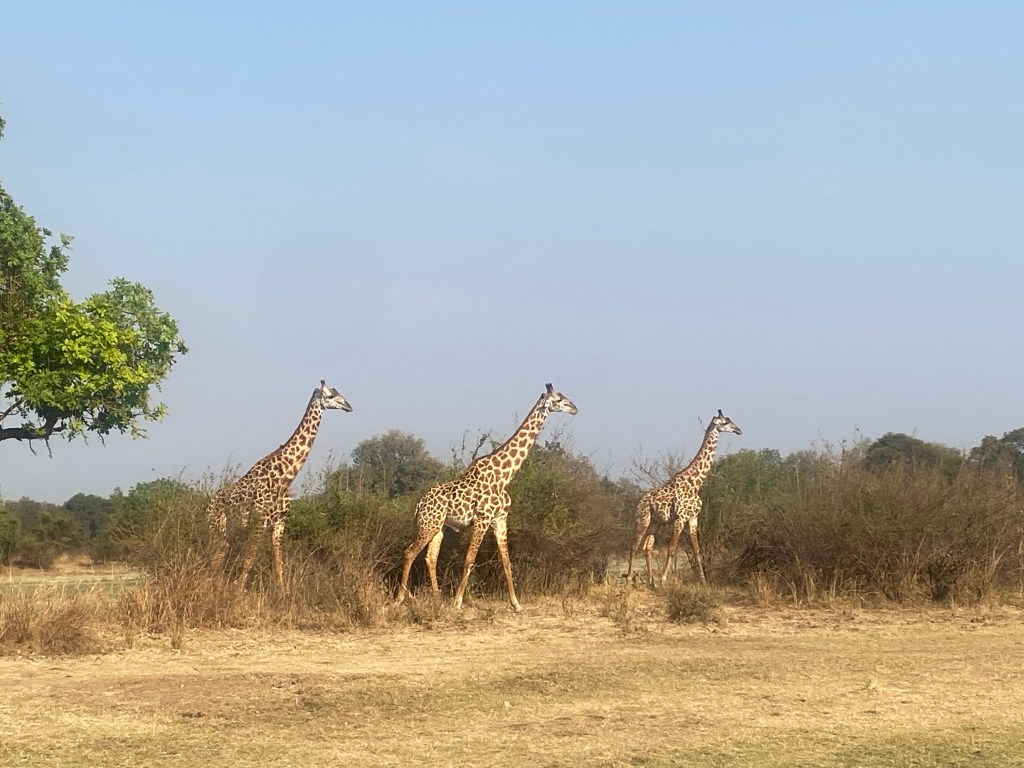
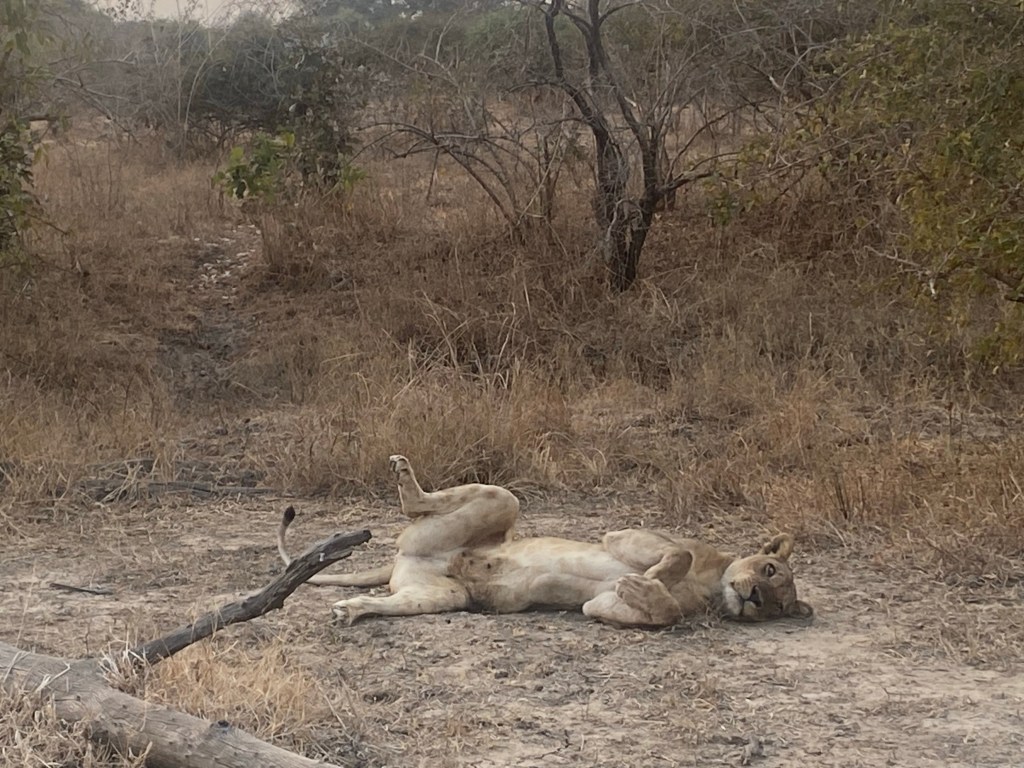
The first hours go by, and we can’t help to think that there is one animal we haven’t seen: the king of the savannah: the lion. We are running out of time, but the 4 of us convene to tell Safas that we are OK with paying a bit more, if that helps finding lions. So, using his phone – there is quite acceptable network within the park – he soon gets a tip of where could be a pride of lions, and there we go.
Although it’s technically not allowed to leave the roads, it looks like everyone does it now and then, and, after 1 hour of searching, we find a pride of 2 female lionesses relaxing in the shadow with 4 or 5 cubs. They are mostly asleep, but it is still a unique experience, again, just 2 meters away. Like this, there is absolute no need for binoculars.

Bird life is definitely also a highlight in South Luangwa. We are lucky to be in the car with Maxim, our new German friend, who is a passionate ornithologist and explains us the different species and their feature. Some birds have hammer-like heads, others have as many colors as the rainbow, others are notorious for being as ugly as it can get.
We return to the lodge, extremely satisfied with our first paid safari, and consider not doing the one in the evening. Maxim, who has quite some experience, tells us that evening safaris are totally different, as predators are active and the things one sees are much more different. Also, there is a spotter, who goes with a powerful night, and the experience takes a particular mattix.
We are so mesmerized by the density of wildlife here that we think we may not need to do many paid more if we do one more here. So we decide to join Maxim and his girlfriend Lara at 4pm for the evening one. This time, the cost is 60 Euro because there is also a spotter. But we can reuse the park entrance. The owner of the park also joins, as she seems not too have many more things to do.
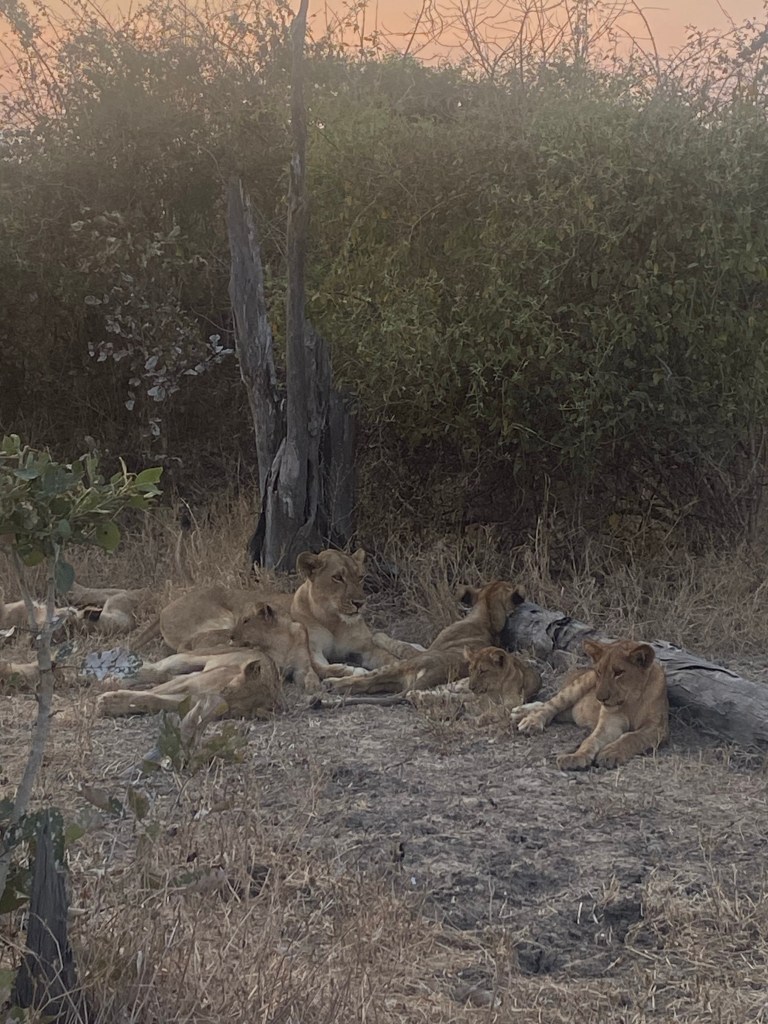
What is clear is that Maxim was totally right. This time, we find a much bigger lion pride, with at least 4 lionesses and 10 cubs. We get ridiculously close to them but we don’t seem to bother them. The driver is so good that he seems to be able to place the car anyway. It’s not easy to stop thinking that if they decided to attack us, we would have no escape. But they seem to identify the car as a whole unit. Safas explains us how important is to observe the reaction of the animals while approaching, so an escape route can be planned in case things go wrong.
We see the lionesses licking the cubs and breastfeeding them while the sun is setting. We see how cubs will drink from multiple females, and confirm from the guides that this is totally common in lions. Male lions go on their own, sometimes in group of 2 (called coalition), and are much more difficult to spot. They only seem to care if another male tries to take over their pride(s).Tragically, It is not uncommon for males to kill the cubs in order to mate again with the females.
One of thelionesses seems to have a very empty stomach. Despite being the one hunting, they are the last one to eat. First the males to protect the herd, then the cubs for the future, and finally the mothers.

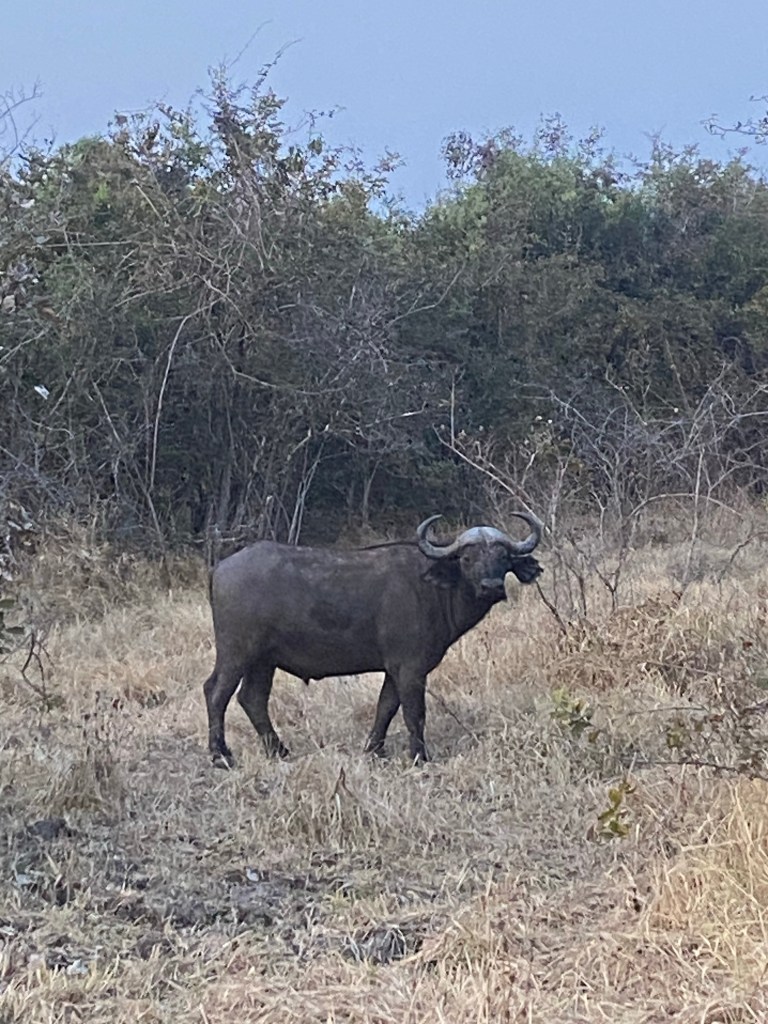
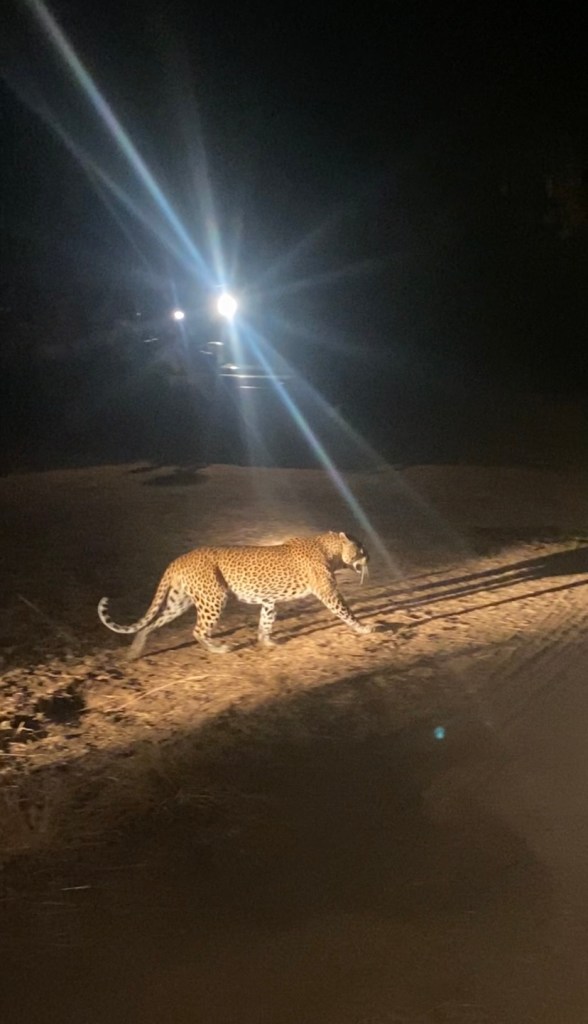
While we are still digesting the fabulous lion encounter, we sudddenly see 2 buffalos. These ones don’t take long to disappear, after looking at us with their pure, innocent eyes. And, when the sun sets, we realize that now it’s time for leopards. We first observe how a hyena starts annoying a leopard so he gets active and hunts something, so that she gets his share too. Another one is walking around, stretching, like if he was warming up before going for the impalas. We return home totally fascinated with the perfection of wildlife in this park. What a day.
27/08 – South Luangwa Gate to Malama, 48.4m, 155m+
Today is the D day. In order to join the Great Eastern Road to Lusaka, the capital, we have to cross 170 kms of dirt road. The first 50 kms border the park and are notorious for having a lot of wildlife. Those animals see many less humans and react more aggressively. The guides are a bit concerned of it, but we have 2 solid reports of other cycle tourers that did it, and said that, with a bit of care and good timing, it can be totally fine.
We aim at leaving at 8 AM, to make sure lions are already asleep because of the hot weather. One of the guides told us the day before that they stop being active at 6 AM, but then, another more experienced one, told us that we should wait until 8 AM. Luckily, we asked a 2nd one.
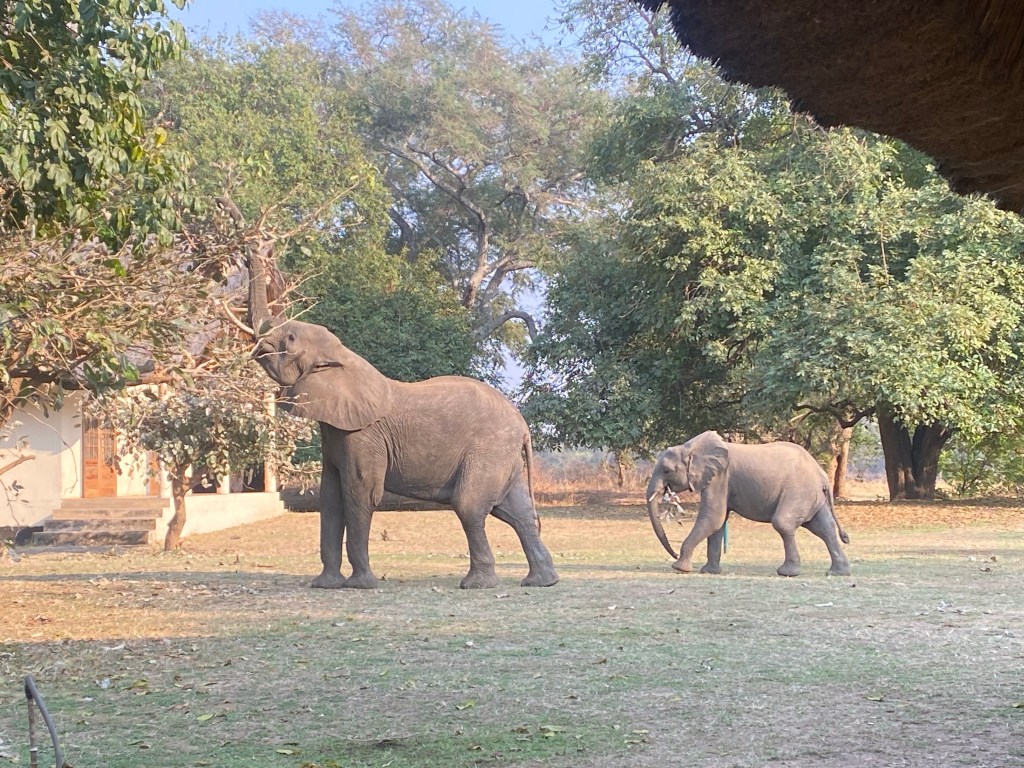
The day starts hectically. First, an elephant and his baby appears in the camp. The dog of the owner, who is young and excited about anything (particularly about our camping tent) starts annoying the elephant and that creates some moments of tension with the elephant trumpeting with the trunk standing high and chasing the dog. Crazy. Then, while we are eating our breakfast, a group of baboons approaches our table like a rocket and steals our fruits. We look at them with hate, while they make funnny noises from the trees.
Inevitably, these events delay us, and we only leave at 8:30. The road is poor and has some sandy patches, but it’s mostly ridable. We are really tense about elephants, so Javi puts his glasses on (he normally doesn’t use them), and we agree we won’t give much distance between us, and that each of us will scout one side of the road. We both agree today is the day we do NOT want to see an elephant.
There is very little traffic, one or two vehicles every hour. Soon, the sun is hitting hard, and the whole combination starts to be very intense.
It doesn’t take too long before we see the 1st elephant. An adult male is covering himself from the sun below a tree. It is around 25 meters from the road, so we get out of our bikes, identify an escape route (a big tree), and slowly and silently pass in front of him. Uff, first one complete.
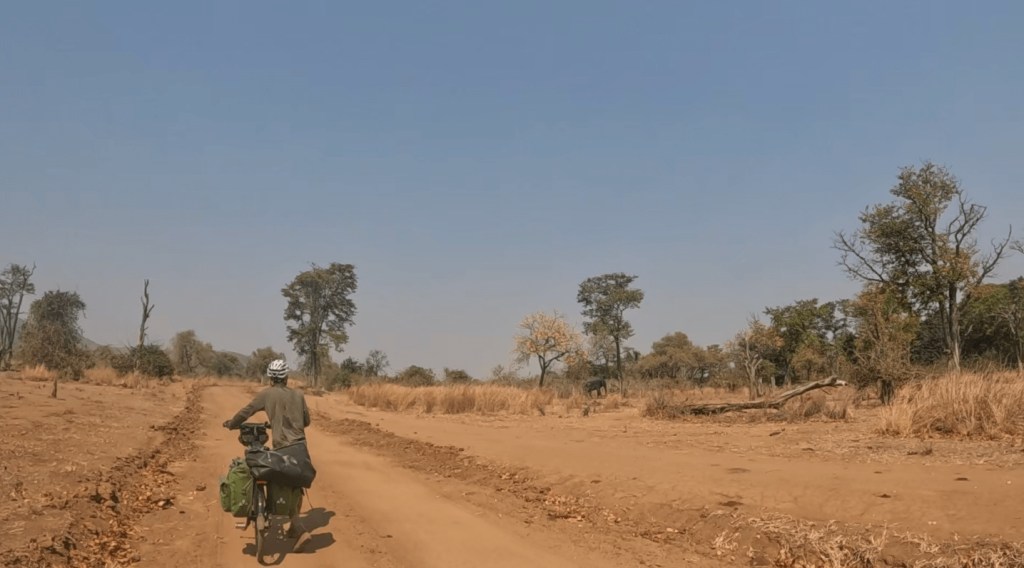
A bit later, a pickup comes in the opposite direction, with some brittons inside. They tell us that there is a big herd of 30 elephants a kilometre down the road, very close to it. Suddenly, an elephant appears from the road they came from, like if it was following their car, and the very brave Brits take off immediately. Thanks for the help, guys.
We park our bikes, look for an escape route (another big tree) and cautiously walk to observe the elephant better. He seems to be alone and it’s grazing below a tree, 15 meters from the road, looking opposite to us. So we repeat the operation. But, as soon as Javi gets on his sight, he turns and starts staring at Javi. As recommended, Javi doesn’t move, but much to his disgrace, the elephant starts walking decidedly towards him. Since there is a protection tree 5 meters away, one has to have balls of steel not to move then. And, when the elephant starts being less than 12 meters away, we start walking backwards, slowly. The elephant stops at the same time. I (Javi) promise that if he had come 2-3 meters more, I would have thrown the bike and run towards the protection tree. But it didn’t happen, thank God.
After this failure, we obviously wait until there is no trace of him to continue. Luckily, a guy comes with his motorcycle and makes excessive noises on purpose to scare the elephant. We see the elephant running away through the bushes. Success, we can continue! But we know there is a big herd ahead, so we are extremely attentive and cautious. We spot parts of the herd in an open space, more than 100 meters away. As we get closer to them the road leaves the open space into an area with high bushes and trees and we lost eye sight from them. We hear many noises, monkeys running away from where we believe the elephants are but that we can’t see anymore. Damn ! Suddenly two elephants crosses the road ahead of us. No way we continue without knowing where the rest of the herd is. It’s then that a pickup with locals inside appears. They go in the same direction as us, and they very kindly offer us to follow them, as the engine of the car keeps the elephants away. We do so and, relieved, we arrive to a camp post, where they tell us that there should be many less elephants from now on. (Partial) success!
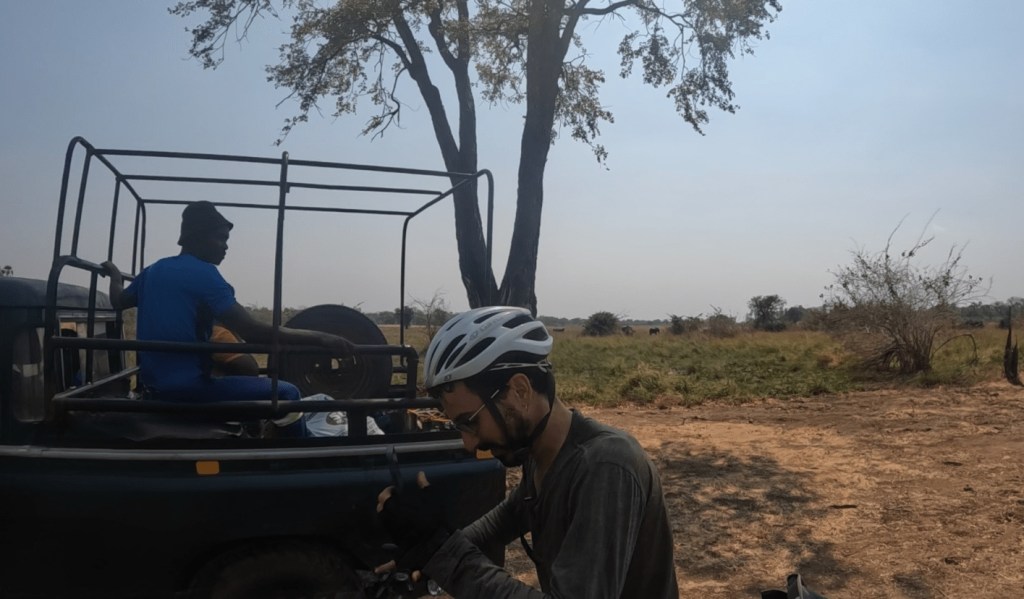
We are very surprised by the scattered lodges that we pass. They seem to be private and owned mostly by brittons. Acccessing them seems difficult and dangerous, but we will soon find out more about them.
A bit later, Gaspard stops Javi, as a group of 4 elephants is crossing the road 100 meters away from us. We can’t help to think what would happen if they would just cross not 100 meters away but 5, since the sides of the road are often bushy. They move monotonously, as if they were slow, but it doesn’t take much calculus to observe that they are actually very fast because, well, they are freaking big.
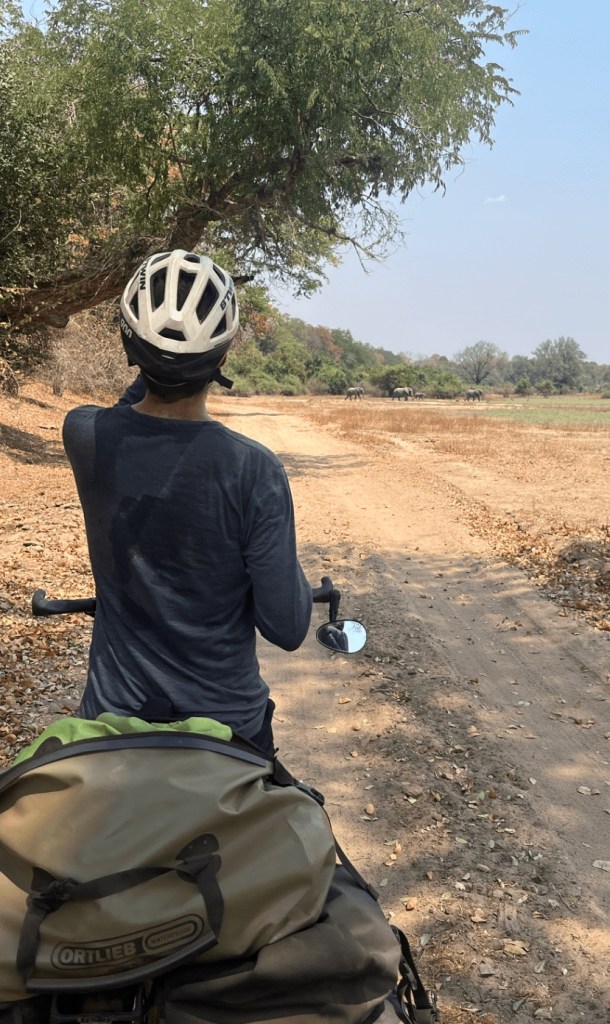
This fourth encounter will be the last one, as we arrive to a school (in a natural park) and then to a series of villages, where kids play in the dirt road, there are crops and we struggle to believe there is so much density of wildlife there. And now the magic happens. A pickup comes towards us and stops. On board there is Andrew, an English man born in back-then South Rodhesia, and his local contact Patson. We very soon realize that Andrew is a special one. He speaks Chewa (local tribe language) fluently and offers us to join him, as he will be paying a visit to the local chief today. There will be some dances, and he can offer us a cold beer. He can then drop us at a safe spot, in a hospital clinic he is helping to modernize, 15 km in our direction.
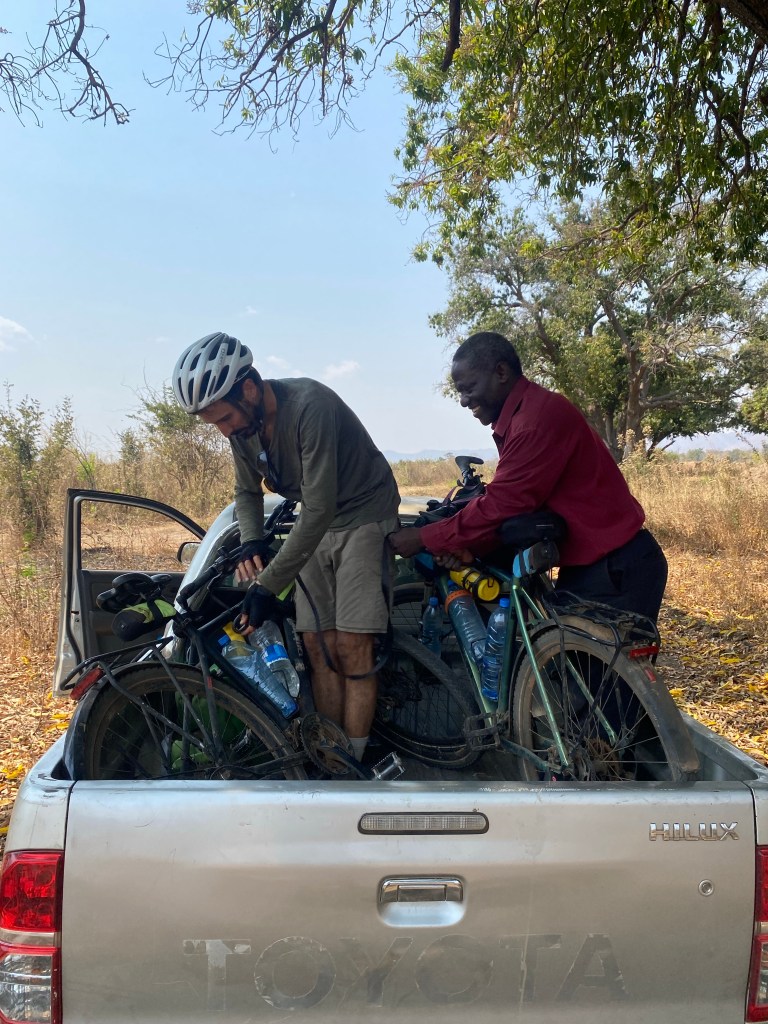
Although we wanted to cycle more kms today, it takes one sight between Javi and Gaspard to agree that this is a unique opportunity. So we gladly accept, thankful for the hospitality of our new friend Andrew. With the help of Patson, we pack the bikes in the back of the pickup, and set towards the lodge where Andrew is staying.
The owner of the lodge wanted Andrew to pay for his stay but the local chief told him he could stay for free. You would expect the owner can decide what to do in his private property but apparently the land always belong to the chief and he can kick anyone out. After explaining to the owner how things work in Africa, he managed to stay for free.
Andrew’s brother, also lives in the area and owns a private game reserve in the area, and a vast farm in the southern region of Zambia. At the lodge, Andrew’s wife and Steven, an old school friend of his, are awaiting. They are all retired and obviously enjoying a dynamic and exciting retirement age.
Andrew and Steven were born in Zimbabwe, Southern Rodhesia at the time, and left when the political situation got too unstable, as most of White Zimbabweans did. But they both keep a deep connection to Africa, particularly Andrew, who owns a house in the eastern town of Katete, and is now devoting his work time to different development projects. He manages them pro-bono and takes care of fundraising too. We are very quickly impressed by all what he has accomplished, and all what he wants to achieve still. As an example, the regional Katete Hospital now counts with a solar and battery system that has expanded and ensured the energy supply for its 500 bed capacity. Renowned UK doctors spend periods in the hospital, conducting surgeries pro-bono and making a true impact in the lives of the locals. In fact, before the implementation of the system every second birth had to be performed under the light of a phone or a lamp.
After enjoying a refreshing Fanta with our new friends (we went for sugar drinks to avoid dehydrating with the beer, as the sun is very strong and the humidity nearly unbearable) Andrew gives us a towel and offer us to use the shower in his bathroom: an offer we can’t decline. We head towards the Chief’s “Palace” (that’s how locals called it) in Andrew’s pickup.
We reach what looks like just a normal house but obviously above average compared to the neighbouring ones. Patson conducts us to a open circular cabin, where we sit in front of the chief’s throne, waiting for him to appear. The throne is madde out of a beautiful wood, with hippo shapes on the handles, and lions on the back seat. Patson asks us to make to kneel (only the men) when the chief appears, and to remove our caps. We are obviously a bit nervous.

A few minutes later, a thin man in his 60s, wearing western-like clothes and a textile, arab-looking circular hat, makes his appearance. He is followed by his wife, a wide, much younger woman, dressed in colourful african clothes, including a fluffy, color-matching hat. They welcome us and tell us they are available 24/7 for us. After that, only Patson will intercede with the Chief, who is called Karonga in Chewa, talking in local language.
He invites us to his house for lunch, despite he won’t join, as the tradition prevents the chief to eat at the same time as his guests, including his wife. He eats first and alone, then his wife and finally the guests get what is left. For lunch, a surprise is waiting for us. Additionally to the typical nsima (mashed corn), there is buffalo meat stew, which is the tastiest meat we have had in a while. Patson tells us that the government granted permission to the Chief to kill a buffalo that was terrorizing the locals and destroying the crops.
We keep learning from Andrew, Anne (his wife) and Steven. Anne is from Australia and used to be an Opera singer. They live in the countryside of South England, and their sons will soon be visiting Zambia for a family reunion.
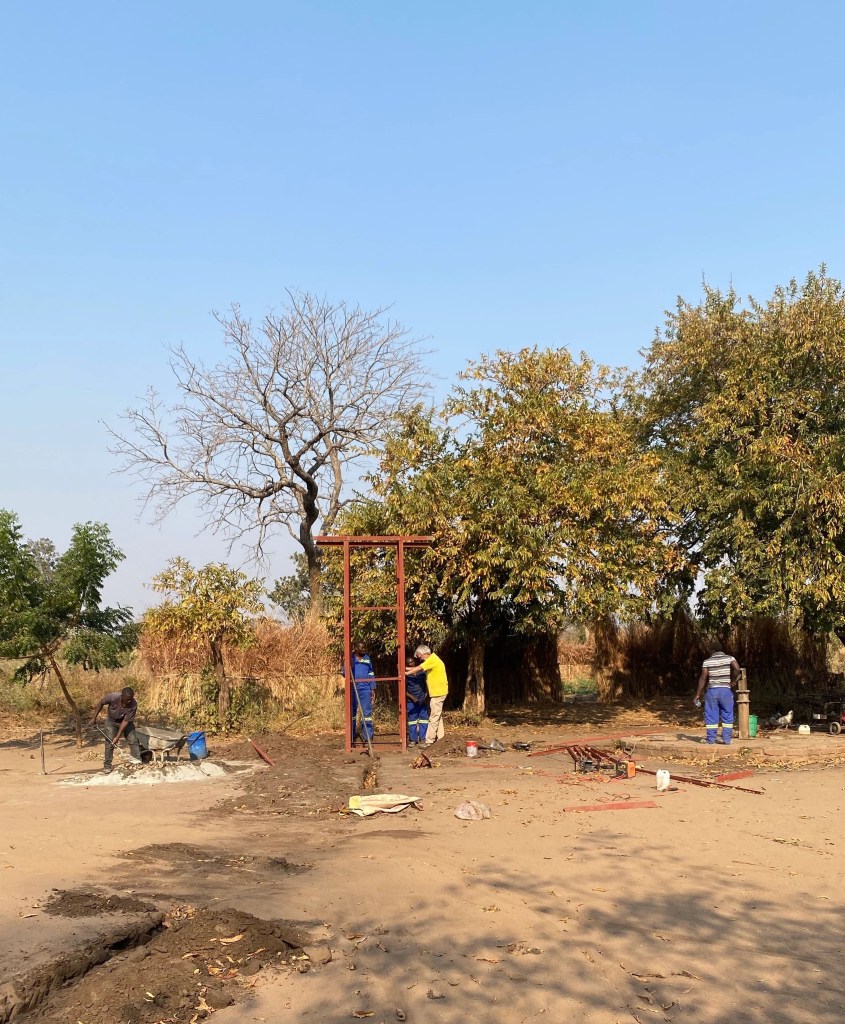
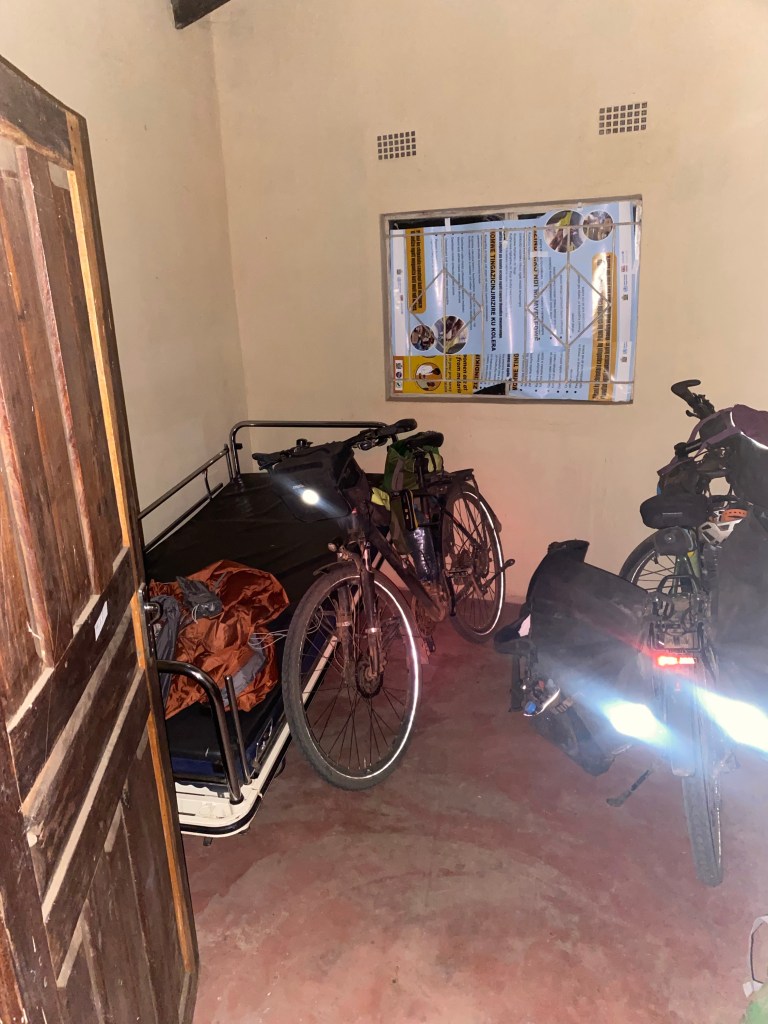
We then head towards the local clinic, where Andrew is installing a 10’000L water tank and plans to install a solar system there. We will be sleeping in one of the empty operation theaters, where we can also lock our bikes. The clinic is in a very poor state, but there are some workers hired by Andrew installing a water tank. Andrew is hectic, making calls with other workers, supervising what the workers at the clinic are doing, and making sure everything moves forward. He is just a man of action, our admiration keeps growing.
So we drop our bikes and bags there, and head towards tthe place where the traditional dancing is going to happen. A big group of locals is already gathering around, including loads of children, women dressed in traditional clothes and some drunk-looking men. It’s very interesting how it’s always the women who excel in preserving the local clothing and traditions, while men tend to westernize and fall into mainstream global culture much faster than women. Power to the women!
There are around 8 plastic chairs for the selected VIP audience, this is: The king and his wife, another important-looking man dressed with a blazer, and the group of muzungus. Once the chief has arrived, 5 men with big drums start slowly singing and playing, and a dozen of women start lining up in 2 lines, and shaking their hips in ways that only Shakira can do. The rhythms are intense and the songs they sing repetitive yet very beautiful. For the music connoceurs like Javi (:-P), you can imagine it like an accelerated cumbia. The small kids of the audience replicate the dancing marvelously, proving that Africans are just gifted for rhythms and music. Some drunken men join the women with some lower skill level, looking at the Karonga in ways that makes us think that the protocol is very different here.
The music is just too good to stay seated, and Javi stands up behind the chair to shily follow the rythm. It doesn’t take long for one of the men to pick him and bring him to the center. A woman laces a traditional textil around his hip, and Javi tries to follow the steps of the woman. The crowd laughs and cheers him up, women shout high-tone and frequency cries, like they did in Ifakara when the train arrived. What a moment.
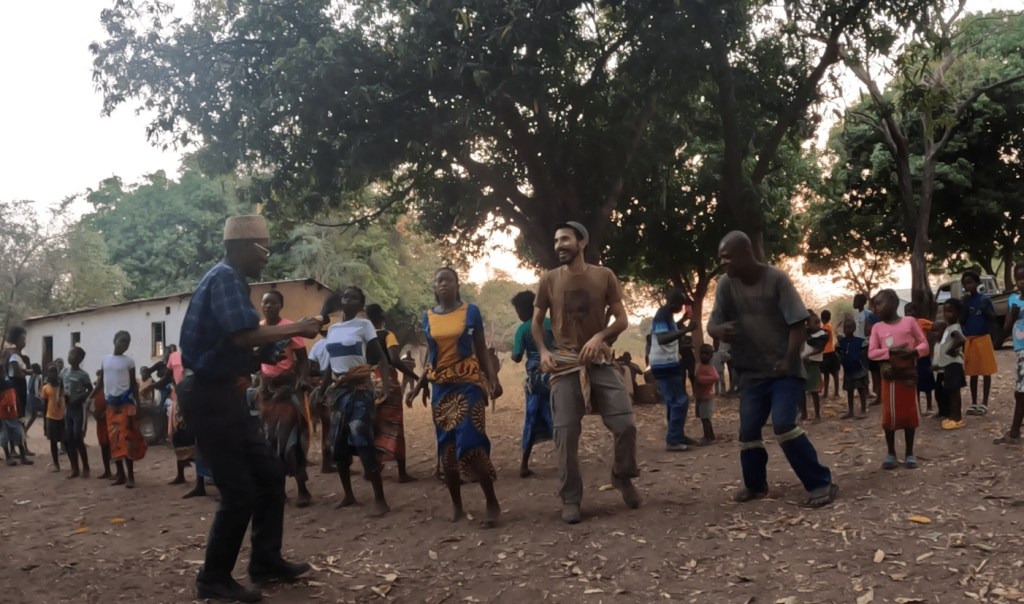
Suprisingly enough, and much to Javi’s sadness, after some 2-3 minutes, the King decides it is enough for a muzungu that is supposed to be part of the audience to be part of the celebration, and he takes Javi out of the crowd. But one of his men doesn’t sem to get the King’s intentions, and immediately substitutes Javi with Steven, who dances along and does a pretty good job. During the ceremony, we observe how respectfullly the men act with the Karonga, as if he really was a feudal lord. We will learn later that the men that danced drunken in front of him in ways that diidn’t look to respectful, were actually his son and nephew.
The dance ends up with the sun, as driving in the darkness is dangerous around here because of wildlife. Before leaving, we go back to Karonga’s palace to formally say goodbye as the tradition dictate it. He gladly takes a picture with us and thanks Andrew for his projects. Andrew highlights that it’s important to acknowledge too the network of donors he works with, and that immediately triggers our thoughts: “Why don’t we join this initiative and contribute to Andrew’s projects?”. Andrew drops us off in the clinic and we exchange numbers. We tell him we would like to explore the option of us supporting his projects, which he is very happy to hear.
During the night cooking (spaghetti with tomato, onions and peppers, what else), the more we think about it, the more we like the idea. Andrew operates in a very efficient way, yet he only employs local people for his projects. He speaks the local language and doesn’t get anything material out of the donations, as he works on it “because he loves it”. It’s pretty evident he doesn’t need money personally, and he is respectful yet strict and serious with the workers of the projects, including surprise quality controls and budgeting. The impact of the projects is very tangible, and the amounts needed to execute them, reasonable (The solar system for the village clinic would be around 10’000 Euro). We agree we will discuss it in depth once we are in Lusaka, the capital.
28/08 – Malama to Petauke, 122 km, 1200m+.
Since Andrew’s appearance delayed us on our plans to reach the Great Eastern Road, (obviously it was very much worth it), we have extra work to do today. We are short in drinking water, so stopping before Petauke, the next big town, doesn’t seem an appealing option.
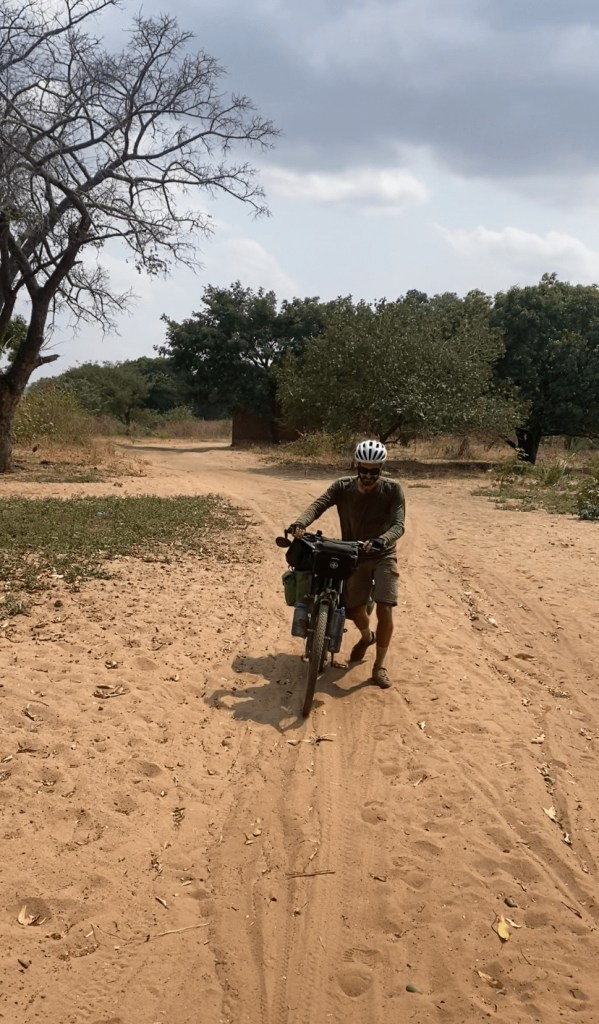
The road is now more populated, what means wildlife risk is lower, but the surrounding is pretty rural and the road is slopy, sandy and slow, yet ridable. We start pretty badly with a solid downhill fall of Gaspard due to a slip of his front wheel in the sand and his inability to rebalance the bike. Luckily nor the Gaspardo neither the Gaspardo bike get damaged, and we are good to continue, this time with extra attention. We also see two moto taxi with passengers capsizing in a similar manner. Slippery road.
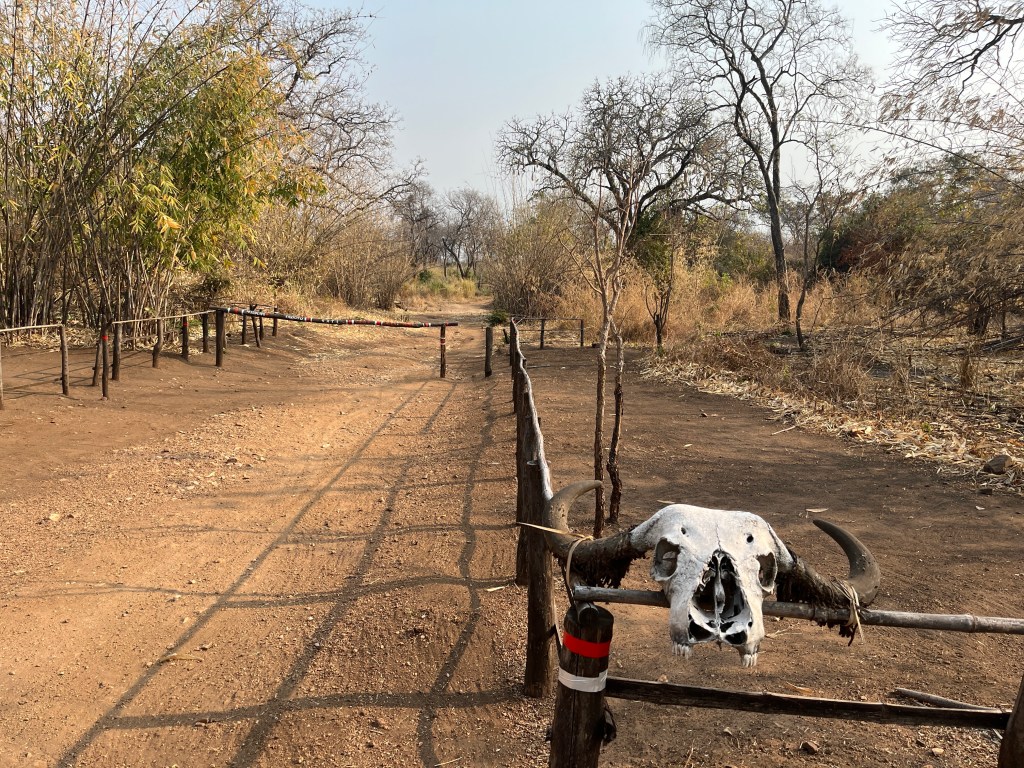
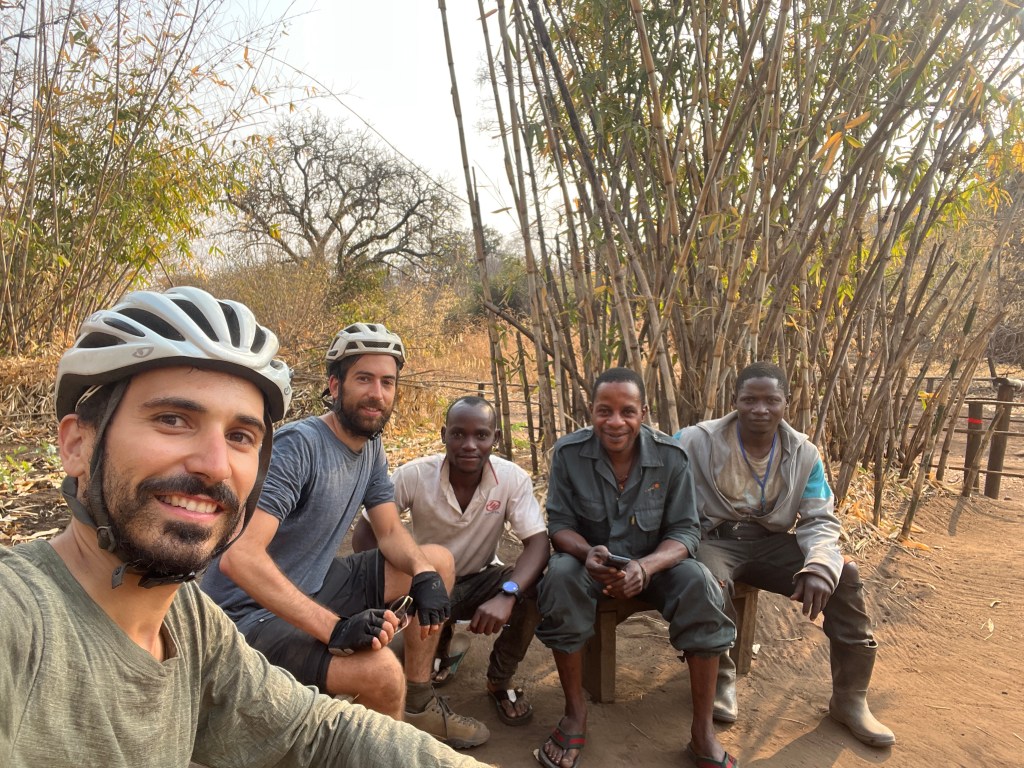
Something particular of this segment is that every single kid that runs to encounter us asks for sweets. Later on, some will also ask for “bola”, which seems to be “football”. We suspect that a previous donation or gift by other westerners has created a local legend among kids about muzungus being some kind of santa claus that have nothing but sweets and presents in their bags. It’s very interesting, because after some 50 kms, this belief drastically stops, with kids just greeting regularly and occasionally begging for money.
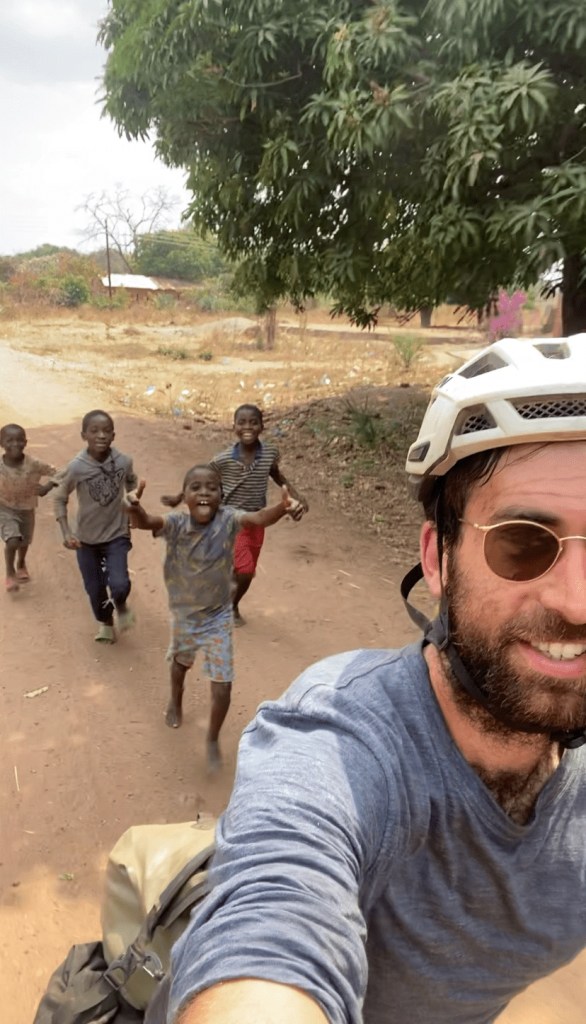
We continue the journey and take a 2km de-tour to a nearby village to meet the only restaurant on the road until Petauke. We add a cold Coke to ensure a sufficient sugar supply for what is left. Together with some Oreo cookies, this makes our energy source between lunches.
The wind is mostly side wards, which difficults our last pushes. We can’t help but to laugh when the wind stops just when we were are supposed to get it from the back, just before arriving. We are totally destroyed, as the km count is very high. Before the final slope, we knock knuckles and motivate each other. Some final sweat while the sun is setting and there we are, we made it to Petauke.
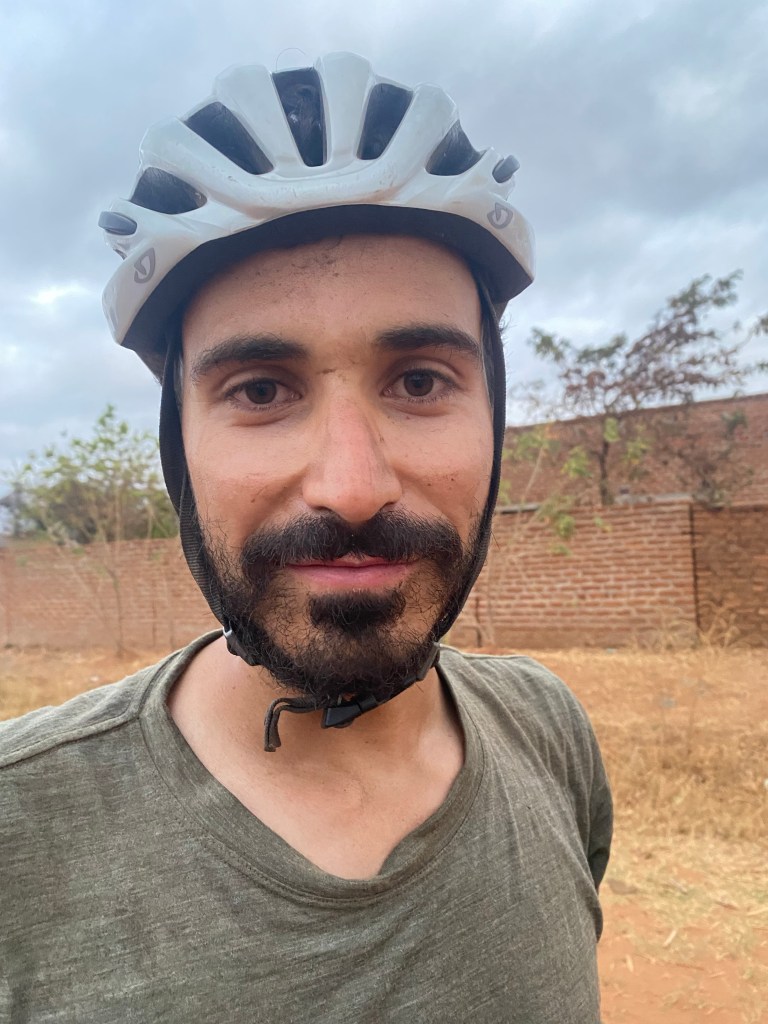
We decide to stay in the only ioverlander hotel marked, as camping is not an option today. The room seems clean but a bit expensive for 6 Euro each, particularly because there is no hot water, towels, shampoo, pillows and even electricity. We complain to the desk guy, who passively and politely gives us what he has, and tells us that the light should come again any time soon.
After a shower in the dark, we head towards the town center, where we find some big supermarkets with take away, but funnily no restaurant. So we take the latest available units of rice, beans and chicken available, and return to the hotel to eat it, obviously with a very well deserved beer.
We are very happy and feel a sense of accomplishment after having completed this road fulll of wildlife. We are sure that meeting the chief and witnessing and joining the dancing will be a highlight we will remember ever, and South Luangwa national park will be something we will always talk about. As of tomorrow we have a different challenge: The Great Eastern Road, with 400 km of asphalt until Lusaka, the capital of Zambia, where a french cooperant has accepted our warmshower requests. We keep excited for what it’s yet to come, and thankful for what he have lived so far!
Days cycled in this post (total in this trip): 6 days (35)
kms cycled in this post (total in this trip): 363 km (1928 km)
Elevation gained in this post (total in this trip): 2230m+ (20’300m+)
 Cycling Pirates