
song while writing: Men at Work – Down Under
7/09/23 – Siavonga (Zambia) to Musango Camp. 33 km, 530m+
Although the day starts as usual, with a beautiful sunrise and peanut butter, the border crossing of today makes it special and we are a bit nervous about what to expect in Zimbabwe. It takes us less than an hour to arrive to the border cross, which is on the dam of Lake Kariba, the largest man made lake on Africa. It is shared by Zambia and Zimbabwe and each country has its own set of turbines. To put things into perspective: the lake generates 6.4 TWh/year, which correspond to 10% of the yearly power demand of Zambia, and 88% (!!) of the yearly demand of Zimbabwe. As we get our exit stamp in Zambia, an old man warns us about wildlife in Botswana, telling us that a man he knew was eaten up by lions in the outskirts of a town. It’s not the first, and probably not the last, wildlife horror story that people tell us, attempting to warn us about the dangers ahead of us, but we also suspect a bit of alarmism.

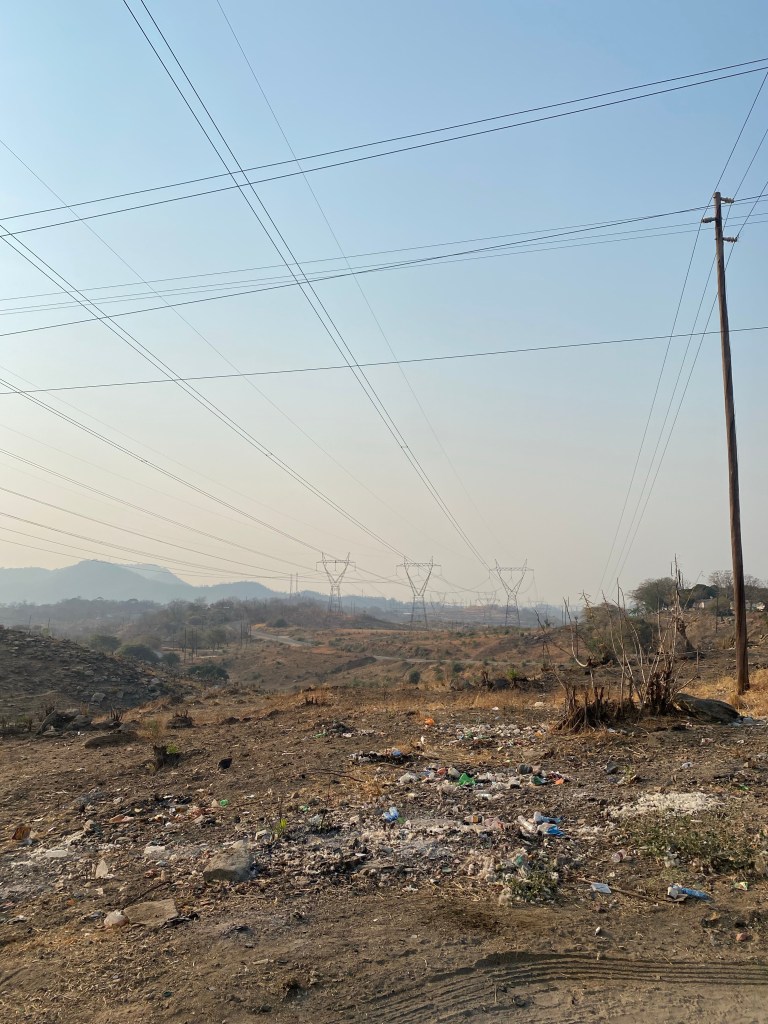
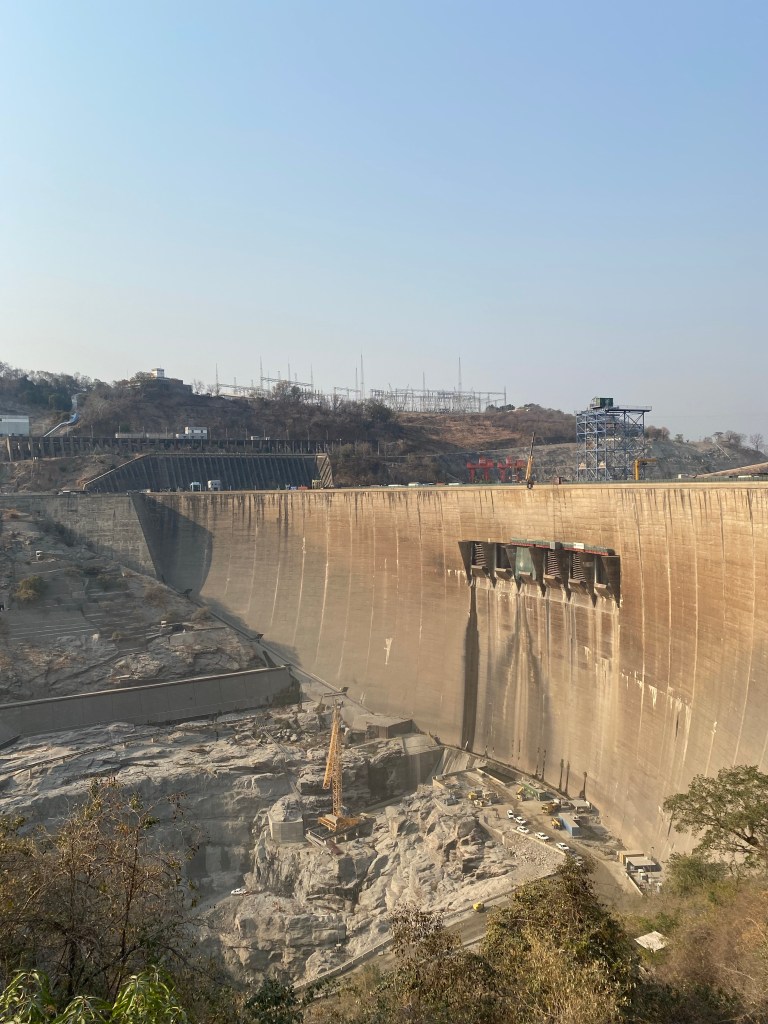
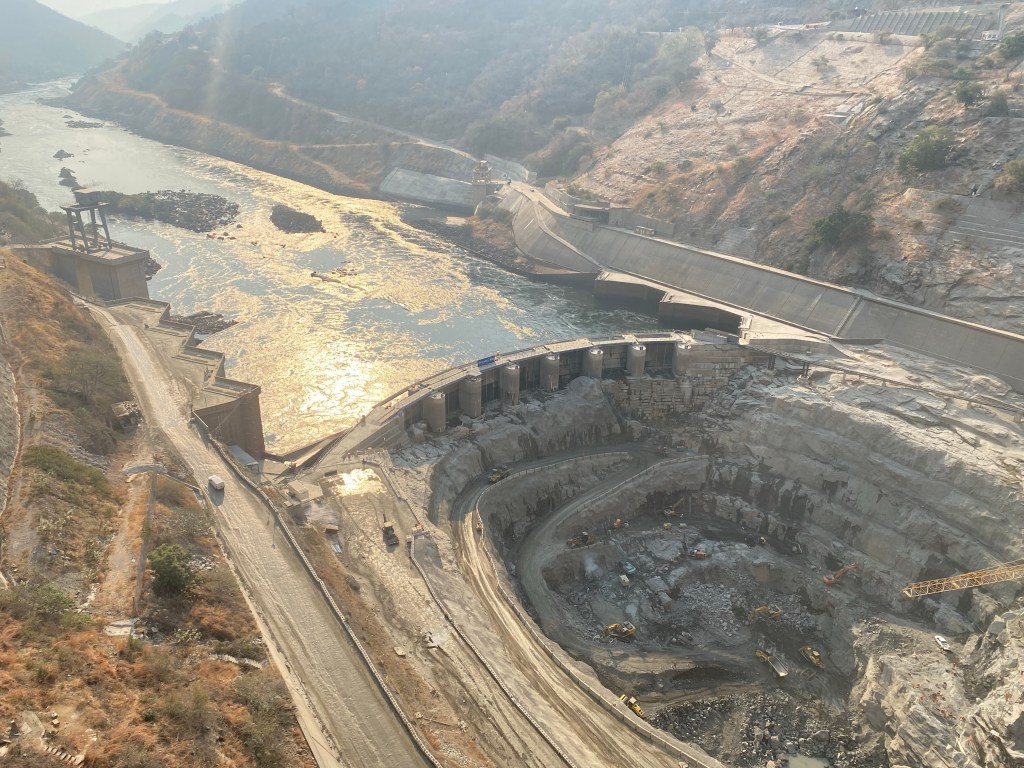
In order to arrive to the Zimbabwean side, we go down a steep ramp with barbwires on both sides and numerous high tension lines above us to then cross through the actual wall of the dam, which offers drammatic views. The dam is 128 metres tall and 579 metres long. Unfortunately, the Kariba Dam is in a dangerous state. Opened in 1959, it was built on a seemingly solid bed of basalt. But, in the past 50 years, the torrents from the spillway (gates for excess water) have eroded that bedrock, carving a vast crater that has damaged the dam’s foundations. As a results it is undertaking a major renovation under the management of two French companies (one for the structure of the spillway, one for the foundation) as a compatriot of Gaspard working on the dam tells us. On the distance, we can see the Zambezi river continuing its course, up to Chirundu, where we got to visit it some days ago (See blogpost #6).
After a short climb, we arrive to Zimbabwe’s Border Post, where very neutral but correct officers issue our visas in matter of 5 minutes, after paying 30$ each. There are two guys checking their phones and laptops out of the post, with their legs on the table, and we chat a bit with them. They seem to work for the government and have a position of power. Again, football is the conversation spark, and, despite Gaspard’s concerns, no one seems to care of him being French.
Gaspard’s concern are not unsustained, as Zimbabwe is an ally of Russia (and China), and Russia and Wagner Group are instigating for quite some time a strong anti-French campaign in Africa, particularly in the Sahel region. Zimbabwe is mostly known in history for the hyperinflation that its endless printing of money generated, not far after achieving independence in 1979. People would literaly need to carry suitcases with money to buy simple things, and there were notes of a Trillion Zim dollars. The previous government was led by the white, European-descent minority, which reached 5% of the total population at its peak. The country was called Rodhesia at the time. The government had an apartheid-like system, and had split land very unequally, with the white minority controlling 70% of the fertile land. When universal elections were finally held, Robert Mugabe became president and instaurated a dictatorship-like government. He was famous for leading the country to the hyperinflation, which, together with AIDS, made the life expectancy hit a low of 44 years (!!!) in the 90s. He also allowed his military to expropriate the lands and assets of the white minority in the 00’s, which involved many episodes of murder and crime, making 90% of the european-descent Zimbabweans flee the country, mostly to Commonwealth countries.
With this picture of racial issues, we were curious to see how we were treated as Europeans, but we can only say that we have been treated well, if not too well. We were also not expecting to see many whites, but as soon as we start cycling towards Kariba town, the main town of its homonym lake, we start observing that a good share of Zimbabwean car drivers are of this origin.
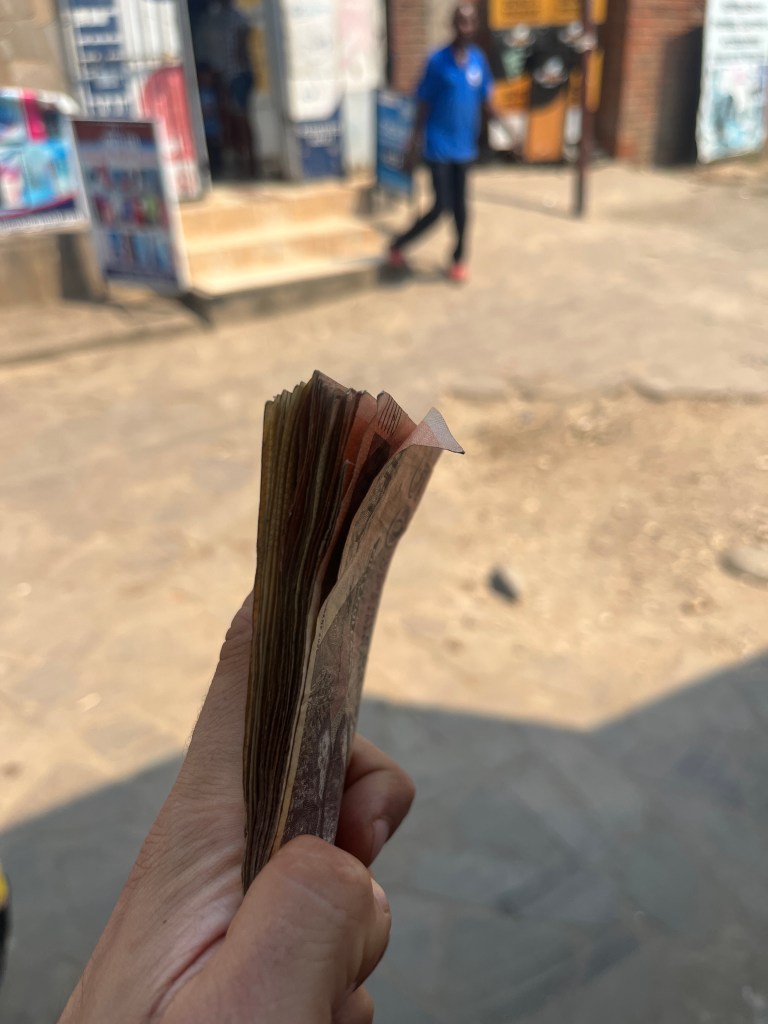
At Kariba town we soon realize some things: Zimbabwe is not nearly as expensive as we were told: we pay 2$ for a filling plate of Nsima (here it’s called Sadza) with beef, and 12$ for 5GB of internet. Funny enough, the company we got it from was advertising online that it’s 17$ for 700MB, which made us even consider buying a Sim-card. Zimbabweans are also very friendly and speak very good English, even a bit better than in Zambia. A “fun fact” is that if you get change of less than 1$, you get it in local currency. We got 50 cent, which equaled around 30 notes of 50 and 100 Zim dollars, as 1 dollar is 5’000 zim dollars. In the countryside, we will soon not get change at all, you must buy in multiples of 1$ and prices are given accordingly: a dollar for two (water, coca, etc).
With a new SIM card we are back in the connected world and we we confirm with Robyn, the daughter of the owners of Musango Safari Camp, that pickup time should be around 1pm in a port nearby. As a refresher from blogpost #6, after we reached out with some questions, the family that runs the camp offered us to stay with them and help us with the transport to their camp: by boat to arrive (as it’s on the other side of the lake, more than 60 kms away), and by pickup to leave, so we can go to the closest safest road, away from wildlife. A private speed boat to hire costs 500 USD so we are extremely grateful that they let us hope on their re supply boat.
We call Muza, the worker of Musango that is driving the boat to Kariba town to get the resupply, and we agree on meeting at the bar of the harbour. It doesn’t take long to arrive to the harbour, which is far from a traditional harbour, but rather one focused on yachting, tourism and recreational fishing.
We make ourselves comfortable at the bar, ready to wait under a sun-umbrella, as the heat is serious. Not much later, some local men park their fancy SUVs in front of us and go to buy some more drinks, despite most of them having already one in their hand. We start chatting and we tell our classic eye-catching, Tanzania-Namibia story. They tell us they are from the capital, Harare, and they are on a boys weekend. They will rent a boat and fish on the lake. They tell us to stay safe, but immediately after the farewell, we see the guy with a whisky glass in his hand hopping on the driver’s seat. We think to ourselves that we would be much safer with him on the copilot seat.
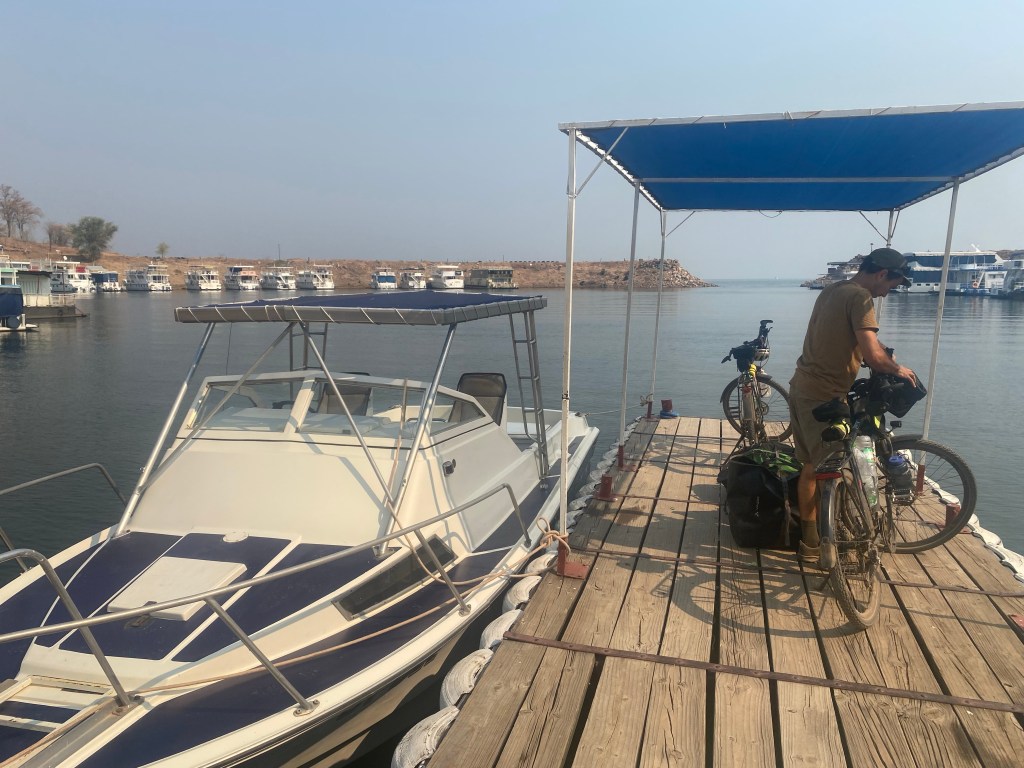
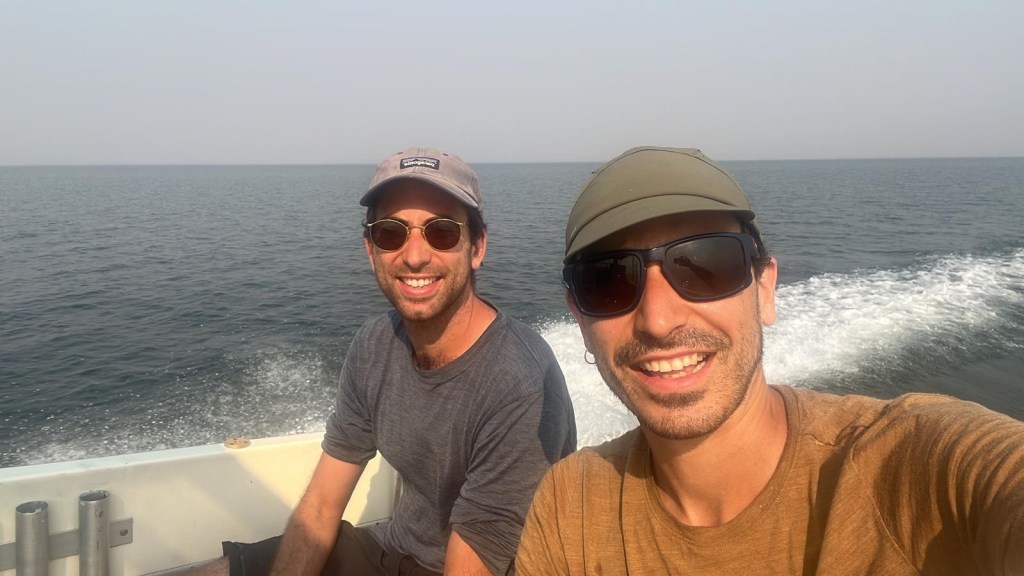
Muza arrives at 2:30 PM and we go towards the small not-so-small boat, where we check that there is just enough space for all our stuff. Muza is a man of not many words, but one can tell he is reliable and performs well at work. We stay in the back with the bikes, and off we go! The wind blows against us, generating a refreshing feeling. We get to observe the intimidating size of Kariba, as there are moments where we barely see the shores. We waive at some other fishermen and tourist boats, who joyfully reply. There are small islands and inundated trees now and there, which we suspect makes the navigations particularly tricky. After 1 hour and a half, we arrive to the camp.
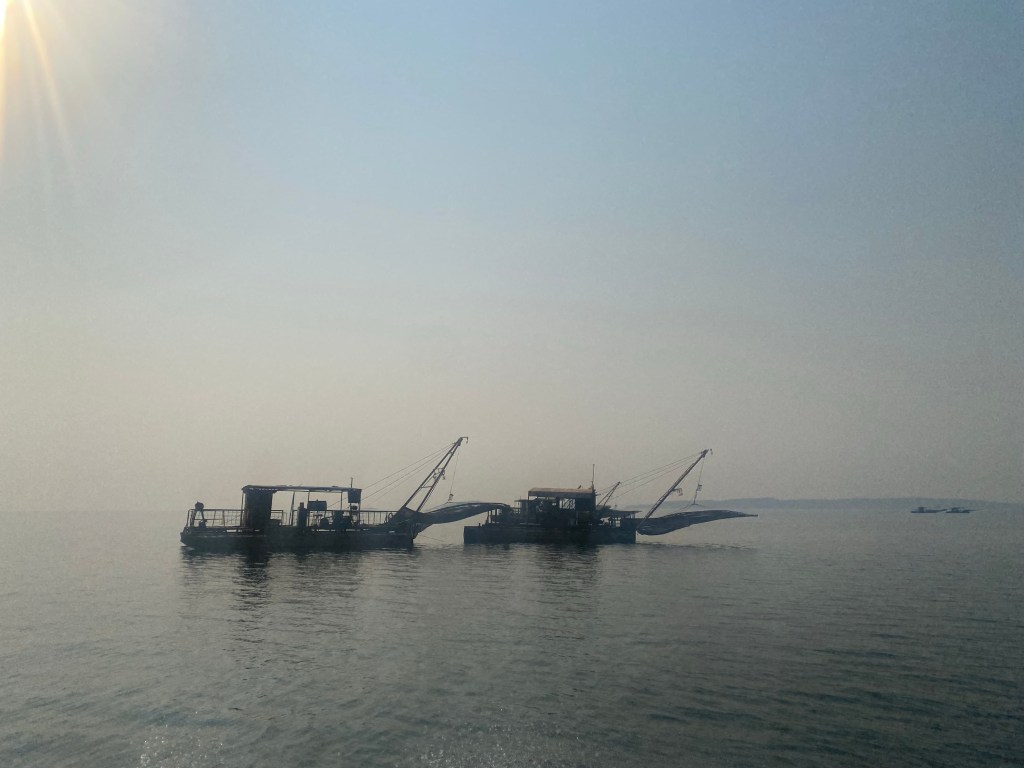
One can tell that the lake is not at full capacity, as the first 5-10 meters of height are dry terrain. A very friendly crew comes to help us with the bags, but we keep our policy of being the captains of our journey, and we politely refuse. We arrive at the lobby, which is an open terrace and a gorgeous two story hut. Mika, the head of staff, gives us some cold, wet towels, which already tells us that we are not at any average place.
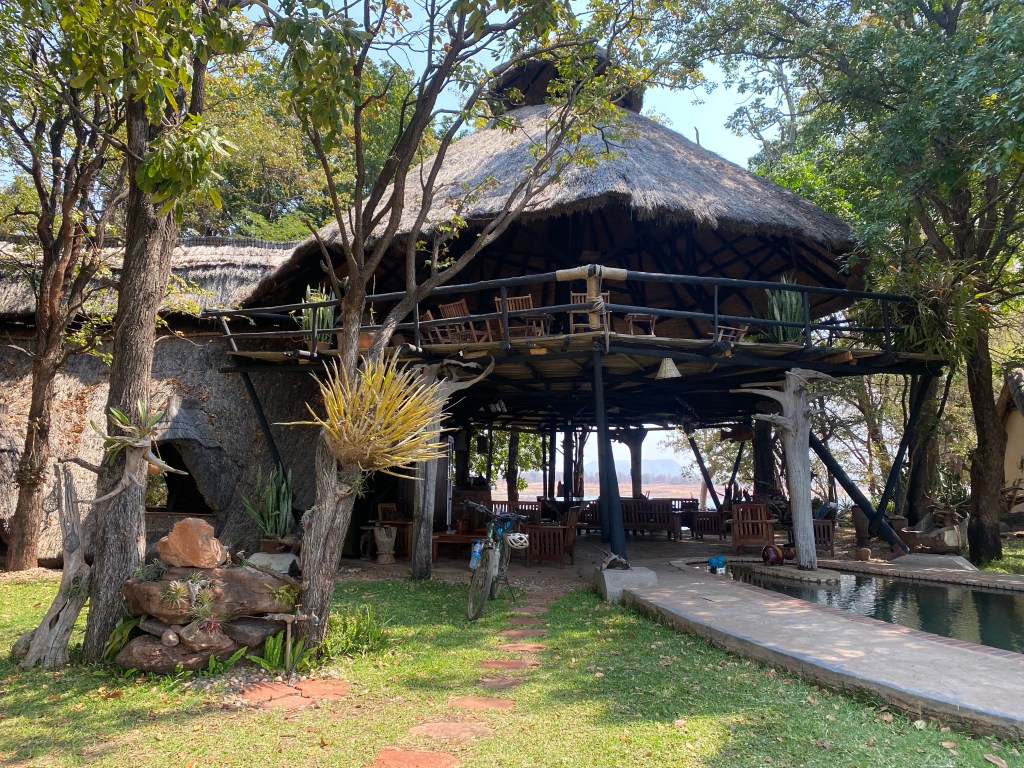
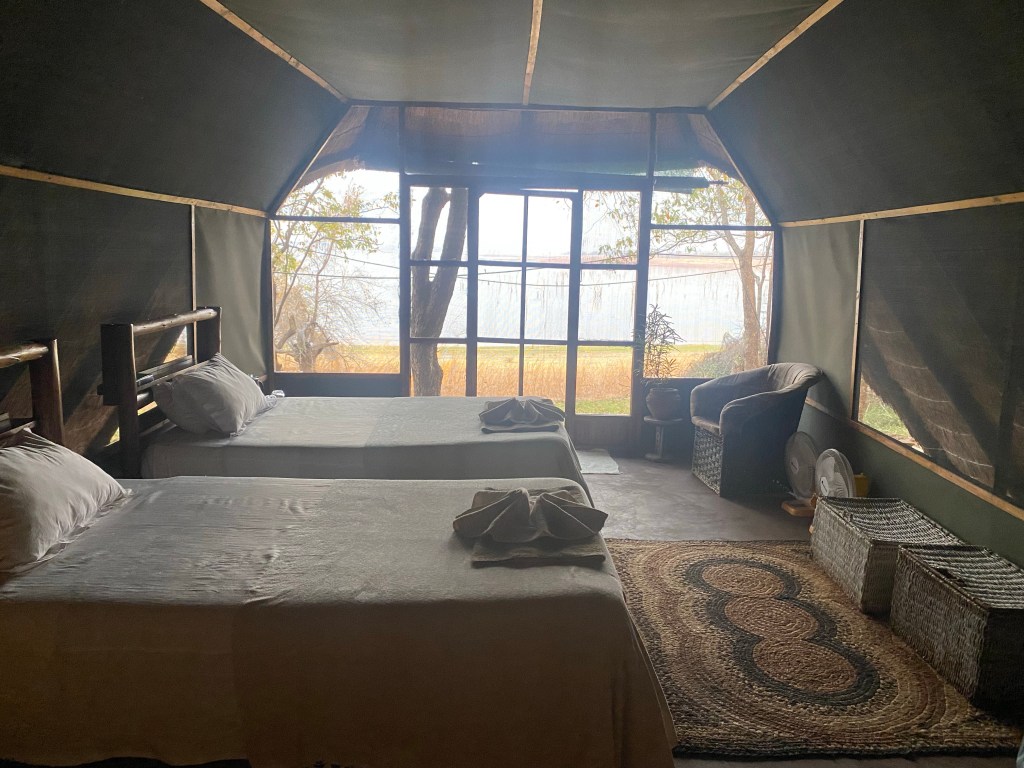
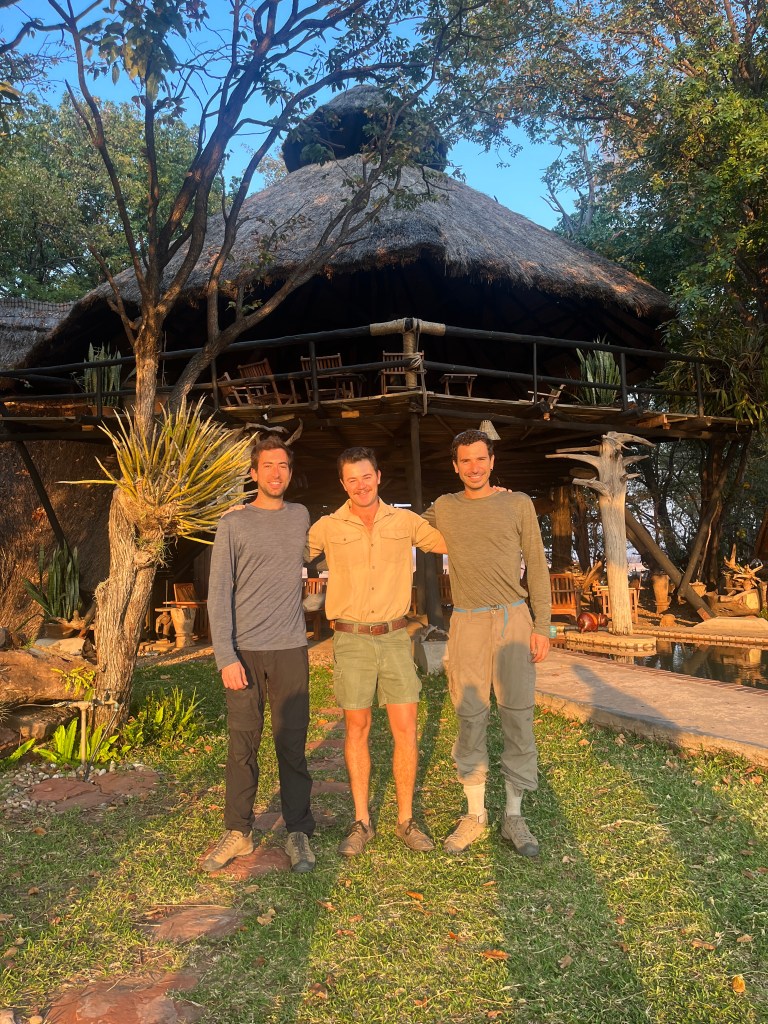
Soon after, we meet Robyn and her fiancé Bradley, who are running the camp in the absence of her parents. They are both in their mid twenties and, despite their young age, we are soon strucked by how well and comfortably they run the business. Since the camping site is not finished, and as a (very) kind gesture, they let us stay in one of the gorgeous cabinets, for the price of camping. The cabinets look at the sea and definitely fall in the high-end side of things. Everything is well thought, and the decoration and the views are splendid. We are a bit humbled by the generosity, and decide to join them for dinner, despite being above our budget.
After a shower, we go to the lobby, where the dining table has already been set. At that time, the other only guests arrive from a birding tour together with Graham, the brother of Robyn. The guests, a couple in their 60s from Durban, South Africa. The camp was supposed to be full at this time, but most of Europeans cancelled due to the tense climate that originated out of the elections held last week, in which the ruling party won, despite multiple international observers questioning the credibility of the vote. A week later, the president of Zimbabwe would appoint his son and nephew as deputy ministers (both having no political experience).
Graham’s hand-shake almost breaks my hand (I might be exagerating). But it’s a good representation off the attitude of the young men leading the camp: self-confident, autonomous, and very polite. Everyone, including the owners, has dinner together in a round table, and the head of service announces the plates in a very formal and traditional way. “Please apologise me for the interruption… Ladies get served first, men second.”

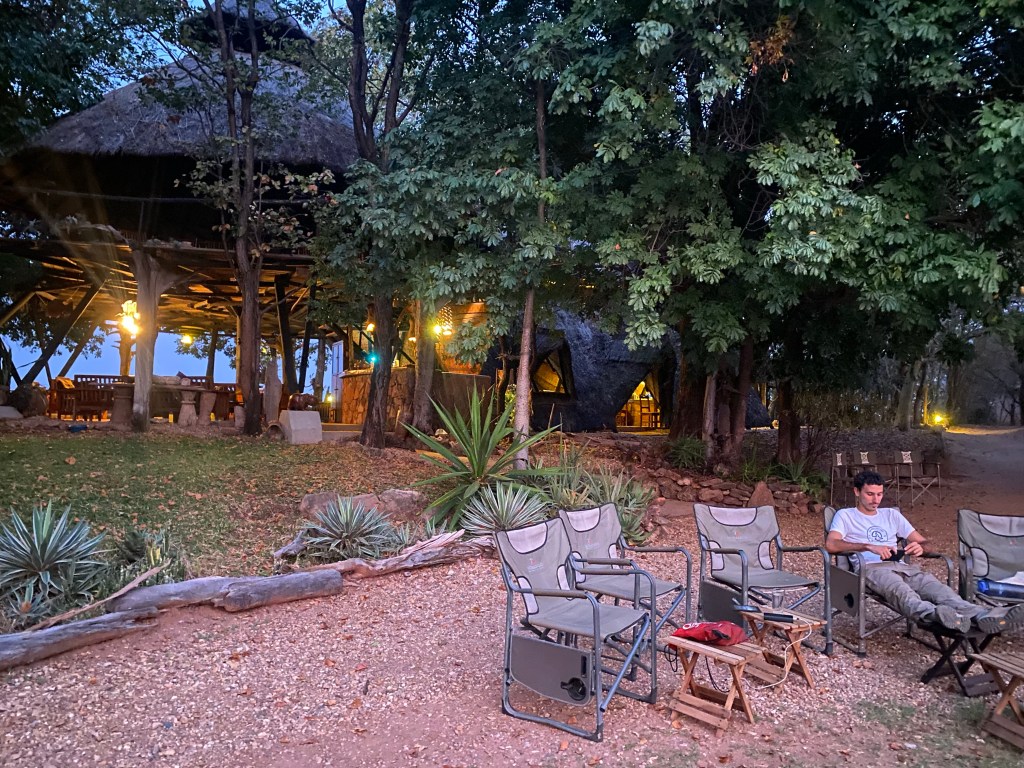
During the dinner, we get to know both the other guests and our hosts better, and, thus, understand better how do European-descent Africans live. The first thing that comes to mind is that, if we had to choose whom to stay with in the event of an apocalypse, Bradley and Graham wouldn’t be a bad option at all. These guys fix their own 50+ year-old Land Rovers, and they are now trying to fix the diesel generator that has made the camp rely only on solar. They dress in cackie safari clothes and boots, with a knife on their leather belt, ready to fix anything. We will find out that Steve, the father of Robyn and Graham, and the founder of Musango, used to be the warden of the Park, and has lived a very wildlife-intensive life, including surviving a hippo attack that let him without splint, or discovering dinosaur fossils that he exposes at the camp. Graham is following the steps of his father and is about to become an authorized safari guide. He is very comfortable with wildlife and knowledgeable about it. We must open our mouthes in awe when we hear from his sister the story of how he once scared a lion that passed near him while he was sleeping in a bivac (camping without a tent/shelter) by burping and shouting at it. “Balls of steel” may be an understatement for him.
Robyn and Bradley, on their side, spent a long time working at a cattle farm to learn everything about it. Now, they are slowly ready to start their own farm, once they will be married. Something tells us that they have figured out the equation and there is no doubt they will be successful.
On the more mundane side of things, the beef stew and the lemmon cake are so good that we both internally agree to do dinner again with them they day after. After some more wine and beers, it´s slowly time to get to bed (a real bed, we should say), not before enjoying a star-packed sky.
8/09/23 – Rest Day in Musango.
We are very keen on doing some of the activities that Musango proposes, and we start by visiting the nearby traditional village of the Tsonga people. Zimbabwe’s main ethnicity is Shona, but in the Kariba lake area Tsonga are the majority.
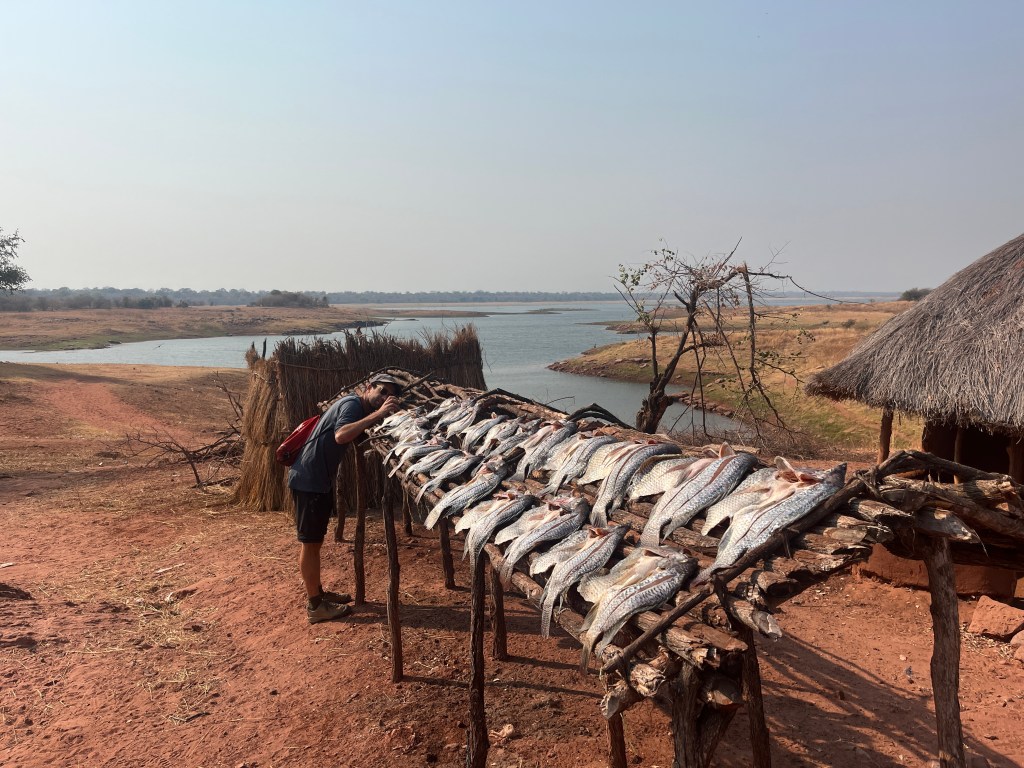
Graham drops us at the village, where we meet Christmas, the secretary of the town and our guide for the morning. During 2-3 hours, he will show us how they live. This village had to be relocated due to the flooding of the valley to create the dam. They are one of the very few villages allowed to use nets as this is part of their cultural heritage -which they keep alive. Fishing has an important role on the village, and we get to see how they build nets, fix them and salt-dry the fish to preserve them in a region with no electricity.
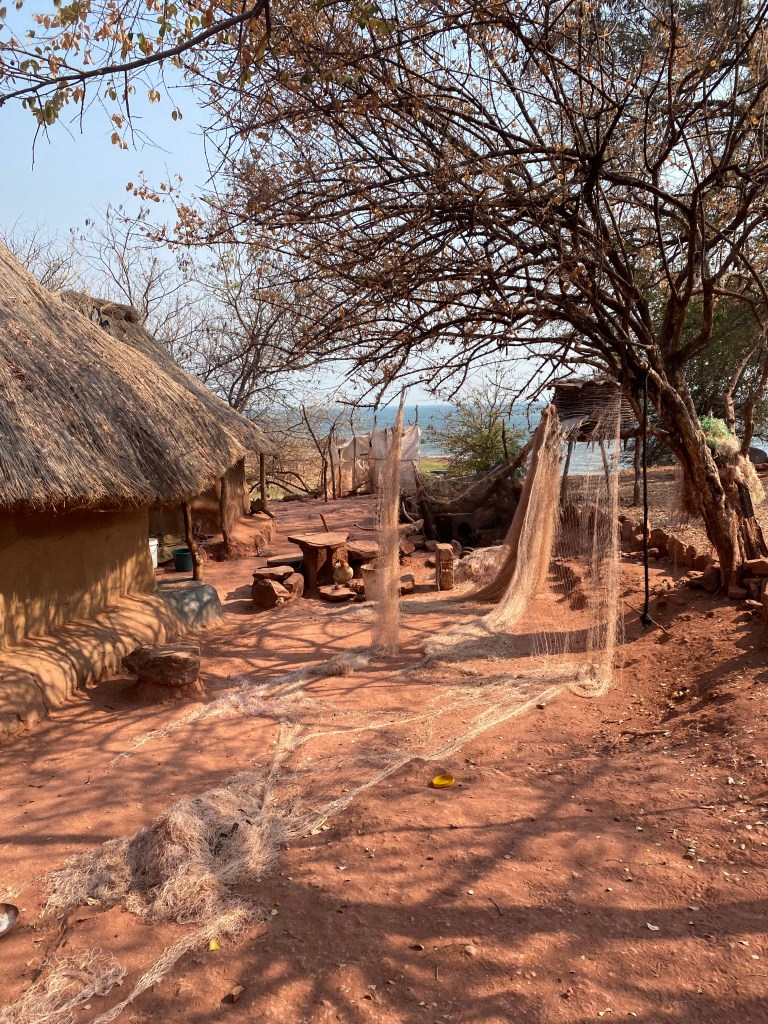
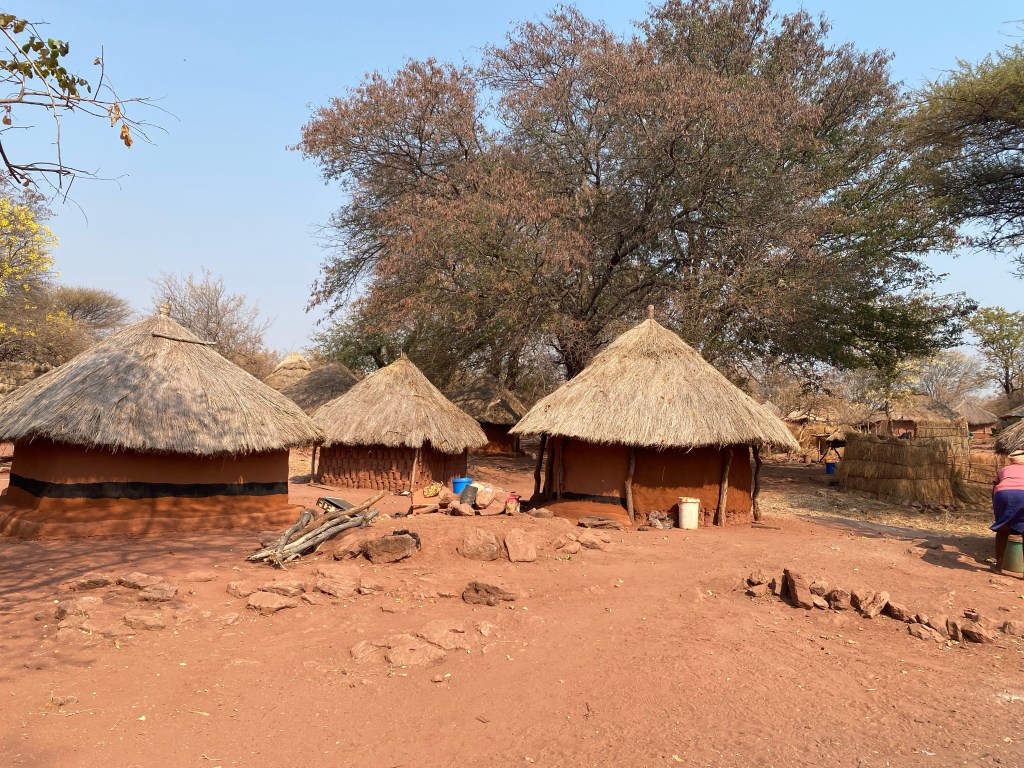
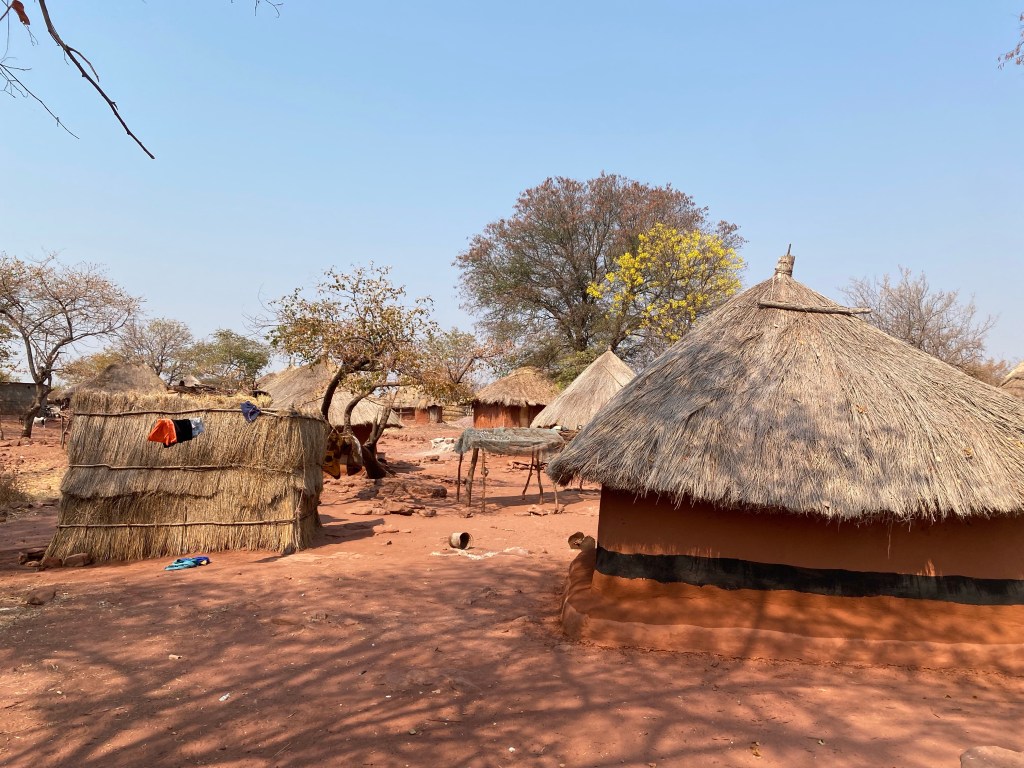
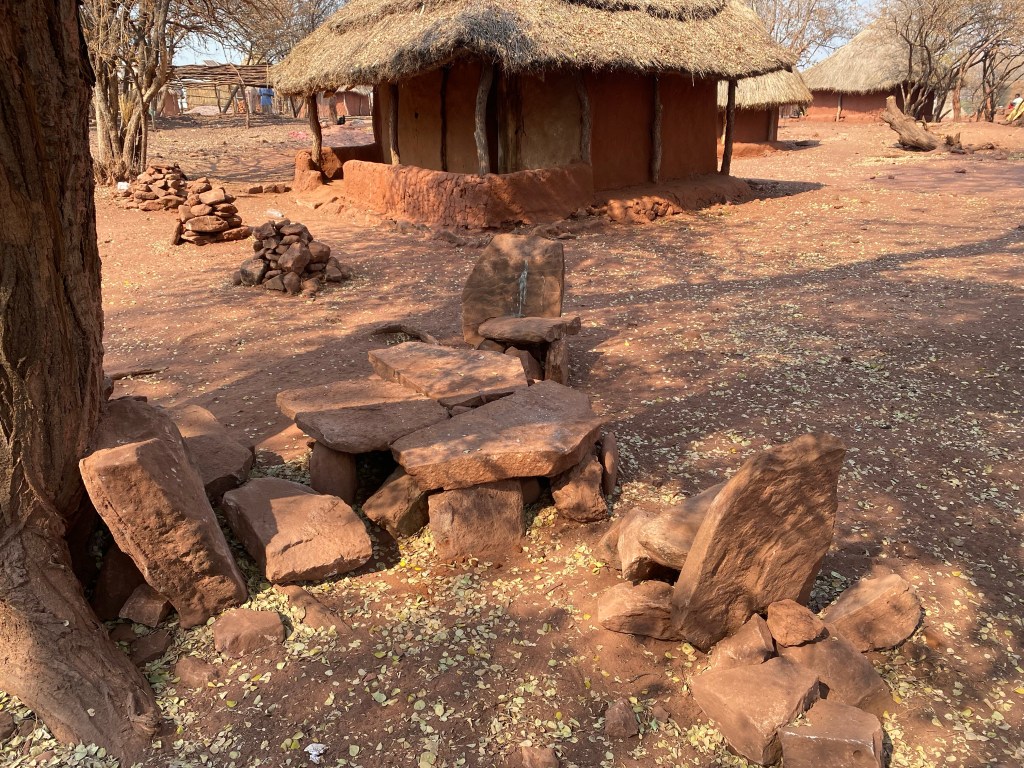
We also get to understand the functions of the different traditional houses, which make the absolute majority of the villages: round ones for cooking, square ones for sleeping. A house with a cheminée (pipe going out of it) is the toilet, while a square house made out of dry grass (without a roof) is a shower.
We see how they cook using “Tsotso” stoves. A Tsotso stove is a clay pot with openings at the sides to make a fire (similar to the one sold by Francis in blogpost #5). Tsotso is a Shona word meaning ‘small sticks’ – it is these sticks that will be used to cook a meal. These fuel-efficient cookstoves have replaced the open wood fires, traditionally used to cook in rural Zimbabwe. They are more sustainable as they are both fuel efficient and use branches instead of whole trees while empowering woman as in most cases they are the ones making and selling them.
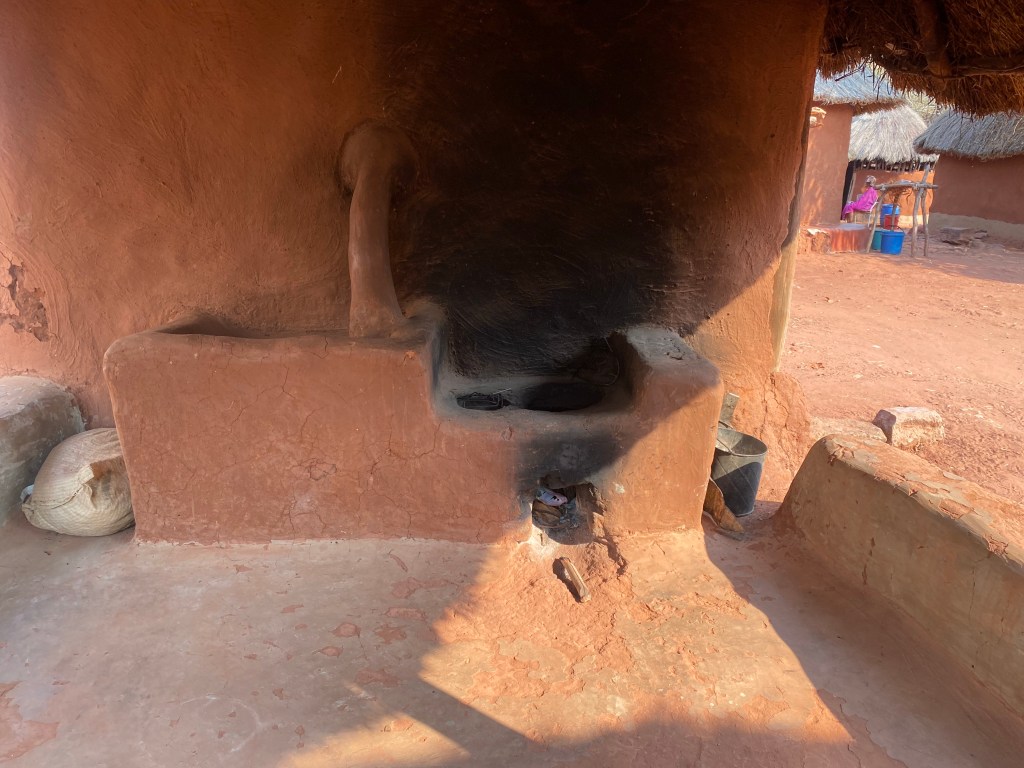
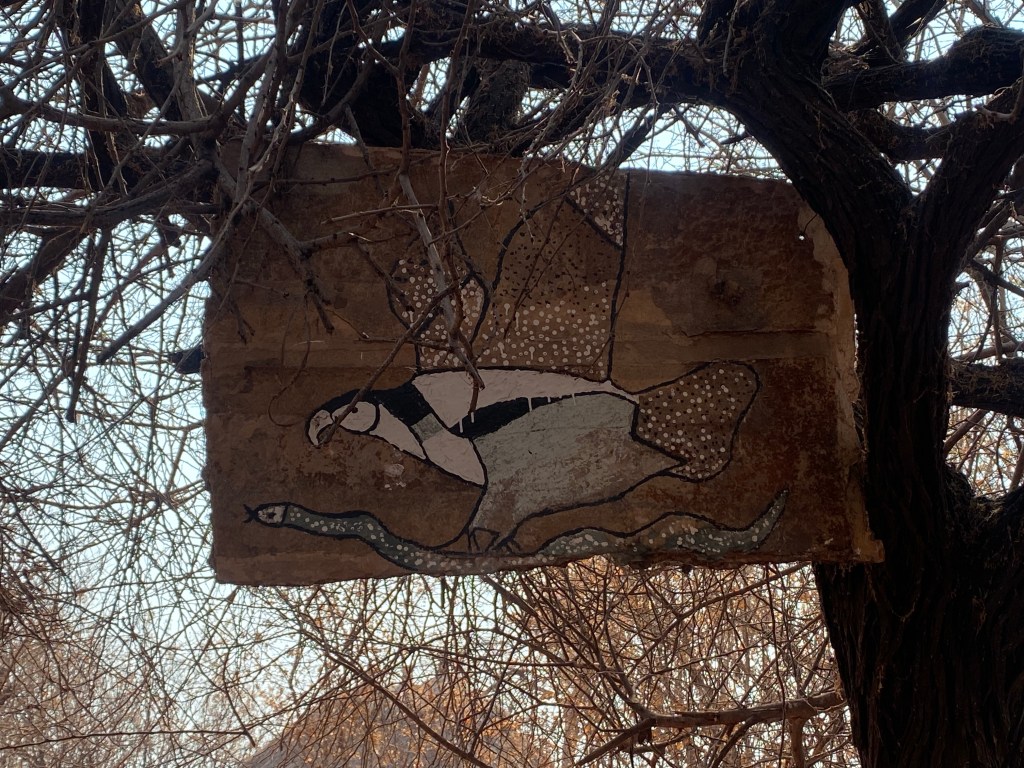
We see the local school, which is unfortunately way too simple for so many kids, and do a small donation.
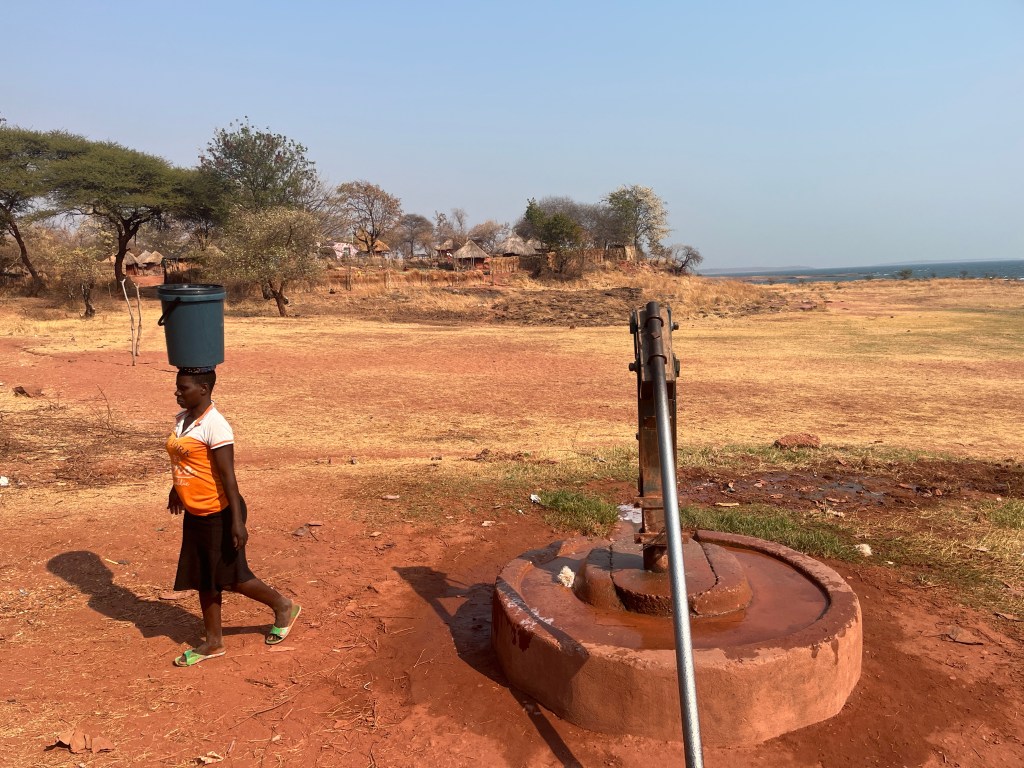

Back at the lodge, we arrive on time to see the delicate process of our South African guests to onboard their car into a small transport boat that will take them in 50 minutes to a place that by road would take 4 hours. The manoeuvre was impressive and it once again showed us how much on an effort the owners of musango are willing to do to help their guests. We say bye to this lovely couple, who invites Javi and his girlfriend to stay with them in Durban when Javi continues the trip with her.

We cook our own lunch, for what we may use the kitchen. The local cooks are definitely confused to seeing the clients doing their own stuff, and they try to do things for us all the time, like cleaning or chopping, but we politely refuse.
After lunch, we clean our bicycle chains, something due for a long time, and Javi readjusts his rear wheel spokes as 2 of them have mysteriously released by themselves. But they are not broken, so we will see how they age for the next thousands of kilometers.
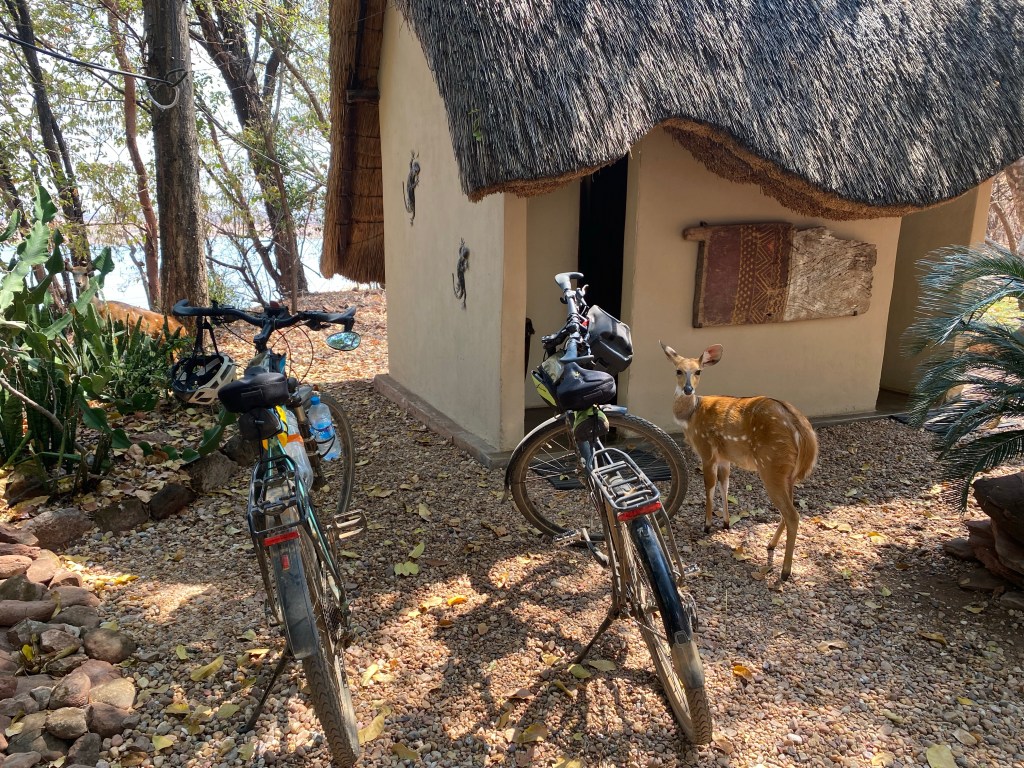
Meanwhile, Graham has gone picking up the new group of guests to a nearby airstrip, property of another exclusive lodge. An Australian family of 4 – 2 adults in their sixties and 2 teenagers – arrives, in a, let’s say, less classic, more modern style. The father was a childhood friend of Steve, but he won’t be able to meet him as Steve is with his wife in South Africa due to some health complications of her.
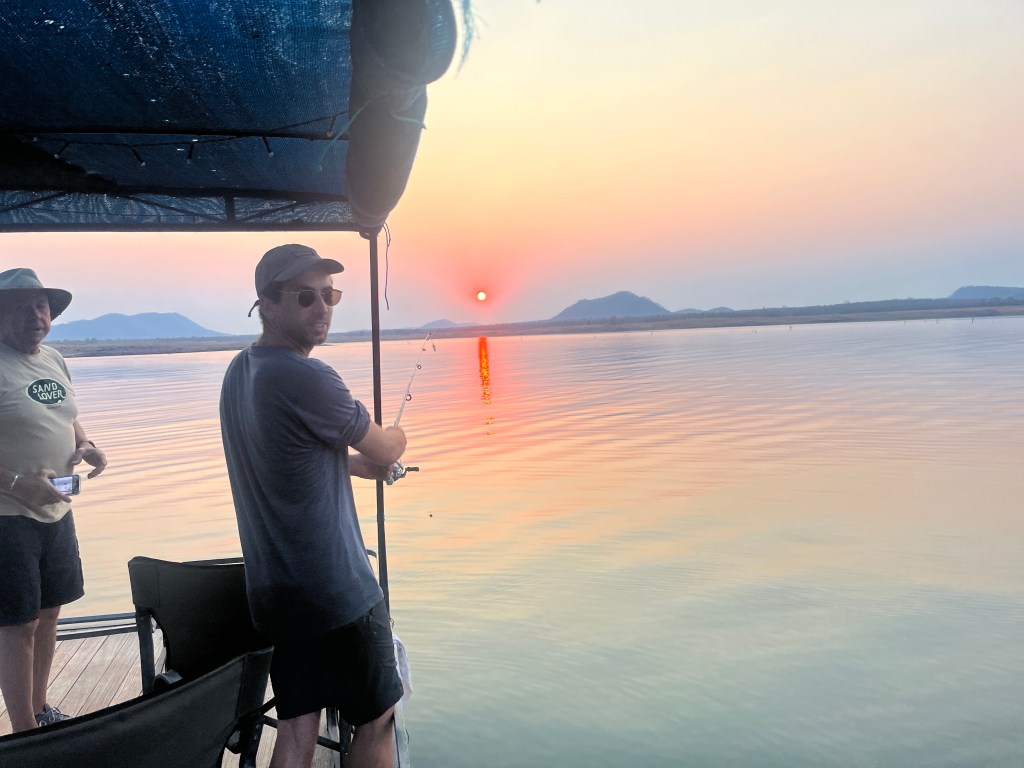
Graham asks us if we would like to join them for fishing. We are a bit hesitant, since Javi has handled a fishing rod maybe once in his life before. But we give it a go and join the family for some new experiences. The family seems undergoing some latent tension, which seems to be originated in the complicated age of the teenagers, but as discussion flows, the ambience relaxes a bit. The father, Greg, who move to Australia from Rodhesia in his 20s, is quite impressed with our journey and tells us about the 9 months he did from Uganda to Cape Town in the 90’s by motorbike. At the time, black market for money was everywhere, since governments held artificial official prices for the currency, which made otherwise impossible to travel for Europeans. He tells us how he almost got killed in Uganda by military after getting caught doing it, and how he risked lying so he would save the life of the man doing the exchange.
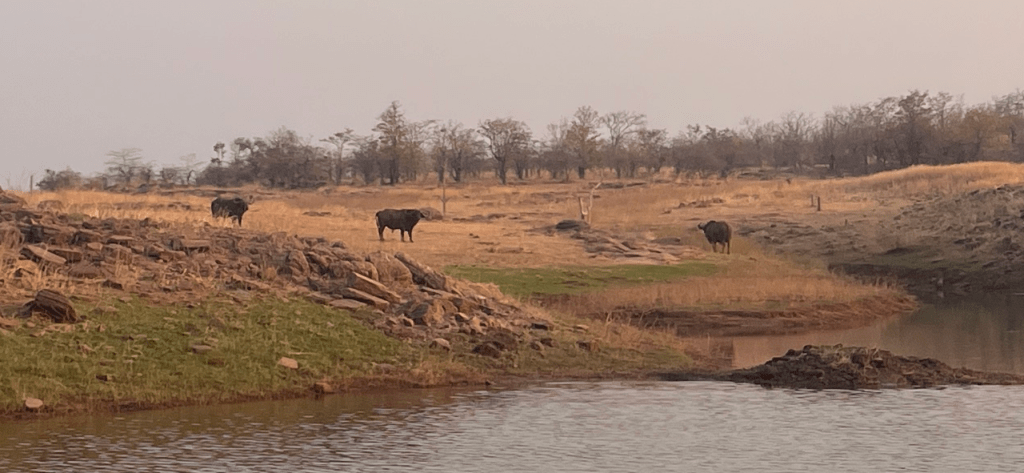
None of us manages to fish much, but Javi learns a bit the ropes, and we all enjoy the view of some buffalos drinking by the lake, fish eagles standing steel at the ghostly trees, and some beers in front of a stunning sunset.
We return back to the lodge, quite satisfied with the day, and eager to learn what’s on the menu for dinner: roasted chicken with ?
During dinner, we talk mostly with Greg, which ends up being the founder and chairman of a stock listed Australian company. We tell him about our previous entrepreneurial experiences, and he comforts us by saying “I always tell the HR department to value more one year travelling in an adventurous fashion than a damm MBA”. It is now the second time we are meeting the founder of a listed company in our trip (and life) which makes us think that Africa is definitively a touristic destination for rich people.
9/09/23 – Musango – Chiwezulu. 53 km, 800m+
The time to leave this fantastic place has come. We say bye to everyone and thank them again for such a warm and beautiful stay. Bradley will drive us in one of the old Land Rovers 20 kms away (40 min drive due to the road condition) to the closest village in our direction, so that we don’t encounter wildlife while cycling. Again, another act of kindness.
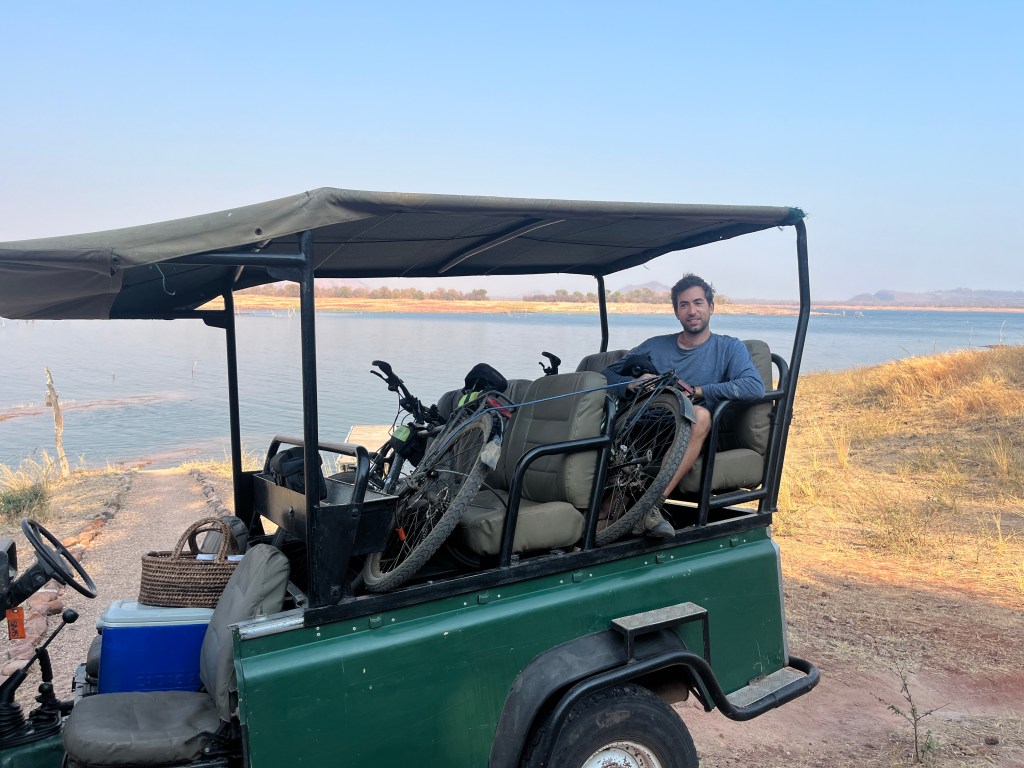
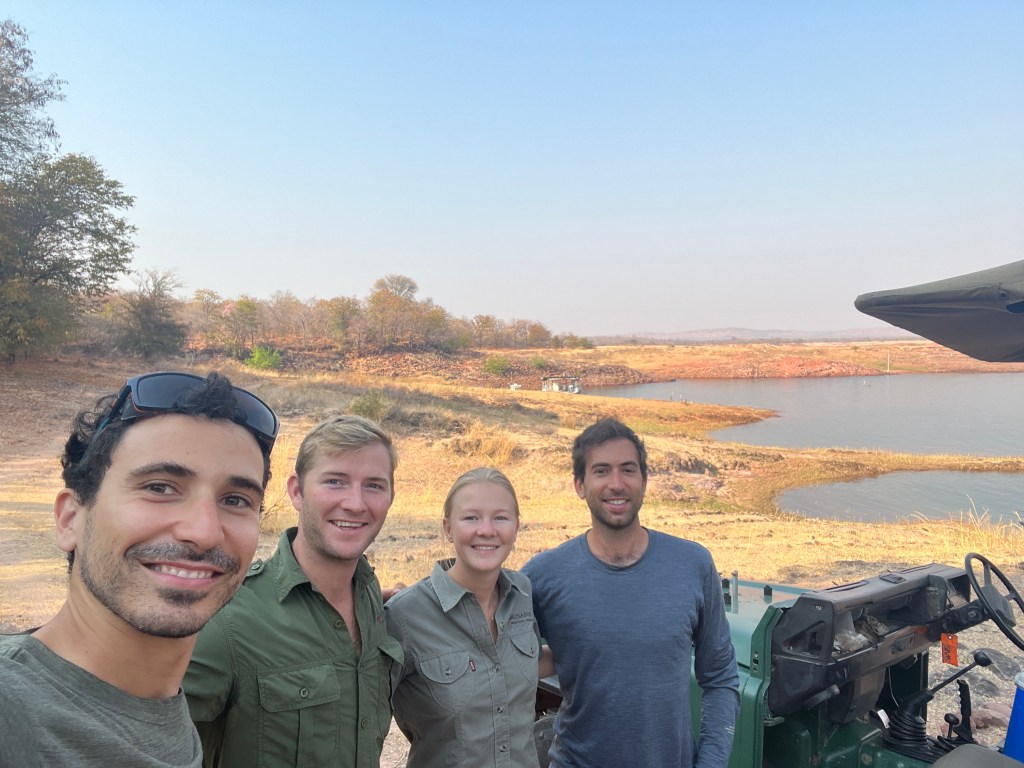
Brad actually lived 3 months in Mallorca, Spain, working in yachting. Apparently, this is a work that many South Africans do. He used to practice motocross at a very high level, but some injuries made him move to other things. We learn from him the very high prices of public schools, costing up to 130 $ for a term (the average salary is 240$ a month, unemployment at 70%). For private schools as his or Graham’s, the cost if of 3’000 $ a semester! Based on what they shared during dinner, we imagine these school as traditional, a bit elitist, british schools, in which manners and discipline are of utmost importance, as much as the rugby team. The name of one of them is “Churchill”, which seems very descriptive.
We arrive at our starting point at 9:30AM under a merciless sun, which gives us a taste of how hot the next days will be. We give a hug to Brad, and invite him and the rest of the Musango crew to Spain, Switzerland or France anytime, hoping we can return the favour.
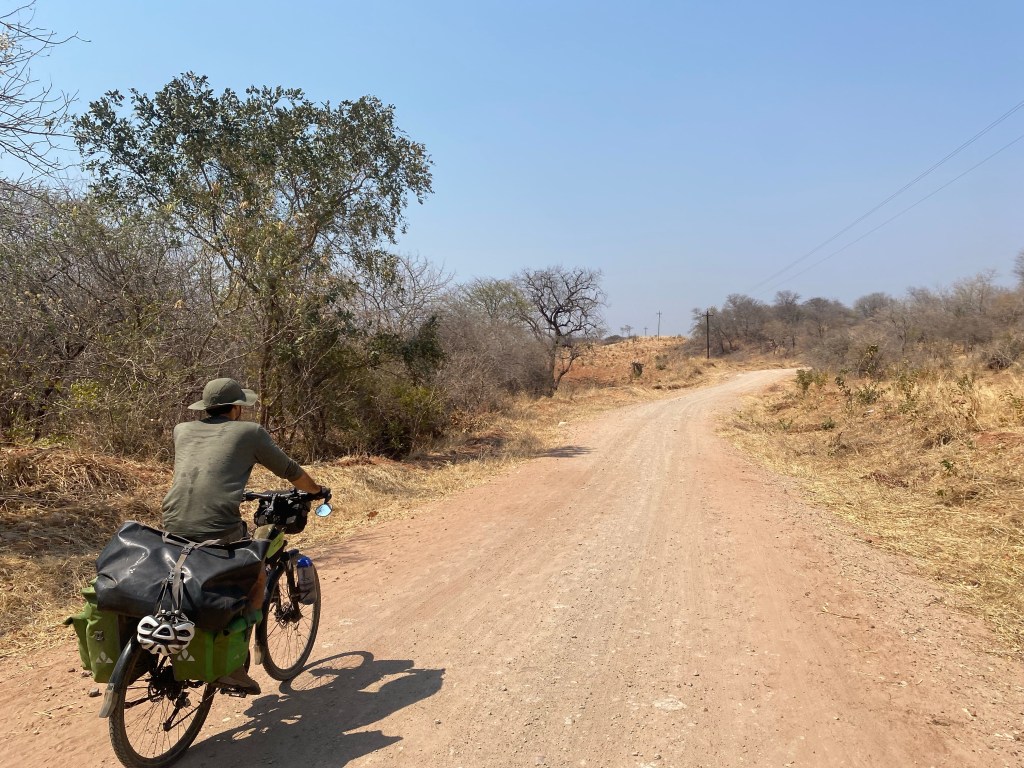
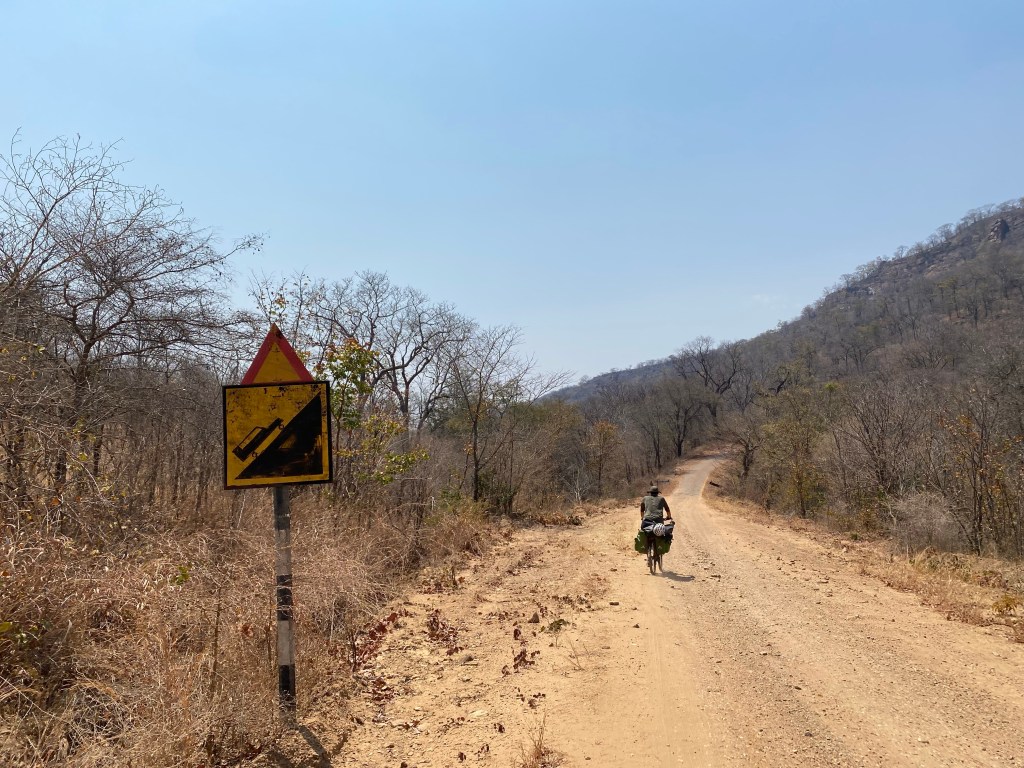
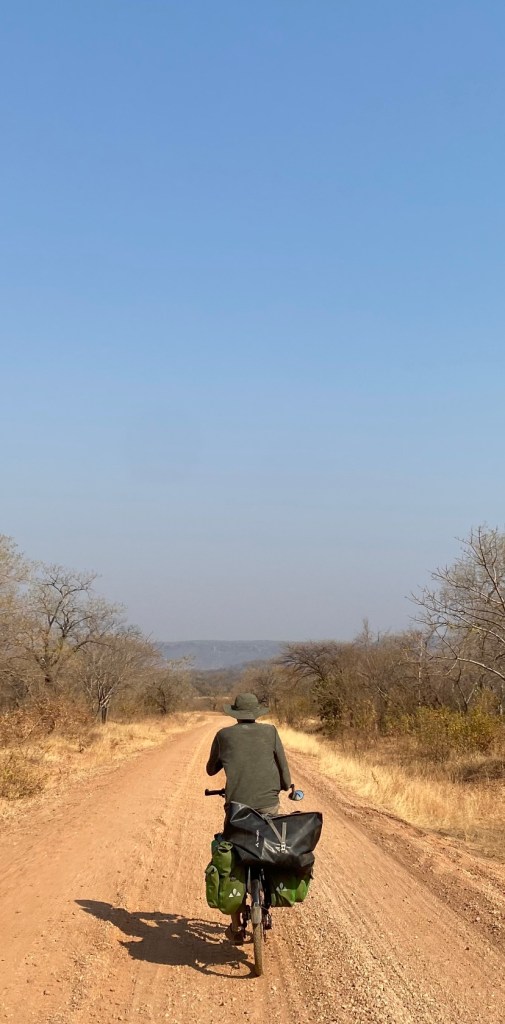
We are packed with water and food, what makes our bikes quite heavy, and soon a steep climb out of the valley of the Kariba lake starts. Sandy patches forces us to step out quite often, and we are very relieved when we arrived to the small town of Siakobvu, where we try to find some Satza for lunch. Unfortunately, a bunch of drunk men come to us and attempt to persuade us to go to the restaurant of their choice (we pressume of their relatives). It’s very sad to see the high rate of intoxicated men already early in the morning in the rural areas of Zimbabwe, where unemployment seems rampant.

We follow the least intoxicated of them, and get offered Zatza with chicken for 1 $. We have to return the plate after seeing the guts and legs of the chicken on it, and get goat instead, which is still very chewy and not good. Our fixer comes back more drunk than before (we suspect he earned a commission for the food) and tries to influence the price of the food. We get a bit mad and invite him to drink less and take are of himself, which he surprisingly accepts by saying “Thanks so much for the advice”. We didn’t expect that.
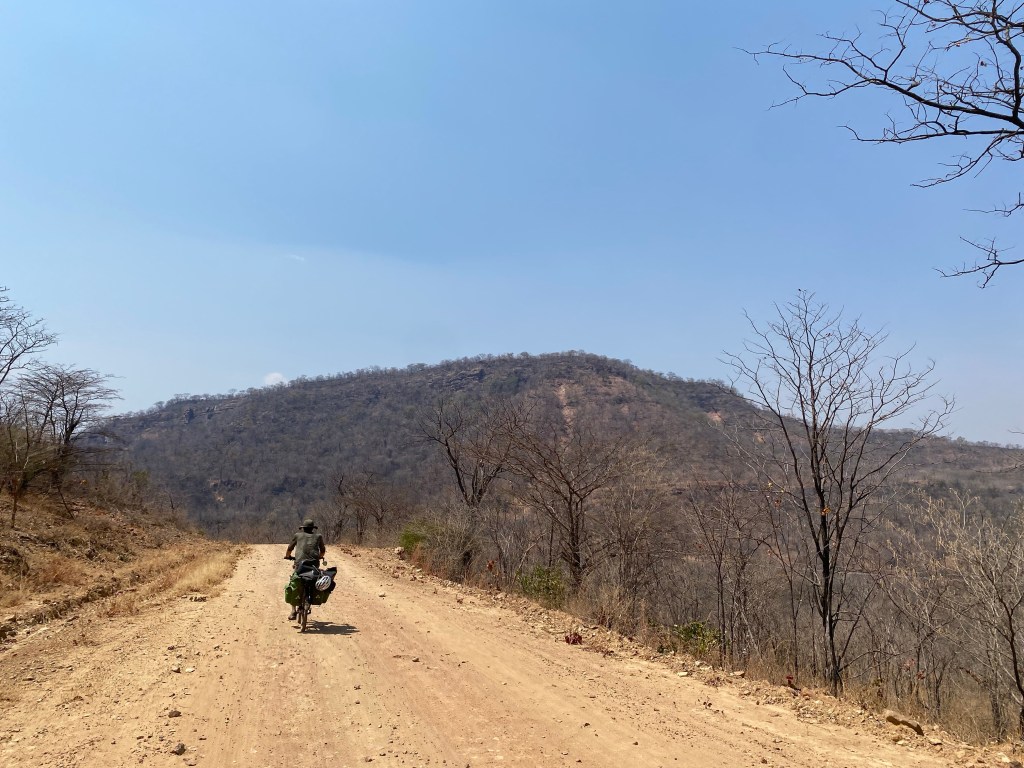
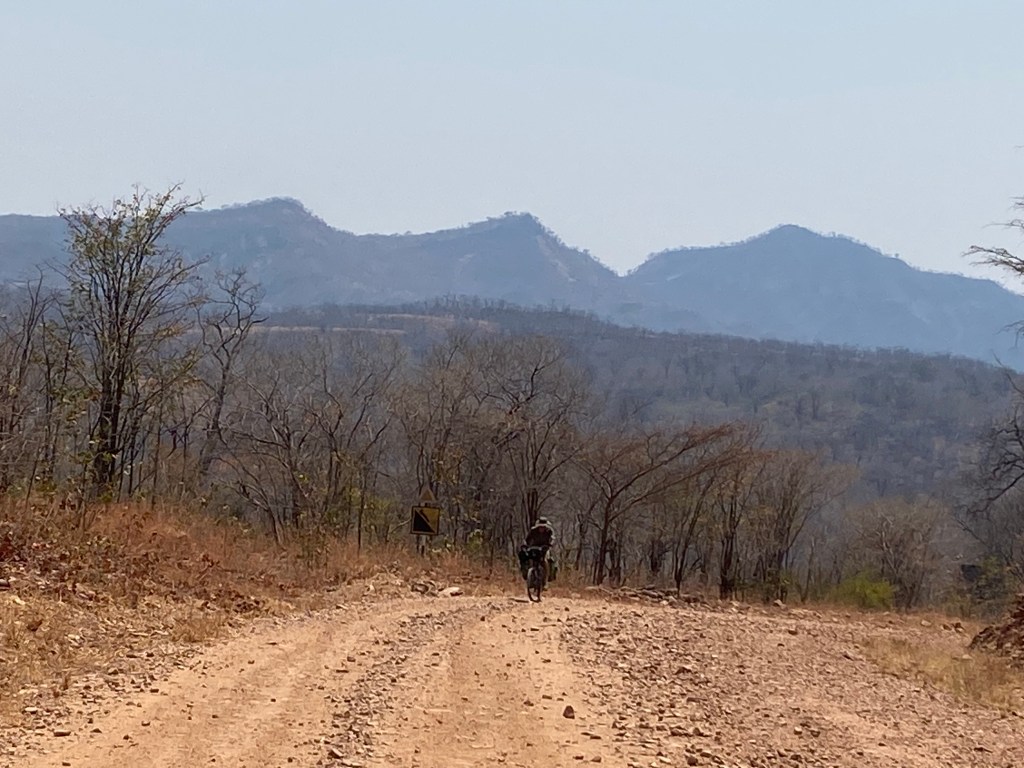
It’s almost 16:00 and we have barely cycled 50 kms. We have no idea where to camp, and are eager to find a village with a school. It’s here when luck plays it to us, as there is an unwritten rule that says that “all surprises wait for you at the end of the day”. Boom, Gaspard stops and observes he has a puncture. Funnily enough, after having ridden through glass, nails and God knows what not with these bikes, the first puncture ever (Including the 2019 Sahara trip) is caused by the pointy spike of a tree branch, which ended up in Gaspard’s tire as he was walking next to the road in order to avoid a sandy patch.
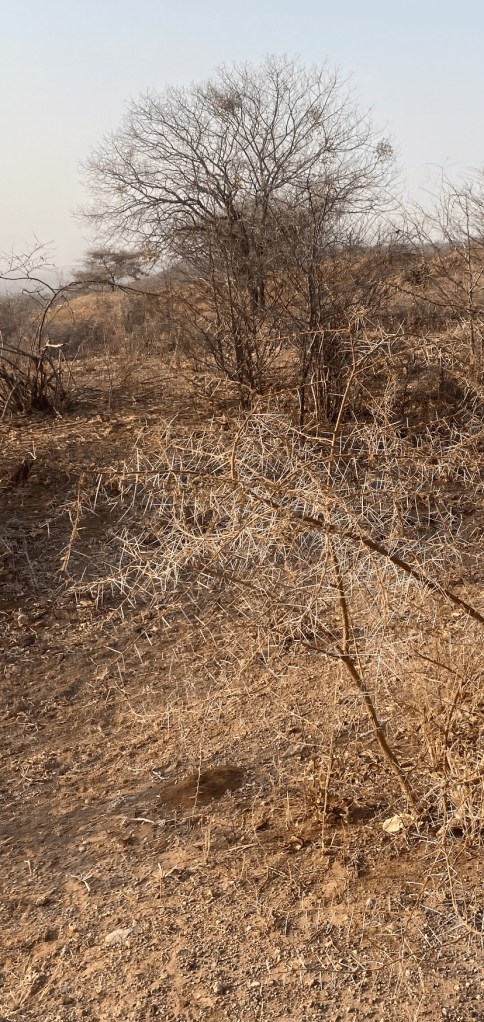

Gaspard is the one nervous this time, as we are 1 hour away from dusk, but Javi manages to find the nail in the tire, what makes the fix easy and quick. Since Fortune Goddess rewards the persistent, after 5 kms, we find a small, empty school, at the cross with the road that goes to Karoi. The only teacher around, which is a bit tipsy but far from annoying, lets us gladly put our tent close to it. No one disturbs during the night, as the village is very tiny, and we enjoy some rice before getting in the tent under a sky of stars.
10/09/23 – Chiwezulu – Siabuwa, 85 km, 630m+
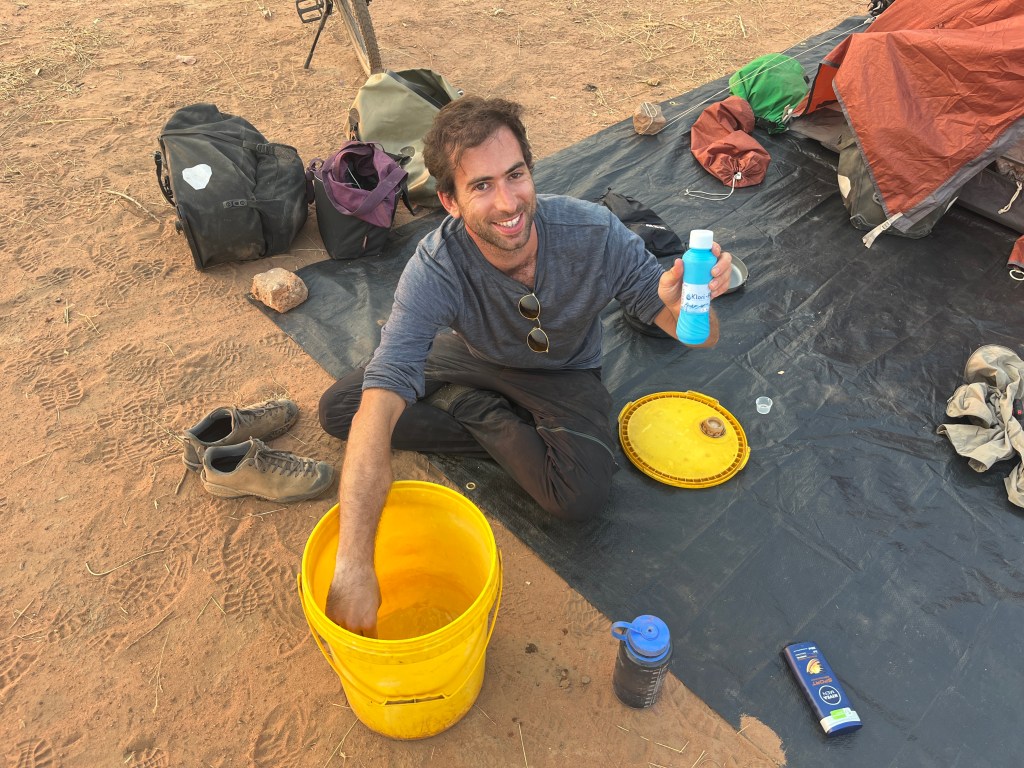
Since shops don’t sell bottle water as such, we don’t have an alternative but to start picking water from boreholes. Luckily, there is quite some, and water looks clean. We add a bit of chlorum that we bought in the supermarket in Zambia, which was approved by Simon our host in Lusaka, who works in water purification topics.
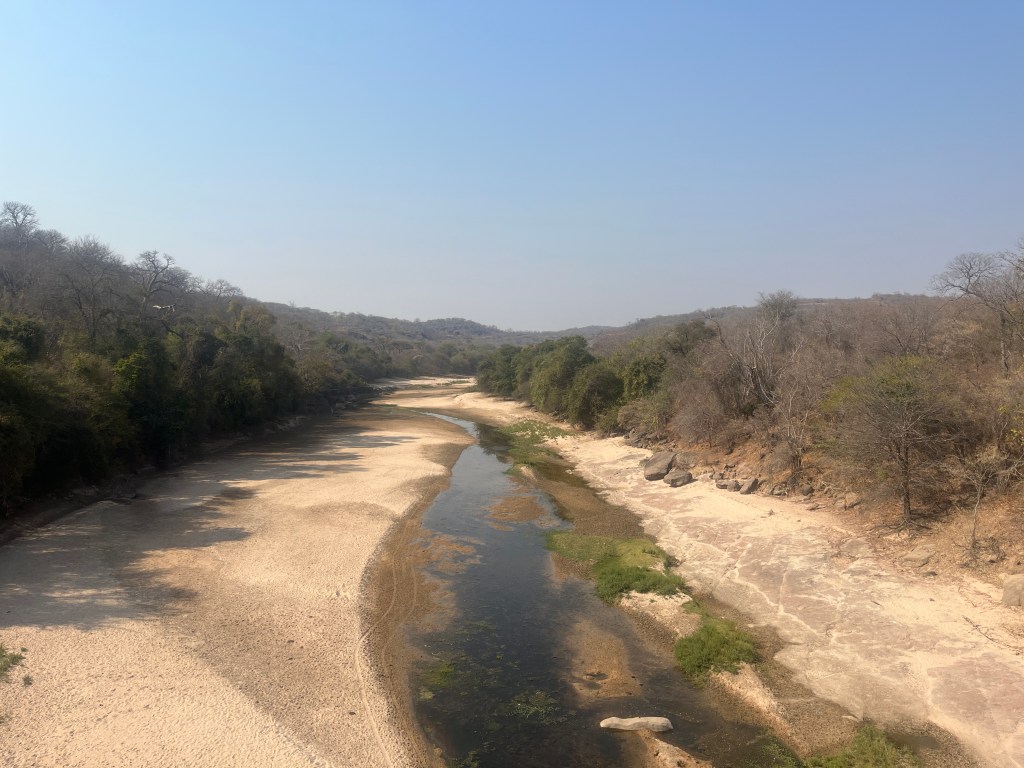
We manage to do most of the kilometers before lunch break, which happens to be the hottest hours of the day. The landscape is only getting dryer and most of the rivers we pass are fully dry.
We buy some industrial white bread and a cold coke, and we stop near a calm borehole to cook some instant noodles. That’s when Gaspard realises that both his (new) iPhone cable and solar panel are broken. There seems to be some kind of curse with Gaspard and electronics in this trip. Women and kids are pulling water out, observing us curiously, but soon some drunk local men come and start chatting. Although they are not respectless, their incapacity to talk or walk properly and their hectic moves result suspicious to us, and we don’t love the situation.
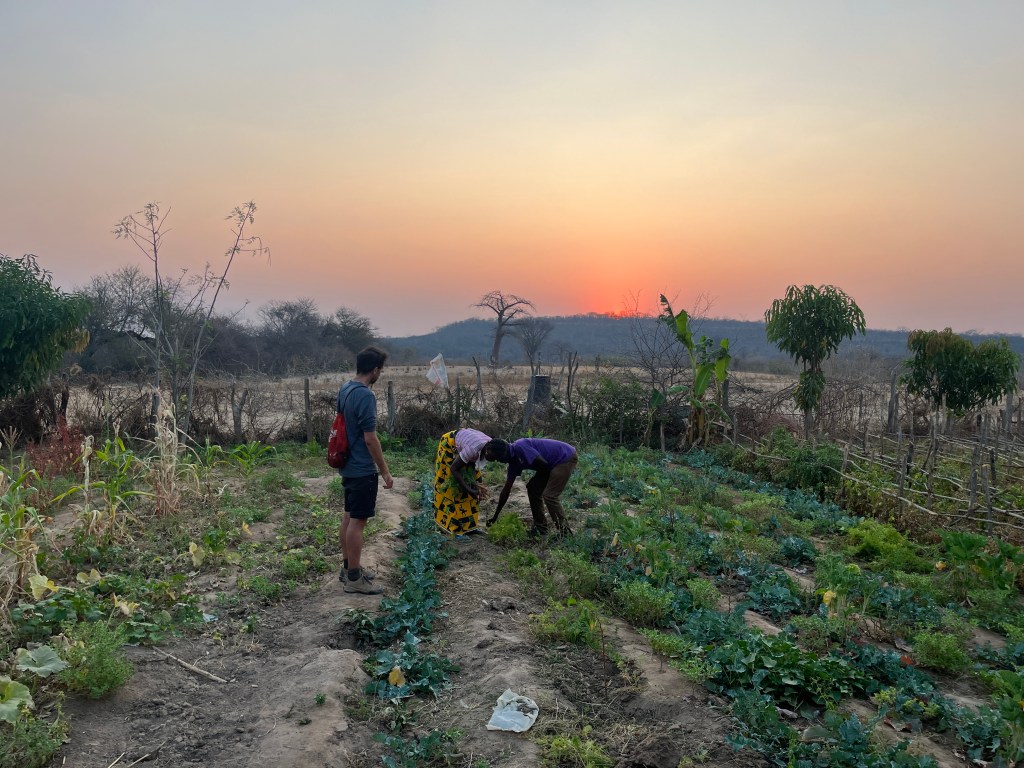
We slowly leave and push for some more kilometers until a calmer village. We get tomatos and carrots from a house that ends up being the house of the local chief. The chief invites us for a chat, and we end up picking the carrots from his garden ourselves, together with his wife. They give us some fruits to try, including the baobab fruit, who as sweet as it is, it’s rather difficult to eat. This chief lives in a much more humble house than the Zambian chief, and he seems to be surrounded by less luxuries. He tells us he is the chief from a group of villages compiling 5’000 people.
We retreat to the school, where camping is again no issue, and we exchange as usual some words with the teachers, who let us a bucket to purify the water all at once, as just 2.5 ml of chlorum are needed for 7 litres. We keep getting clues of water poverty as all the water tanks of the school are empty and even the chief told us that he does not have running water anymore.
In terms of the menu, We start adding some canned beans to the rice and spaghetti we buy, which we find quite often and cost “just” 1 $. Javi is slowly tired of peanut butter and biscuits for breakfast, and starts buying milk, which costs as much as 2$ per litre. C’est la vie, there is too many kilometers to be ridden. We chat a bit with the shop owner about how friendly Zimbos are, but how sad is to see so many men struggling with alcohol. His face turns serious, and solemnly says: “It’s terrible, it’s destroying our society. These people don’t work, don’t do anything. I am a Christian, so I don’t drink”. We hope for more like him.
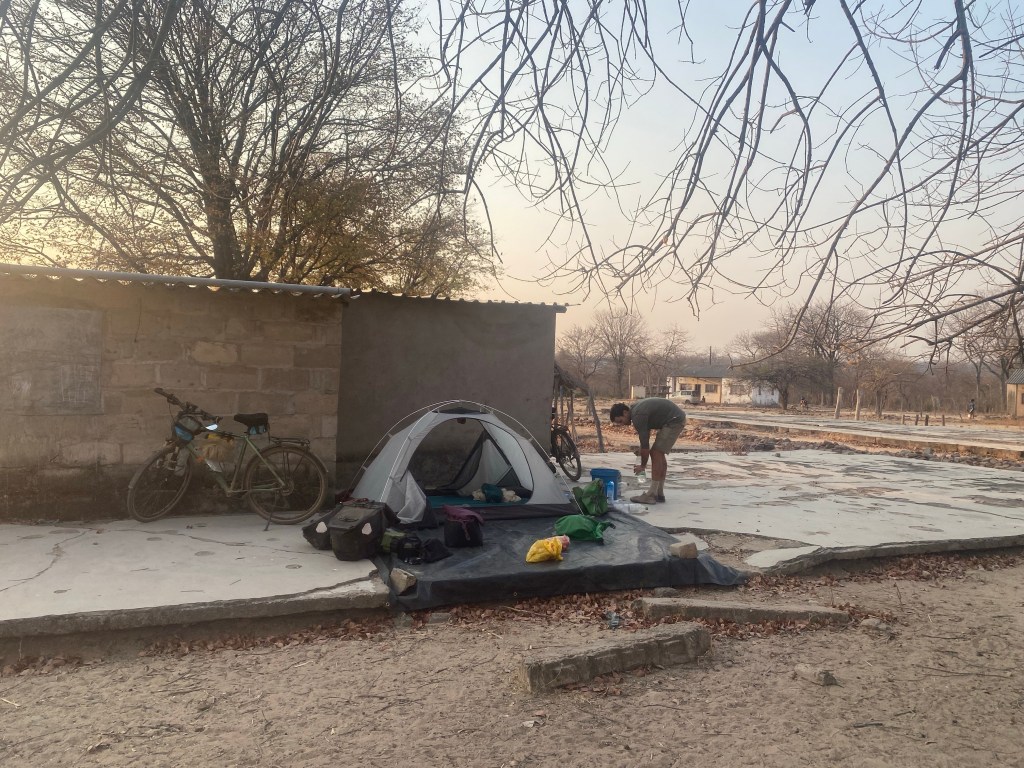
By now we have stopped covering the tent with the outer layer, as after the sun has set, the temperature is still unbearable and it only really cools down at midnight.
11/09/23 – Siabuwa – Siamwinde, 99 km, 760m+
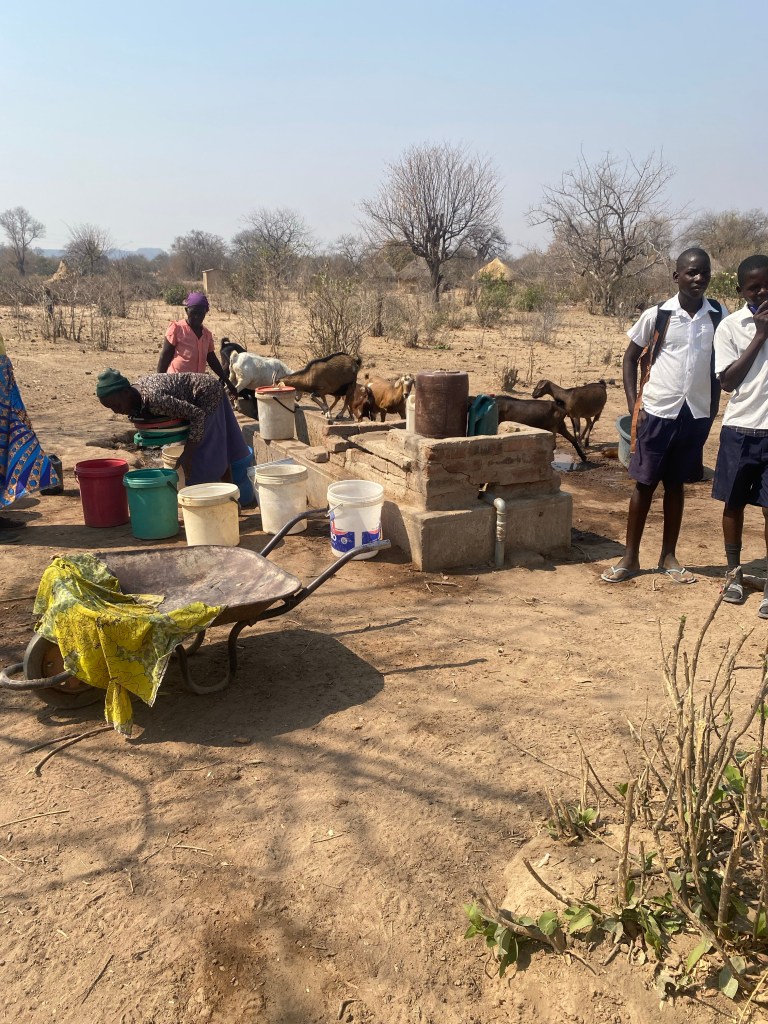
The borehole we took water the night before is now dry and we cannot refill our bottles in the morning. The lack of water is by now very evident, and we fail in many places to find boreholes close to the road. Rivers are also ridiculously dry, and we realize we have to start getting the water topic more seriously.

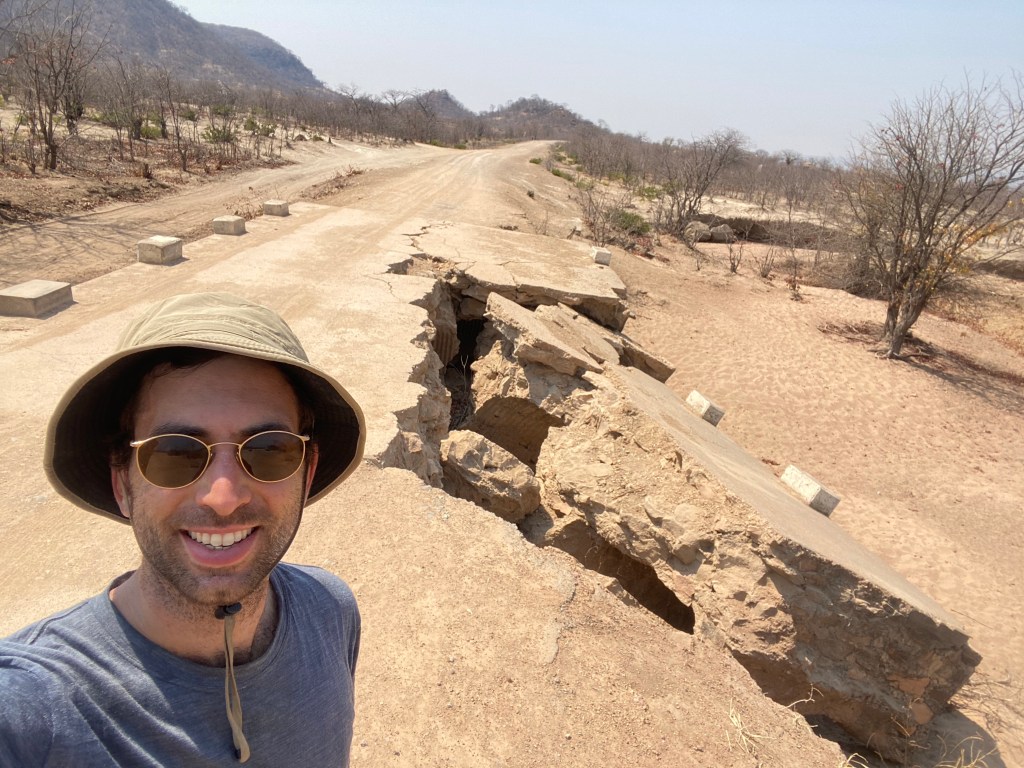
The good news is that, without us expecting it, the dirt road turns into tarmac/asphalt, and we start accelerating. We pass the road junction that goes to Binga, but we don’t get in, as we suspect is similar to Kariba town, and the hot weather doesn’t invite for detours.
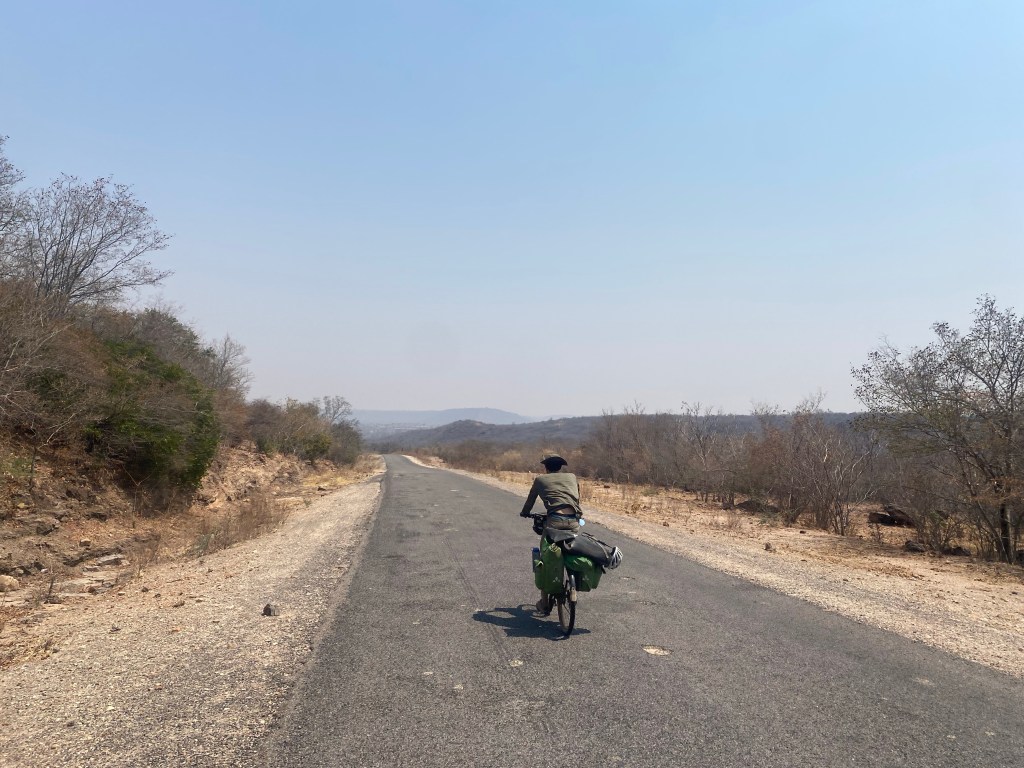
When we are slowly very short on water, we meet a local catholic priest who tells us not to take water from the next borehole, as it is contaminated with uranium. We doubt the uranium thing, but we definitely pick water from the one he recommended, which has a salty flavor, but it does the job.
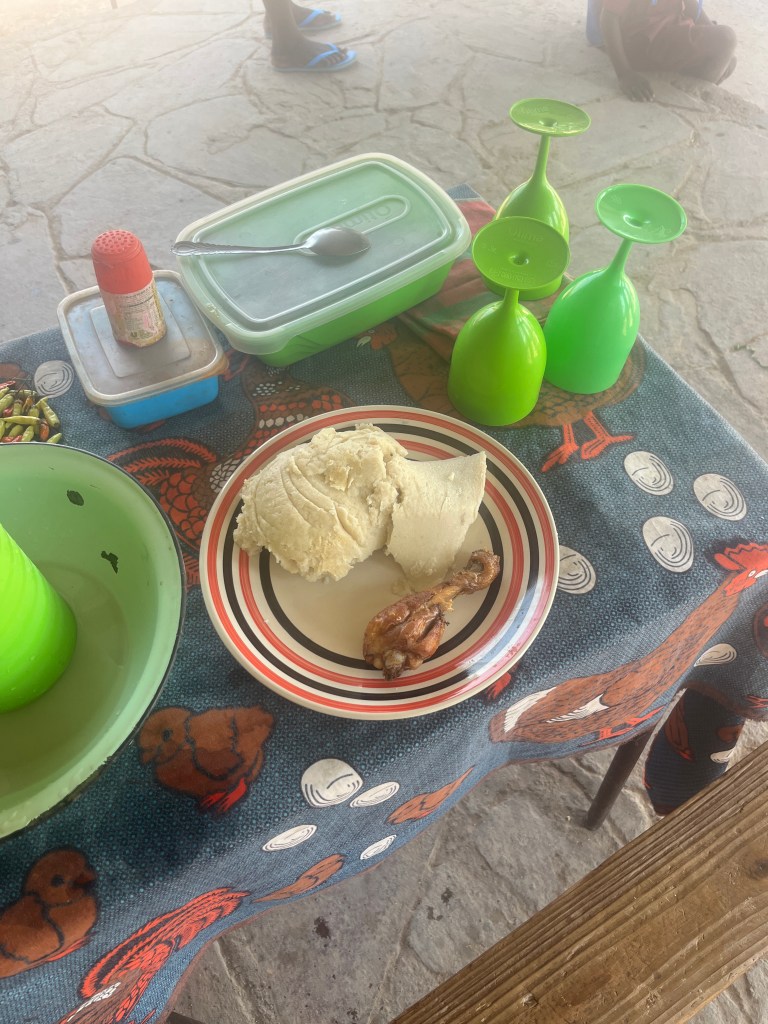
We get our daily nsima/sadza dosis, this time without sauce, only chili powder. They say that spicy food helps you tolerate the heat, doesn’t it? Again, many drunk people in the small village. At every village, there is usually a shop, a “restaurant” (a woman cooking in some pots), a mechanic, and a bar blasting music since 9 AM, with the local drunk, unemployed audience. Quite sad.

We continue with our salty water until we hit 95 kms and start realizing it’s enough for today. We re-stock up water in a borehole, but this one looks very dirty. Since we don’t know what is awaiting for us, we still take it, as the local secondary deputy tells us that everyone in the village drinks it. At the school of this village, we arrive while many classes are still ongoing, and we become a bit of the local attraction. Secondary students are shier and pretend to care less than primary ones, so no one really comes talk to us. But the deputy asks us to camp in front of the dorms of the “boarding students” (the ones coming for very far away and sleeping in the classroom during the week). That being said, we find this school operating pretty well, and their fees seem logical: 55$ per term. We log in the visitors book of the deputy office, whih allows us to sneak pretty well into school life: reports of students, who fails, who passes, their names (some are called Finance, Ignorance one so on). All the teachers are definitively burning the midnight oil which wasn’t always the car in the previous school we saw. We would learn that there is an upcoming inspecting from ministry of education which might be the reason for it.
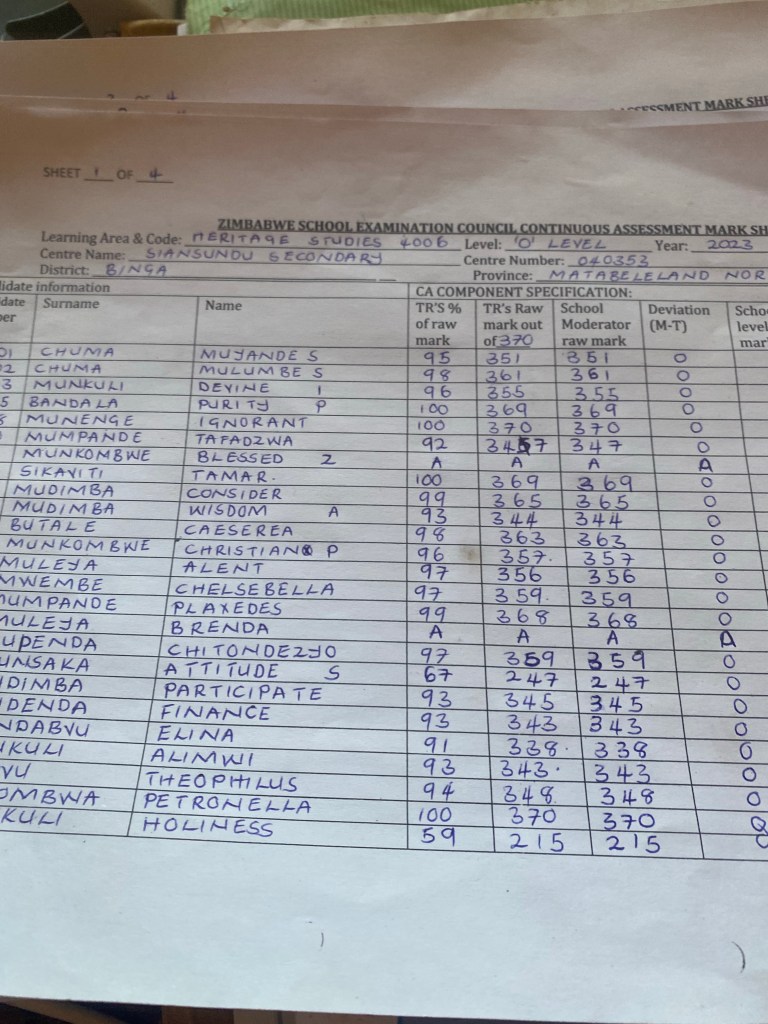
After cooking spaghetti, we get in the tent but this time, even without the outer tent, we are still sweating like pigs. We decide to anticipate the awakening of next day at 5:15 to maximize the cycling in the morning breeze. We fall sleep with the zippers of the inner tent open, regardless of mosquitos, which anyways are surprisingly absent in this region.

12/09/23 – Siamwinde – Deka, 77 km, 570m+
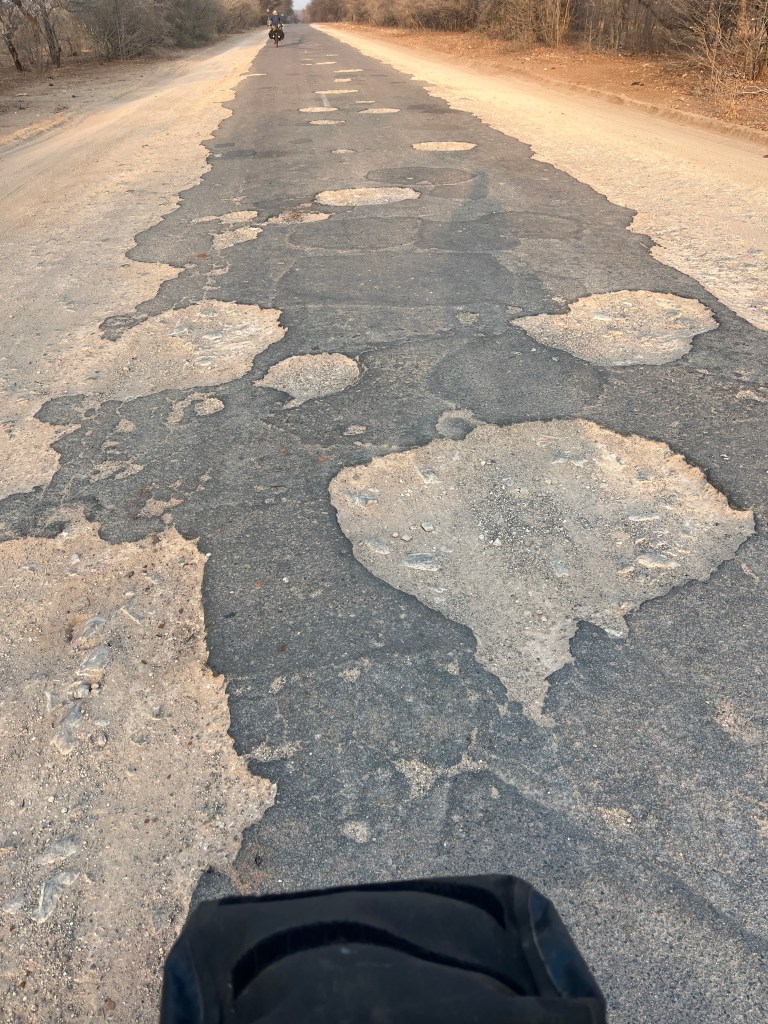
The tarmac road we are following goes to the highway, which also goes to Victoria Falls, our next main stop, but takes 10 km longer. So we take a dirt road that goes to a town called Deka, which borders the Zambezi river. We manage to buy some borehole water from a woman living on the side of the road as the level of our salty supply is running low and we would have to start soon to drink from the yellowish one. This water looks very clean but we made the mistake of not trying it before cleaning it as we will realise that it taste like rotten eggs (it was probably contaminated by some coal). But still better than no water.
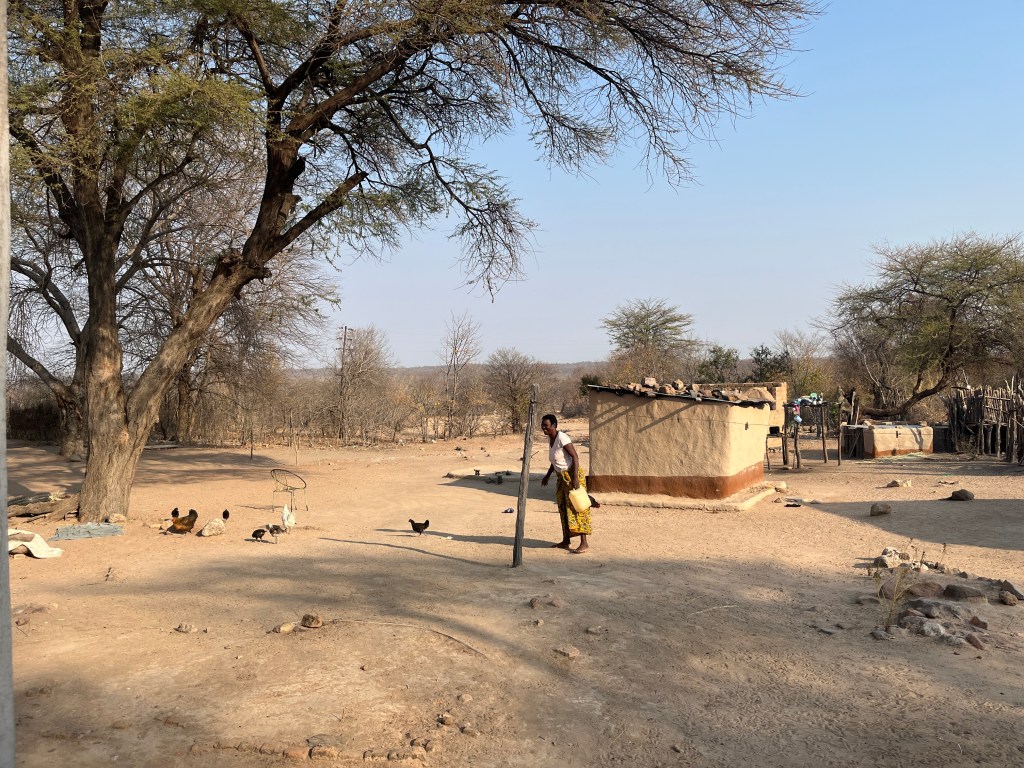
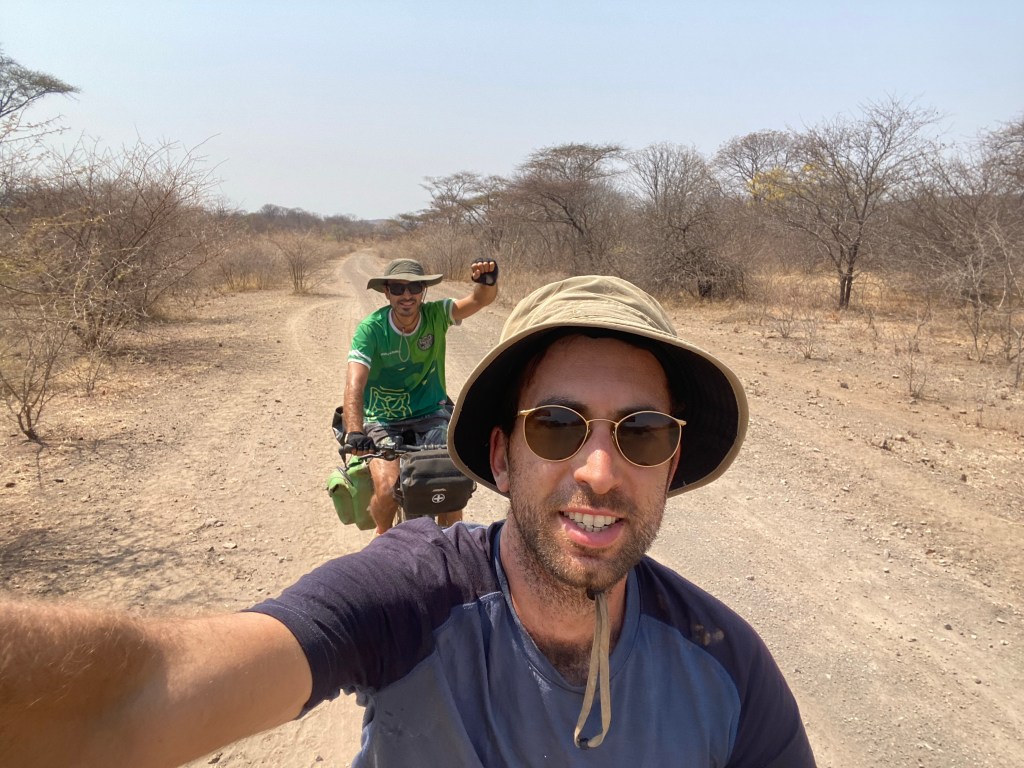
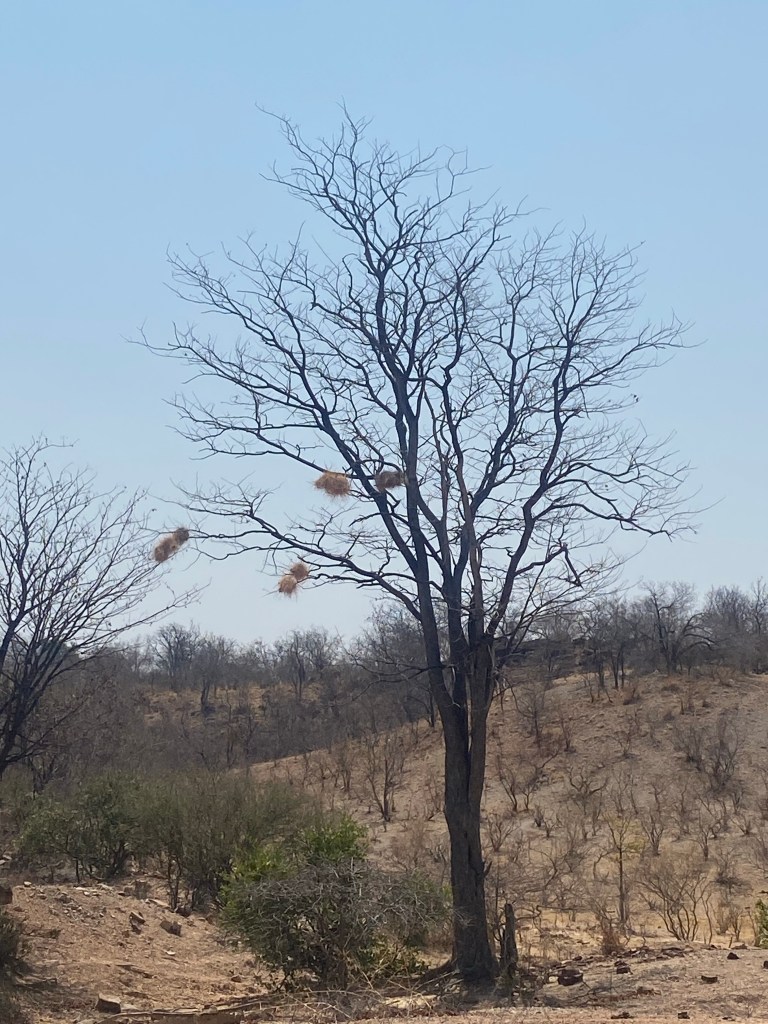
The size and amount of stones makes us doubt our decision, but with a bit of patience, we cross this solitary area, which happens to encomprise what looks like a private hunting reserve. Birds are constantly flying above us, alone or in a coordinated majestic flock, trees on the side of the road are filled with nest making the ride very enjoyable.
We were imagining Deka as a big town, as it had an airstrip, but when we arrive, the airstrip is basically a mowned grass field, and there is few houses. As we are getting closer the landscape is changing drastically from dry, desert like to an oasis. We suddenly see palm trees and rivers making us realise we must be very close from the Zambezi river.

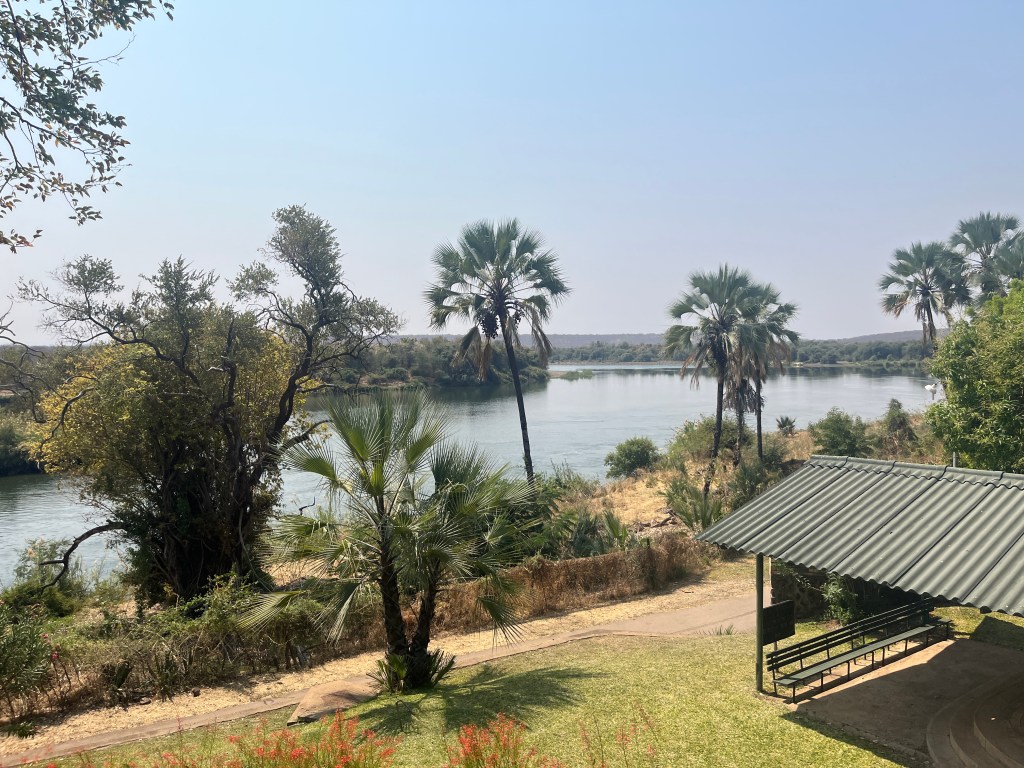
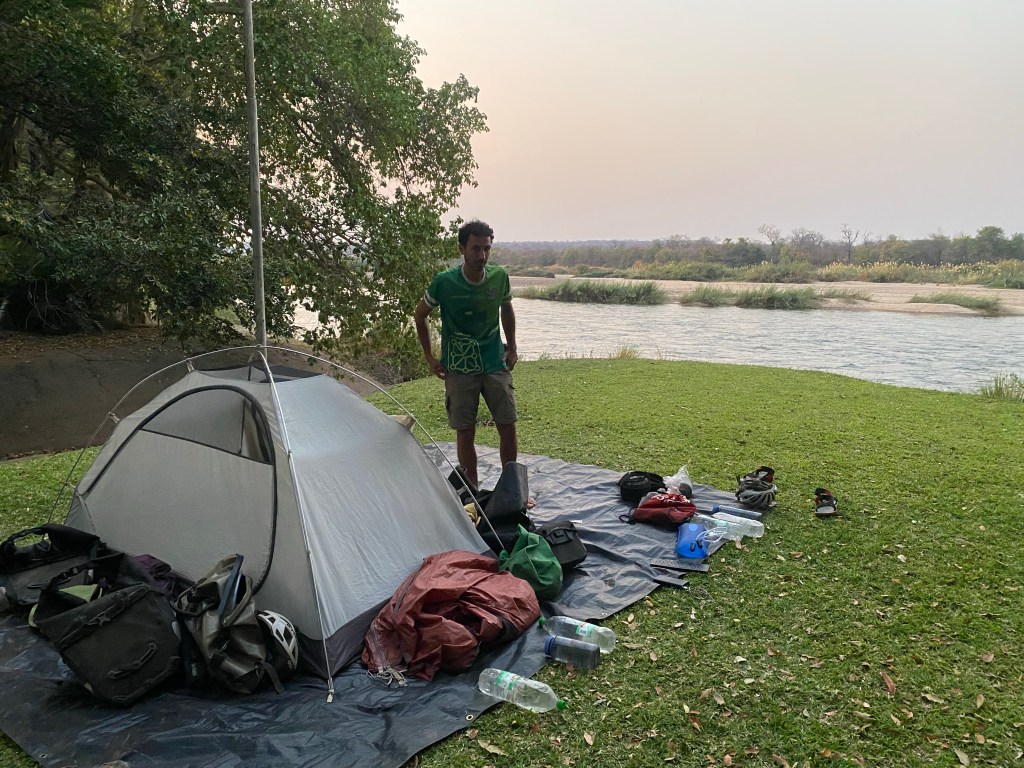
We do find a cold (ish) fanta like drink in a bar that also is a shop. Most shops here consisting of a guy selling a can of beans, bread and some drinks. A weird, drunk guy, who says every 3 minutes that he works in Vic Falls for a white man called William, insists that we should go to the Angling Club, which we actually saw announced by the road. Some intuition tells us to follow his advice, but he comes with us, talking non stop and putting us a bit on our nerves. What he was right about is that the club had food, and very tasty (although a bit “expensive”). The great surprise is that the club has a swimming pool, a majestic view of the Zambezi river, and lets us pitch the tent for just 5$ both!

Their borehole water is very good, so we feel lucky. We fill our bottles, put them in their fridge, next to the beers and feel privileged to have cold water. Meanwhile the drunk guy keeps following us while we go to pitch the tent, and we tell the security guy please not to assume that he is our friend. He then starts asking for money, which we just ignore / deviate. We are grateful for his tip, but no way we are sponsoring his next alcoholic session. The security guard ends up asking him to leave.
In any case, the club is really interesting. It was built in the 60s and it is owned by one of the local mining companies, who pulls water out of the Zambezi to its mines. Their giveback to the community was this club. In the pictures of the walls, one sees that the white high class of the time used to hang out there, and curiously, there is no more pictures after 2000, when the expropiation of white-owned land began.
We spend the afternoon collecting opinions of which road is better to Vic Falls. The one that goes to the highway (145 km), or the dirt road (120 km). We do an average with all opinions and decide for the highway – we believe it’s going to be much faster.
13/09/23 – Deka – Victoria Falls Airport, 128 km, 1230m+
Early start. Peanut butter and cookies. Let’s go! The road turns asphalted, as we choose the one that goes to the highway. We see myriads of kids and teenagers walking in very classic and cool red school uniforms. Most of the girls are wearing a hat in a Harry Potter fashion. The road is really crowded with them. We salute them in Tonga – “Mapona!” – what they find extremely funny.
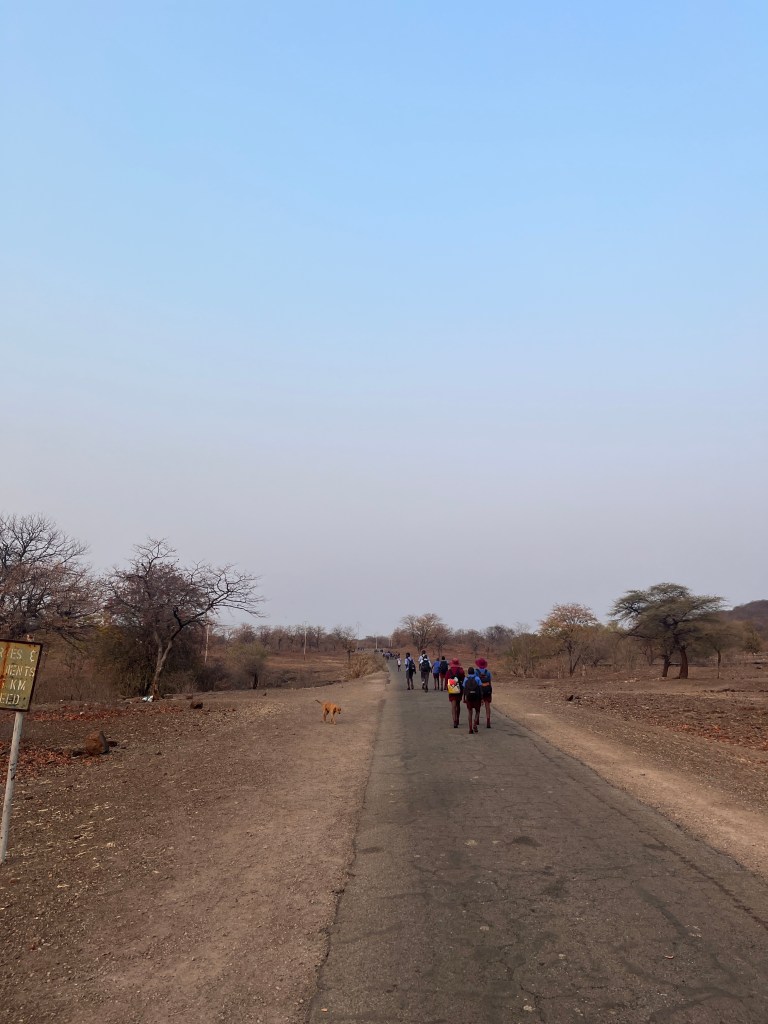
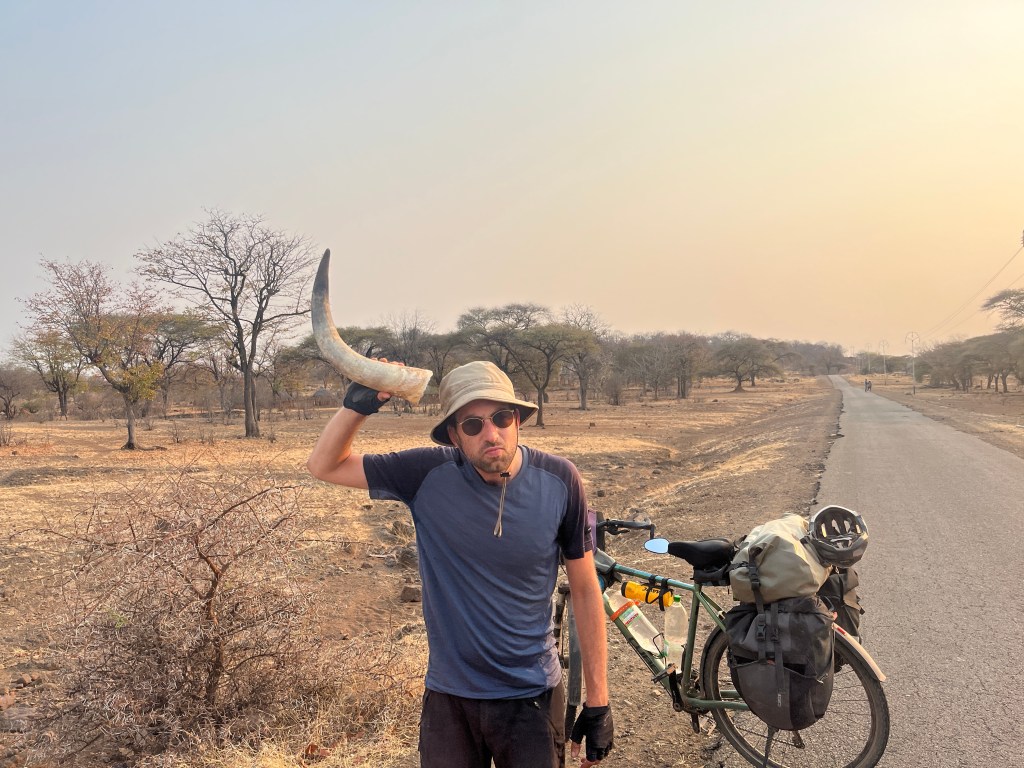
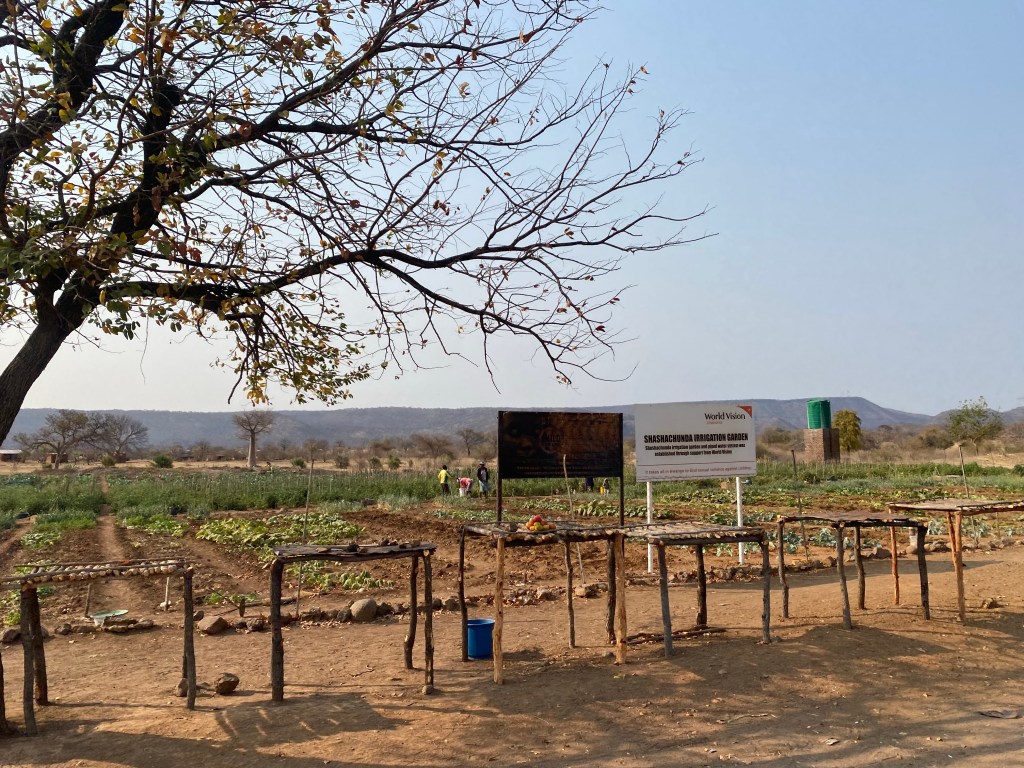
The landscapes get less dry due to the proximity to the Zambezi, and the appearance of the cultivated terrain looks very professional. Most of them have their own boreholes, solar panel (to pump water) and are funded by USAid. Churches also look very solid and pretty, in colonial style. We seem to be in an area that is doing well for Zim standards.
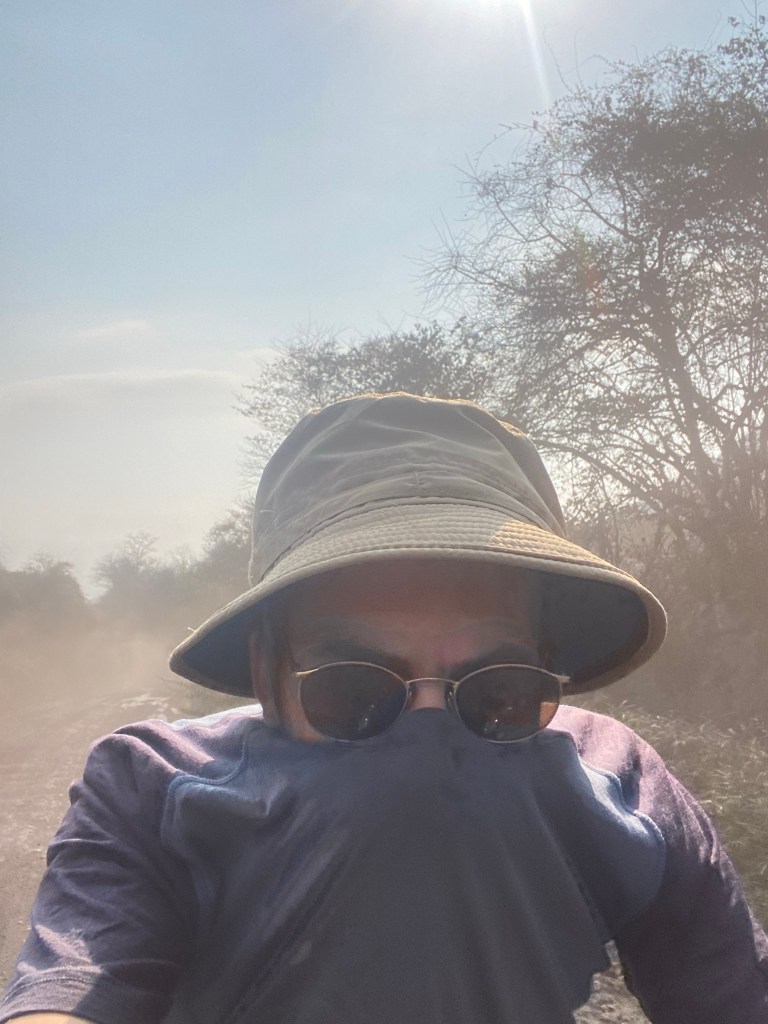
After 40 kms, we arrive to the coal mine of the company that runs the Angling Club, what may be the reason for the “prosperity” but also a source of incessant trucks that arrive empty and leave full. It seems like the tarmac road has been broken by the continuous traffic of trucks, leading us to ride for 10 km on a black dirt road consisting of coal powder from the extraction and slowing us down a lot. We cover our nose with the t-shirt, while our clothes and skin start getting almost black. The mix with the suncream doesn’t help.
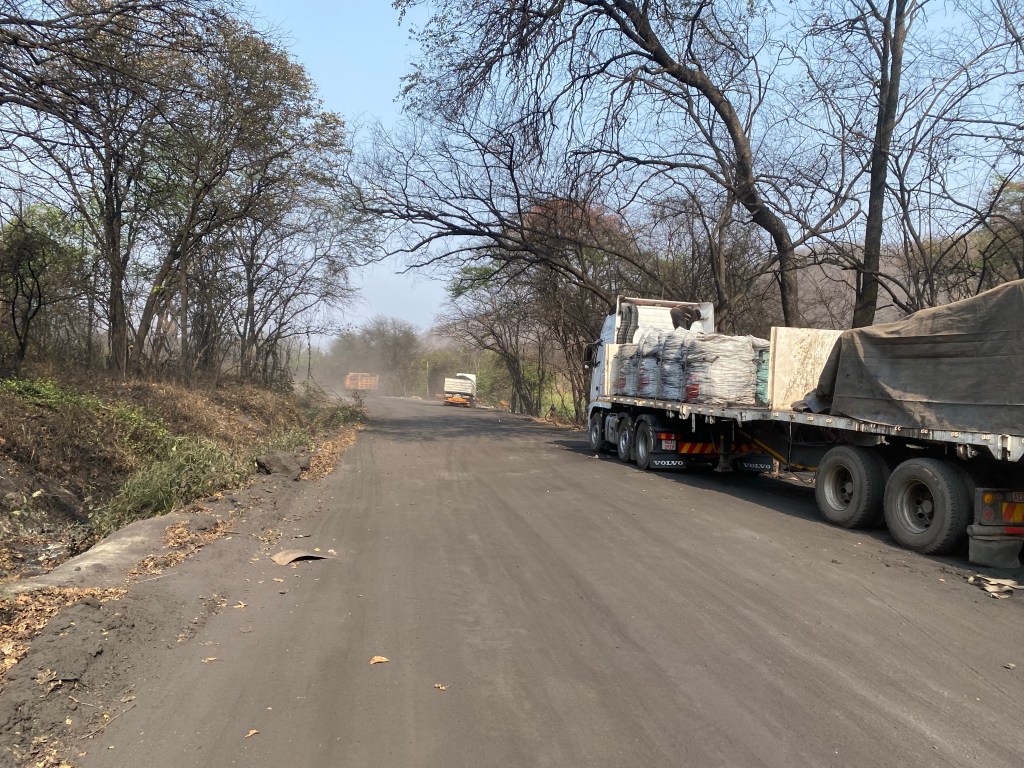
The come and go of trucks doesn’t stop until we arrive to the highway, where we observe more mines and what looks like a nuclear power station. A very industrial environment surrounds us suddenly. We will learn later that the Chinese run many of these mines and power stations and locals are complaining that they are polluting drammatically the rivers and boreholes around. Sad to cycle, even sadder to see.
The highway is undergoing maintenance work, which we hope to end soon as it slows us down. For once, Fortune goddess pays attention to us and after 5 km, the tarmac returns. What we missed in the confusion of factories, construction work and trucks, was to stop at a shop to buy some extra food. “We will soon find a village I guess” says Gaspard. Kilometers go by and by, and we see nothing. On the left side, there seems to be what looks like a private game reserve, pressumably hosting expensive game rides originating in Vic Falls, which is now less than 70 kms away.
When the day kilometer count hits 71, we congratulate each other as we know that it means we have now completed 3’000 kms in this trip! We really do get our dopamine from these useless things. We start to get excited about arriving there having used a bicycle since Tanzania. A bit later, we finally arrive at a village, which seems to be far enough from the factories to have clean water, and happens to have a shop. We cook instant noodles in the backside of the shop, under a pleasant shadow. We get some extra canned beans, milk and bread, for the last push. As always, the shop is door to door with the bar, where a couple of drunks talk and stare at us. But this time, no one bothers us too much. The local secretary does come to us to welcome us and ends up asking if we dont want to relax at the bar, pressumably hoping for a beer invite. But we have an easy excuse, we have to continue cycling!
What we start noticing is that there starts to be a bit of diversity in electoral propaganda, with even people wearing t-shirts of other parties. That’s something novel so far, sine we have seen locals wearing t-shirts and caps (pressumably gifted) belonging only to the ruling party, the one that “won” the recent disputed elections.
We retake the cycling under the annoying afternoon heat. A convoy of 30 trucks of the same company comes in the opposite direction, speeding at probably maximum capacity, and making us struggle to control the bike due to the wind. But the shoulder of the road is good, and when we have done 120 kms and have only 25 kms to make it to the town, the debate starts. Gaspard proposes to continue so we enjoy already normal food at town. But Javi finds it’s too late to make anything with the evening at town, as it’s already 4 pm, and he would rather stop what is already a solid day. In this type of discussions, the most conservative approach tends to have preference, and so we do. We stop at a cultural center run by local Ndebele people, where they tell us they have rooms for 20$. We find a bit expensive for the outskirts of the town, but when we check the room, we politely tell the family that there is no way we can pay so much for a room in so precarious conditions. They immediately step back and accept our request to camp, and reduce it to 10$ for both (they wanted to charge us 20$ initially, what doesn’t make any sense).
After the initial slight tension and attempted slight scam, the family ends up being super friendly and welcoming. We learn about their Ndebele ethnicity: they are descendants of the Zulu people of South Africa. The main ethnicity in Zim, the Shona, originate in Mozambique, while the Tonga, in Zambia. The Shan, the original ethnicity of the Zim geographical area, is almost extinct, diluted in the others. Ironies and injustices of history that are not unknown to us Europeans.
The place happens to have no network, so Gaspard cycles 5 km more, to be able to call his girlfriend Yasmine. That’s a good boyfriend, the rest is bullsh*t. The evening turns out to be much chillier than we are used to recently, what anticipates a good sleep.
14/09/23 – Victoria Falls Airport – Vic Falls.
We start cycling with our pullovers due to the cold, something we hand’t done since the Nyika Plateau in Malawi. But we are exultant, as we are close to one of the 7 natural wonders of the world. The road starts getting crowded, and unsurprisingly, after we pass the airport, the streets become much better, and all road banners are about government propaganda.
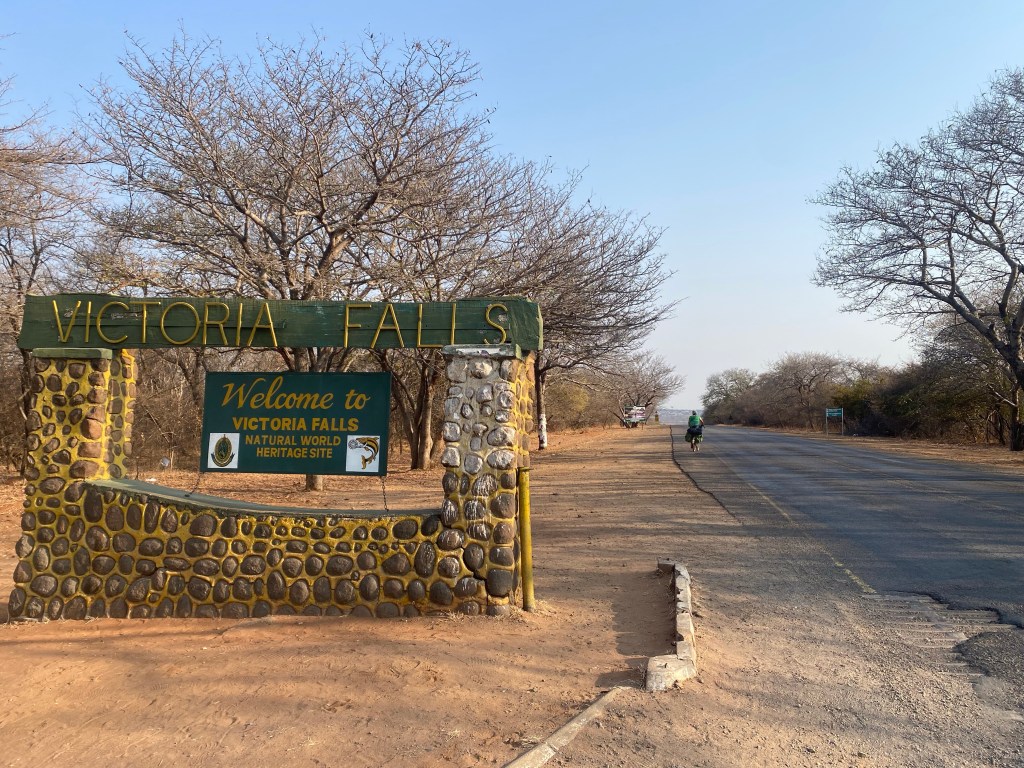
We are just a couple of kms away and by now the amount of tourist is already very noticeable. We go towards one of the Lonely Planet advertised hostels, and a guy tries to persuade us to go to one he knows for the same price. We decline, as it’s the same price and it doesn’t have a pool. They guy ends up asking for money. As expected in any major tourism hub, the interaction with locals turns much more transactional. The street are filled with baboons and mongoose running in groups.
We check in the local hostel and manage to bargain a mediocre 5% the price of the room, which costs 36$ a night. Vic Falls is expensive. Just when we are about to pay, we have this realization that there is a machine drilling just in the parking lot, and making a very annoying noise. “How long are they going to drill?” we ask, expecting 1 or 2 hours. “Oh, only 3 days”. Damn, we look at each other and agree that it is going to be impossible to write our blog in the dust covered pool with that noise. The hotel is also out of power. We are getting out of here. The other recommended hostel has crazy expensive rooms for 80$, but they have some big tents with actual beds inside for “only” 40$. The common areas and the pool are far superior, and the bar size anticipates a party at night. We are staying here.
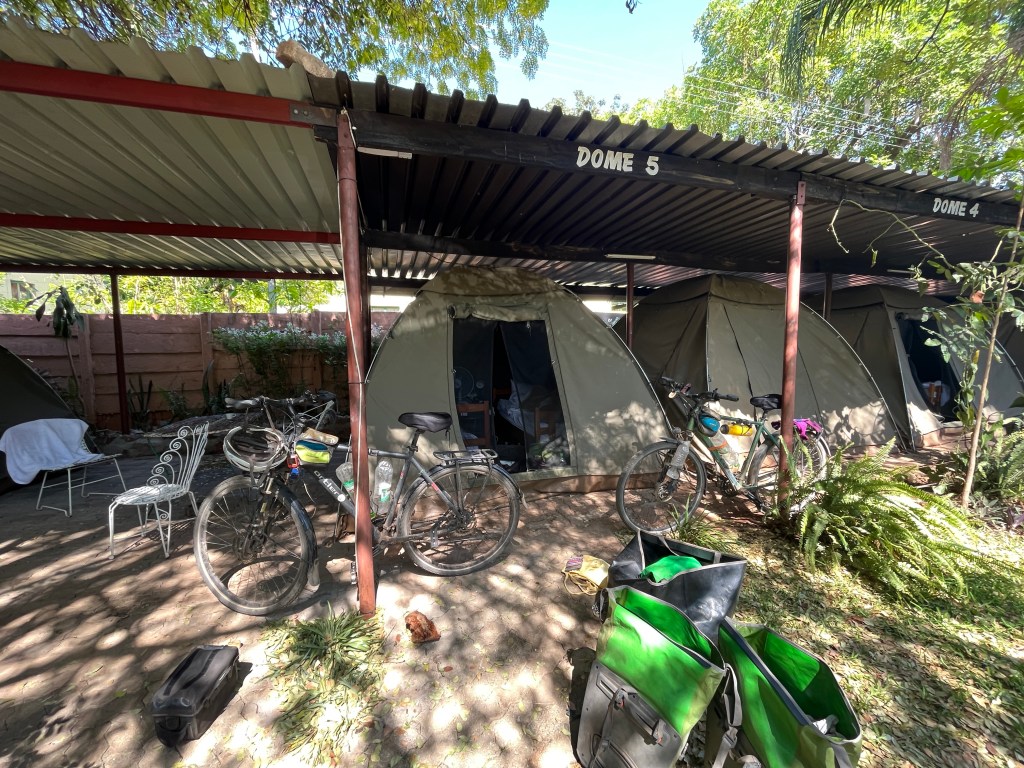
A shower. A laundry machine. Wi-fi. We slowly get back to the civilized world. The restaurant prices are through the roof for what we have been paying, but going to the supermarket and cook spaghetti again sounds like a major endeavor when you are by the swimming pool. So typical hostel cheeseburger with fries it is.
In the meantime, Gaspard has now managed to break his iphone cable for the 2nd time. Together with his dynamo converter, which died after 2 weeks, and his solar pannel, which just stopped working, that counts for the 4th electronic breakdown, what makes Gaspard candidate for being allergic to electronic products, or rather the opposite.
So he goes buy one, and we go pay for the white water rafting activity of tomorrow. It’s very expensive, 118$ each, but everyone talks wonders about it, and I guess we are only once here. Outside, some guys try to sell us Zimbabwean notes of 1 billion dollars, what seems to have an audience. We decline, to then get offered weed, and end up being begged some euros. We are really in a touristic place. But it is so for a reason, and that’s the falls, and it’s time to watch them.
The falls are located literally on the border of Zambia, where they come from, and Zimbabwe, where they land. The border goes through the water drop zone, which goes West to East. On the East side, after the falls are over, there is a drammatic, classic bridge, where the actual border crossing happens. Tourists do bungee jumping, zip line and what not from it. Below, the famous rafting starts.
The entry fee on the Zimbabwean side, where 80% of the water flowing can be see, has increased to an unfair 50$ per person. Even the local price is way too high (7$), as the maintenance for the area seems rather low. Anyway, we are here for that, so we pay while we comment that luckily there doesn’t seem to be crowds of people, with only 10 tourists lining up.
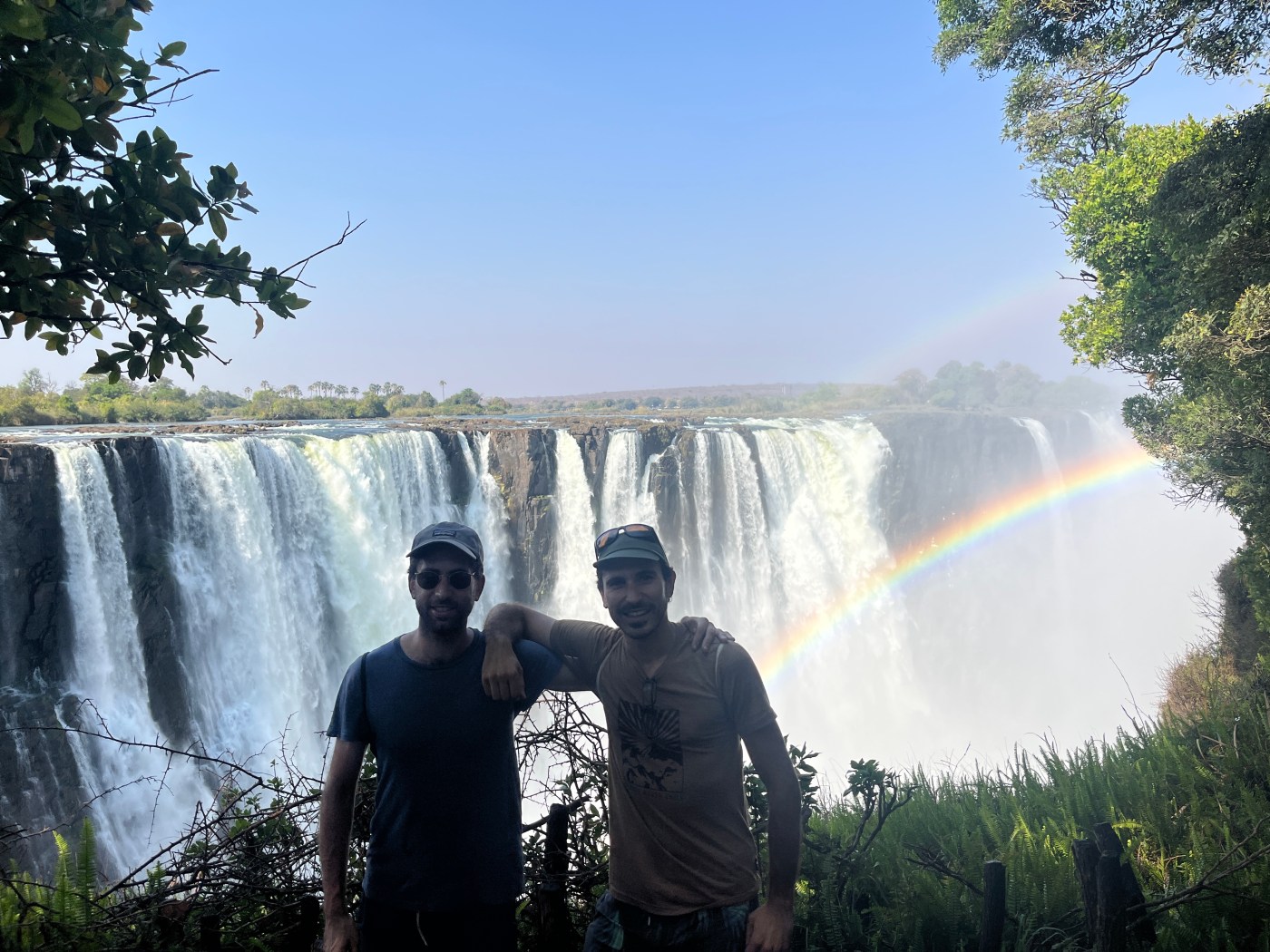
Javi has avoided to see actual pictures of the falls to have a more breathtaking first impression, and he has managed to do so. We start from the Devil’s Fall, where Dr Livingstone, the british explorer and missionary, saw them for the first time around 1850. We spend two hours going through all the scenery, West to East, charmed with the rainbow that slowly elevates itself from the bottom of the gorge.

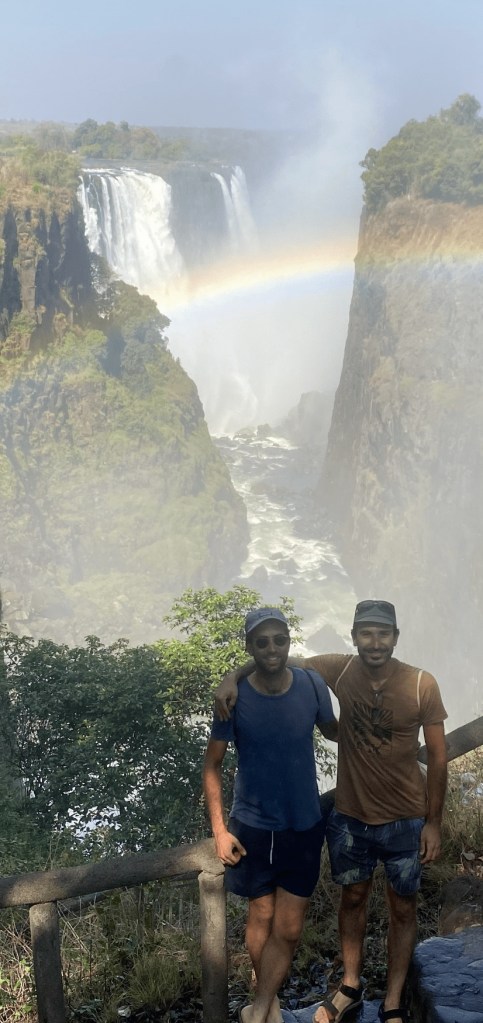
Despite now it’s dry season and the amount of water is rather low, that actually allows the falls to be seen, otherwise the moisture and the evaporation prevent the tourist from a full view. It is also a good time to go rafting, as in rainy season they get more committing, and the rapids end up closing in Spring.
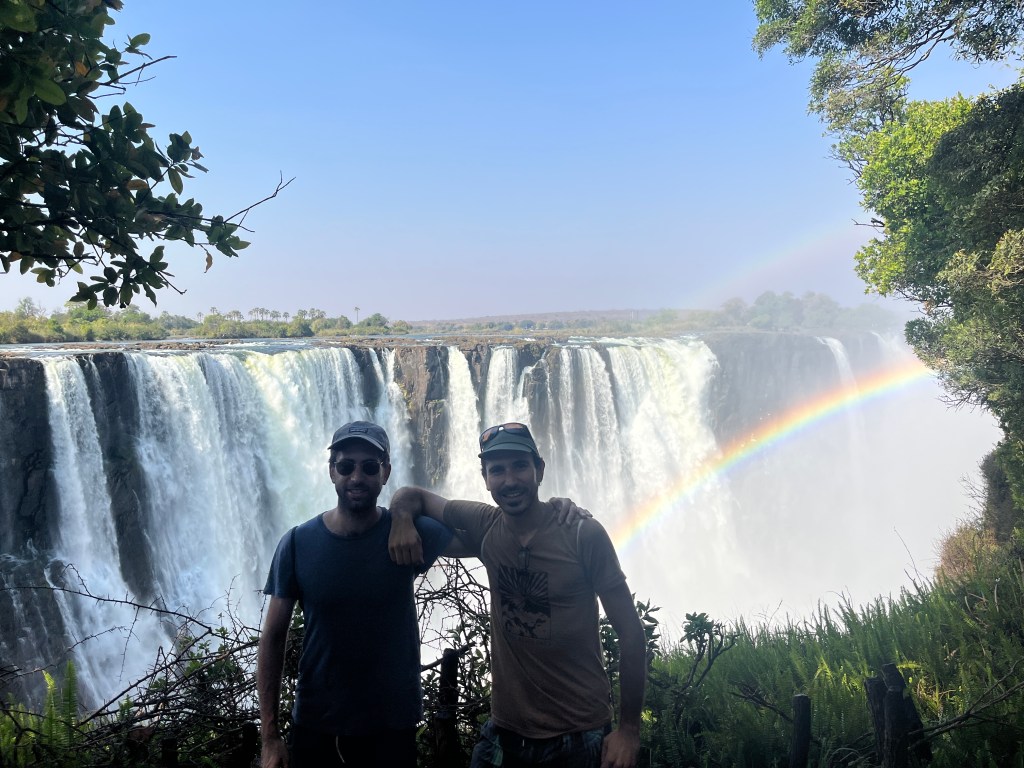
We both truly enjoy the visit, as the falls are a real wonder, and it’s difficult to embrace their size. I guess the pictures will speak for themselves.

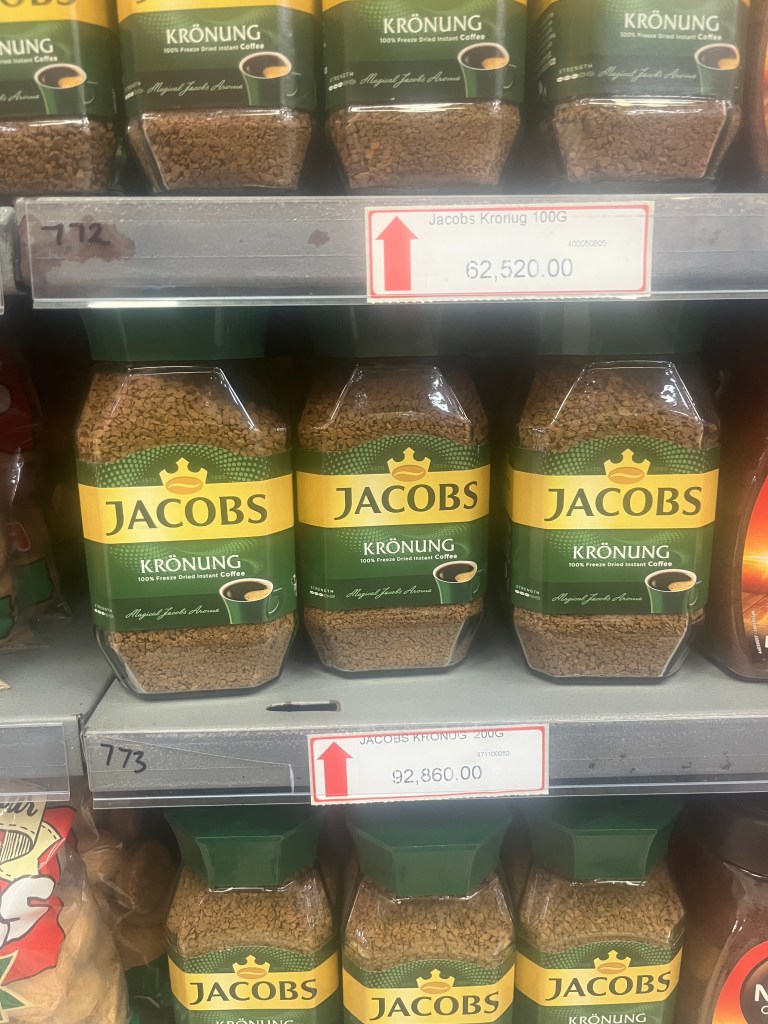
Back in town, we go to a supermarket for the first time in Zimbabwe, where we are more than shocked by the price of imported goods. A box of instant coffee “from Germany” costs 20$, just madness. We still get our breakfasts, and go back to the hostel for dinner.
At dinner, we meet a couple of volunteers that work at the hostel, Hersh from India and Sabrina from France. Despite their young age (they must be younger than 25), they have travel a pretty good deal, always in a backpacking, volunteering style.
We enjoy a nice dinner and evening with them, exchanging travelling tips. The fun fact of the night is that, out of the blue, a random group of 20 polish in their 50s enter the bar and start having shots like there is no tomorrow. They dance (or try to( with some local men that dance approximately 100 times better. The polish don’t care, and just take videos and shots. We somehow find the scene a bit cringe, and leave for bed as we have a solid day in front of us tomorrow.
15/09/23 – “Rest Day” at Vic Falls: White water rafting
The short summary for the day is: if you happen to be in Victoria Falls, you must do white water rafting. Period. Yes, it’s very expensive (118$ per person, in fact is the most expensive thing we have done in the trip by far), but we found it worth it every penny. The rapids are apparently world class and some of the most challenging ones that can be done by amateur people in the world. Yet, given the big depth of the river, they are relatively safe, so when you fall out of the boat (which will happen at some point), you will make it back either on the boat or to the shore. There is obviously local experienced guides with you.
We are picked up at the hostel at 7am and end up in a boat of 8 with a friendly couple from Uruguay, 3 czech men in their 60s, and a middle-aged british man. one of the czech men, Karel, was a former special force colonel officer, who was deployed all around the world. He holds a French Merit Medal for participating in saving 80 french soldiers in the Serbocroatian war in the 90s. He also walked 5000 kms solo from Mexico to Canada. Very talkative and interesting guy, who shares a lot of tips for our next move, which we are slowly confused about (Going to Namibia through the Caprivi Strip, the funny extension of Namibia that almost touches Vic Falls, or through Botswana, where we could see the Okavango Delta and other highlights).
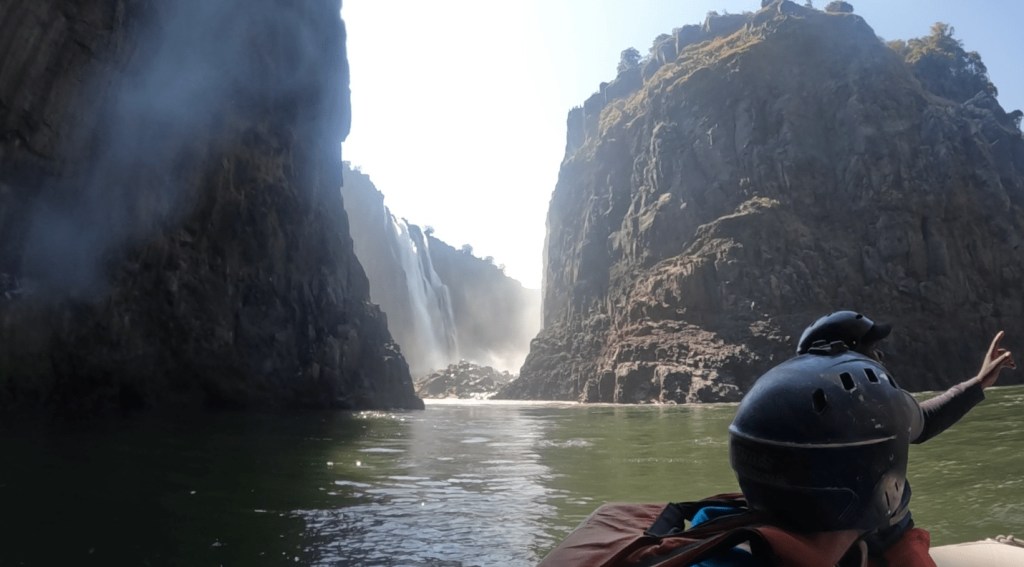
Anyways, the rapids start strong and the training received extends for just 5 to 10 minutes. The starting point is located below the Vic Falls bridge, with a partial view of the falls, it is just magnificent. The whole route is through a deep gorge, with different birds nesting and fishing. Zambia on the left side, Zim on the right one. On the 3rd rapid, everyone except ourselves and a Czech guide goes to the water due to the tempestuous splashes of the waves.
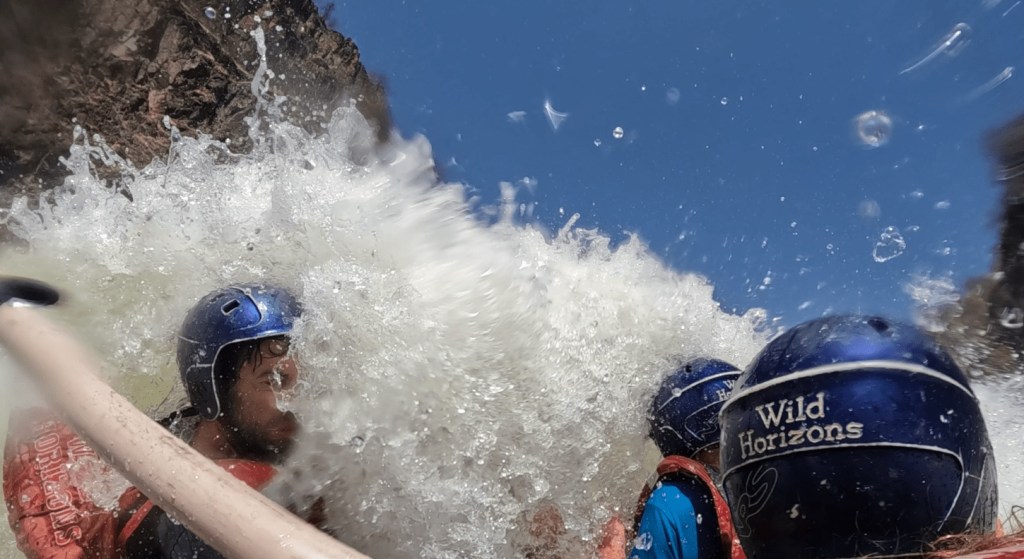
When this happens, and you see your comrades struggling in the water, floating thanks to the leif jacket at a considerable speed, all your instincts activate as you think they are going to die. You struggle to help them bak to the boat, and the whole thing feels like a special force operation, particularly because Karel the czech military keeps motivating everyone with a strong “forward, forward!! All together!”.

On the 7th, if I remember correctly, we have to choose between tackling the jump, graded level 5, the maximum we can do (level 6 we need to walk out of the water), or skipping it, making it “just a grade 3”. We shily agree on trying, but offering anyone who doesn’t feel comfortable a “bailing joker”. Ernest, our guide, tells us that if we don’t padel extremely straight, we are going to capsize the boat. We obviously do, what feels again like a fight for your life, whih ends up with one of the Uruguayan being rescued far away from us and our sight, what makes us think the worst. We obviously capsized the boat with a view of us “stuck under it”. Flipping the boat back in the upward position was also an interesting exercise . Luckily, “only” one person out of the 4 boats with 32 people ends up injured, with a black eye due to a flying paddle. We hike up a steep path out of the gorge and enjoy a free bar of beers and food, including cocodrile food, which we obviously abuse after having paid a fortune. We are particularly surprised by how many people above 60 have endeavored on the challenge, what we have found absolutely no joke. Many of them look exhausted, but everyone seems exultant by having experienced such an amazing adrenaline rush.
The tourist packed open bus brings us back to the hotel, where we take a nap to recover, expecting to find a crowded bar in the evening. Our Indian friend Harsh joins us for dinner, and we learn more about his remarkable travelling style.
As an Indian, getting visas is unfortunately challenging, so he has to choose countries based on rumours of approval prices and on the actual costs. Colombia already refused his visa twice, and ther are countries that charge Indians 200, even 400$, for visas, while they charge 50 for Europeans or US. So unfair. We are astonished how, despite the very different cultural background, we agree on our vision of so many things in the world, what makes us very happy. What a great guy. He combines travelling with youtube video blogging, where he does videos in Hindi with travelling tips, hacks and just info. He recently released one on how he had to pay bribes in Malawi (he even recorded the audio of the conversation!!), and one about an investigation he did on a “volunteering job” for a None profit hostel that he suspected to be just a business for the English owners to live a relaxed life by the sea. We tell him that he has a place in Switzerland when he gets his European Visa, which may take some time.
The bar is (very) slowly dynamizing, but Gaspard is tired and goes to bed. Javi stays with Hersh, and both inevitably end up pretty drunk after playing drinking games with a bunch of English and White Zimbabweans. A crowd of 8 extremely drunk Kiwis (New Zealanders), make the night very fun. They are supposed to go white water rafting tomorrow, and Javi can’t help but laugh about how they are going to struggle. Otherwise, everyone in the bar crowd are local white and colored Zimbabweans, who seem to be all working and owning businesses in the tourism industry.

The owner of the lodge, a white Zimbo of just 26 years of age, is wasted, and seems to be very proud of being the owner of the place. Locals drink heavily, and there are also some prostitutes trying their luck, also with us at some point. After the bar closes at 2 AM, everyone moves somewhere else, while Javi decides to go to bed to avoid being destroyed the day over. Finally a night out for Javi, Gaspard’s is still waiting.
We wrap like this our incursion in Zimbabwe, a country most of cyclists skip, but very worth detouring to. It’s poor and challenging, but definitely doable. We have really enjoyed and found a lot of kindness and beauty in this struggling environment. Tomorrow we cross to Zambia again, where we stay 2 days in a Couchsurfing place, where we finally have to decide how we make it to our endpoint in Namibia. Caprivi Strip in Namibia or Elephant Highway in Botswana? We will see.
days in this post (total): 9, out of 53
kms (total): 502km, out of 3085
gained elevation (total): 4700m+, out of 31200m+
 Cycling Pirates
Hey Javi, this is Jonathan. I’ve just read your Zim experience and loved it! My wife and I, together with our 3 kids, have just returned earlier today from 2 weeks of safari camping in Zim (starting in Harare, going up to Mana Pools at the Zambian border, and gradually working our way to Vic Falls) and it was fascinating to compare the different travel perspectives yet shared experiences that we both encountered. Wishing you a great rest of your trip and looking forward to catching up IRL when you’re back in Switzerland.