
Song while writing: Koffi Olomide – Loi
16/09 – Victoria Falls (Zimbabwe) to Livingstone. 20 km.
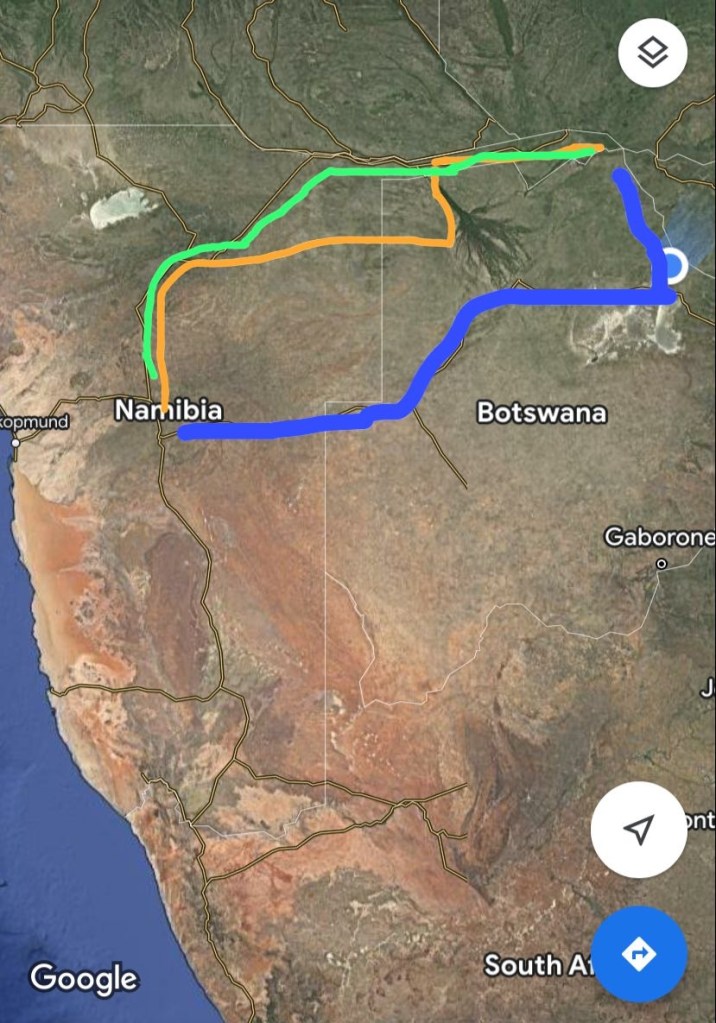
As expected at the end of the party (see post #7), Javi wakes up hungover. We start analyzing by the pool of the hostel (Vic Falls, Zimbabwe) our next options: acccessing Namibia directly through the Caprivi strip (the famous corridor that extends remarkably out of Namibia’s main territory), or crossing first Botswana, to then later enter Namibia “just” 400 km away from its capital and end destination, Windhoek. Road status, points of interest, wildlife safety… We find info from different sources: cycle touring web blogs, a whatsapp chat for cyclists in Africa, Lonely Planet, and the one we like the most: info provided by other travellers over a beer.
We collect some info but not enough to take a final decision, as it’s slowly time for lunch. Our Uruguayan friends are back from checking the falls on the Zim side, and we join them for lunch to a local restaurants with prices 3 times cheaper than at the hostel. Uruguayan and Argentinians are really good travellers, and they always try to find authentic and affordable places, so it’s a good idea to become friends with them. Hersh and his girlfriend are supposed to join, but somehow they don’t manage to find the place, Google Maps location might be wrong. So, to Javi’s disgrace, he won’t be able to farewell his partying brother in arms of yesterday.
Food is very good (although very meat intensive) and we enjoy a deep yet interesting debate with Melissa and Agustin: “is the homo sapiens mainly a cooperative animal or a competitive one?”. We would definitely enjoy more time with these kind people, but it’s almost 2 pm and our Couchsurfing host at the Zambian side of Victoria Falls is waiting for us.
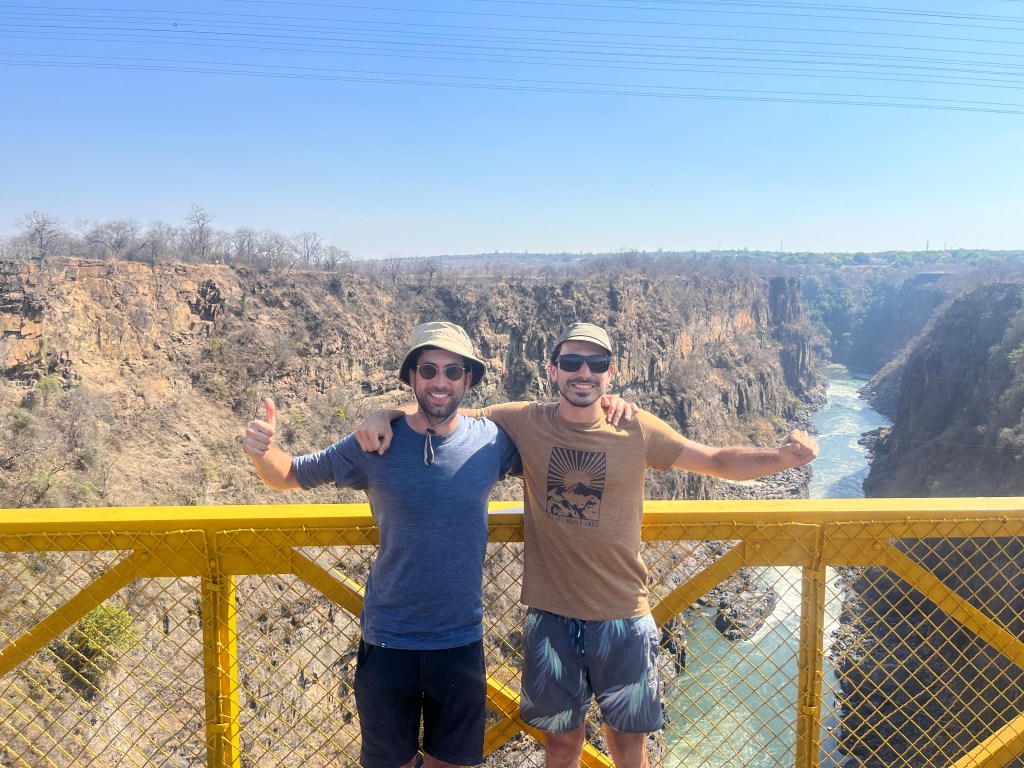
After 3 kms, we arrive at the Zim post, where we get the exit stamp in matter on seconds. Javi 30 days, Gaspard 6 days. When Gaspard complaints about it the officier replies that the only thing to do is to go to another office to get an extension while saying “why do you want to stay more than 6 days”. Then, we cross the famous bridge, while we see the tourists queing for the bungee jumping, all with a gopro on hand. Many locals carry extremely loaded bikes, pressumably to sell them in Zambia. One of them gets in trouble and, despite we try to help him, his bike ends up getting the whole derrailleur broken. Poor him.

We cycle with the young man that also tried to help him for a while. He is 21 years old and he also works bringing goods across the border. He asks us for some water and Gaspard gives him some. Surprisingly, he spooks it, saying it’s way too hot. If he only knew that hot water is our daily bread…

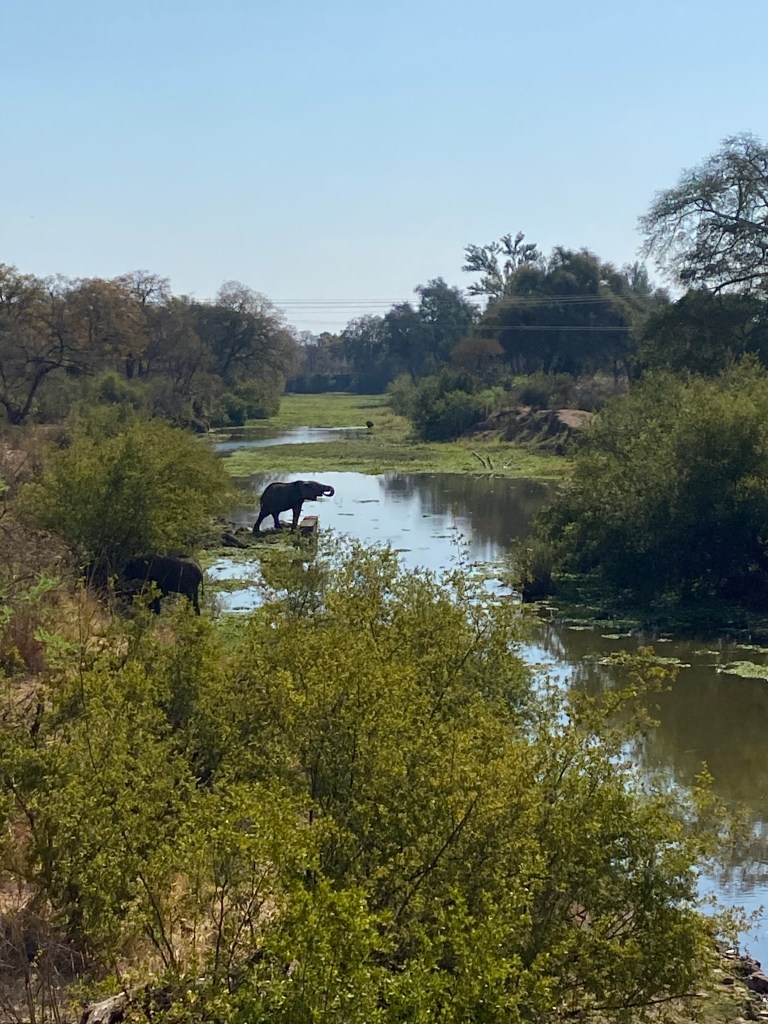
We pass through the Zambian gate for its Vic Falls outlook, but we will leave it for our rest day tomorrow, since Livingstone is only 10 km away, and see elephants drinking from a nearby river. Livingstone is named after Dr Livingstone, the first European to discover Vic Falls, and a famous missioner that ended up fighting to attempt to abolish slavery in the 19th century. The city used to be the capital of Zambia (before that North Rodhesia), but it moved to Lusaka, which it’s closer to the main export of the country: copper.
It’s a friendly city of only 150’000 inhabitants that, unlike Lusaka, one sees it has a soul and a proper town center. We meet David, our couchsurfing host, at the craft market, which is painfully empty of tourists. The shop owners try melancholically to persuade us to buy something. Many locals seem to work in the traditional craft business but, in this digitalized and over-materialistic world, I have the feeling that tourists look rather for experiences and memories.
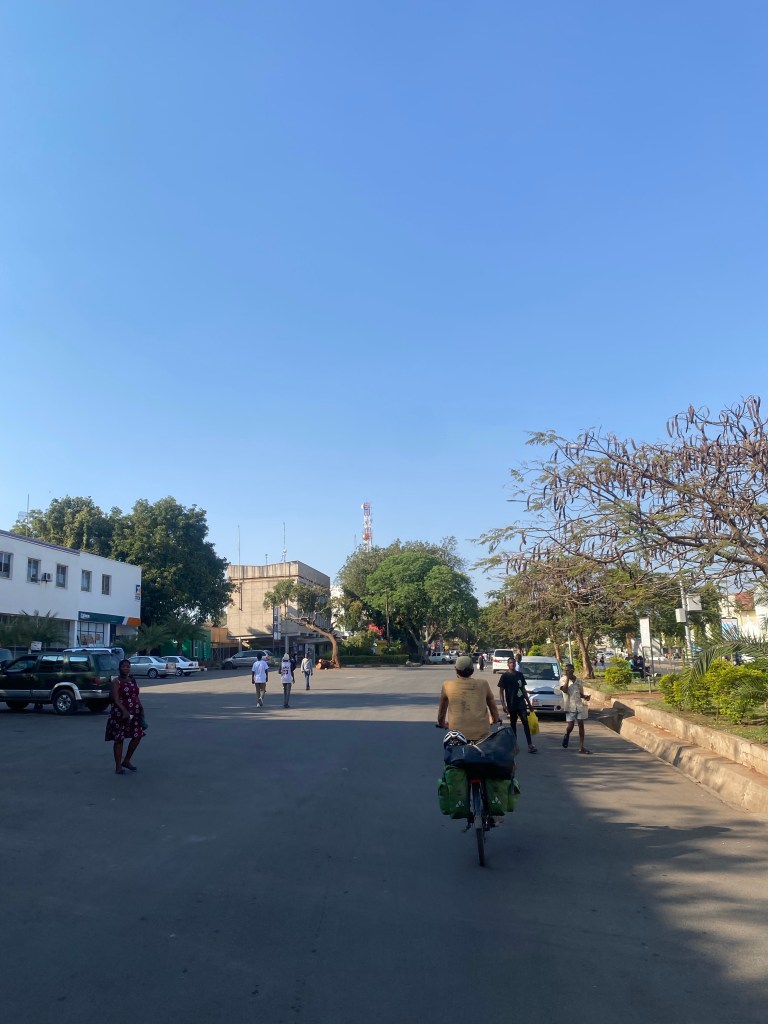
We walk with David towards his place, which is 30 minute strall away from the center. He is an avid couchsurfing host: more than 100 people have stayed with him. He must be in his 40s and has a t-shirt printing business that he is trying to grow with guerrilla marketing, such as graffitis. Very quickly we are impressed with his deep knowledge of Europe as well as his insatiable curiosity. His house is small, yet cozy and pretty clean. The absolute highlight is the vinyl player, with an oldie collection including hip hop from the 90s, jazz, and bob marley. To our disgust, we discover that he plans to let us sleep in his bed, and he will sleep in the sofa. It won’t matter how much we try to persuade him, the decision has been made.
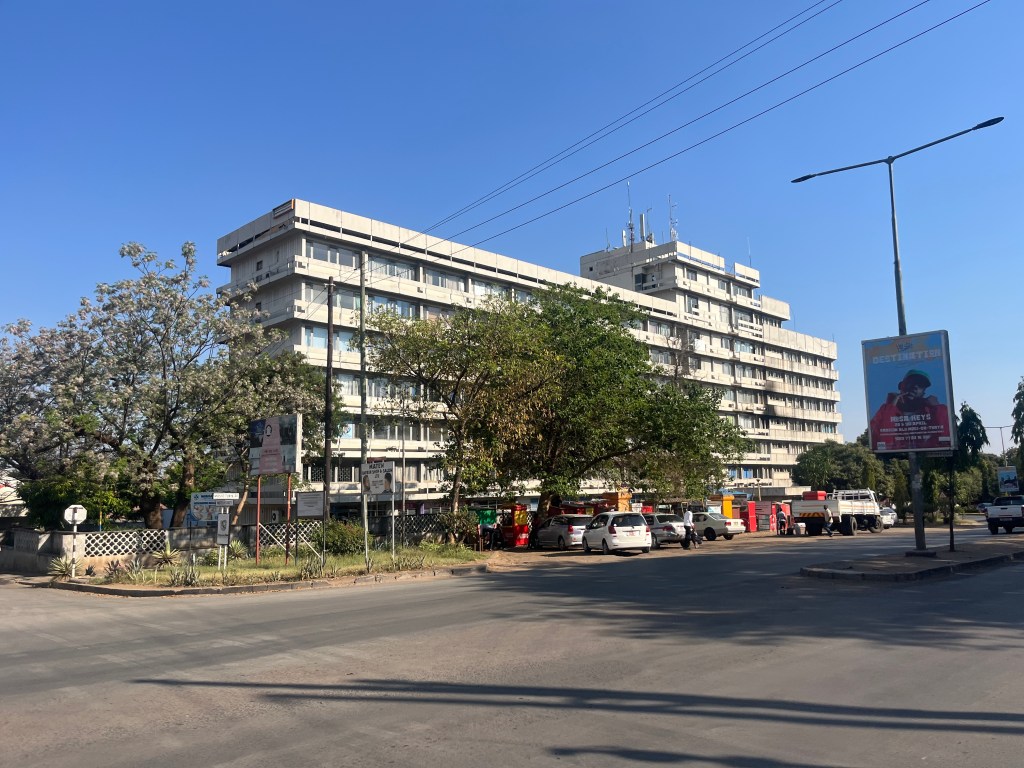
After a shower, we go to the center for dinner. Hersh, our Indian friend from the Vic Falls hostel, told us about an Italian restaurant with very affordable prices, Da Canton. We go there and it’s true, you will never find so cheap pizza in Africa. The food is obviously not a t the level of Macondo Camp in Mzuzu (See post #4, Malawi), but it’s pretty acceptable. We find out that David is a vegetarian (the first African we have met), and doesn’t drink since 8 years. Our admiration for him keeps growing. He has a kid living with the mother of the mother, since she is studying nursery in the Copperbelt. One can see that he is really emotional about it and wants understandably to be living together with his kid as soon as possible.

It’s a saturday evening, so the many pubs of the town are full to the top with locals, and also some muzungus. Despite Javi’s tiredness, we go for some drinks to a pub, but the music is soo loud that we can’t talk to each other. Always like this. After sitting silently we agree to go to another place.
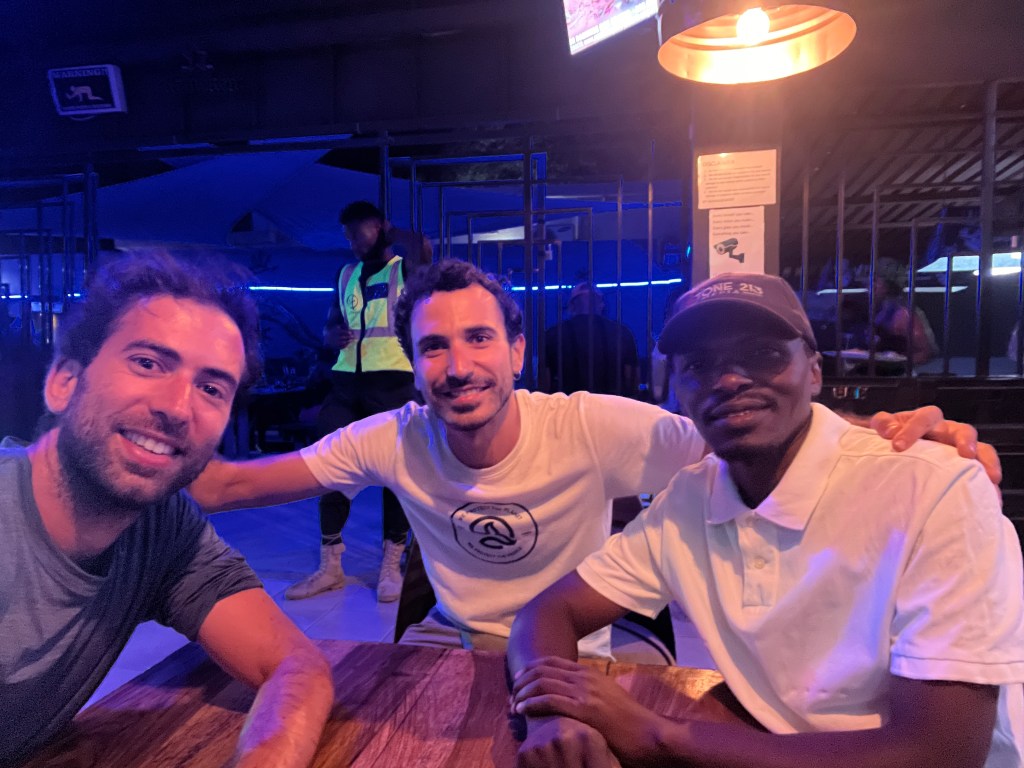
We go to Limpo’s, a bar with Zambian and Congolese live music, following the recommendation of David. We soon fall in love with the place, particularly with the music. Both grandmas and young women dance in front of the music band, who plays superbly well. A group of dancers jumps on stage every other song, moving the hips like nothing we had seen before. Javi goes to leave a tip while dancing but, given his trauma of getting kicked out of the dancefloor by the chief man some weeks ago (see post #5), he doesn’t stay long there.
We share the table with some local young women, that talk shily with us. One will tell Gaspard that her friends like him, and then run away, leaving Gaspard in an awkward situation. Despite their friendliness and gift for dancing, women and men don’t dance together, and flirting doesn’t seem to be happening in every corner.
We go to the local backpacker hostel to see if some dancing at an acceptable music volume is happening there, but it’s already closed, so we enjoy a relaxing walk home.
While stralling, we find out that a Basque volunteer that used to teach Spanish to David some 7 years ago, is from the same town and age as Javi, despite he can’t identify her by the name. David seems very fond of her, and he even learned a lot about Basque Country and its culture from her. Small world.
17/09 – Rest day in Livingstone. (26 kms)
Gaspard wakes up early and, after observing Javi’s placid sleep, decides to go for a walk around town, check a local church and the swimming pool of the backpacker hostel (and its coffee). Javi goes with David to try to get some breakfast nearby, but only end up finding some beans, which we complement with some eggs, and end up having a solid meal at David’s. David shows him his garden, full of onions at the moment, which he has learned to plant by himself, using Youtube. He has his own irrigation system, and he seems willing to plant tomatos, chilis and more stuff.
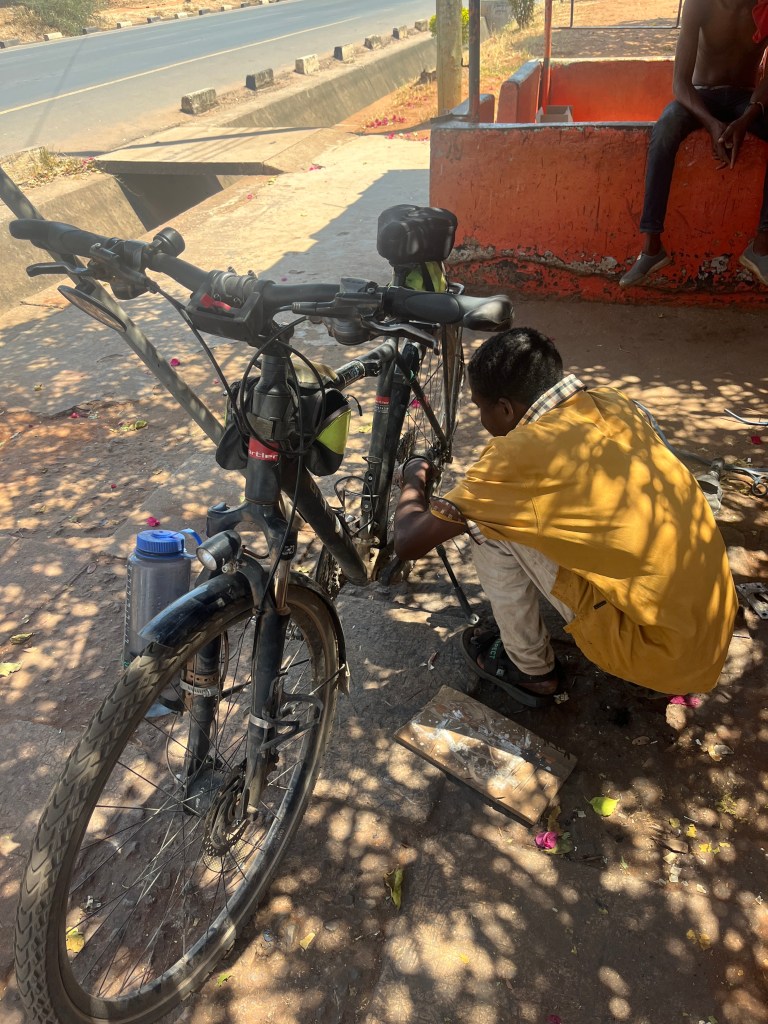
We then visit a local smith, with the hope he can repair Javi’s kickstand, which prevents the bike from standing when fully loaded. Since we don’t expect many trees in Botswana and Namibia, this repair sounds about critical. However, the reinforced metal plate installed by the hungover-looking smith (remember it’s a Sunday morning), won’t hold very long, which will force Javi to become creative.
Javi and Gaspard meet in the backpackers hostel, Jolly Boys, which has a superb pool, at lunch time. There, we meet Lucia and Raquel, two young spanish cooperation workers, that are working at a local NGO. Raquel has already vast experience in refugee crisis, and both emanate passion for their work. They are very friendly and we wish we get to know them better, but it’s time to go to Victoria Falls from the Zambian side. So we cycle the 10 kms that separates us from it, and pay the 20 $ fee, much cheaper than in Zimbabwe.
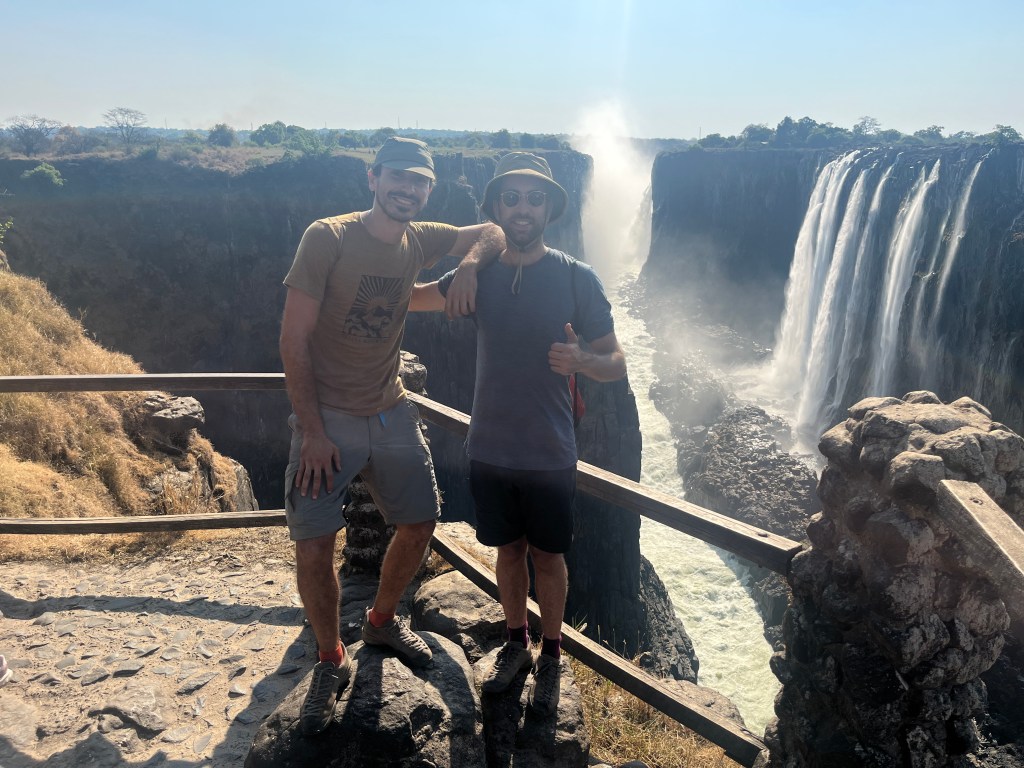
The price might be lower for a reason though. Very soon, it becomes clear to us that the views won’t even be close to the ones of Zimbabwe, for two reasons. First, most of the water falls on the west side of the falls, which is only visible from Zimbabwe. Second, anyway the view from the Zambian side is from the east side, but by no means catches the front of the falls, but just a side.

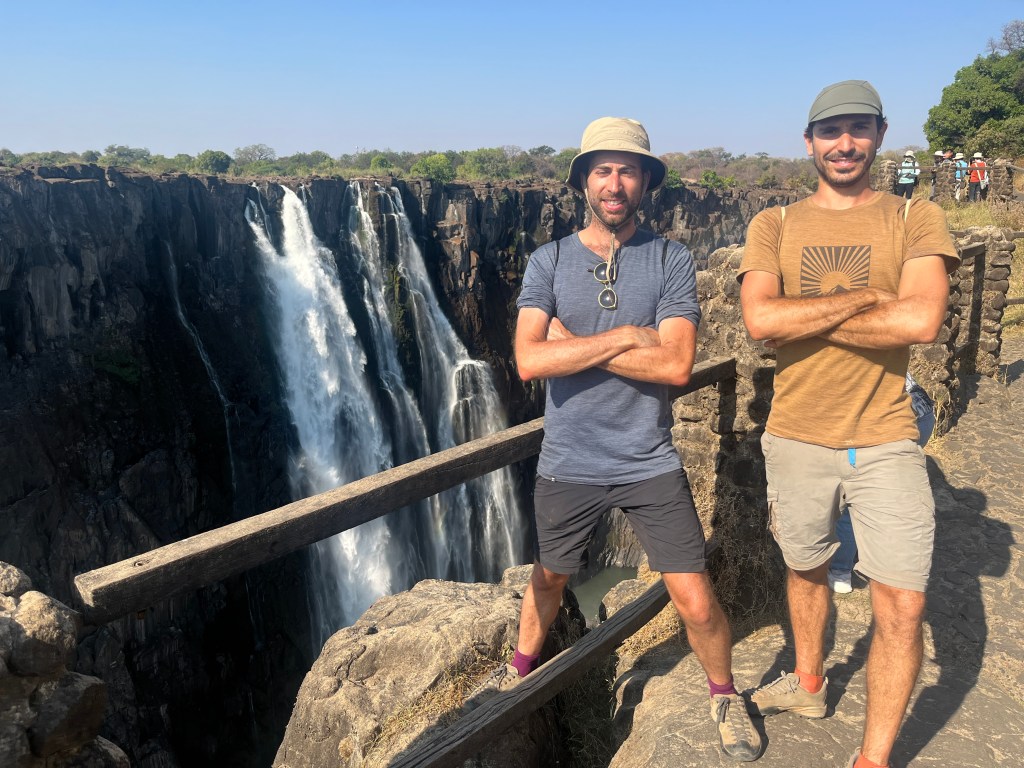
However, this poor rating of the Zambian side is only true in dry season, since in wet season, the falls generate so much moisture that they can’t be really seen from Zimbabwe, despite being literally in front. In wet season (October to April), Zambia is better.

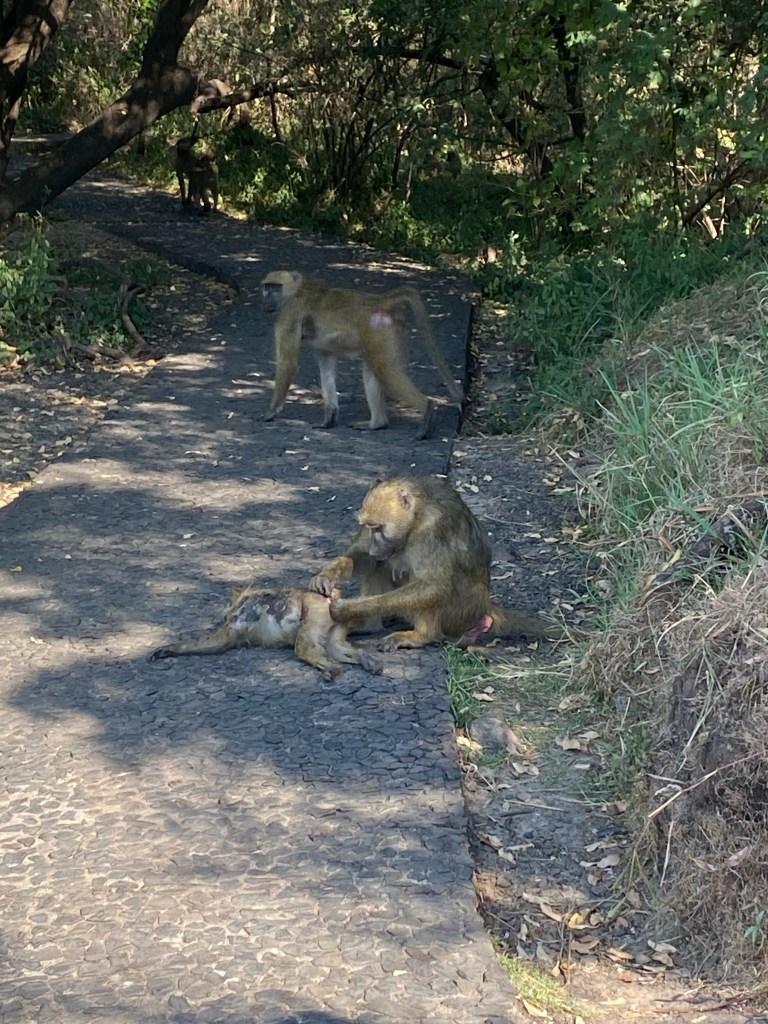
The Zambian side is full of baboons running around with half-full Fantas and Cokes, what makes us think they have stolen them from tourists. We witness a grotesque yet interesting scene, as we see how the baboons are bringing along themselves the body of a dead young baboon, rigid like a wooden table. For minutes, we observe how the carrier takes care of the body, removing insects from it. There is something very human about the scene, what makes us remember we are just another species of apes.
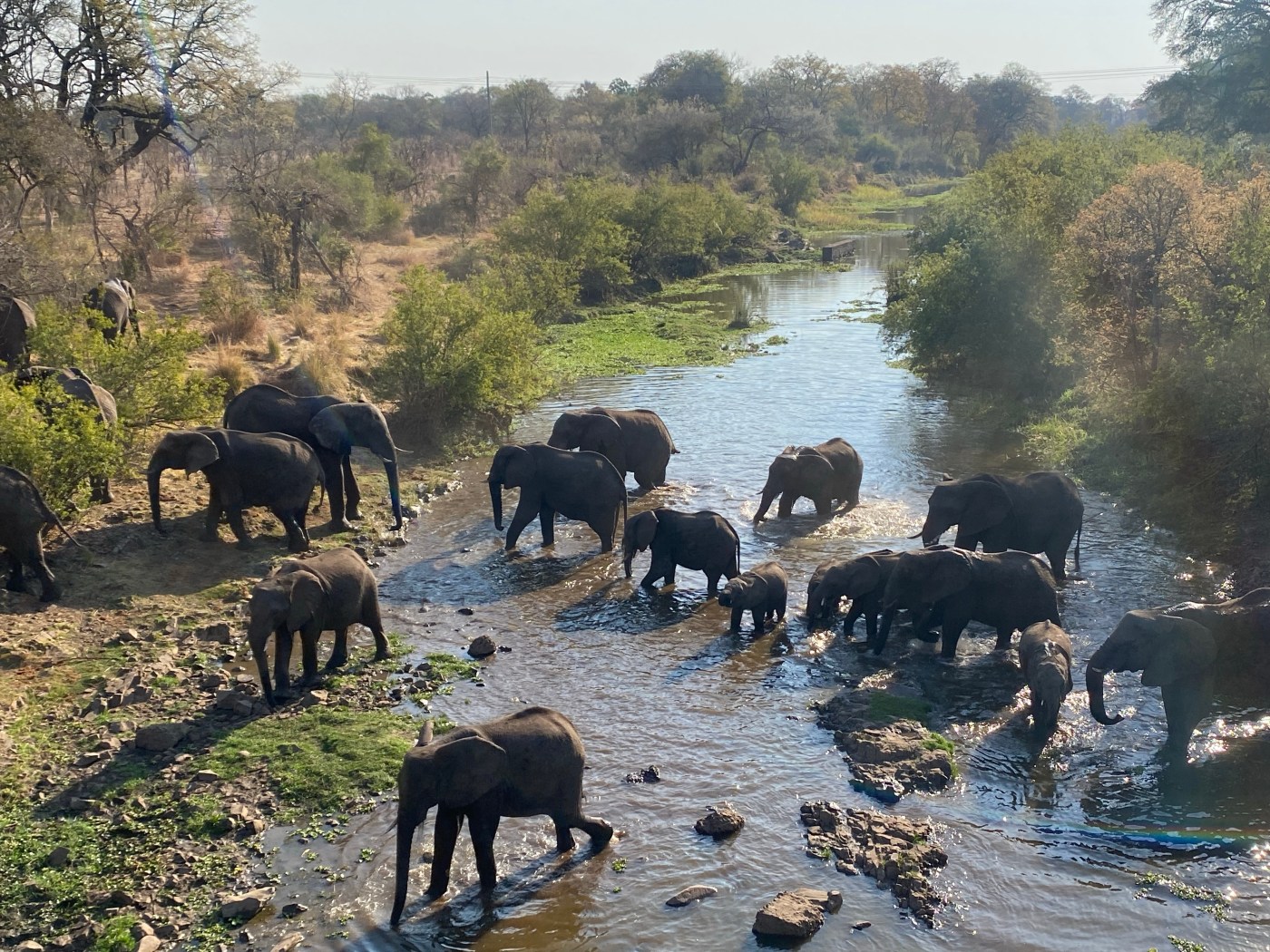
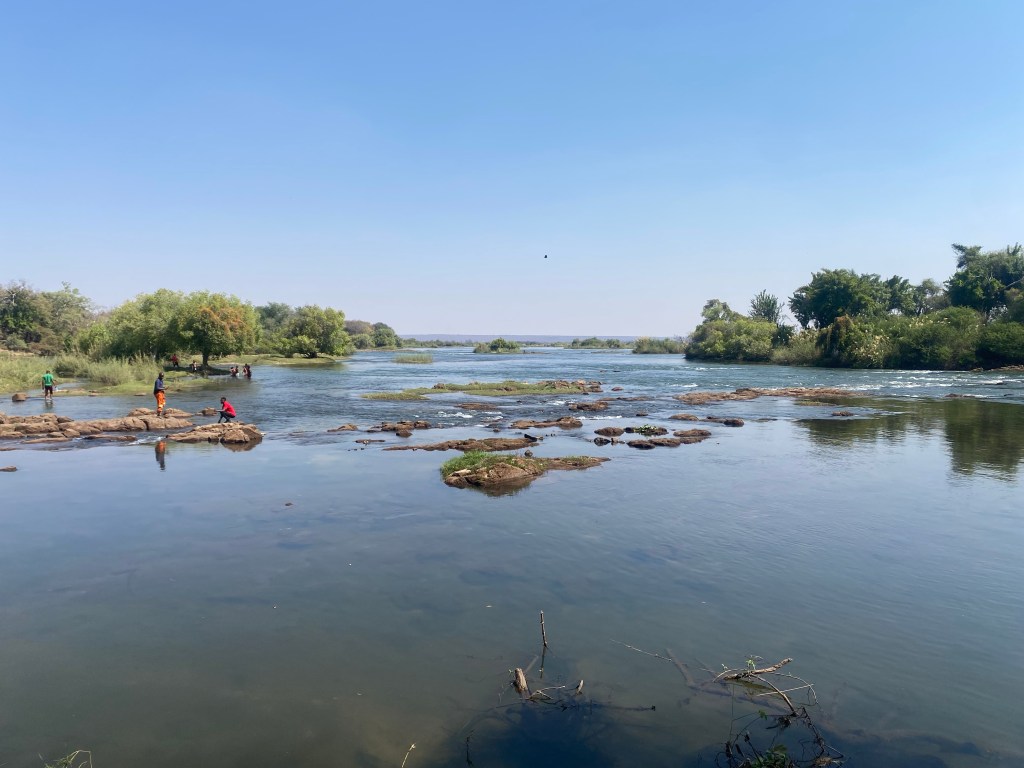
We slowly start the return to Livingstone, a bit disappointed with the excursion of the day. Once again, the corrective karma prophecy proves us that it had a surprise for us. At one of the bridges, we see a lot of local cyclists waiting and taking pictures. We soon realize there may be some wildlife around as this is the spot we saw some elephant the day before. When we join them, we see a dozen of elephants drinking from the river below the bridge, just around 10 meters far from us.
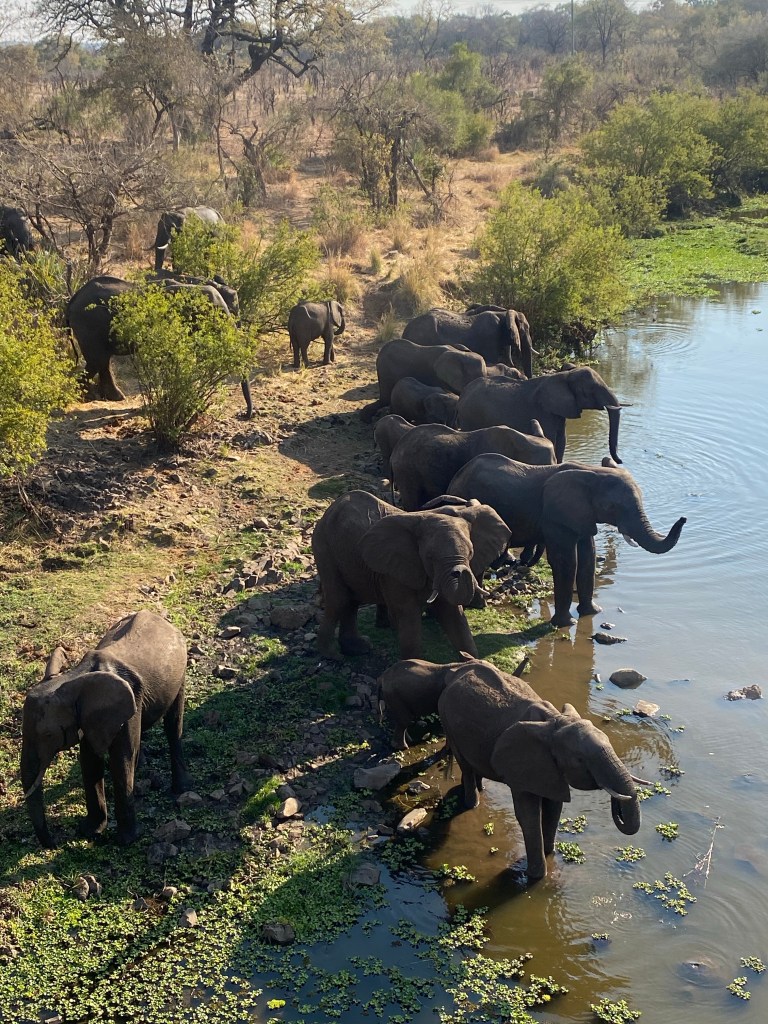
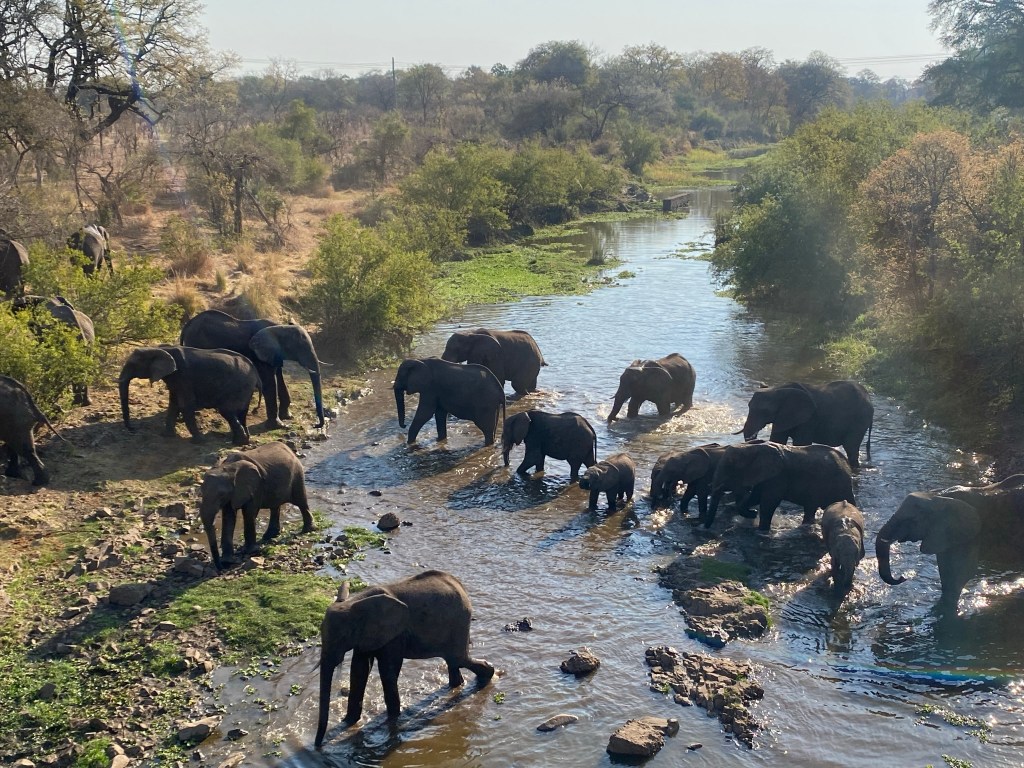
But things get more interesting when an even bigger herd of maybe 2 dozen elephants, appears from the opposite side, eager to drink the same water that the 1st group. Both groups face each other, each at one side of the 4 meter wide stream, and for some moments it looks like a fight for the river it’s going to start. But the 1st group retreats, while the 2nd one starts fragmenting, with a group of elephants crossing the road, thus blocking the traffic. Cyclists start to get nervous, and start sharing stories of how elephants killed a cyclist last week, and injured severelly another one just yesterday.
But things get more interesting when an even bigger herd of maybe 2 dozen elephants, appears from the opposite side, eager to drink the same water that the 1st group. Both groups face each other, each at one side of the 4 meter wide stream, and for some moments it looks like a fight for the river it’s going to start. But the 1st group retreats, while the 2nd one starts fragmenting, with a group of elephants crossing the road, thus blocking the traffic. Cyclists start to get nervous, and start sharing stories of how elephants killed a cyclist last week, and injured severelly another one just yesterday.
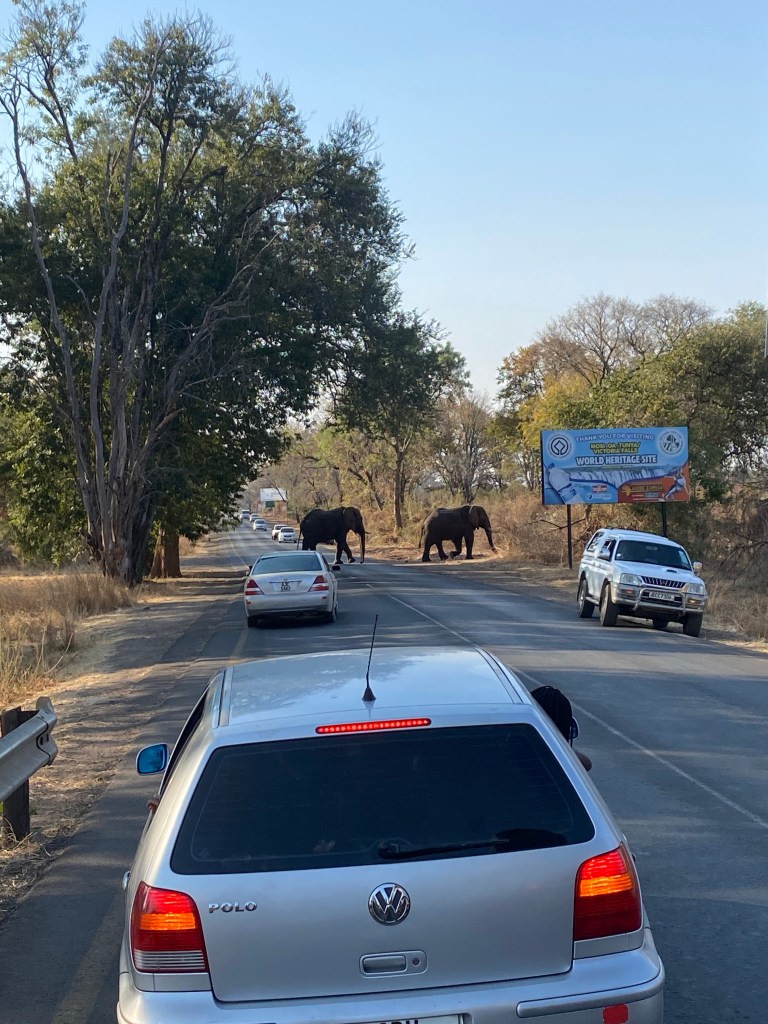
That doesn’t help us completing the task we have literally in front of us, as elephants finish crossing the road, but stop just 2 meters away from the other end. We take the flow of vehicles as a protective barrier, and execute fastly and determinedly. Success.
We get back to Jolly backpackers, where Raquel and Lucia are still at. We enjoy a beer and their company, while we make time for dinner with David. Raquel seems very eager to travel with the bike, and we encourage her to do so, to start small like we did in 2019, starting from Javi’s hometown, straight out of our comfort zone. She tells us about Cinecicleta, who Javi knew and are his absolutely favourite cycle travellers, and about a guy he knows from his hometown that stopped his Engineering career, took the bike and cycled all the way to Gabon, where he had an accident that made him return home. He became a Muslim after a disruptive experience with a local ancestral drug, and he is now a school teacher. There you go.
By now, we have collected enough information to conclude that the option of going through Botswana and then Namibia has the best combination of sights, route quality, and wildlife safety. We considered for a while going down the Caprivi strip back again into Botswana (orange line in the map at the beginning of the post), so we could visit the ancestral San and bushmen villages, where the first homo sapiens are thought to have lived, but we get bad reports about the road quality and density of lions from other cyclists. So tomorrow we will head towards Kasungula, the border post between Zambia and Botswana, and stay once again in a campsite by the Zambezi.
Raquel gives us a good tip for local food, and we meet David there for one of the best nsima we have had in a long time,served with a generous portion of vegetables: finally. Time to go home and sleep for a bit.
18/09 – Livingstone to Kasungula (Botswana). 75 km, 350m+
We leave David’s home with a bit of sorrow, as he has been not only a fantastic host but also an interesting and knowledgeable companion. He ends up saying that he would also like to travel cycling at some point. We also offer him our consulting services (for free, goes without saying). It’s a bit touching to see that people really value what you do and would like to do it themselves.
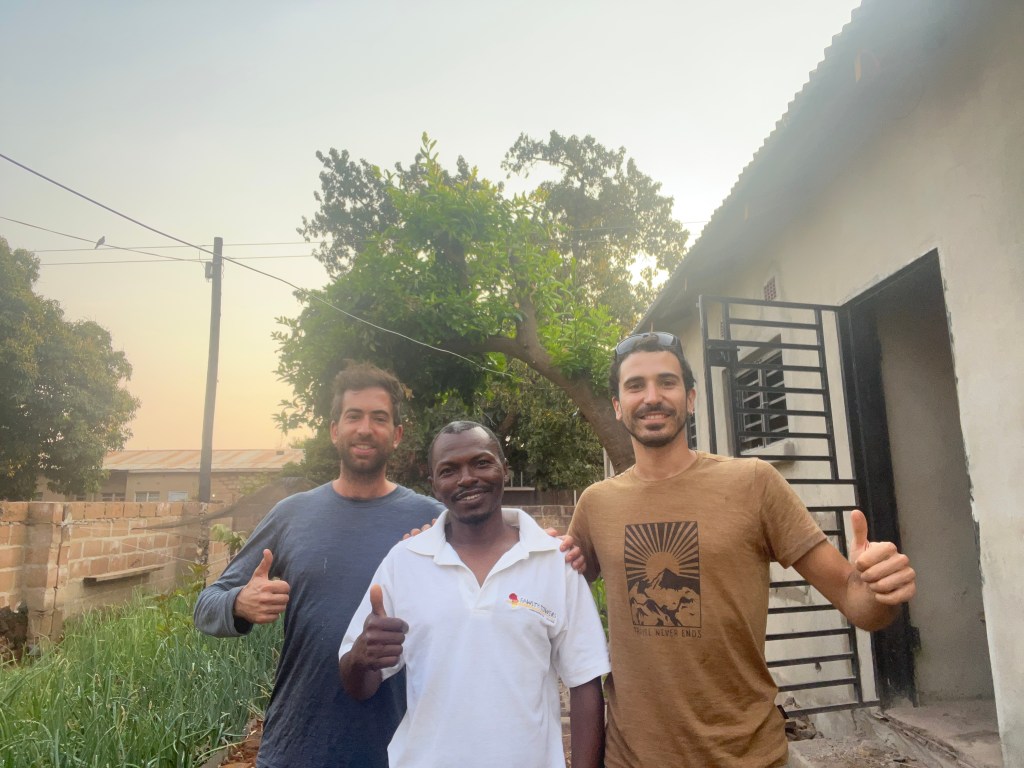
Some girls have written in the whatsapp African cyclist group that they will be around Kasungula, our destination of today, and ask if someone wants to hangout. We write them back and agree on talking once we have both arrived.
The road to Kasungula is not particularly special, you find the typical kingdom of Jehovah hall next to the road, except for the fact that the landscapes starts to irrreversibly flatten, and will continue like that for the rest of the trip. The wind pushes us and it doesn’t take long to arrive at the border post. The last push includes a majestic crossing of the Zambezi river through a modern-designed, white bridge. At its end, a bi-national border office waits for us. Getting the exit stamp of Zambia and the entry stamp of Botswana (like Zambia, fee free) proves again to be ridiculously easy.

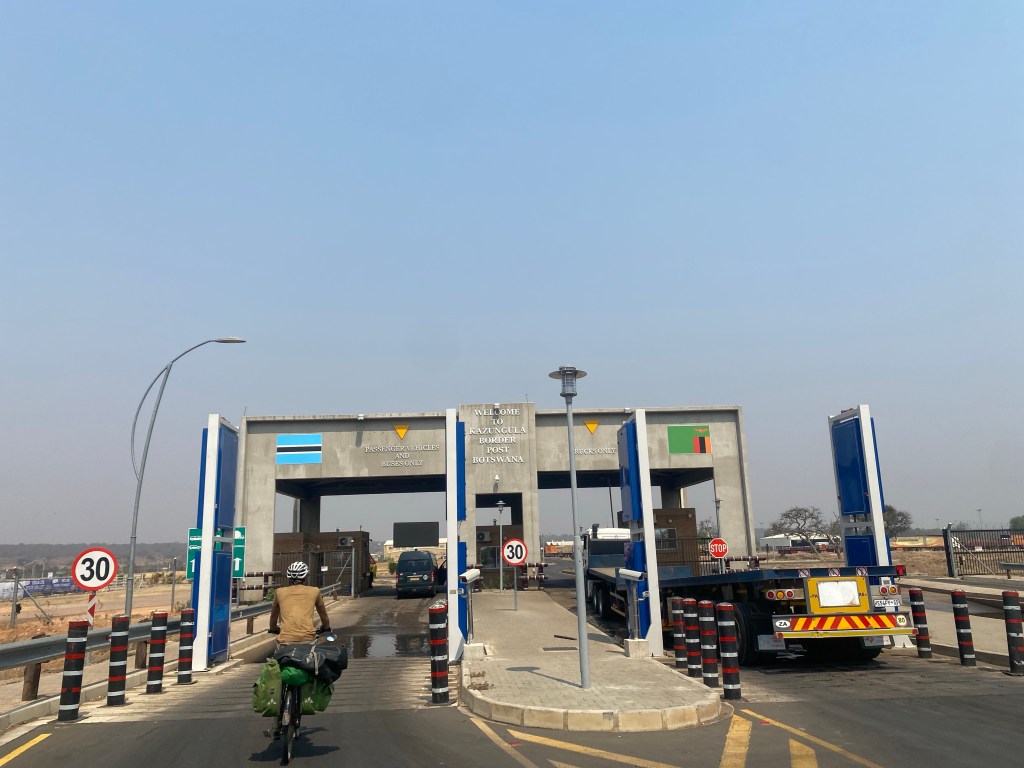
We did it, we are in our 5th country and fore-last country of the trip.
Days covered in this post (total): 3, out of 55.
Kms covered in this post (total): 121, out of 3218 km
Positive elevation covered in this post (total): 600m+, out of 31890m+.
 Cycling Pirates
Loved the article… beautiful scenes and pictures. Keep up.
Thanks a lot and glad you enjoyed it !! Yes the sceneries we got to see were very impressive and we feel very privileged.