

Song while writing: Amoya – Nweti
18/09 Livingstone (Zambia) – Kasungula (Botswana)
{… continued from post #8 }.
Botswana is the 3rd country in the world with the lowest population density. There is 2.5 million people in a country twice the size of Poland (yes, I am wild guessing). This means multiple things. 1st, there are very few towns, and the distances between them are often at least 100 km. 2nd, since tourism is one of the main industries of the country (together with diamond mining), tourists are very visible: every 2nd car is a tourist one. 3rd, as we mentioned, Botswana has plenty of diamonds. This has enabled the government to to increase the standard of living of the reduced population, making it the country in Africa with the highest GDP per capita.
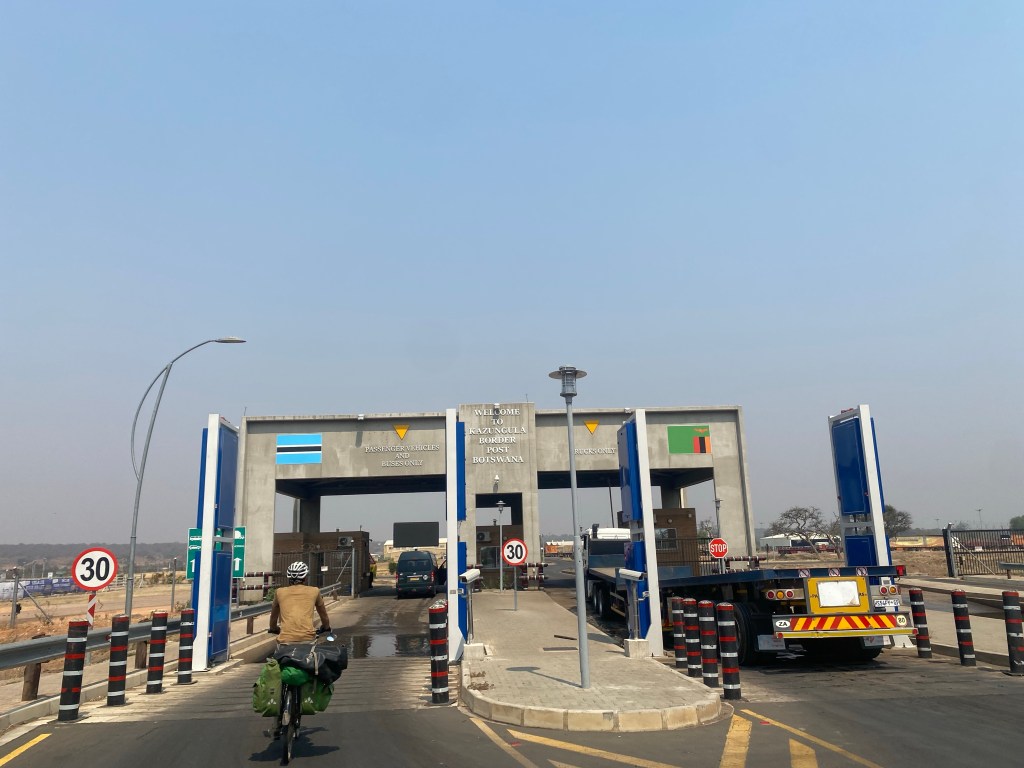
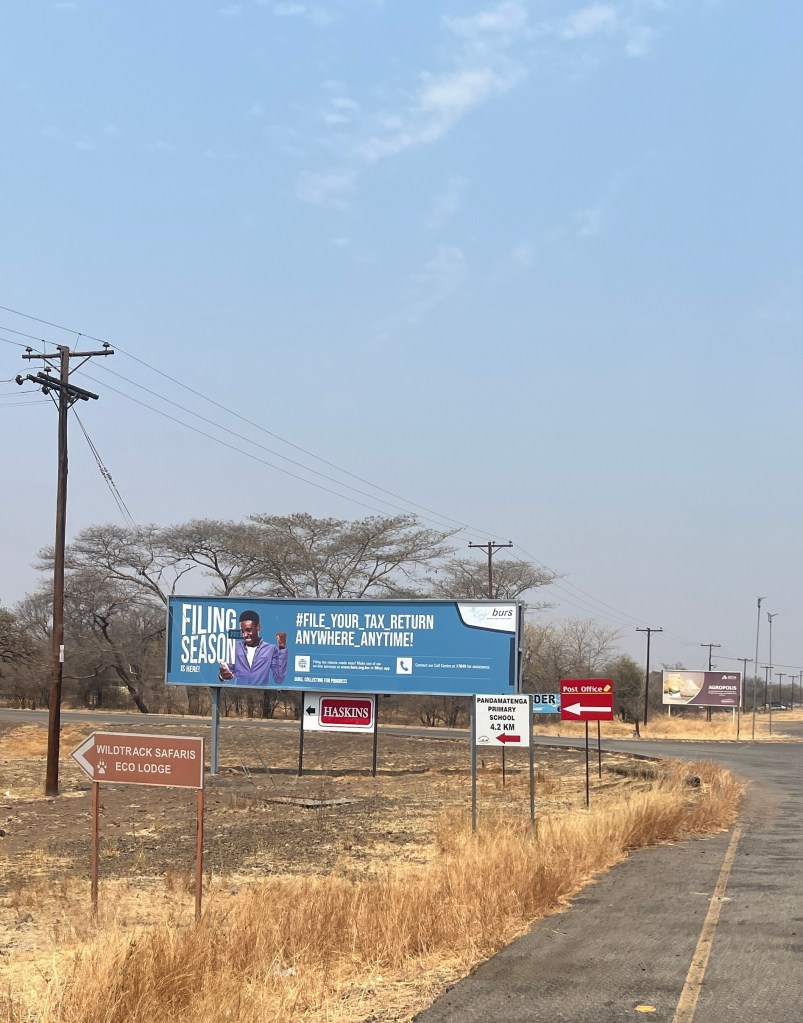
The signs of its comparative high developments become evident soon. A western like mall waits for us, 5 kms from the border post. There is a government billboard encouraging citizens to do the tax declaration online (think about it). We go to the mall and get our most necessary things. water, simcard, food, and a gas canister. Boreholes seem to be extremely scarce in the country, not less because we are close to the end of the dry season, and previous rain season was not very intense. However, every town has a water dispensary where one can refil a liter for 10 cents, avoiding plastic waste. Fantastic.
We start looking for a place for sleep. Since we are close to the Zambezi river, bush camping seems rather risky. But that also means that all lodges are full of tourists, charging as much as 15$ per person per night. There are cheaper options 15 km away, but they are not in our route for tomorrow, so 30 km extra seems too much. So we stay at Big 5 Toro Camp. No, it’s not a Spanish owner (Toro means dream in Tswana), and no, there is no big 5, since Rhinos are scarce in Botswana (Big 5 refers to the 5 animals that every tourist wants to see: Rhino, Lion, Leopard, Elephant, Buffalo).
The camp is really impressive, including private bathroom and brai (grill) station, including firewood. That gives us the idea to do a grill tonight, as the supermarket is very close. We tell the 2 girls that are around (we know them from the African Cycling Whatsapp group) if they want to join and they say they will pass by. We go shopping for the grill to the nearby mall. There is plenty of meat in Choppies (and ridiculously cheap), but literally no vegetables apart from onions. So we return packed with meat and food for four days.

Once in the camp, Gaspard manages to break his 3rd iphone cable on the trip (this one lasted barely 3 days), so he has to return to the mall for the 3rd time of the day. His electromagnetic incompatibility seems to be getting more acute.
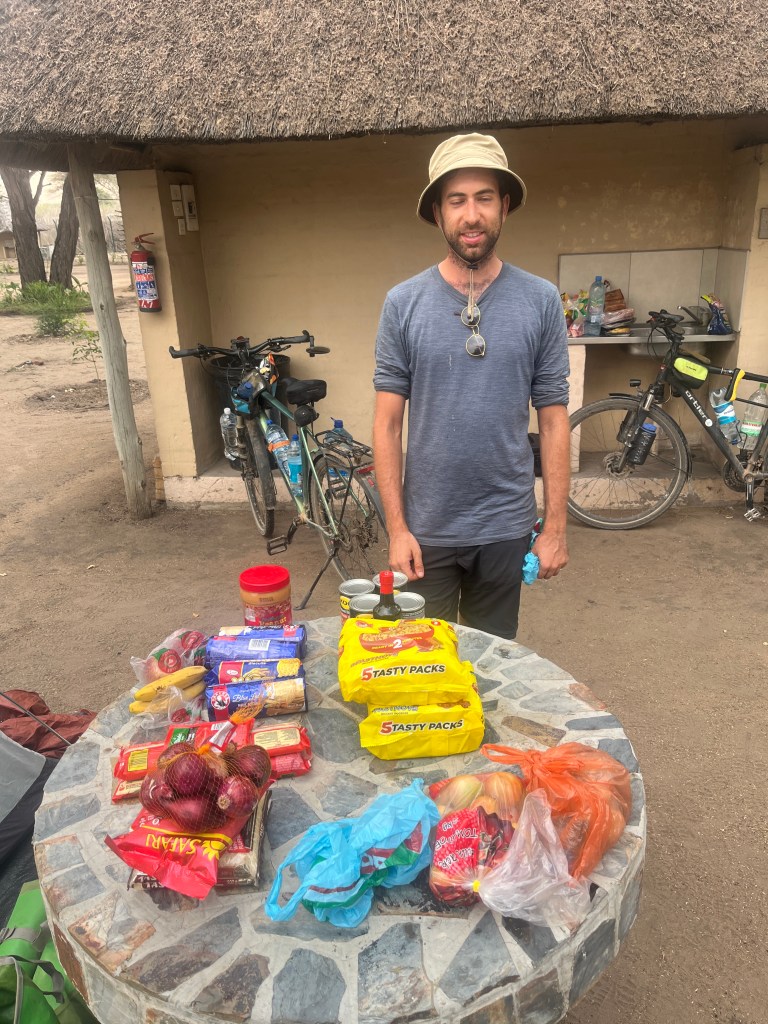
The girls arrive and meet us for a beer in the riverfront of the camp. Fiona (UK) and Sandra (Germany) are actually travelling by motorbike. They have crossed the Americas and now they are doing africa’s east coast after having done the west coast, which it’s already a feat on its own. In fact, they have been travelling for…. 5 years!!! They are in their mid thirties, they are a couple and plan to travel much longer. We find their adventure very impressive, they are very easy going and talkative and they also are interested to hear about our travelling. Funnily they also thought that we were a couple as Gaspard sent them a photo of both of us in Victoria falls with a rainbow in the background as an introduction of who we are.

During the grillling itself, it soon becomes evident we have overdone it with the meat and chips quantity (1 pack of crisp each to compensate for the lack of vegetables). But luckily, Fiona is a crisp addict like Javi, and with a bit of effort, we finish everything except for some very chewy meat that we end up giving to a cat, as it’s harder than a shoe sole.
We have good fun together, exchanging travelling tips, and learning about each other’s lifestyle. They manage to afford this lifestyle by renting out their property in the UK and having sponsor support, as what they do is rather out of the ordinary and they have 100’000 followers on Instagram (@adv_travelbug). Despite that, they are both humble, down to earth and very friendly.
It’s slowly late and Fiona and Sandra must stand very early for a day safari. Since Chobe is mostly famous for Elephants, and we expect to see enough on the road, we decide not to join and cycle tomorrow, since, for the only day in the week, backwind is forecasted for our next route: the so-called Elephant Highway.
19/09 Kasungula – Pandamatenga. 102 km, 360m+
The Elephant highway is a 300 km stretch going from the north border with Zambia to the town of Nata, which surprisingly has a lot of elephants around. Thanks to ioverlander, we have identified the very few points where one can stop: a gas station, an antenna, and a lodge famous for having elephants around it.
So we kick it off, with a light side-back breeze that allows to go to a very decent pace. The road is full with banners warning about wildlife and rejecting any government responsibility if you get in issues because of it. Not very encouraging. The traffic is very scarce, with a big proportion of cars being white Toyota Hilux camping cars driven by tourists. By now it’s patent that Botswana is very touristy compared to the previous countries we have visited, and the low amount of locals makes it even more noticeable.
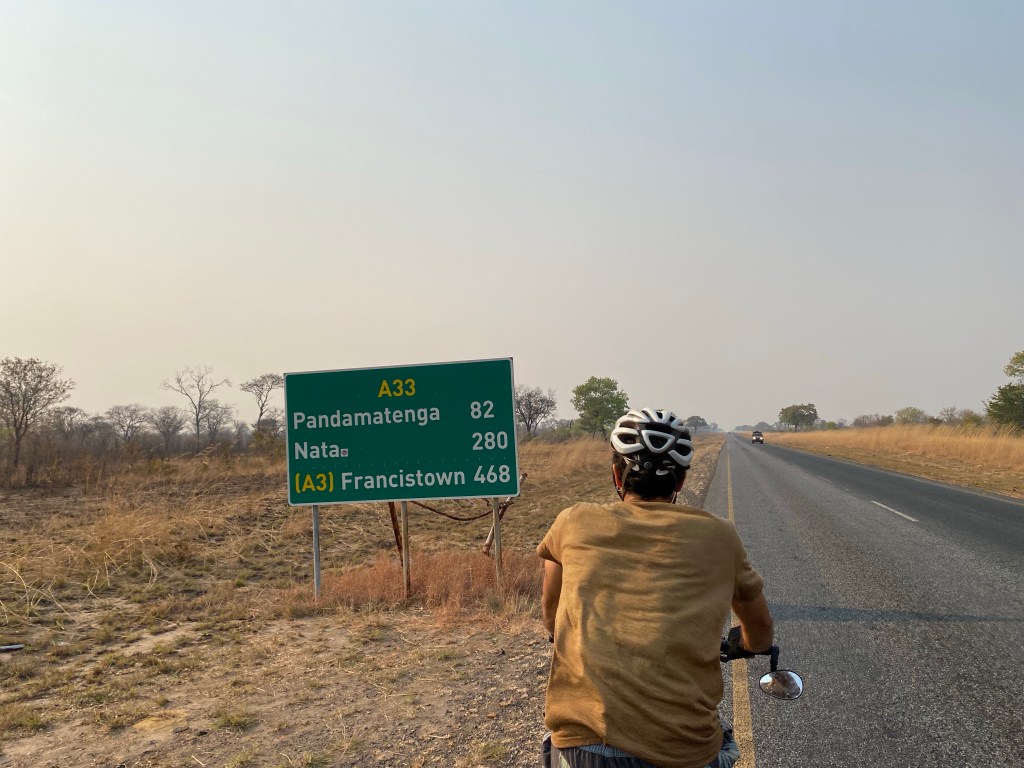
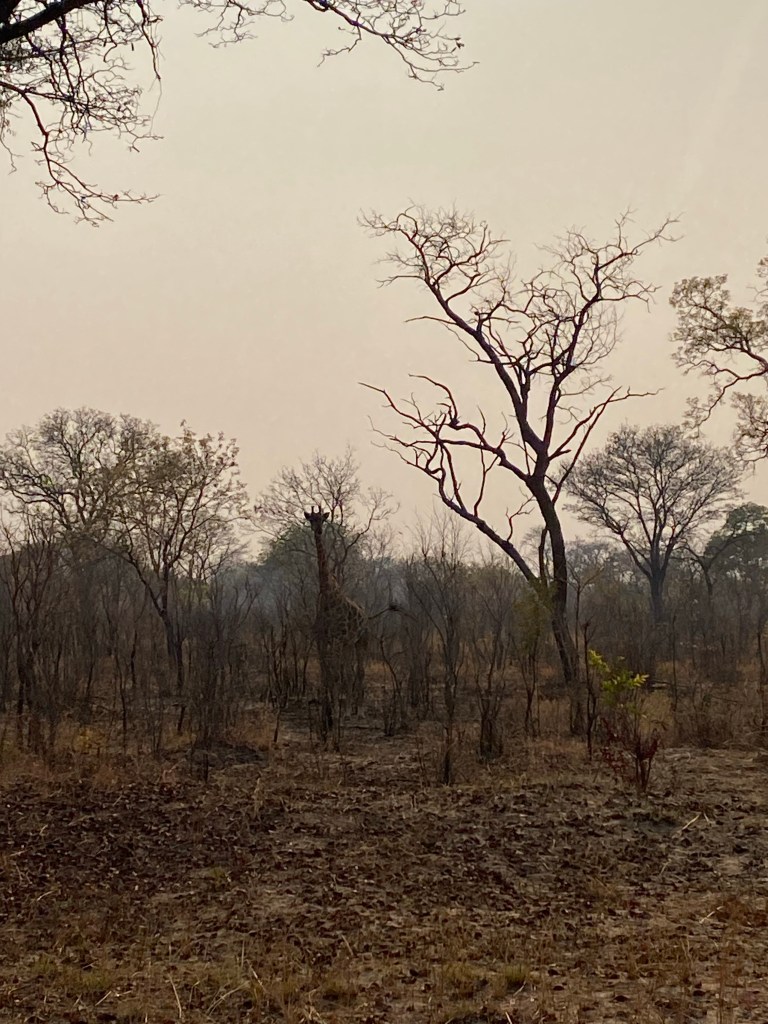
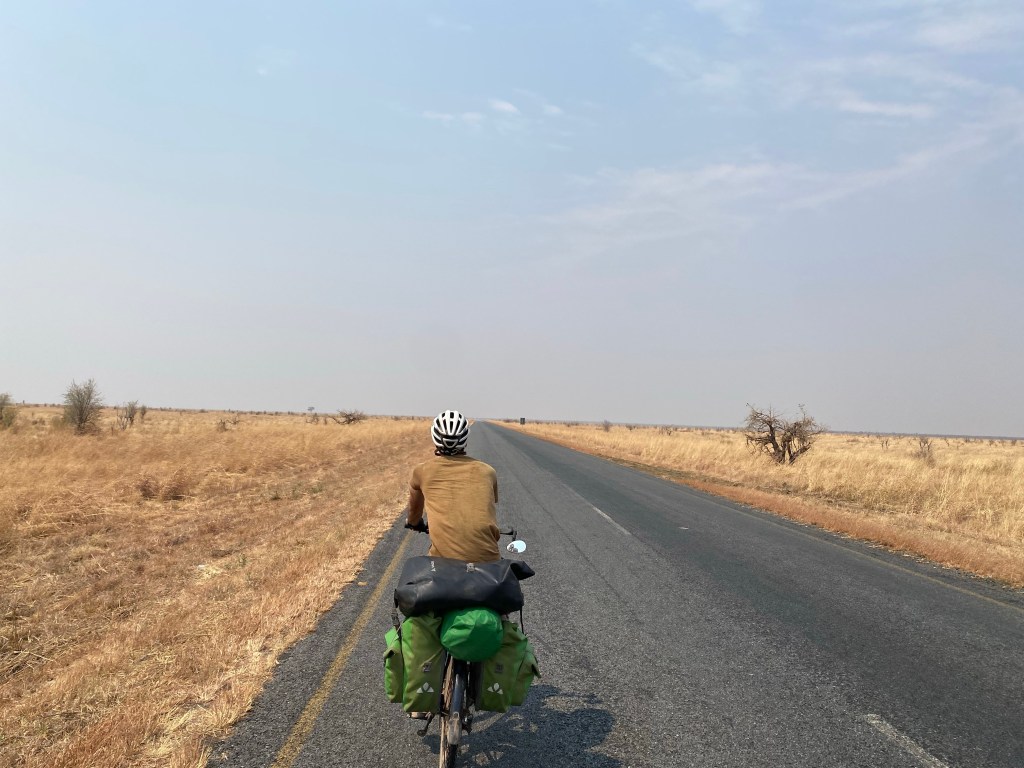
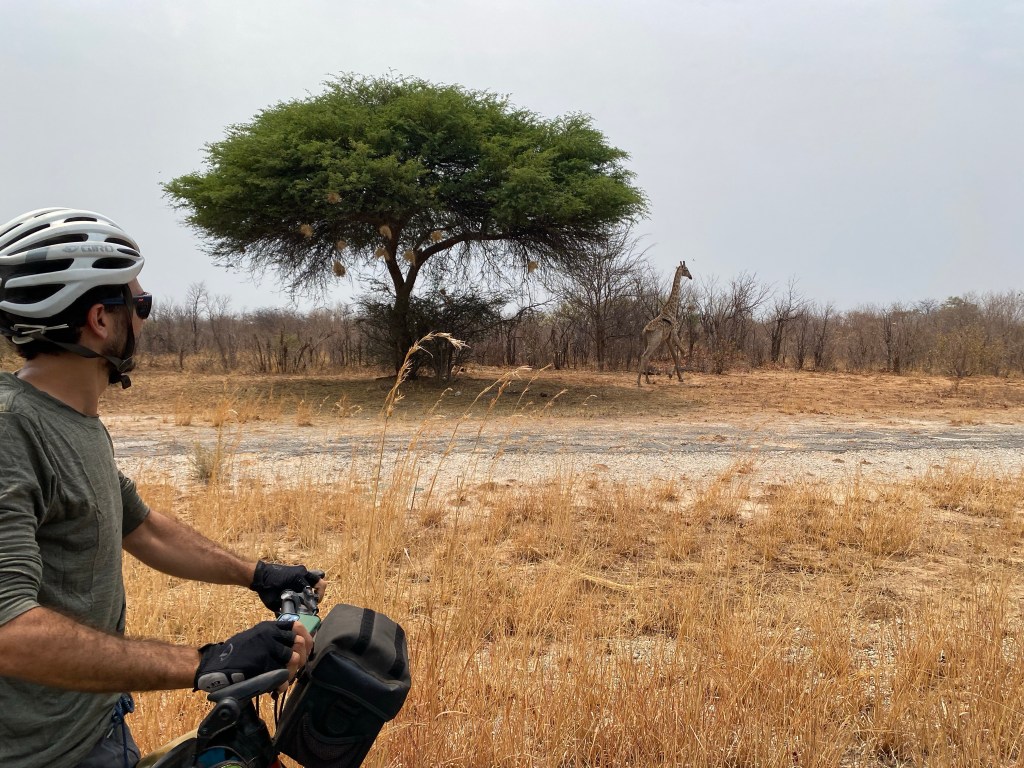
Coming back to the road, we realize we are for the first time cycling purely flat terrains. The roads are mostly straight lines in which the horizon can’t be seen, and merges with the reflection of the heat. Every 5-10 km there is a slight curve that provides a minimal dynamism to the journey, but other than that the landscape is literally always the same, with scattered bushes and low trees projecting until the infinite. The other obvious source of dynamism are animals, and soon we see some giraffes observing us attentively, ready to hide in the bush as soon as we get too close or do any brute move.
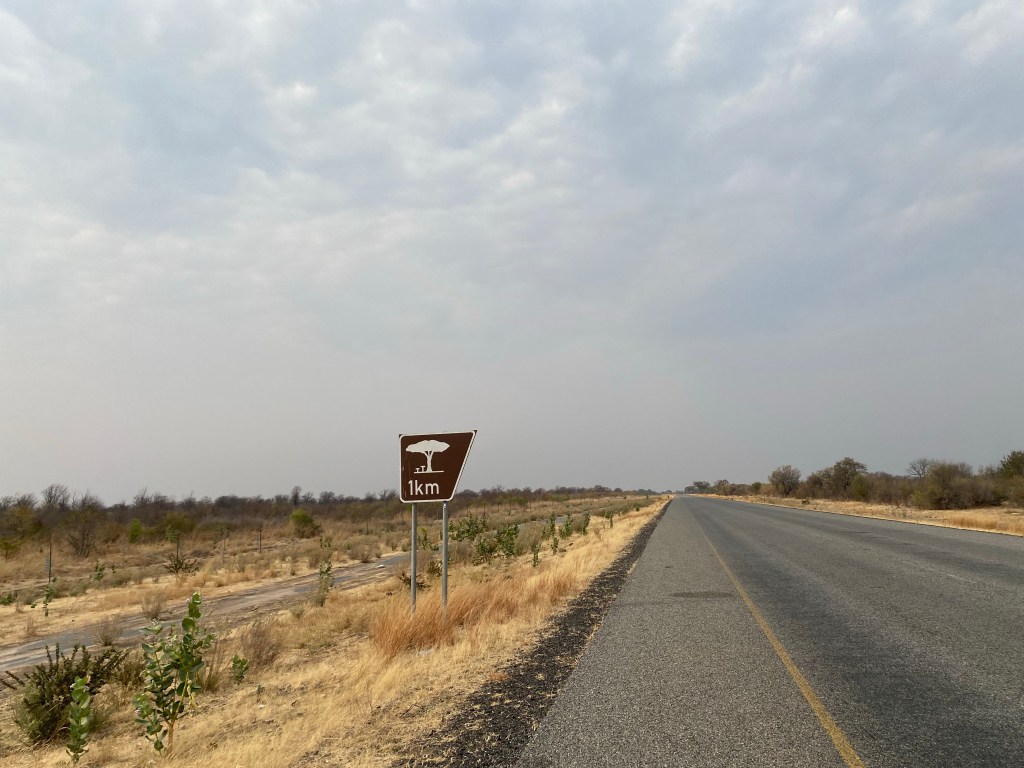
The only special thing about the road are the picnic areas popping up here and there with the sign “this is a wildlife area you are stopping at your own risk” and the road changing into a landing strip for planes accompanied with the sign “be aware plane flying at low altitude”. They are some fields further away and it seems that plane are used to spray insecticide.
We see some antelopes too, but no trace of elephants until kilometer 80 of the day, when we see some far away in some open, naked fields. While we take a small break to get some peanuts for the last push until the gas station where we are planning to camp, we see a herd of elephants peacefully crossing the road 500 m away, what makes us feel lucky to have stopped precisely there and not a bit later.
As we get close to Pandamatenga, we cross 20 km of endless crop fields, what, following the government propaganda, seem to feed the nation. In fact, Pandamatenga is not much more than some huge Silos to store the grain, and everyone in the town seems to work in the fields. There is a large building in construction, which turns out to be a supermarket (for future travellers you could resupply there). It’s also a border town to go to Zimbabwe, and doesn’t seem to host more than 5’000 souls.
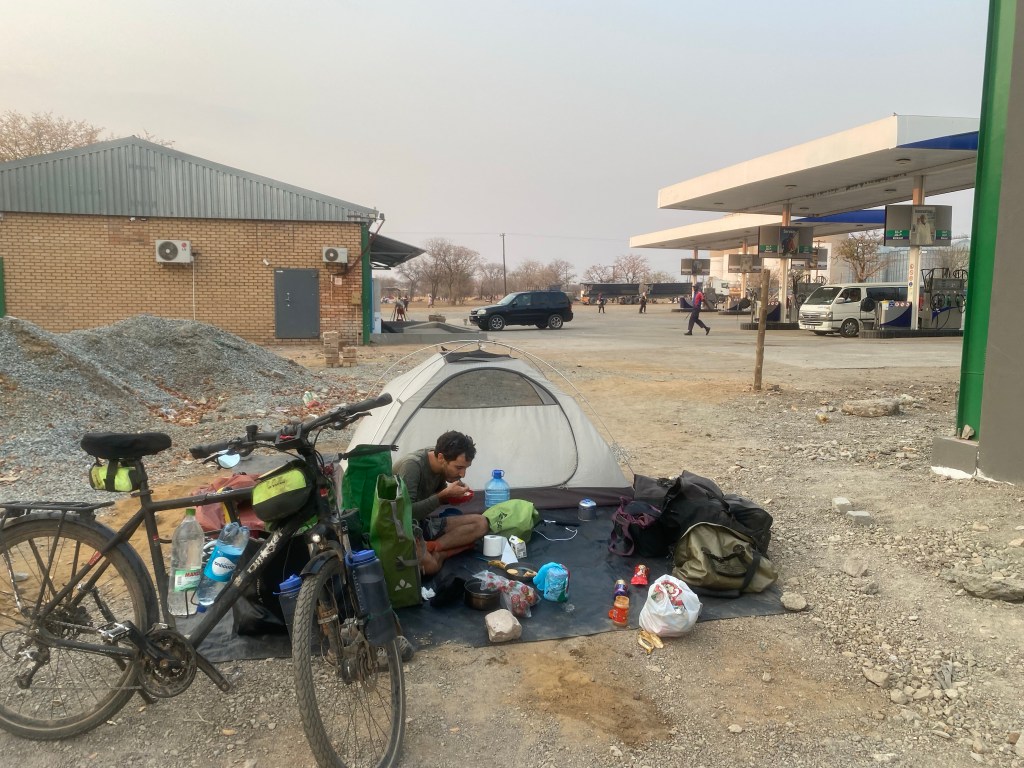
We arrive to the famous ioverlander gas station, the only one in 50 kilometer diameter, where we are received by the station manager and the security guard pretty nicely. They look used to allowing cyclists sleep in its backyard, and while we start cooking our lunch, they seat near to us and we have a nice conversation with them. They ask as questions about the travel, and ask us if we are doing Cape-Cairo, which they know from other cyclists. They teach us some Tswana words, and offer us to shower in the bathroom of the gas station, which we can just not reject.
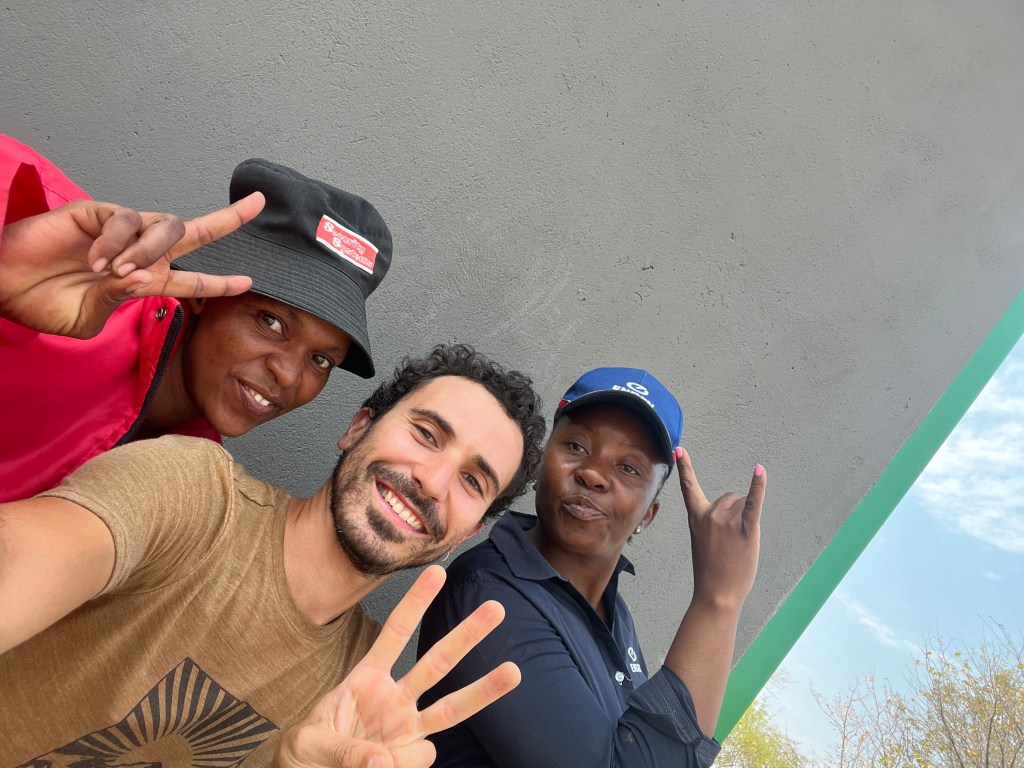
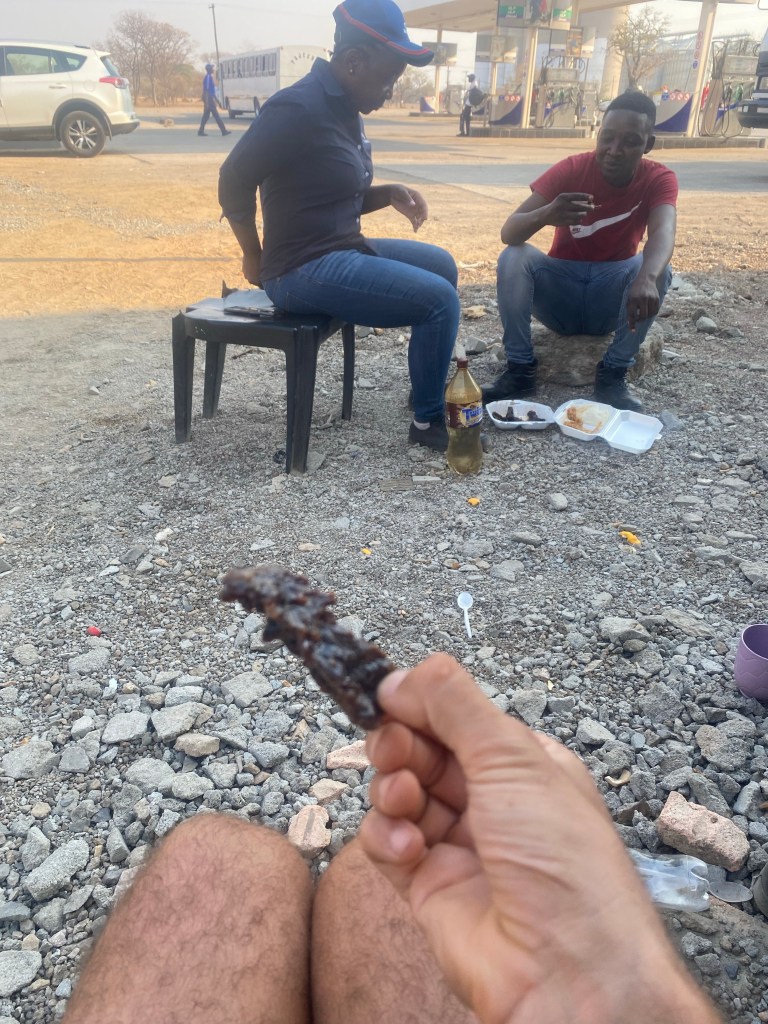
Funnily enough, they would ask us for some 5 pula to buy oranges, which we do with a bit of mistrust, as we are used to begging. But asking each other for money seems a very african thing, and it’s often not the begging we are used to in Europe, more like an implicit “hey dude, I don’t have my wallet with me, can you lend me some? I will pay you with some other favor in the near horizon”. Indeed, not after, the security guard comes to us and offers us some dried elephant meat, which we struggle to believe. They tell us that when an elephant gets killed in the hunting reservoirs, the meat is distributed among the bordering villages, and dried to be preserved better. The taste is pretty good, although one sees that is from a wild animal due to the big amount of fibers it has. The species are strong, but we like it. We have just learned how african mutual support works.
Hours go by and we take time to clean our bike chains. Some kids appear and observe us, but they soon start to touch the bike and our things, making us fear a robbery. Until now, kids have been very well behaved, but these ones seem less shy, and we have to ask the security guard to kick them out. We are ridiculously close to the gas station, and client cars park the whole time in front of us, what generates an awkward feeling. But there is nothing like being tired for a good sleep, so by 7:30 pm we say bye to the security guards, who are going home, and we fall asleep under the constant come and go of trucks and cars to the gas stations, since the gas station is open 24/7.
20/09 Pandamatenga – Communication antenna. 72 km, 120m+
By the time we wake up, yesterday’s security guard is back on duty. “Don’t leave, I am going to get bored without you!” She tells us that she has been working at the gas station for 8 years, 12 hours a day, 5 days a week. It looks like a pretty boring job, and it does seem that visitors bring her a bit of joy. Thanks for the hospitality, Amy.
The conditions are the same as yesterday: endless road, dry bushes all around, and giraffes every now and then. No elephants today. Gaspard starts (after 3000km) listening to audiobooks to win to the monotony and find some distraction. We completely cut the afternoon cycling because of the heat: the plan is now to arrive to the sleeping destination by lunch.
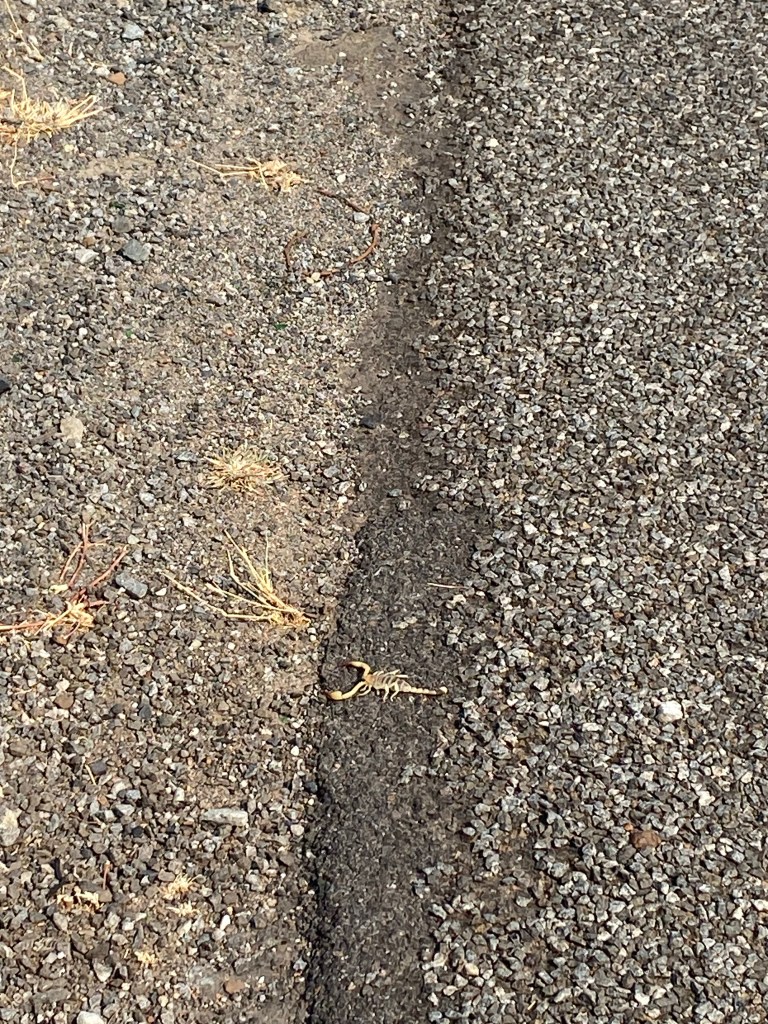
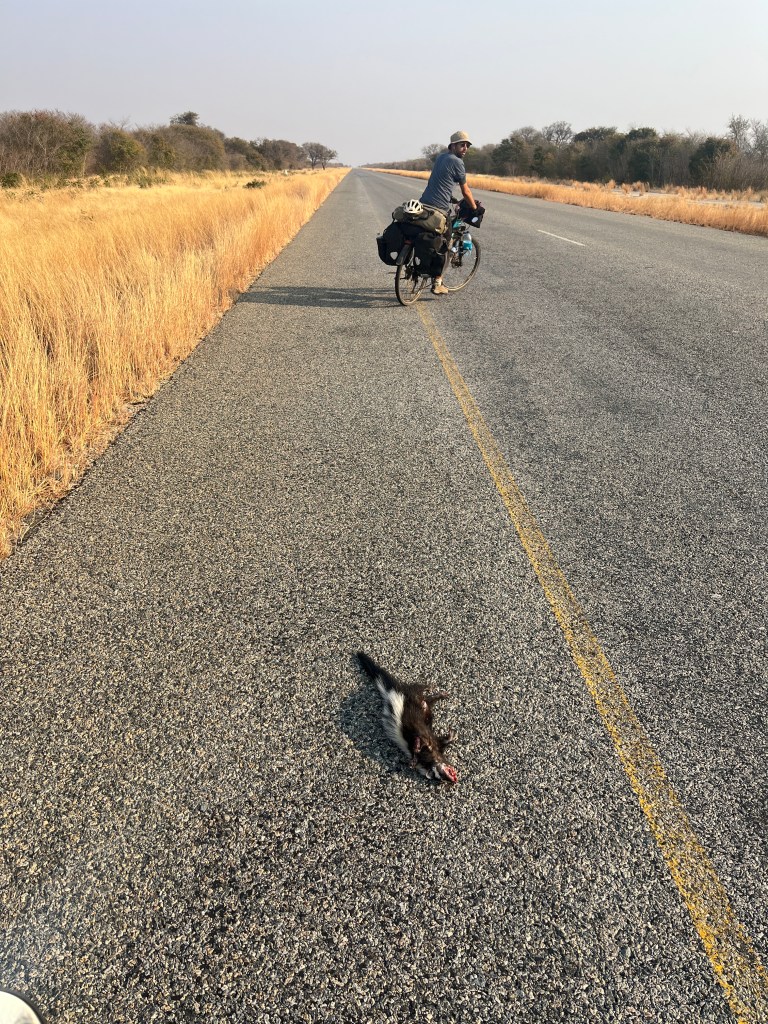
Despite the podcast distraction we see a bit later a snake, which we initially think it’s dead, but it doesn’t take it long to hide in the high grass. Its silvery color makes us think it was a very young black mamba, comparing to the animal books we will have access to later. It’s one of the most lethal snakes, biting up to 20 times in 10 seconds, injecting a poison that kills you in 10 minutes.
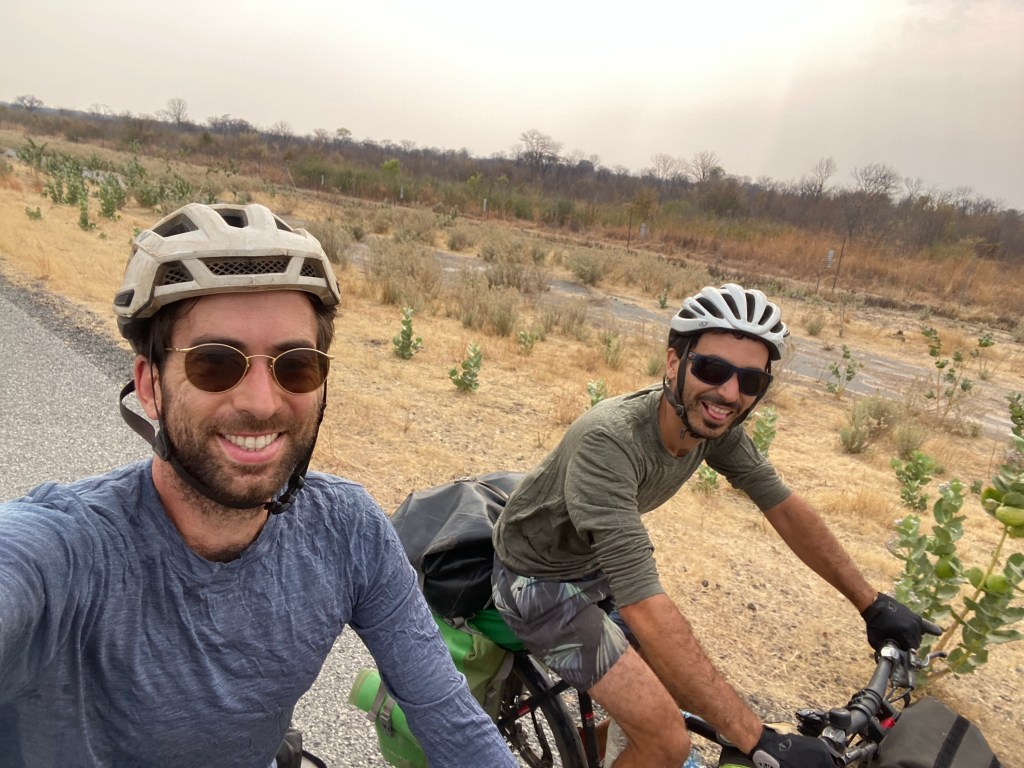
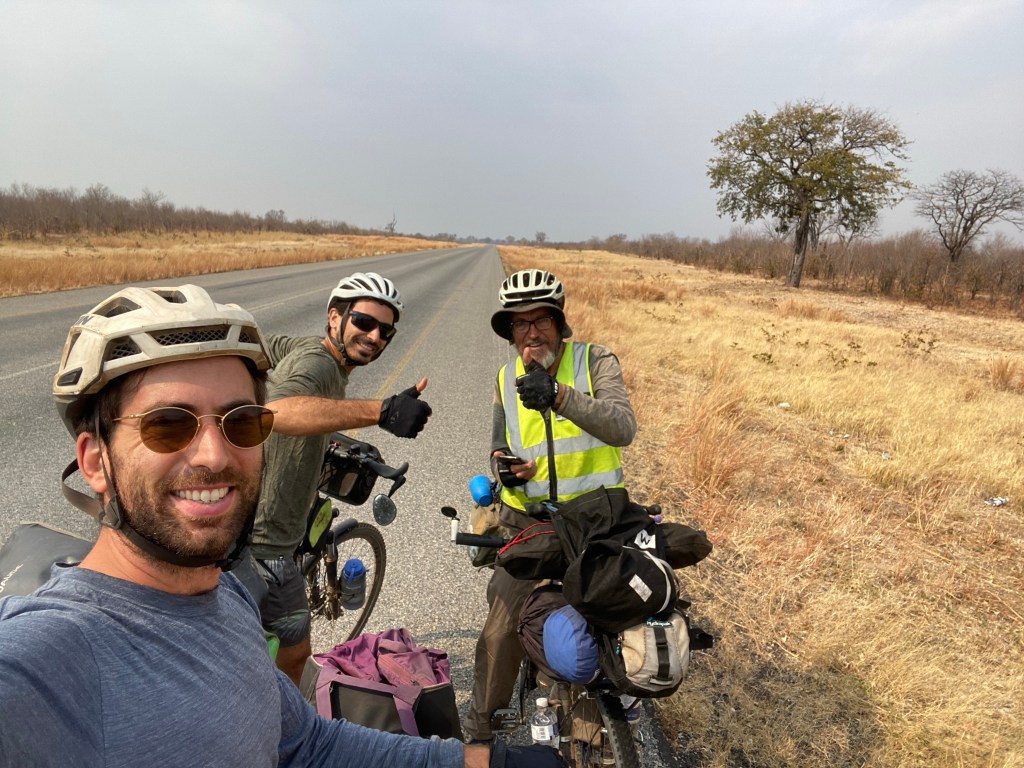
Today we must sleep at a communication antenna 70 km away – again an ioverlander tip -, as the following sleep place is 140 km away, too much without very good wind and wild animals around. Communication antennas have the advantages to be fenced to protect them from thieves stealing parts parts (or raw materials) of the antenna, solar panel and or/backup generator to power it. 30 kms after starting the day we cross ways with Martin (first cyclist we actually meet on his bicycle), a South African solo cyclist in his 60s, who is endeavoring into Central Africa after having toured his own country and survived an accident. He seems very motivated, but judging from what he tells us, he seems to be struggling with wild life, physical effort, wind and water. He carries only 2-3 litters and said that he drunk 7 litters yesterday, which he manages by asking car drivers for more. The version of the antenna’s gars (who we will meet tonight) is very different describing a man shacking, dehydrated to whom they had to give 5 litters of water so he wouldn’t pass out. We exchange numbers, some tips and tell him about the gas station we split in and wish him all the best.
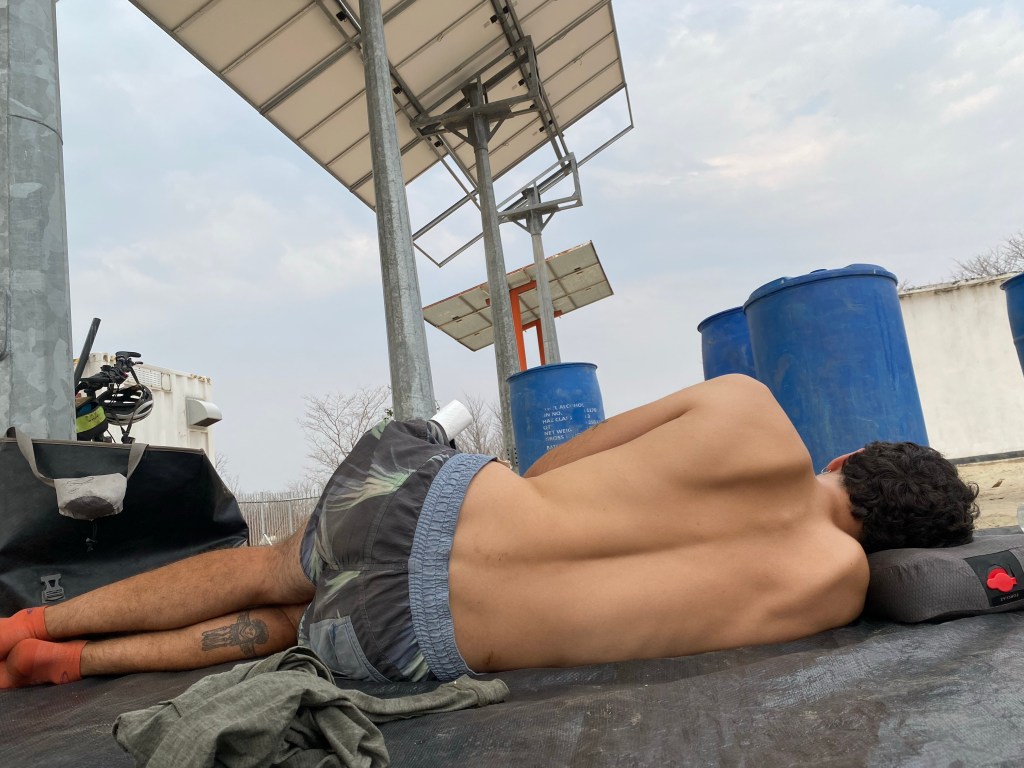
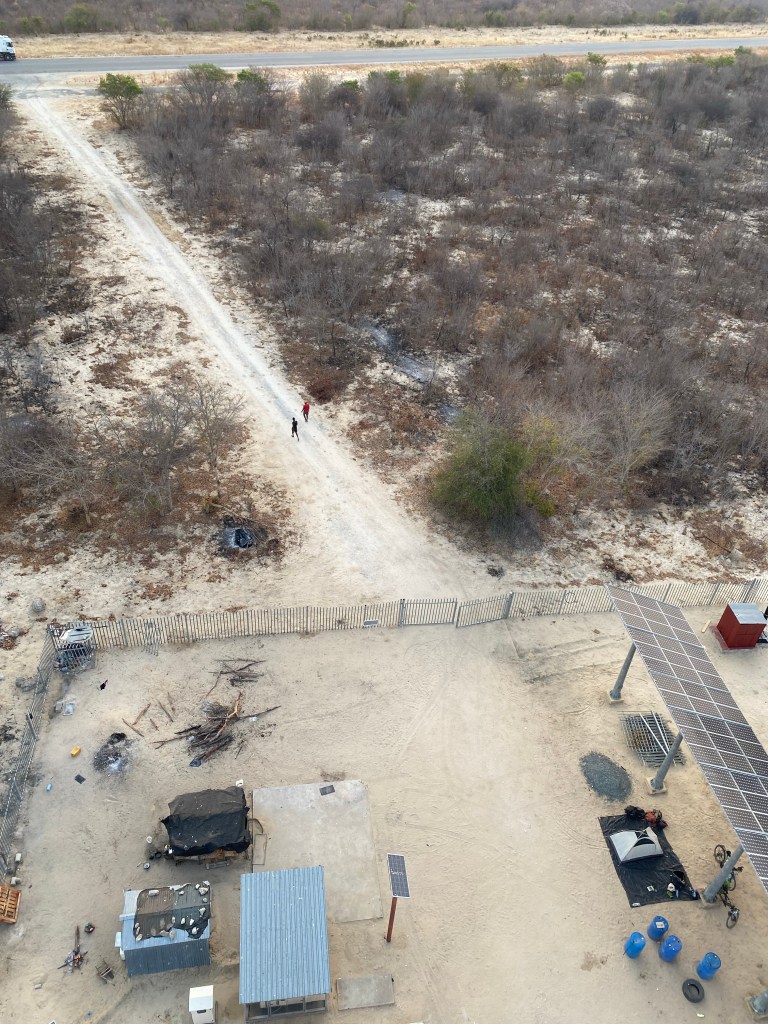
We arrive at the fenced communication antenna, which lies just 20 meters away from the road. There is no one there, but there is obvious traces that someone lives there and a bone fire is still smoking. We decide to get in and put already our camping plastic to relax. We have lunch and very soon we are having a past out siesta on the plastic, what feels fantastic. We didn’t put any sunblock as we knew we hold finish our day by 11am. We températures as high as 38 degrees and being fully exposed to the sun was a big mistake.
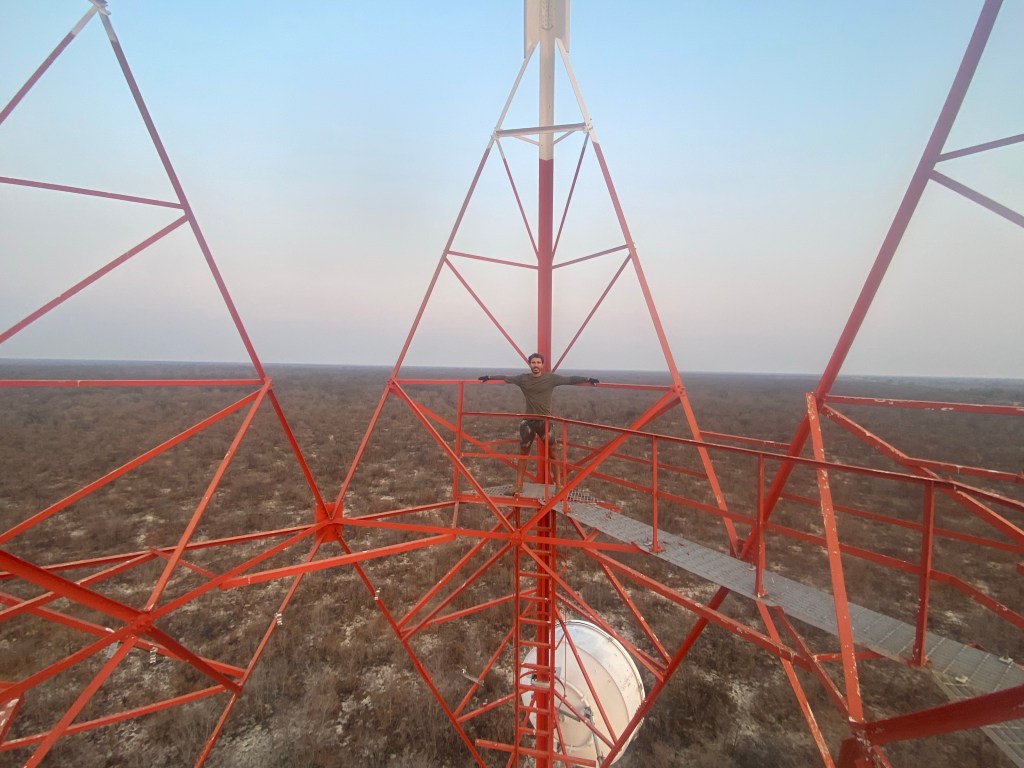
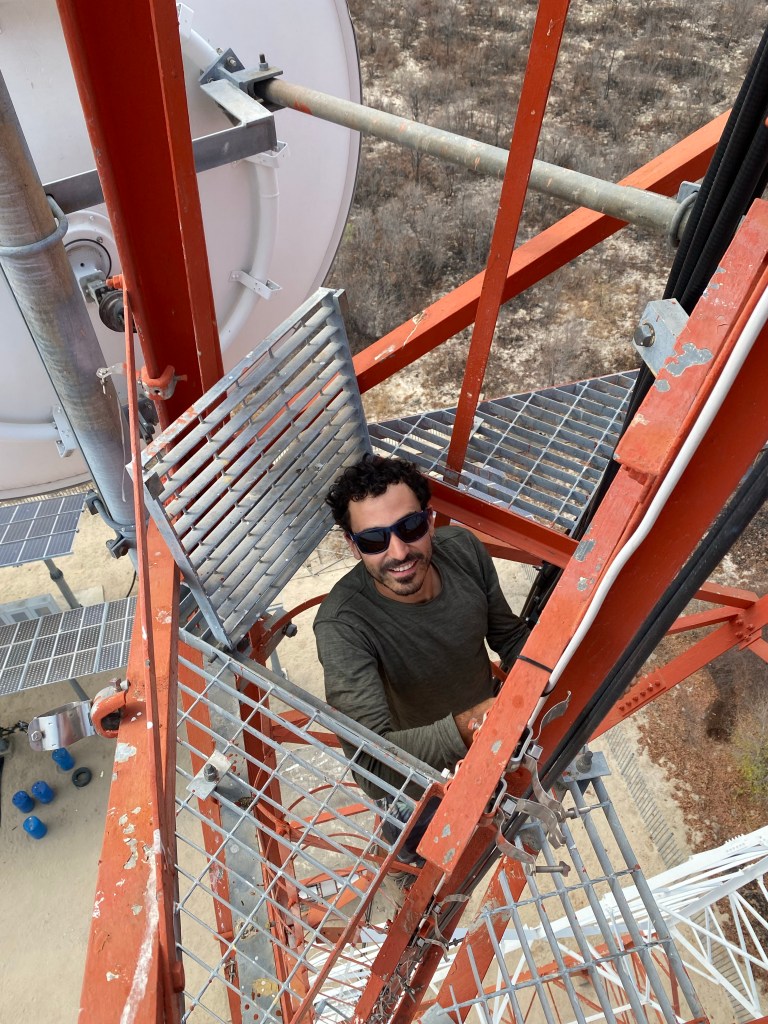
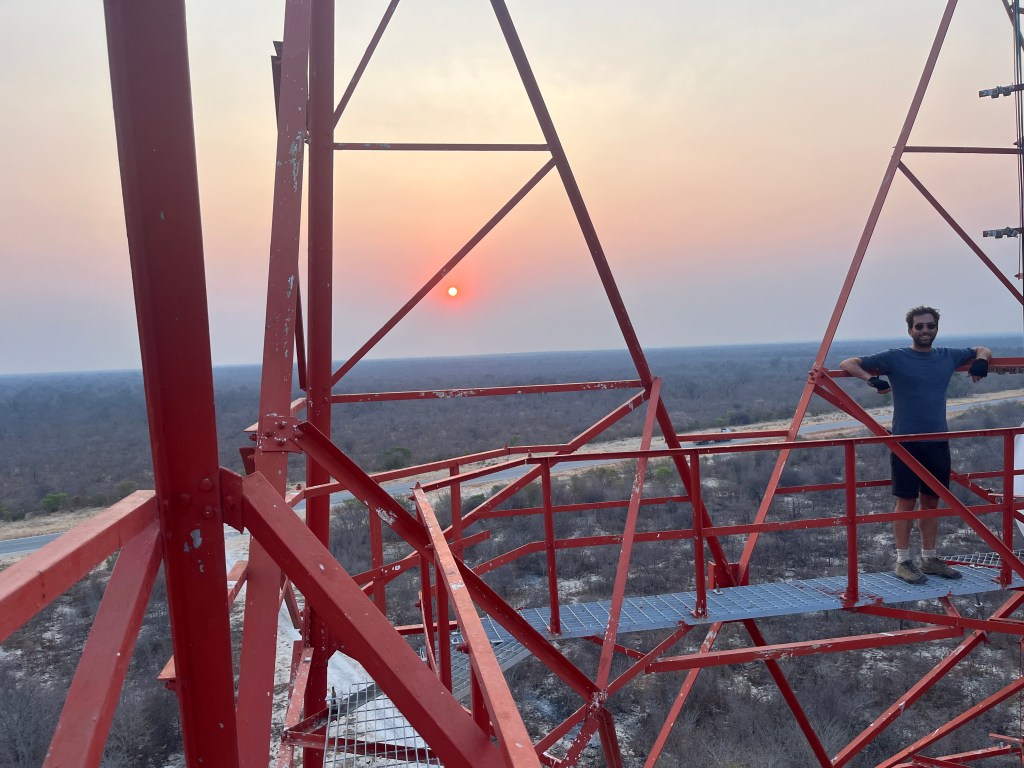
Hours go by but no one comes, so we make some time by climbing the antenna until a platform halfway. The wind, the big amount of electrical cables and the lack of climb protection makes it a bit sketchy, but the view from the top is worth it.

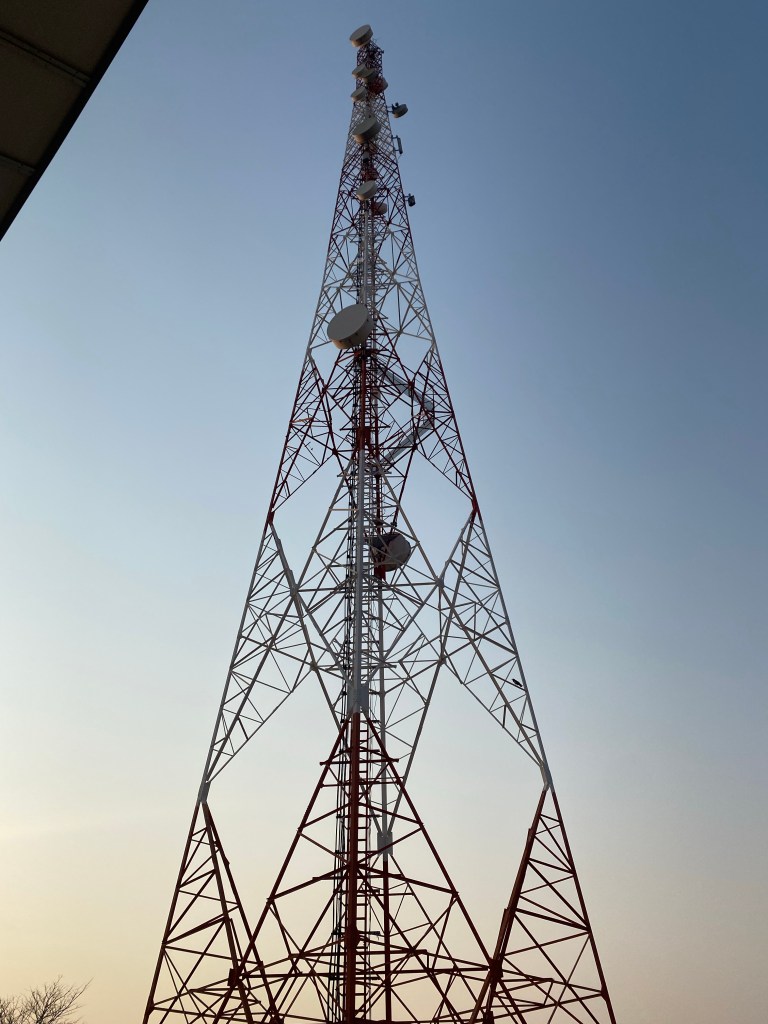
A bit later we go down, the guard of the antenna arrives. He is coming out of a truck passing by with a bottle of coca cola in his hand that he got from Pandamatenga (70km away). He is called Samuel and is around 30 years of age. We talks in a rather criptic way, and as soon as he arrives, he starts rolling a joint. He tells us stories of other cyclists and visitors to the antenna, including 3 base jumpers that jumped from its top. In the visitors book, we identify the name of other cyclists we have met (Michael, Joanna, Isi and Simon in Malawi) or chatted with exchanging tips (Holy for Zimbabwe). We somehow find that quite cool, and we conclude that around 5 cyclists a month sleep there in dry season, many less in wet.
Samuel is drying some kudu (a kind of antelope) meat in a cage, which he sells to truck drivers (mostly South African and Botswanan) that pass by and already know him for years. They also give him water to not depend too much on the irregular supply of his employer. He tells us that what he does is illegal (we pressume he puts some traps around the antenna) and he could end up in jail. We try the meat but its much harder to chew than the elephant meat of yesterday. Probably due to the fact that he is over drying the meat so if he could get caught people wouldn’t know what type of meat (wild animal) it is. Seems like a rather weird explanation but we do not focus on it.
We then get into a discussion about dating in Botswana’s. He proudly explains us that in Botswana you do not need to get married to sleep with a woman and that dating is very open. However if the woman gets pregnant or if you want to marry her traditional rules apply. Lengthy négociation will take place between delegations of the two families (typically the uncles) who not only have to gain the favour of the bride to be family, but also agree on the price of the bride. Traditionally the price is around 8 cows but today it is commonly paid in cash. As the family do not have this much money, it can take years until the full payment is made. As you guest it, when there is a need they are businesses offering such loans.
We climb to the antenna platform again to observe the sunset. Samuel climbs half way but he decides it’s too high (or he is too high ;)), the wind too strong and descends before reaching the platform. We offer him to have dinner with us and give him a plate, but by now we think he is very high and he prefers to spend the night drawing in his room. Good night, then!
21/09 Antenna – Elephants Sands. 77 km, 114m+
While we have breakfast, we find interesting to observe Samuel’s morning routines. He has a showering station with a bucket, and a rudimentary gym with some ropes and 5l bottles full of sand. We say bye, and hit the endless roads once again.

Although we refilled water in the gas station, we are below expected level, as we have drunk more due to the heat. We arrive to a wildlife checkpoint, where they make us clean our shoe soles and the wheels of the bike, to prevent transmission of tse tse flies and other parasites between areas. A car with 2 dutch tourists in their 60s is also stopping and, after talking for a bit, we ask them for a bit of water, which they immediately offer. Another 5l for us! Nice people.

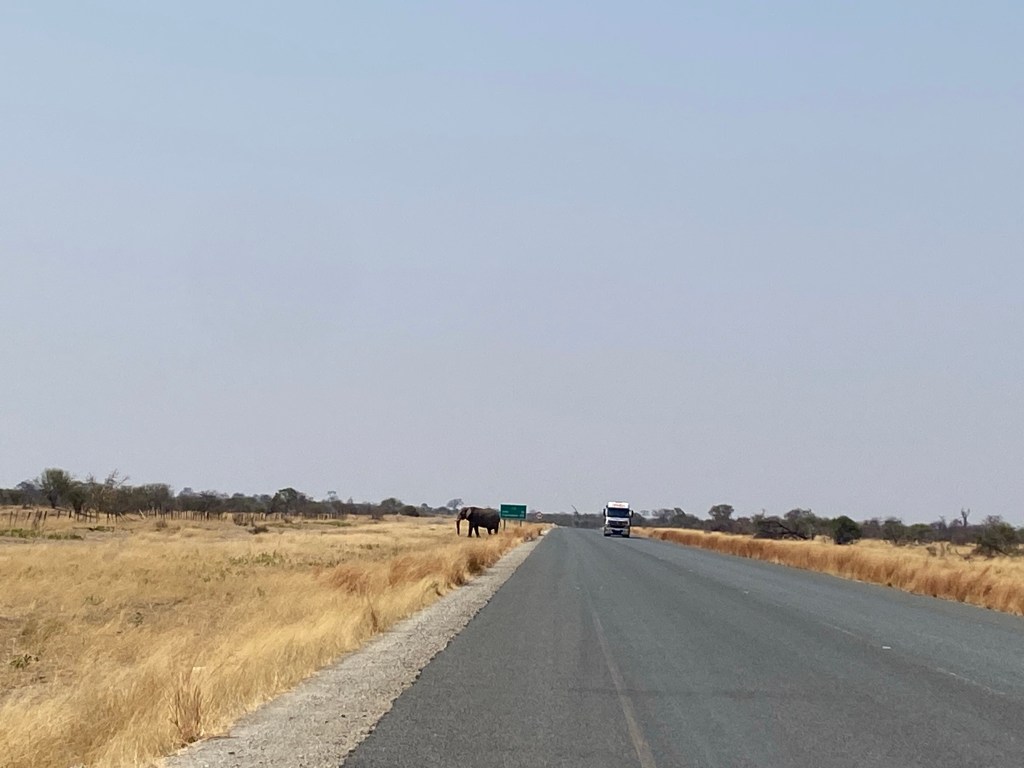
Soon after this encounter, we observe an elephant crossing some hundred meters away, which we respectfully let cross and disappear in the bush. But a bit later, another one, this time a really big one, crosses and stays by the road side. Time goes by and he is not moving, so we decide to overcome him from the other side. The wind is coming from him, what should be on our favor. We decide to commit and cross, but as soon as we are in front of him, he does turn and looks seriously at us, showing his gigantic tusks. Luckily he doesn’t move, but we conclude that elephants here are also to be handled with care.
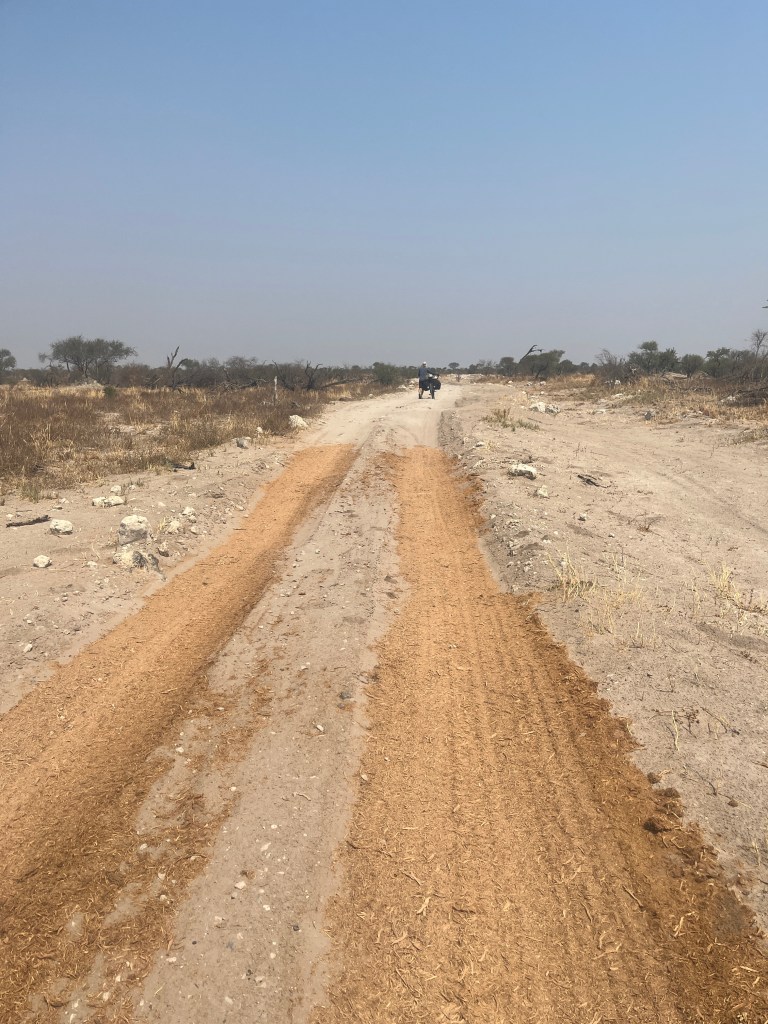
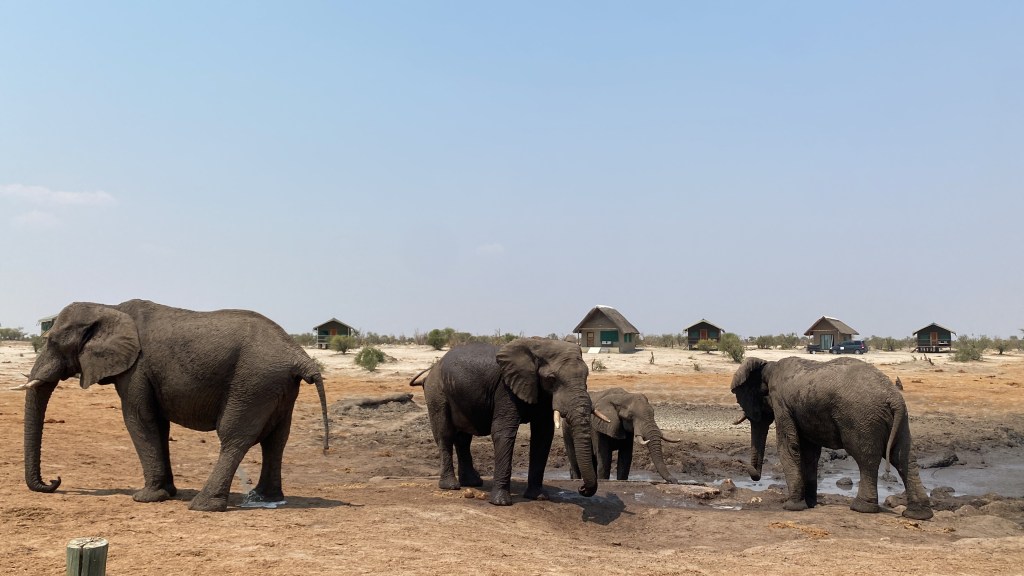
We arrive at the exit towards Elephant Sands, a safari camp famous for having elephants freely roaming around. After 2 painful kilometers full of sand and bike pushing, we arrive at it. The main building, where the reception, restaurant and the pool lie at, faces a pressumably artificial spring 2 meters away from it, with an electrical fence in the middle. The spring is visited constantly by elephants, who, like all other species, are struggling with the water supply at the end of the dry season.
Although the camping is a bit pricey (16$ per person), we decide to stay, as it’s pretty early and we believe we will enjoy the pool to the fullest.
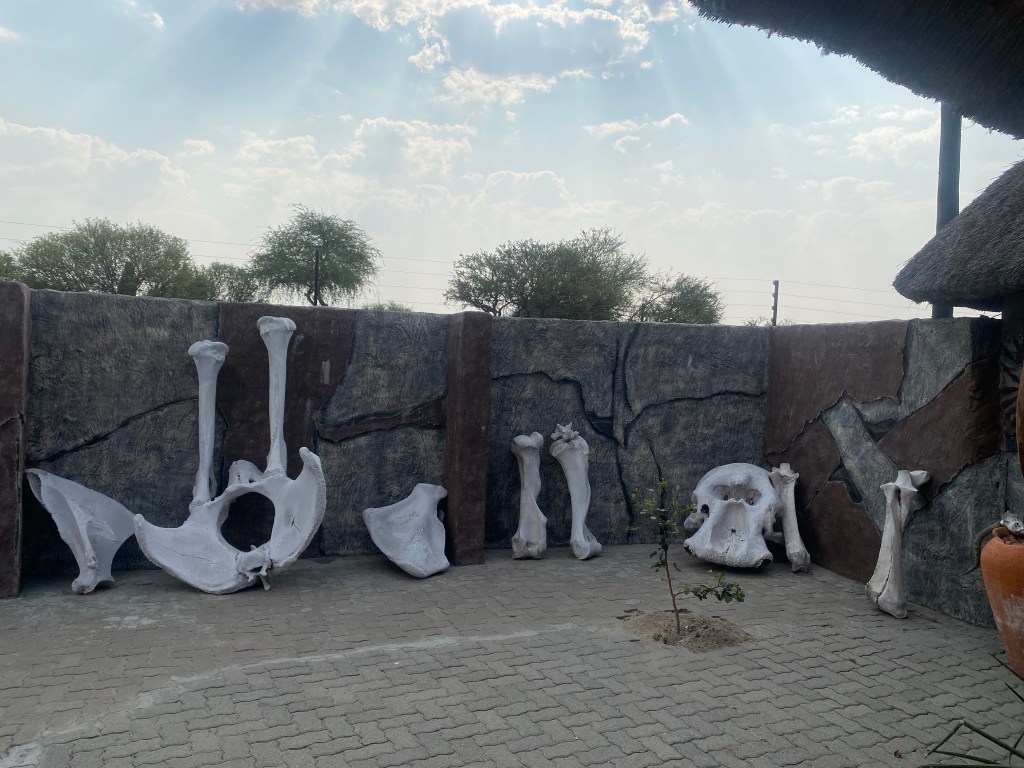
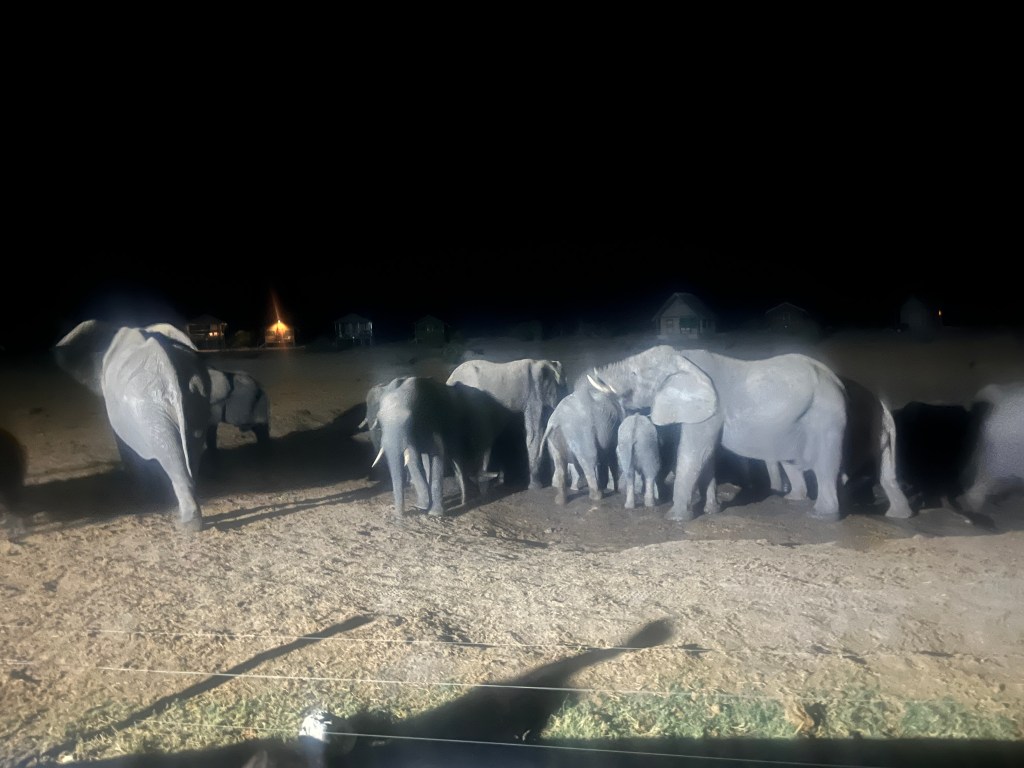
The camp is fully booked out, with herds of tourists photographing the herd of elephants that calmly drinks, ignoring the annoyance of the cameras of those homo sapiens. We witness a quite sad event, when the camp crew has to scare elephants away from the spring with the pickup van, so that they can take away a dead baby elephant that has collapsed, apparently due to natural causes. Tourists recording the process makes us feel a bit disgusted, but we do also feel an impulse to record. Human condition and nature’s cruel reality at once.


The afrikaans young guys working at the camp tell us that the weak rainy season is making the end of this dry season particularly hard, and there are dead animals virtually at every spring they visit in their safaris. They have also heard that 800 buffalos have moved from Zimbabwe to Botswana looking for non-existing water, and they expect a lot of issues deriving from that. Uncontrolled fires are also causing issues. Their spring does in fact looks fully dry, and they seem to pump water to keep the elephants coming, so tourists also keep doing the same.

Gaspard is sad that we didn’t eat yet local food (only rice and instant noodles for lunch and dinner) and we decide to pay the 18$ that the all you can eat dinner buffet costs. Despite making it the single most expensive meal so far, we don’t regret it at all, as we get three full plates and go to bed near to a food comma. Kudu beef, Nsima (in Tswana called Bohelo), nice salad and boiled vegetables, tasty bread and a delicious dessert. Giving ourselves a treat now and then, you know.
After dinner, we observe the increasing number of elephants that come to the spring, including a small one that must be 1 month old at max. Seeing him move below his mother among an ocean of elephant legs that could kill him anytime gives us a bad feeling, so we go to our tent dizzy from the feast. The camping area is obviously out of the electric fenced area, and we have to remind ourselves that an elephant could be crossing in the dark. The screams of the male elephants during the whole night fighting for the water and kicking each other out of the spring.
22/09 Elephant Sands – Nata Bird Sanctuary. 93 km, 64m+
We leave Elephant Sands paranoid about crossing all the elephants of yesterday night, but luckily we make it to the main road without seeing any.

As we get closer to Nata, a town on an important road junction, usual wildlife reduces, but we discover a new one: ostriches.
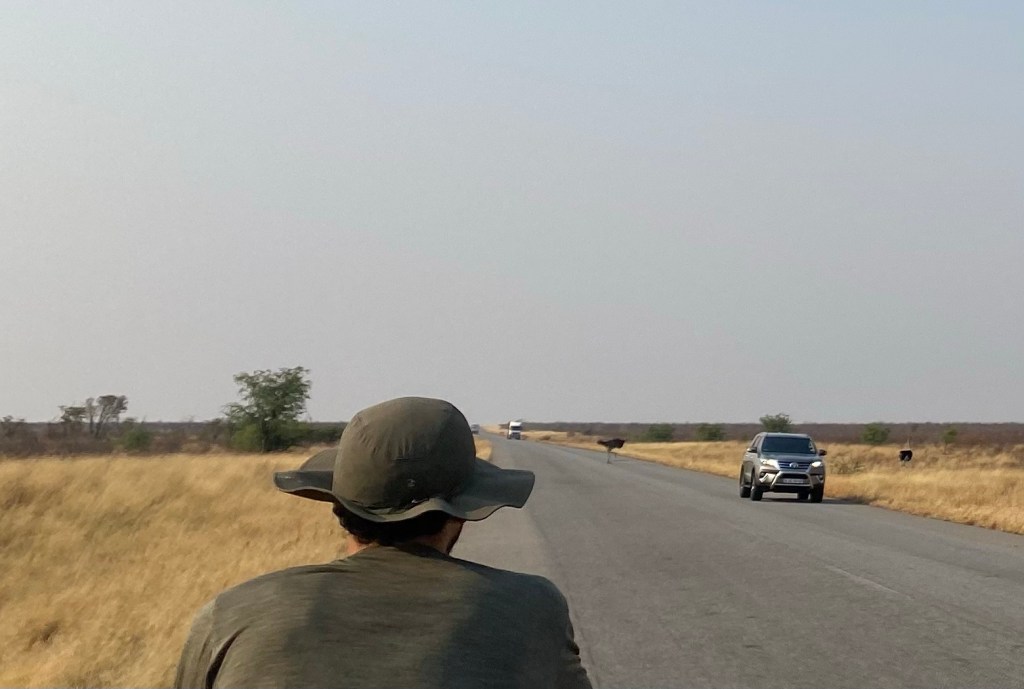

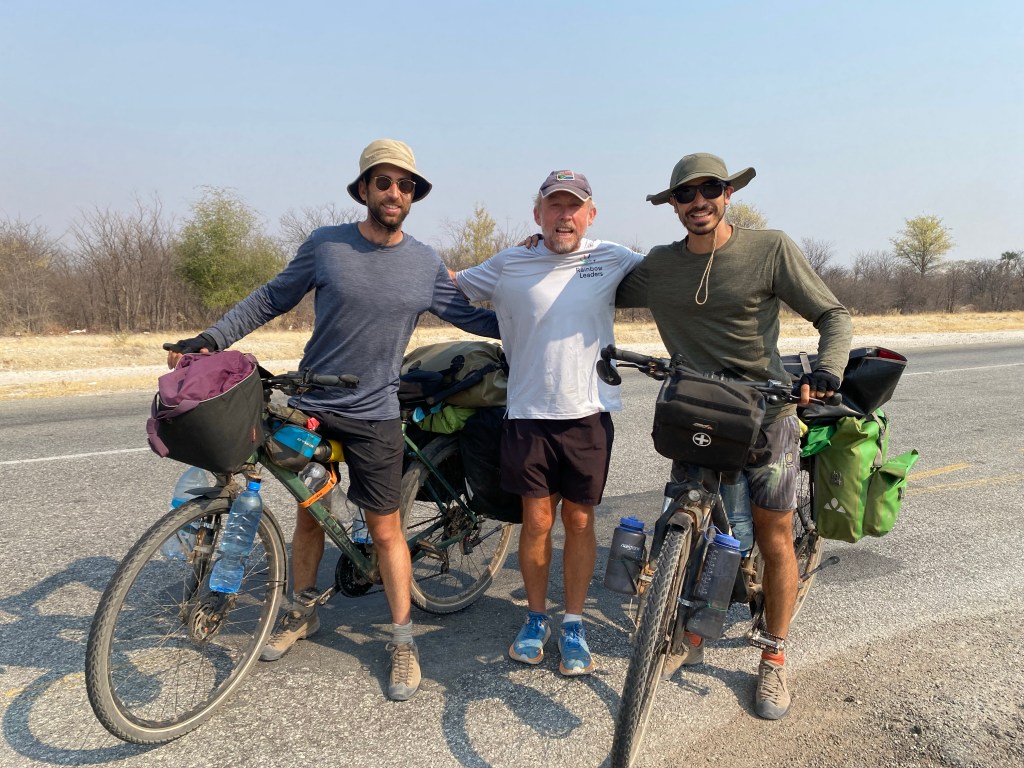
Fewer animals today but we substitute them with an equally interesting encounter. Today we cross ways with Keith, a 57 year old South African, who is (wait for it) crossing Africa from Cape to Cairo (wait for it again) running. Yes, running. He is followed by a support car driven by a friend of him and he is raising funds and awareness for Rainbow leaders, a South African NGO that aims to encourage young people to vote, since as little as 10% of people below 30 register to vote. Keith is full of energy and kindness, and he is enthusiastic yet realistic about his challenge. He walks when he can’t run anymore, and he is averaging 41 km per day. He is attempting to break the absolute world record, which he is on track to break. Mad respect for him.
We arrive at Nata, where the road to Gaborone, the capital, goes south, and the road to Maun, the gateway to the famous Okavango Delta, goes west. We aim ultimately at Maun, but first we want to visit the famous salt pans of Botswana. After asking some people, we have concluded that the easiest place to access them is through Nata Bird Sanctuary, 20 km southeast from Nata. Despite being a detour, it’s the only place with a decent road that brings you to the pans.
We stock up water at the water refill station and food at the Choppies of Nata, and head towards the campsite. Getting water from a refill station is about 5 times cheaper than buying the bottled water. The East wind complicates the last miles, but we do eventually arrive, just in time for lunch.
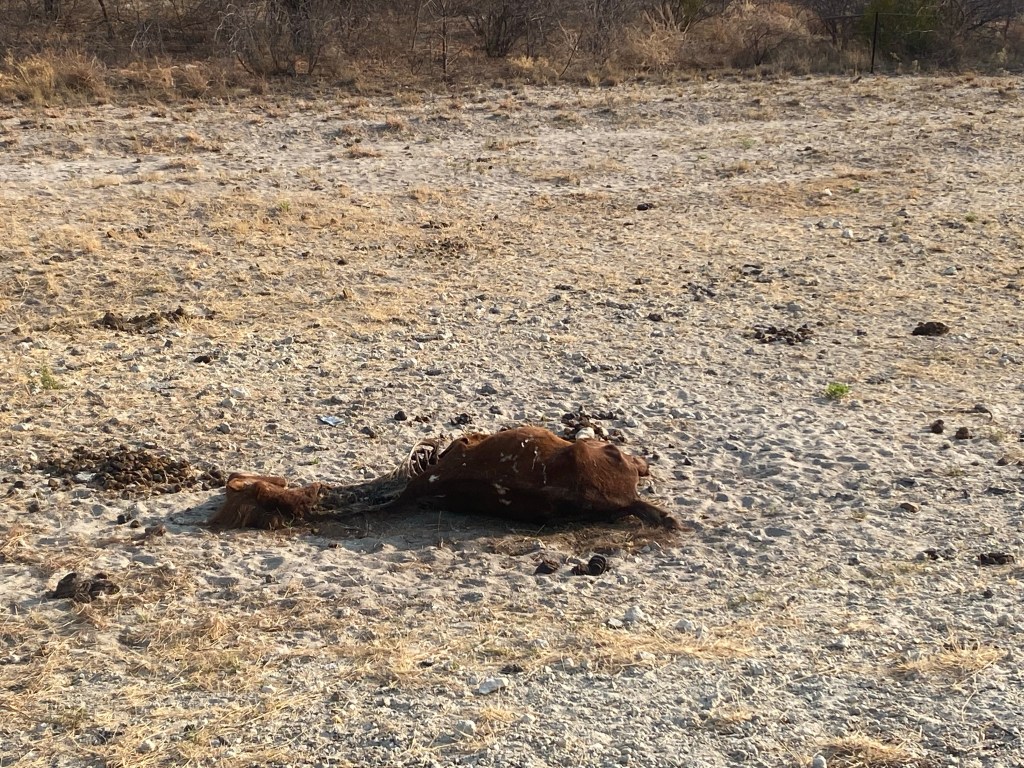
A woman at the desertic reception tells us that the pans are fully dry, which means that there are no birds around, but the place is beautiful for sunsets. The camp is community run, nice and very affordable (6$ per person) but the campsite is painfully empty. Most of tourists stay in lodges nearby and access the pans during the day. We leave our water bottles in their fridge (as by now water inside is probably at 40 degrees) and head towards the camping. We would walk back from the camping to drop new bottles and take the cold ones a few days during the day.
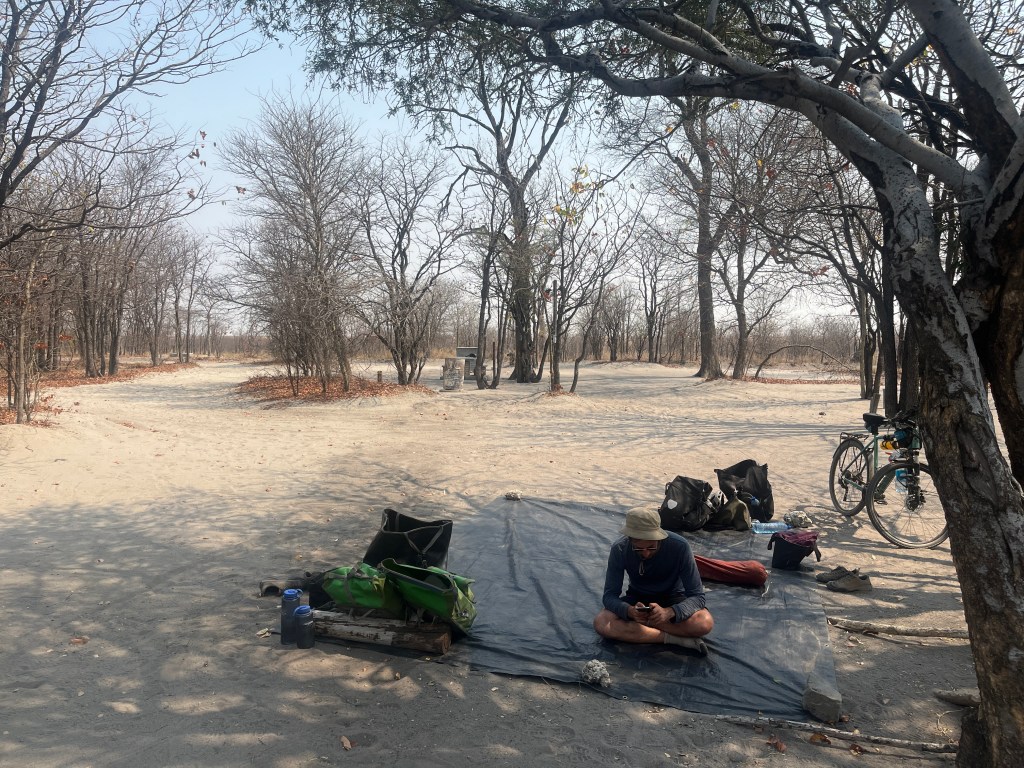
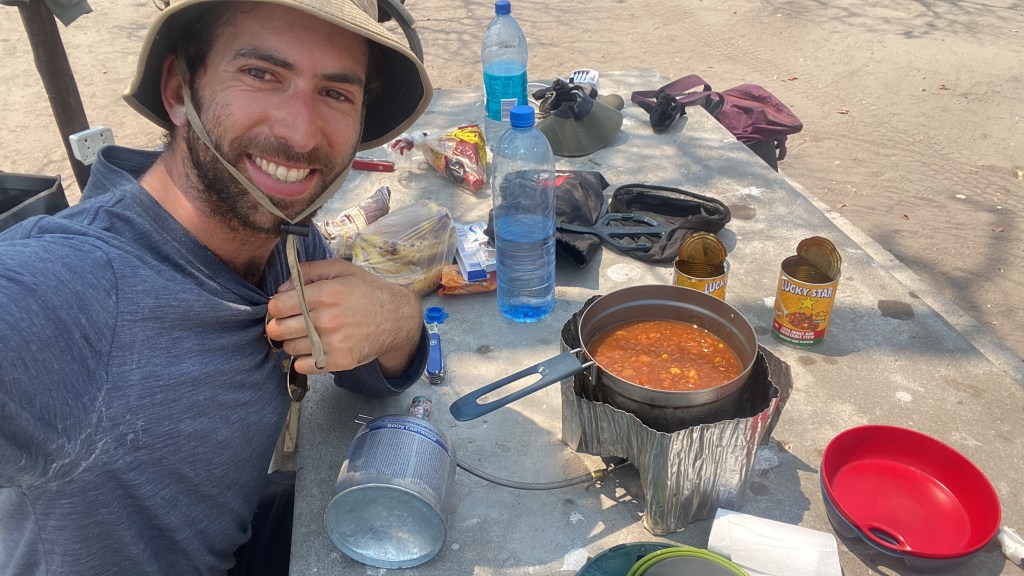
We take an extended lunch break, finding enough time to even shave us under the shower. Again shaving with disposal razor took us a solid 30 min each. An hour and a half before sunset, we head towards the pans, crossing a few gnus and some inhospitable grass fields on the way.

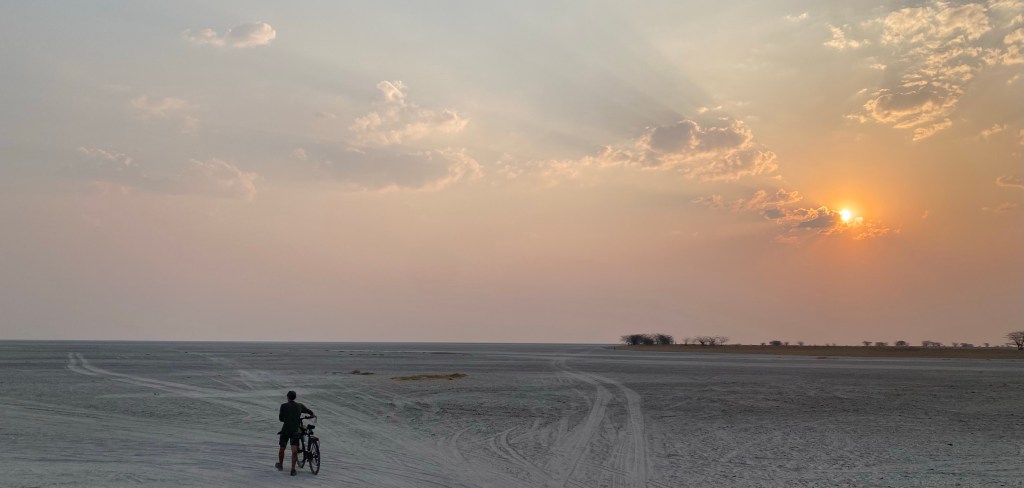
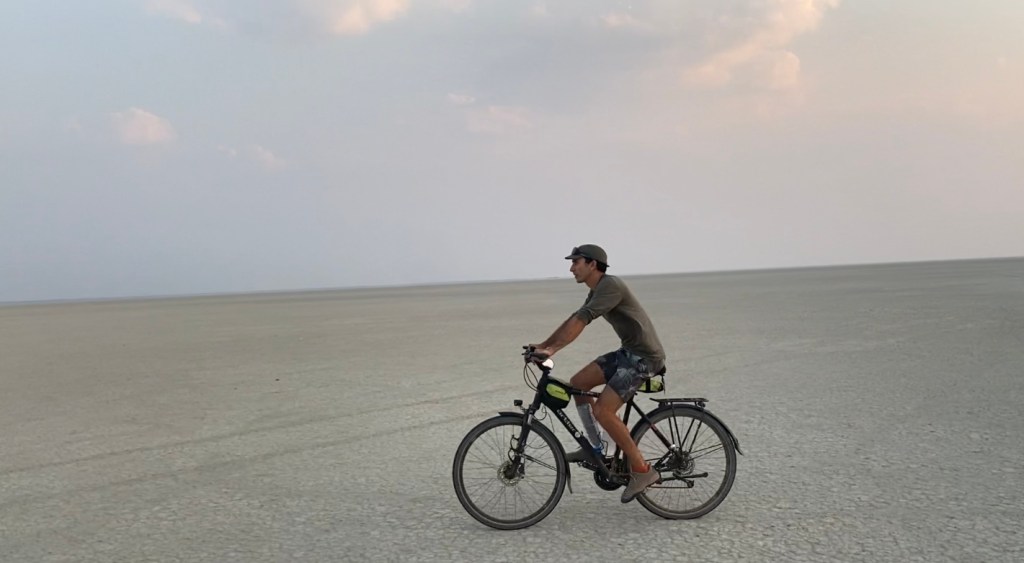
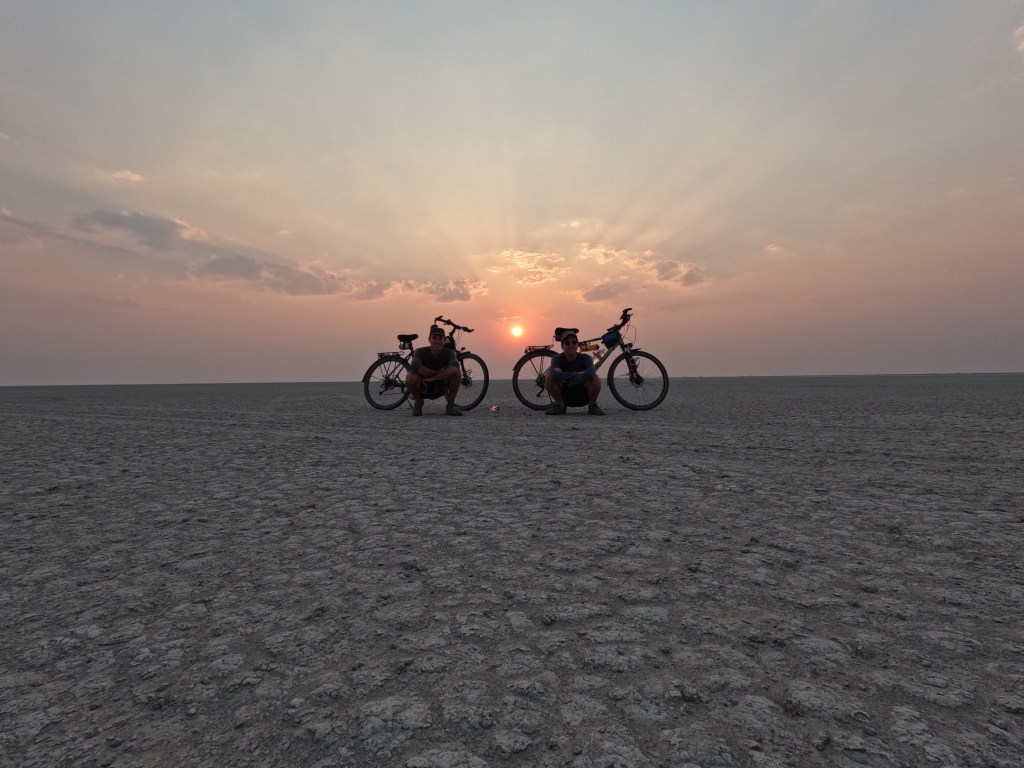
Once in the pans, we discover that they are hard to cycle on them. We enter a bit in their immensity, enjoying their solitude, silence and truly endless horizon with the sun slowing going down. The pans extend for hundreds of kilometers, but adventuring into them sounds rather risky due to lack of water and easiness to get lost. Unfortunately, the sun sets in before the horizon due to the big amount of atmospheric dust, product of the lack of rain. But the visit still becomes a highlight. We cycle back before it gets too dark, only getting overtaken by 4 other cars. Beautiful day.
23/09/23 – Nata bird sanctuary – Gweta. 113 km. 95m+
We start cycling back to Nata among cows, horses and donkeys, what reduces our fear for wildlife, as cattle and wild animals tend not to coexist. We refill water at the local water station, for as little as 8 Euro cents a liter. The boy responsible for the shop asks us inquisitively the price of our different gear items, and asks us to give him our camera. When we say we do not have a camera he did not believe us. He reacts surprisingly good to our obvious negative. He says he wants to travel too, and we recommend him to study, save and give it a shot. Botswana is after all one of Africa’s richest country, so we ge hope there is a chance for him.
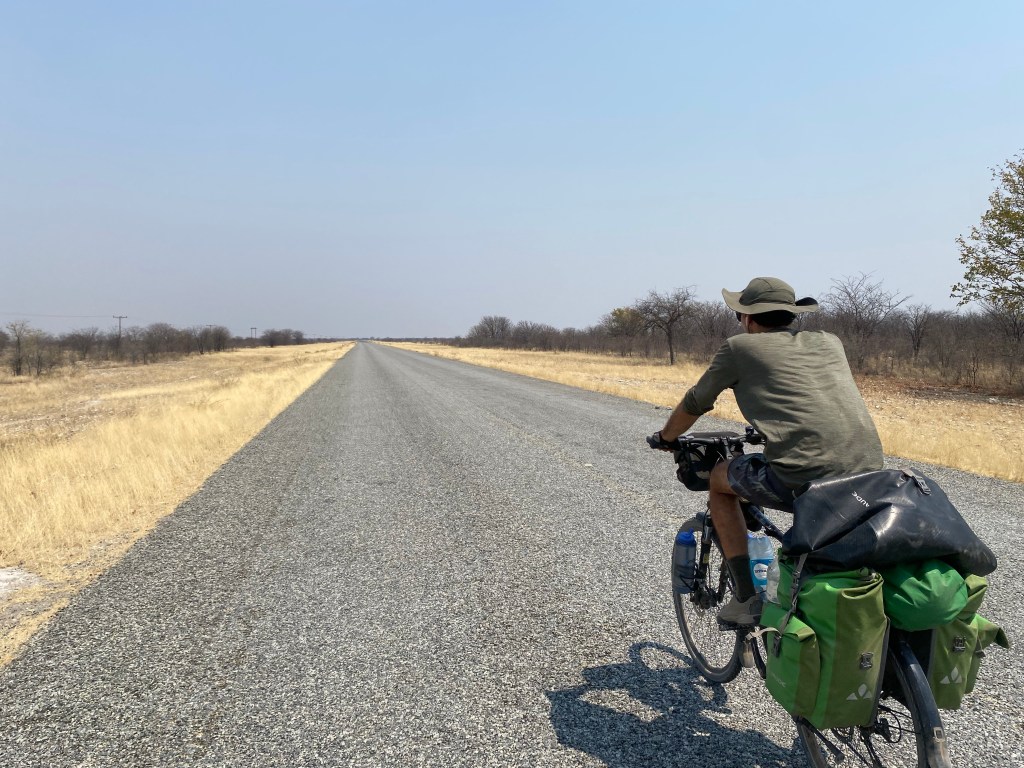
The road to Maun provides little distraction, so we stick to our podcasts and audiobooks. Gaspard listens to geopolitics, Javi to neuroscience (Huberman Lab). From time to time we see a warning “potholes ahead” which basically means the tarmac disappear to leave a dirt road.
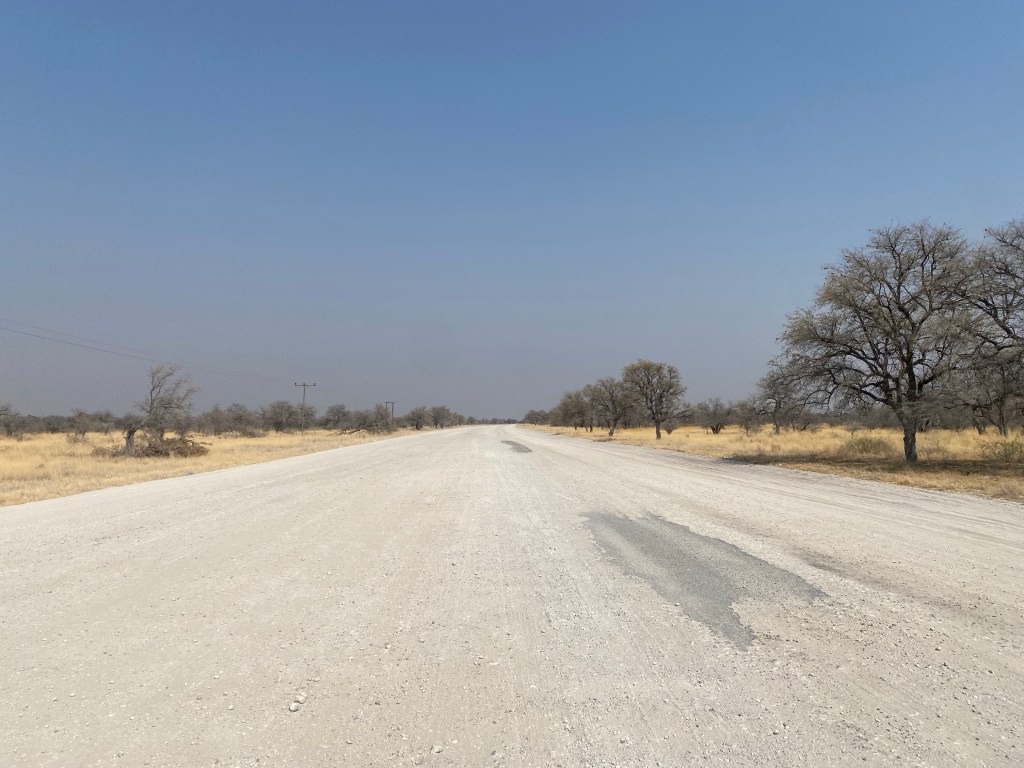
Apart from that the road remains the same straight road as the previous days. With high dry grass and a few trees. Only slight change is the amount of gigantic termite mound by the side of the road which has increased a lot.
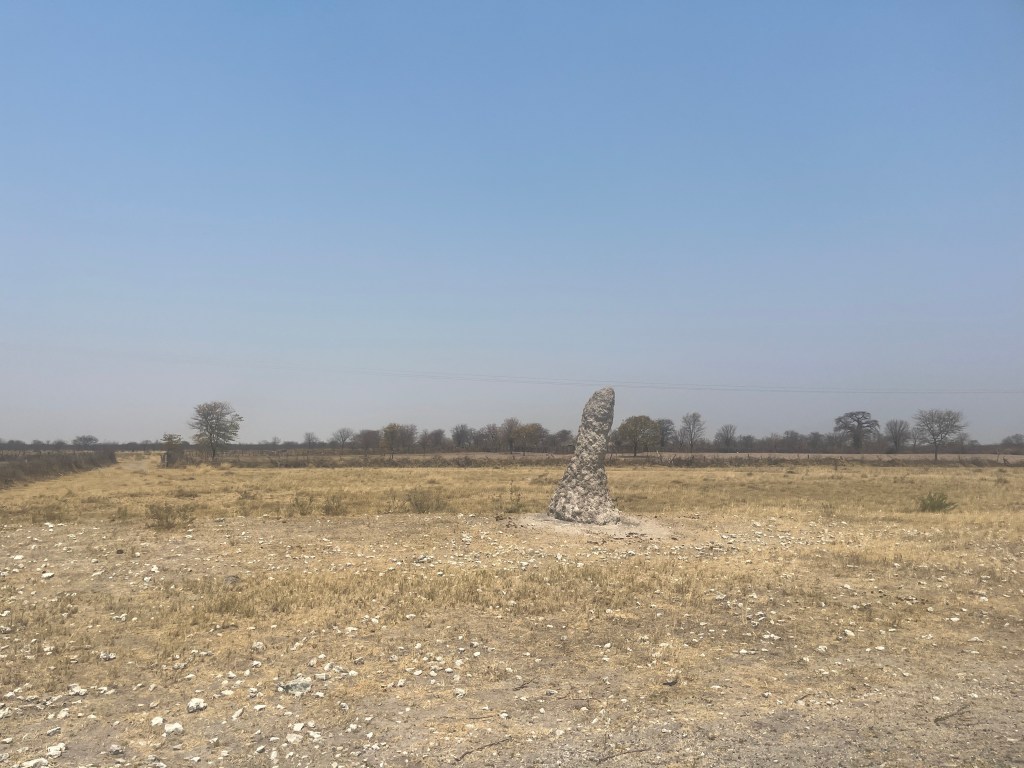
It doesnt’t take long to arrive at Planet Baobab, our stop for today. Many ioverlander’s reviews by motorbikes and cyclists mention that they were told that the camping is fully booked, despite there was plenty of space. As soon as we arrive, we confirm the rumours.
“-Sorry, we are fully booked”.
“-But we only need 4 square meters to pitch our tent. We are cycling and we don’t really have anywhere else to go today. We would really appreciate your support”.
“-Go wait at the bar, let me see what I can do”.
An hour goes by and our patience starts to run out. Very soon, the real reasons for their negative become clear.
”-We can accommodate you if you spend 1’000 pula (80$) in the bar.
We reply that we are OK with having lunch and dinner at the camp, but it’s unacceptable to make us commit to a minimum amount. The worker goes back to talk to the manager and comes soon after with a surprising new proposal.
”-OK, if you have lunch and dinner with us, you can stay for free”. We look at each other confused by the sudden reduction, since with the camping fees we can finance most of the lunch and dinner. We obviously accept and go pitch our tent, in an area that can accommodate easily 10 other tents. “There is no space” they said. My ass.
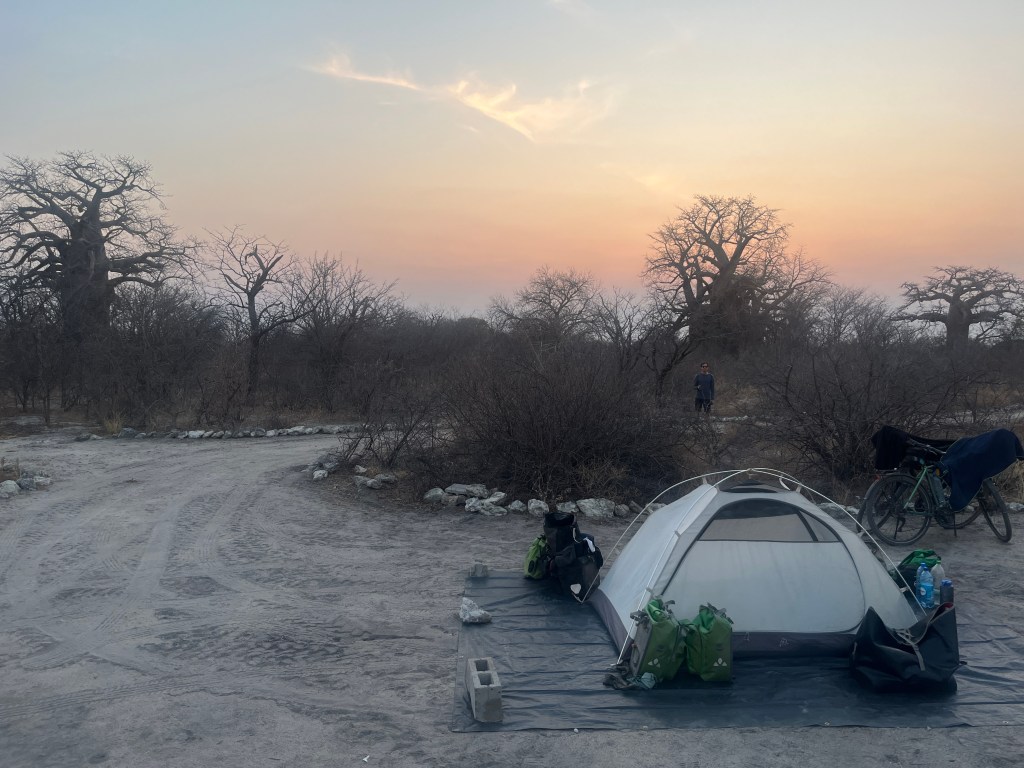
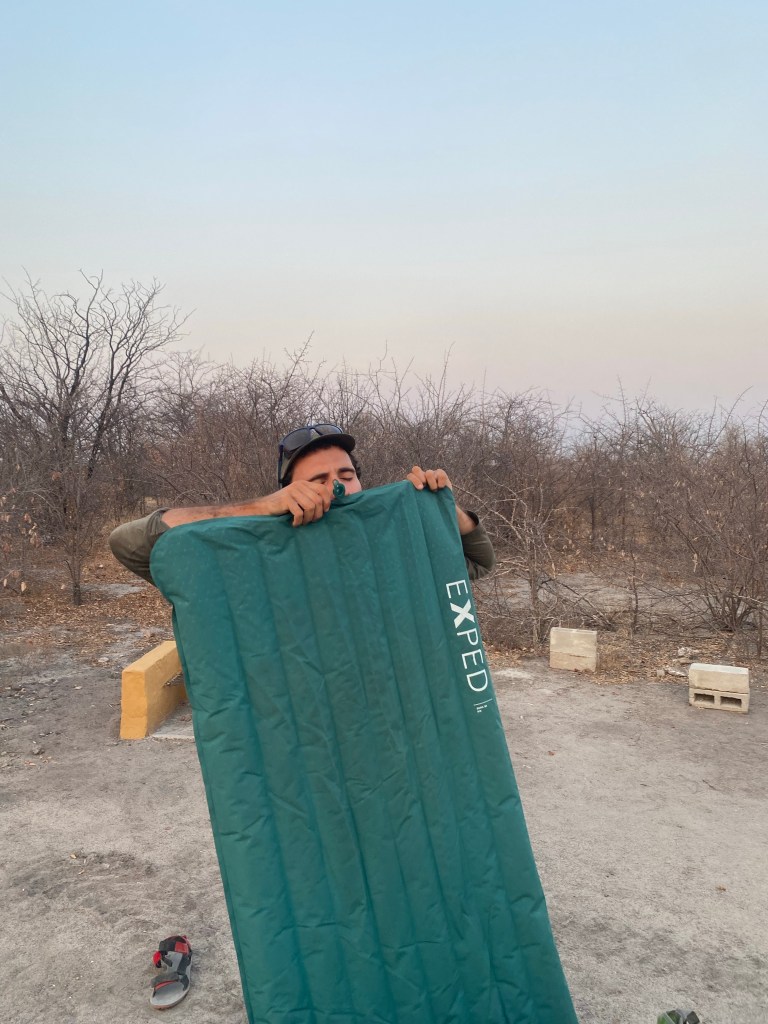
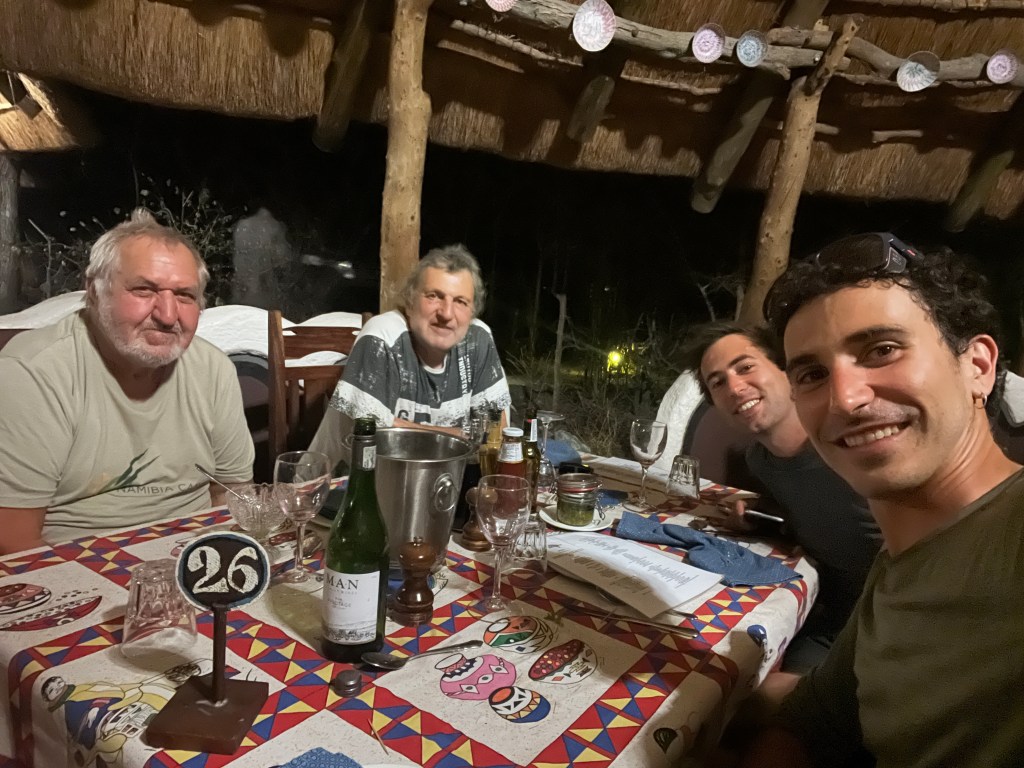
At the bar, we meet Erwin and Venanzi, two Swissmen from Ilanz, Graubunden, aged 68 and 77. They are very friendly, simple, old-school men, and we very soon get along with each other. We agree to have dinner together.
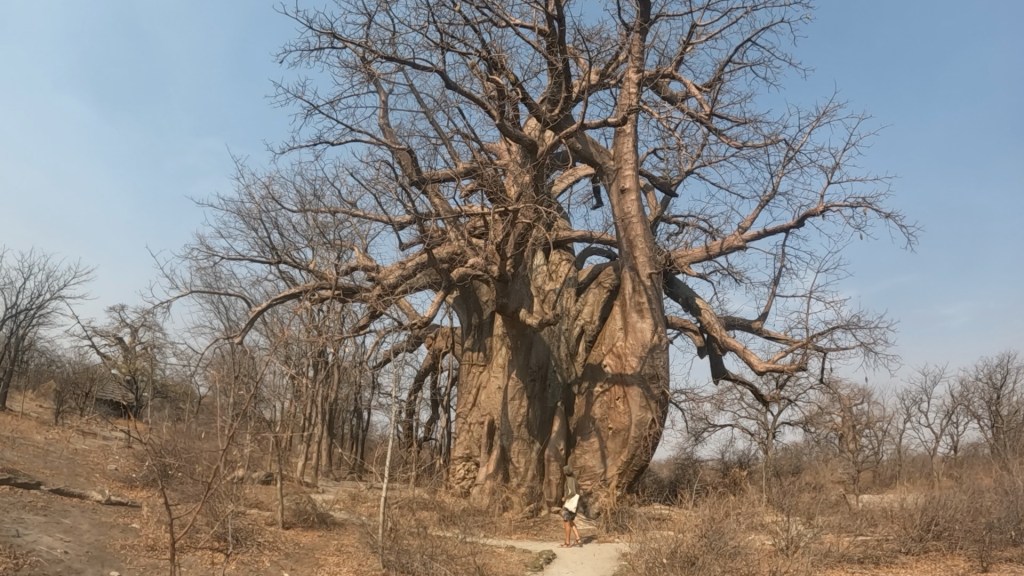
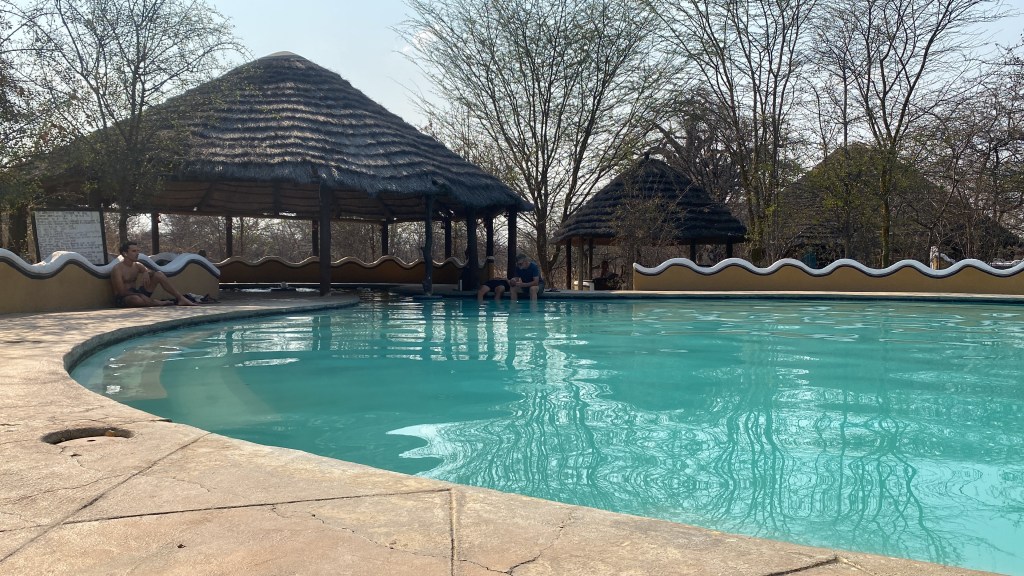
After we manage to let go the anger of the poor welcoming, we enjoy the raison-d’etre of the camp, the baobabs. they are scattered all around the camp, and some of them are humongous. 10 people holding hands would struggle to surround them. The swimming pool is also superb, and we end up having a good time.
During dinner, we get to know Venanzi and Erwin better. They are neighbours and talk Rumansch to each other. Erwin lived in South Africa, Botswana and Zimbabwe in the 80s and 90s, working in construction projects. He left in 1999 when he got assaulted twice in a week in Johanessburg. Venanzi, however, has seldom left Graubunden, apart from going to Italy to bring wood, which has been his long-life employment. He doesnt’ speak English, but he is fluent in German, Italian and a bit of french. His phone is 20 years old, and he uses it 5 minutes a day to send a SMS to his wife. Whatsapp? What’s that. We are impressed by their resilience and positive attitude on this type of travelling, particularly Venanzi’s. This heat at 77 years of age must be tough. We truly enjoy the evening and agree to see each other in Maun, which is the destination of both groups.
24/09/23 – Gweta – Antenna in Motopi. 127 km. 128m+
The 3 wine glasses of yesterday slow the day start. Javi realizes that he misses his helmet, which he finds by the parking. The joy doesn’t last long, since the part to adjust the size is broken. Someone has probably stepped on it, dammit. We are anyways not using them these days, since the traffic is little, the road doesn’t offer dangers and the heat doesn’t invite to.

Today we have a long program, as we want to camp at an antenna 127 km away. The few options before don’t appeal us, as we really looking to arrive at Maun tomorrow for a deserved break and an upgrade in comfort.
Erwin und Venanzi overtake us at km 50, and by km 85 we decide to make a pause at the only village of the route. We read on ioverlander a review from Michael saying there is a small shop and that the owner gave them water for free. We refill all of our bottles with tap water (7.5 L each for the last 40km of the day and tomorrow morning) and cold Coke at the local shop, and cook on the shade of their porche. It is almost midday and being in the sun by 38 degrees is exhausting. A group of kids approaches us and proves us that indeed Botswanan kids are wilder than Zambian or Malawian. They don’t stop asking us for presents and money, touch our stuff all the time, including an attempted peanut robbery, and they even throw small stones to us to catch our attention. They pretend to be crying and scream “I am huuuungry”. We surrender to their annoyance and ask the shop guy to please kick them out, as the heat has significantly reduced our patience.

Despite the merciless heat, the coke, break and food have replenished our energy levels. Good they did, since a surprise is awaiting for us. At km 100, we see an elephant 5 meters from the road. a bit further, a full herd. in the horizon, many, many more. They seem to drink water from a water pipeline/ underground reserve that follows the road that they have smashed open. They are way too many herds to simply overtake them, so we decide to ask cars to escort us for a bit, since the noise and size of them is known to scare them.

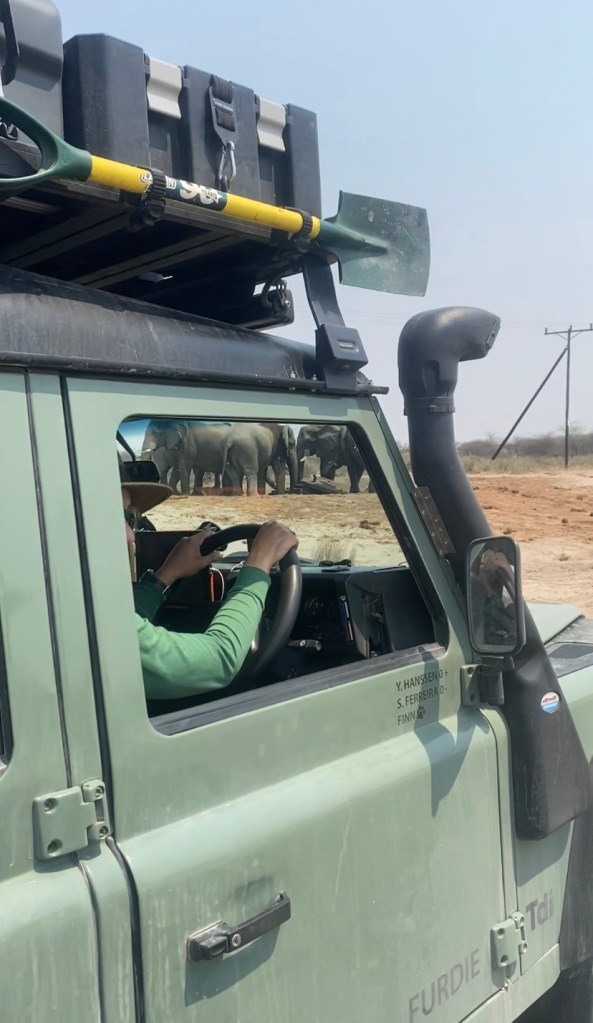
We stop a car coming in the opposite direction and ask them if they could do a U-turn to escort us for a few meters. They immediately say yes! We overcome the first 3 herds with the help of a friendly Zimbabwe couple, that even offers us water. A local guy helps us with the 3 next groups. We normally hide behind the car so elephant can’t see us as we pass by. However we now have herds on both side of the road so we need to follow the car from behind and as close as possible. “Walaa that was stressful”! We then cycle a bit more and get stuck soon with another section of endless herds. Cars pass only every 5 minutes and, surprisingly, 5 cars in a row decline our support request. The first two, american and british tourists respectively, tell us to just go on the opposite side and “you will be fine”. We thank them for nothing and wish them internally 5 years of bad sex. The 3rd one, a local guy with his wife, declines because they are scared, what we obviously respect.
Time goes by, the heat wastes us, and no cars are passing. It is now almost 2pm with another 20km to cycle and without knowing how many herds are waiting in front of us but knowing we should be at our next campsite within 2h we are considering giving a go by ourselves. At this time a New Zealand pair appears (again from the opposite side) and gladly supports us, changing our opinion on humankind.
We arrive at a wildlife checkpoint, where we pressume we are leaving away elephants for good, since now it’s cows and donkeys which profit from the water pipe. We suspect the local authorities have opened it up deliberately to help animals cope with the draught. However there are still a few elephants drinking, funnily coexisting with cows at the springs. We overcome these ones by ourselves since they are only a few ones, one herd at a time, and, surprisingly enough, they get scared from us and run to hide in the bush, like if they knew they are out of the area that they should be. The speed at which they hide makes us reconsider our chances of running away in case they start chasing us, since they can run at up to 45 km/h. The theory keeps saying to stay without moving, but, it would be difficult not to give a go to sprinting away with the bicycle in case they chase us.
We arrive at the antenna after the last 15 kms with an annoying facewind that makes us do turns in front. In front of the path leading to the antenna there is one last elephant to pass. The path to the antenna is very sandy and bushy, so we do it very fast, hoping not to ruin the last bit of the day with an elephant appearing 2 meters away. This antenna is not warded, and its fence is in a poor state, with multiple holes. We cover them with metal plates, tubes and rocks, and lock the main gate with our bicycle lock. We don’t want any lions visiting at night, thank you. Actually we kind hope they would come so we could put in practise the theory we learnt from a safe place: do not run away, stay your ground and make loud notices while clapping strongly in your hands. All things we would never dare to do in a real confrontation.
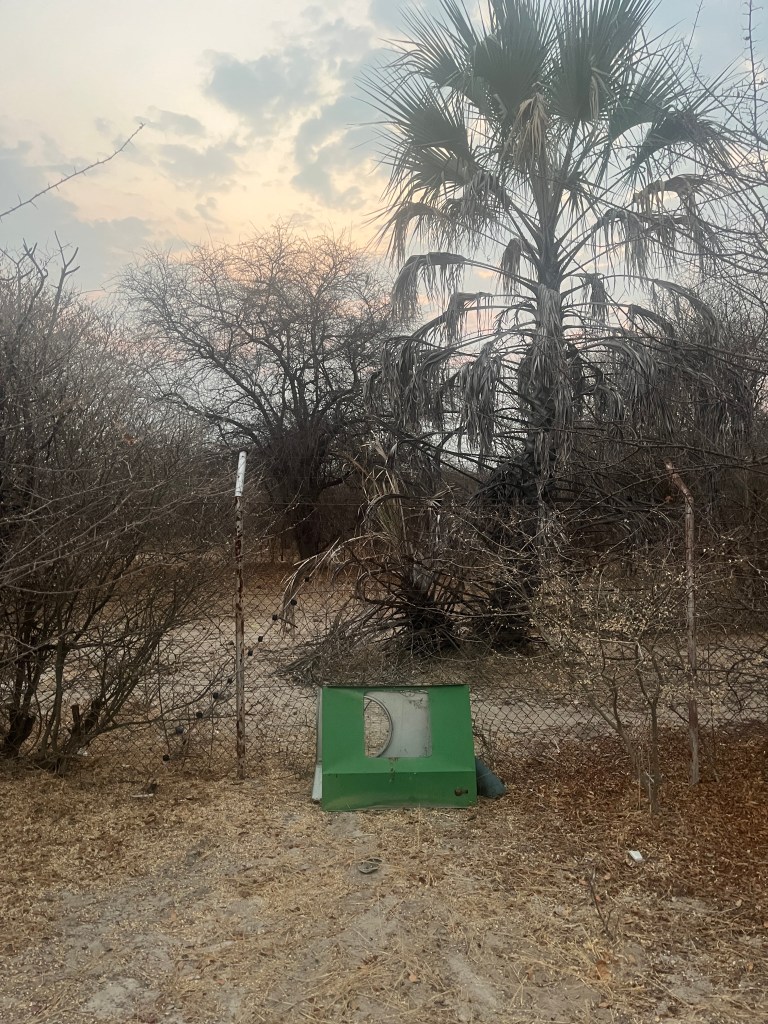
We are so physically destroyed that we don’t even consider climbing up the antenna this time. We just transform into beasts for dinner, finishing up a half kilo of rice with 1kg of beans in matter of minutes. We profit from the good network to call our girlfriends and family while our bodies rest, and even find the time to plan our social life at Maun. Gaspard probably talked too loud as when he got into the tent javi had the two pillow, one on each ear. Sandra and Fiona, the girls we met in the first night in Botswana, have offered us to cook lunch for us tomorrow, and Erwin and Venanzi have offered us to join them the day after for a self-drive safari to Moremi, a renowned game reserve home to the big five. Nothing like making friends!

25/09/23 – Antenna in Motopi – Maun. 91 km. 125m+
We start the day wondering if elephants are more active in the morning or in the afternoon, since we mostly see them after lunch. The theory says they are active al night and day long, including some intermittent sleeping standing. But we love creating our own hypothesis and theories.
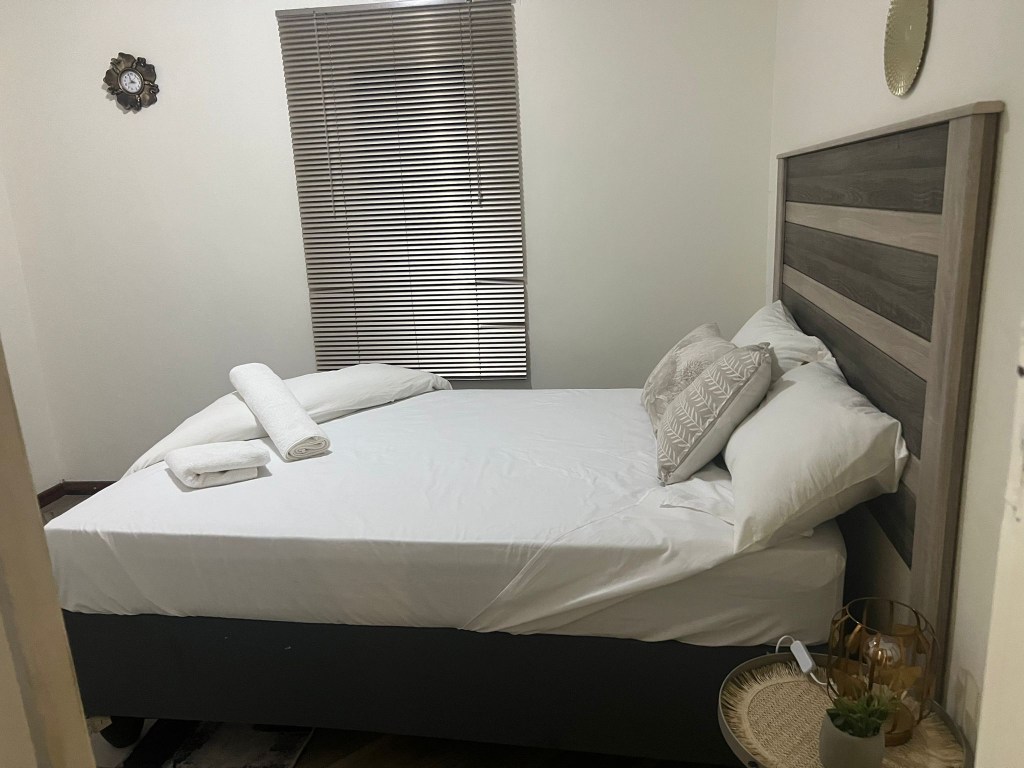
Apart from the last elephant we saw yesterday where the sandy off-road to the antenna meets the main road we don’t see many more of them. As we are approaching Maun, a 60’000 soul town that serves as the main touristic hub of Botswana it makes sense to see less wildlife. The traffic increases as we approach the town, and we actually cross ways with Fiona and Sandra as they were going grocery shopping to cook our lunch. They are friendly as the first time and we meet at the nice Airbnb they have found. We decide to stay there, as a real bed is very appealing and we have no doubt we will enjoy their company. This also make us save 15km to stay at the campsite of Venanzi and Erwin. We can take a taxi to meet Venanzi and Erwin tomorrow, since they want to start as early as 5 AM. Damn, this swiss men are tougher than concrete.
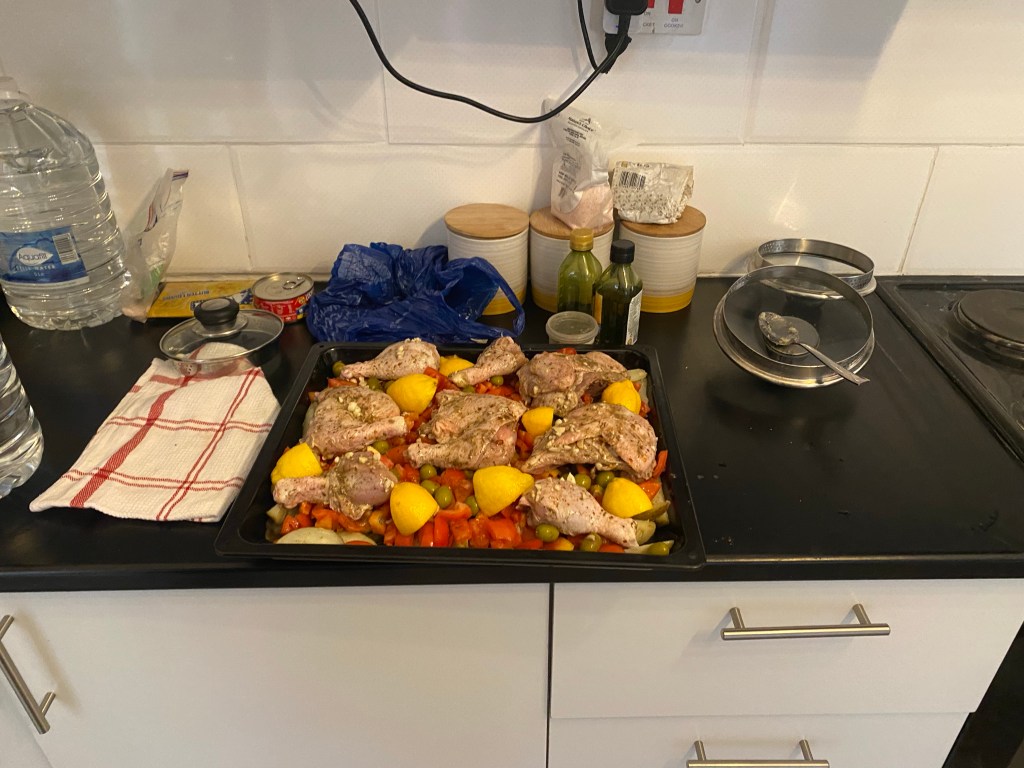
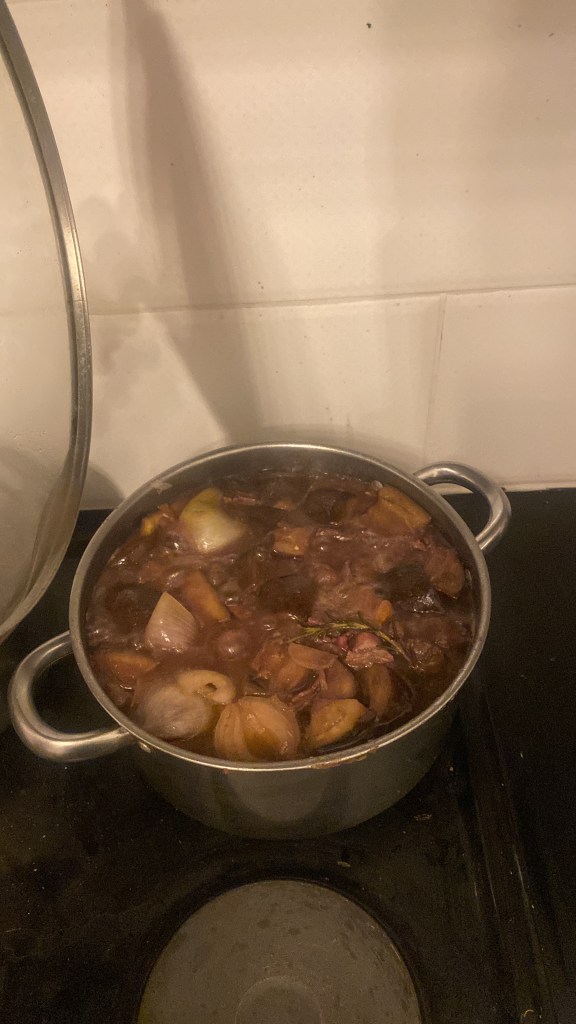
Our friends cook an amazing chicken in lemon sauce, which makes us like them even more. We enjoy the discussion, but when Sandra makes some jokes about our poor barbecue of Kazungula, Gaspard gets internally challenged and resolves to impress them with a beef bourguignon in the evening. So we go to do some shopping to the fancy Shoprite at downtown. We also find our final gas canister for the trip, ensuring gas supply.
Before dinner, Vicky, a Spanish girl that Fiona and Sandra have met in the Caprivi strip, pays us a visit. She is travelling solo in a particular way, since she is returning home every 3-4 weeks to visit her dog Lolo, which she can’t bring with her to avoid her suffering in the plane, as she is huge and would have to go in the luggage area. We enjoy a nice dinner and conversation, but we go to bed immediately after, since we have to wake up in less than 6 hours (3:45 am) to go for the Safari with our Swiss friends.
All in all, our first incursion in Botswana’s flat territoir has been far from boring, thanks to the unusual camping experiences, the tension and the beauty of its high nature density, and the wild, unforgettable view of the mighty endless pans. We are now looking forward to enjoy what the Okavango Delta has to offer us, before we tackle the final leg of the adventure, the one that connects Maun with Windhoek, crossing the infamous Kalahari desert, the oldest desert in the world.
Days in this post (total): 8, out of 64.
Cycled km in this post: 674 km, out of 3,894 km.
Positive elevation done in this post: 1,000m+, out of 32,900m+.
 Cycling Pirates
Kudos to you, reaching as far as Maun already. Looks like by now you know all Botswana elephants (those outside Okavango delta anyway) by name. Say “Hi” to them, as it looks like we will also be visiting them at the end of this year (Central Kalahari, Mkadigadi and Nxai Pan).
Wish you flat roads (not a big problem until Windhoek), and heavy tail winds (don’t realy know much about wind directions at those parts of Africa).
Thanks for the support, Jurij! We loved the Pans, their solitude was very unique, and we didn’t venture into the middle itself. I think end of the year is much better for wildlife, at the moment there is not much since tehy are very dry. The Kalahari must be a fantastic place to meet San people, the bushmen. We heard Tsolillo hills is a good place for that, but it was too far from our route.