

Song while writing: Hermanos Gutierrez – Dorado Valley
09/10 – Otjiwarango – Musterland Camp. 105km, 300m+
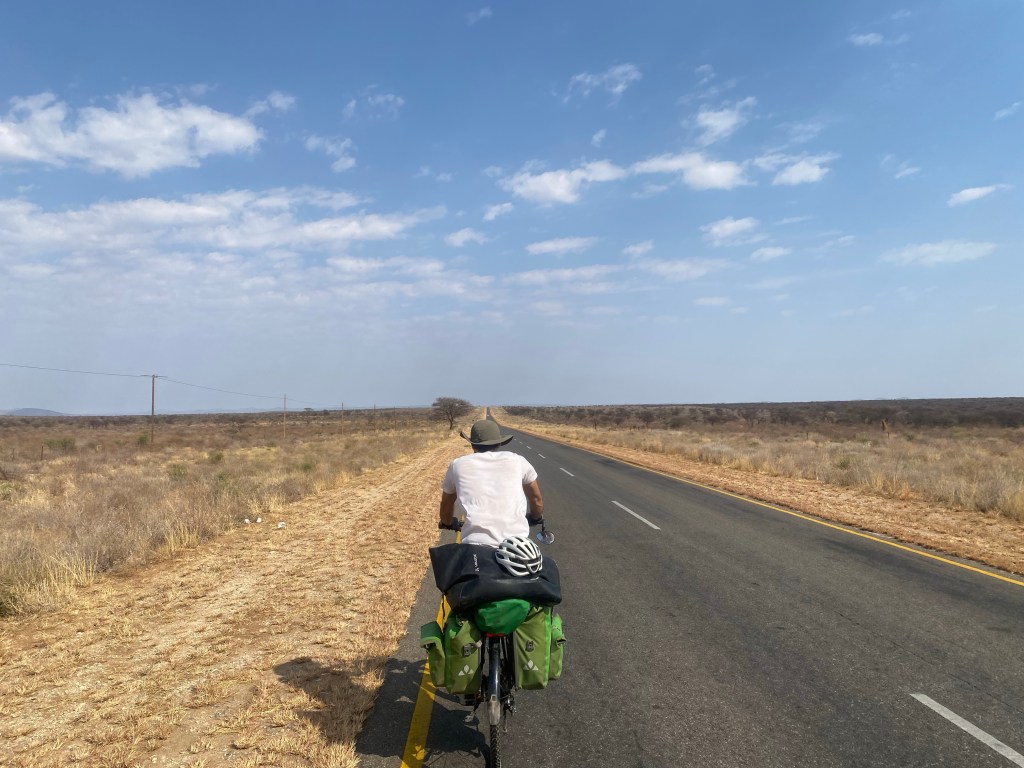
Today is meant to be an easy day, as all road is tarred until our expected destination, a camping 100 km away, and we count with back wind for the first 60 km of the journey. We leave Otjiwarango and its majority of Herero people, after having learned some words in their language, and get into Damarland, or the land of Damaras. We have also learned some words in Damara (we always learn the same: hello, thank you, friend, how are you?), but this language is special, as it also uses sounds sounds created with the tongue, not only with the mouth (the so-called click consonants). It‘s also the most widespread non-Bantu language in Southern Africa (Remember that the vast majority of languages in Central and Southern Africa belong to the Bantu family, which spreaded to the south of te continent in an undetermined time in the first millenia AC.)
In any case, we start cycling direction to Outjo, the biggest town close to the famous Etosha National Park, a place home to the “big five” where animal spotting is relatively easy in the dry season, due to the concentration of game in the few areas with water.
But our direction is to the west, where the Damara mountains wait for us. The road to Outjo remains surrounded by fenced farms (some of them even with security towers), with the exciting difference that we are getting closer to the mountain ranges of the horizon. Lots of tourist pickups pass by, either coming from or going to Etosha.

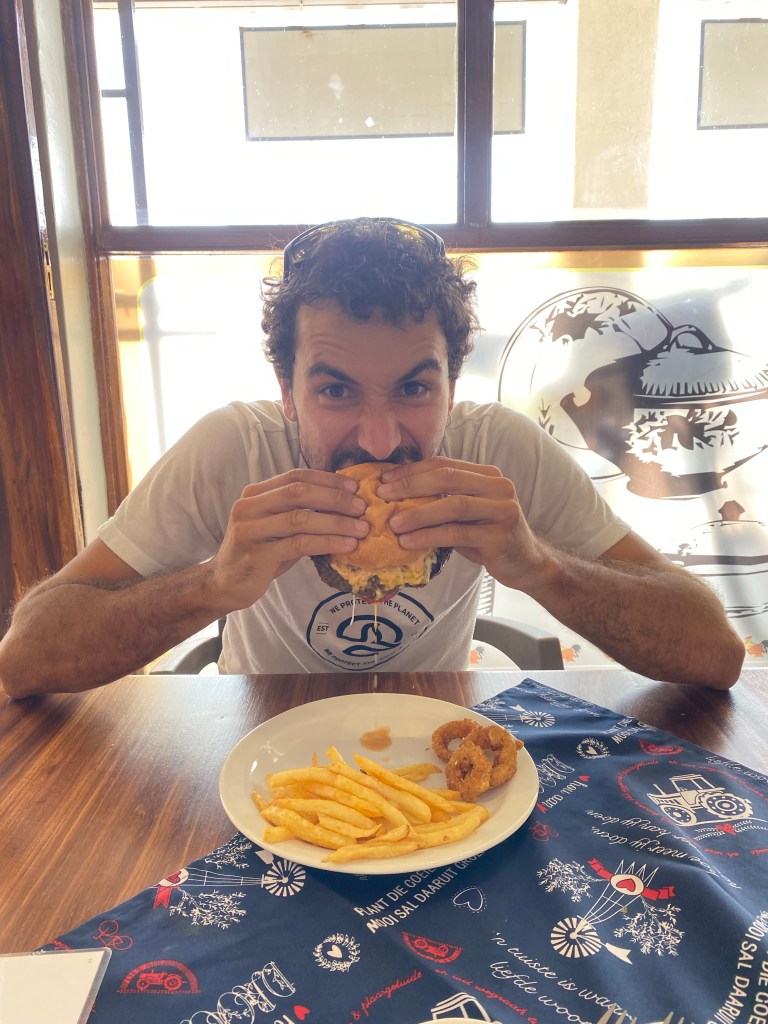
We arrive to Outjo, a mid size town where we stock up water and, under the difficulty to find a Damara/Herero/Himba food place, we end up in an Afrikaans restaurant, where unsurprisingly we end up ordering a burger. The colored working women are very friendly, and ask us please not to bush camp, due to the presence of desert elephants and desert lions. They remind us how hot it is (like if we didn’t feel it), but tell us that in 2 days it will get a bit cooler. Thank God.

We put direction to the town of Khorixas, the main town in the Damaraland, again in a tar road, until we make it to the exit to the Musterland camp. Next camp is 40 km away, and although we consider pushing the extra mile, we want to consider taking a parallel dirt road that passes through some famous rock formations for tomorrow. So Munsterland it is.
Munsterland is a small camping owned by an Afrikaaner family, who also live there. Daniel and Anne are extremely welcoming. They are retired and bought recently the farm from a German original from Munster, who went bankrupt, so that eventuallly their son could take over. But their son is busy making money in farms of the US, so for the moment they are leading the business. Working 2-3 seasons in the US would allow him to have a very good capital to start his own business in Namibia. Daniel and Anne are running it pretty damn well, for a very reasonable price. We barely arrived that they welcomed us with jars of ice cold water that we downed immediately. The taste of cold water after a day in the sun is so special.
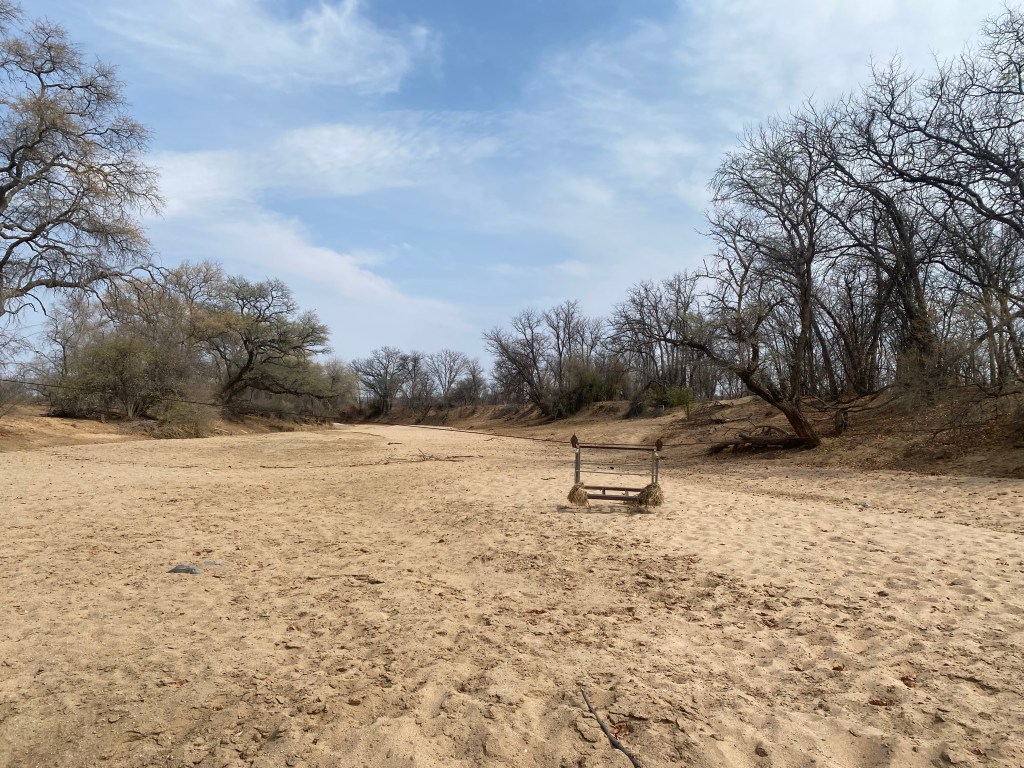
they have taken care of pretty much everything in the camping. and have even built a chapel so weddings can be hosted there. They have also designed a network of hiking trails, and the pool view with the Uhab riverbed in the horizon is just superb. This dry river is important for our journey, as we will be constantly following it, and exiting and entering its dry bed all the time. As we saw in many farms they installed many water pumping windmills for both their house and their animals. Unfortunately, one of them broke and, due to inflation, replacing it is too expensive (100 k Namibian / 5k €) so they are using a diesel generator. What a pity that initial investment cost for a renewable solution are so prohibitive.
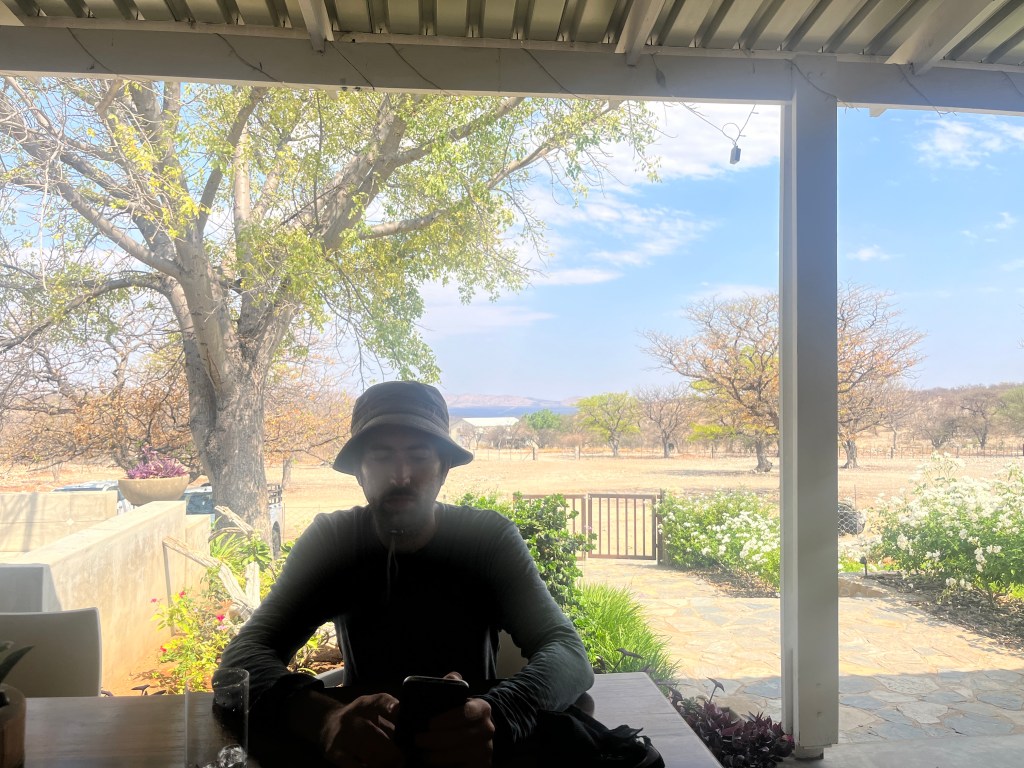

We spend some time by the pool planning the low level of the route: Vingerklip‘s rock formations, Brandberg mountain, or Brandberg West mine? All de-tours look superb, but we only have time for one. We end up deciding for the Vingerklip rock formations, and decide that we will do the Brandberg mountain with the car when the girls come. The Brandberg West mine will have to wait for next life, despite Freewheely‘s strong recommendation for it (our biking idole).
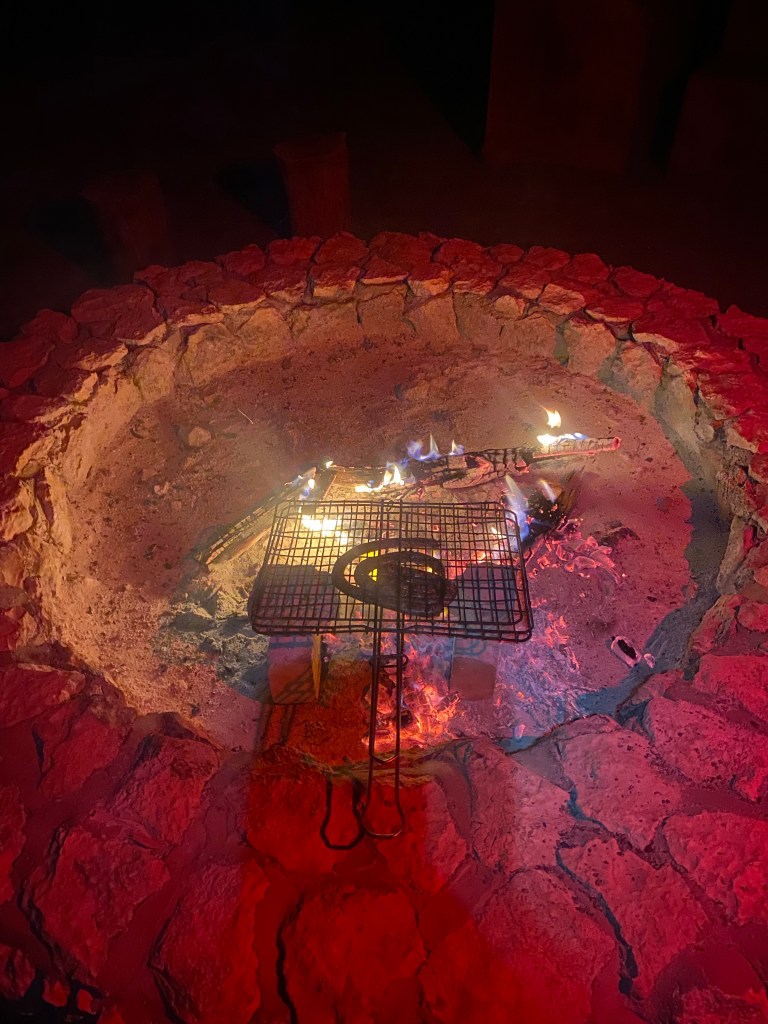
We braai some meat that Daniel and Anne sell to us. Interestingly enough, it‘s not from their farm but from the supermarket – Anne is apparently unable to eat the meat of their own animals (she may know deep inside that something is fundamentally wrong with meat consumption?). Anyways, What a luxury to have meat in the evening instead of the usual canned food and rice! And We have a plan for tomorrow, and the shrinking moon phase offers us a majestic star view.
10/10 – Musterland Farm -Vingerklip. 72km, 300m+
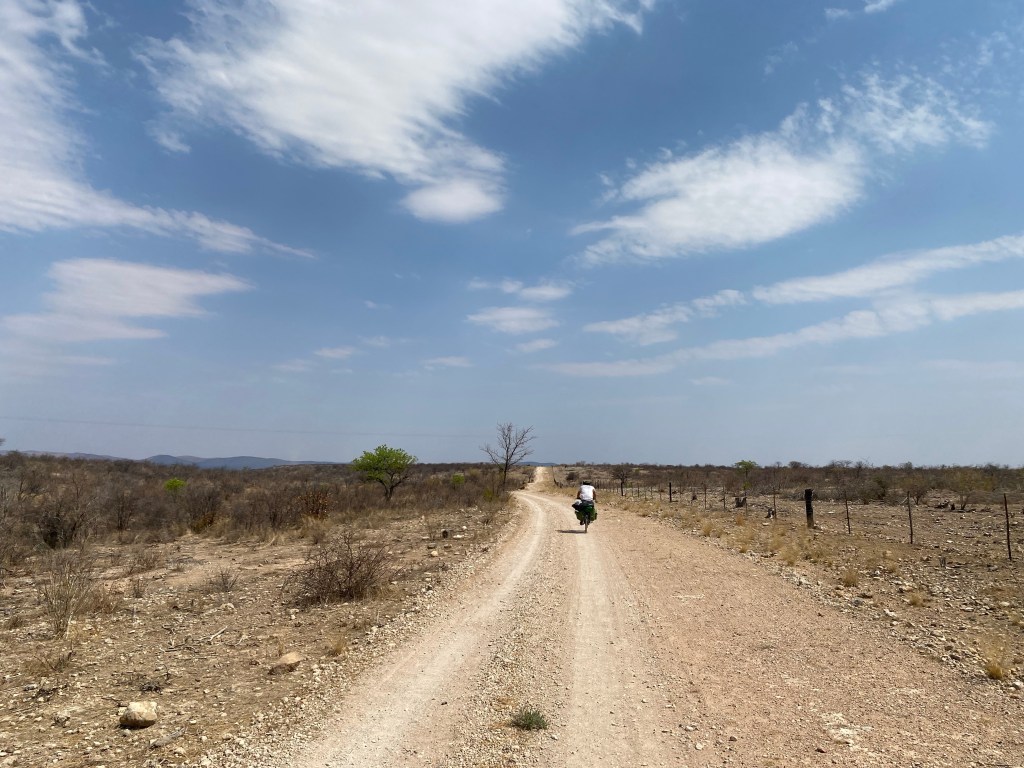
Finally on a dirt road! We can actually join the dirt road directly from the Musterland Farm. Now that finally the landscape offers us hills, we spend some time taking some GoPro videos from far away, as we think we have time to spare (only 70km to do). If we only knew what‘s awaiting, that was no rest day…
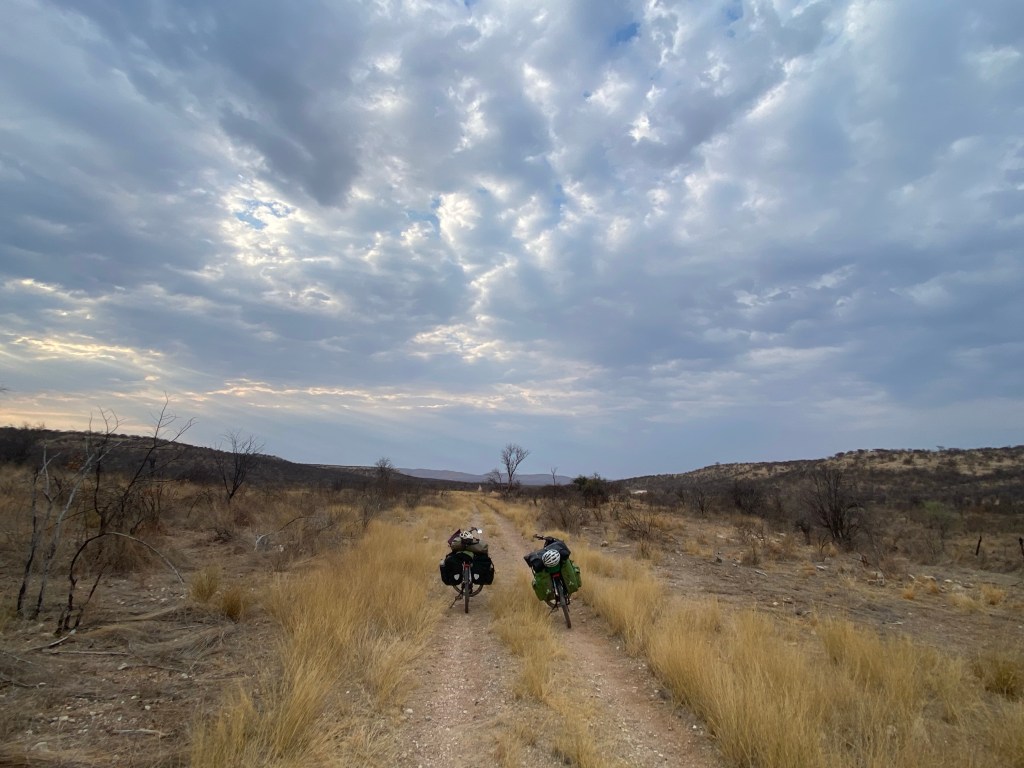
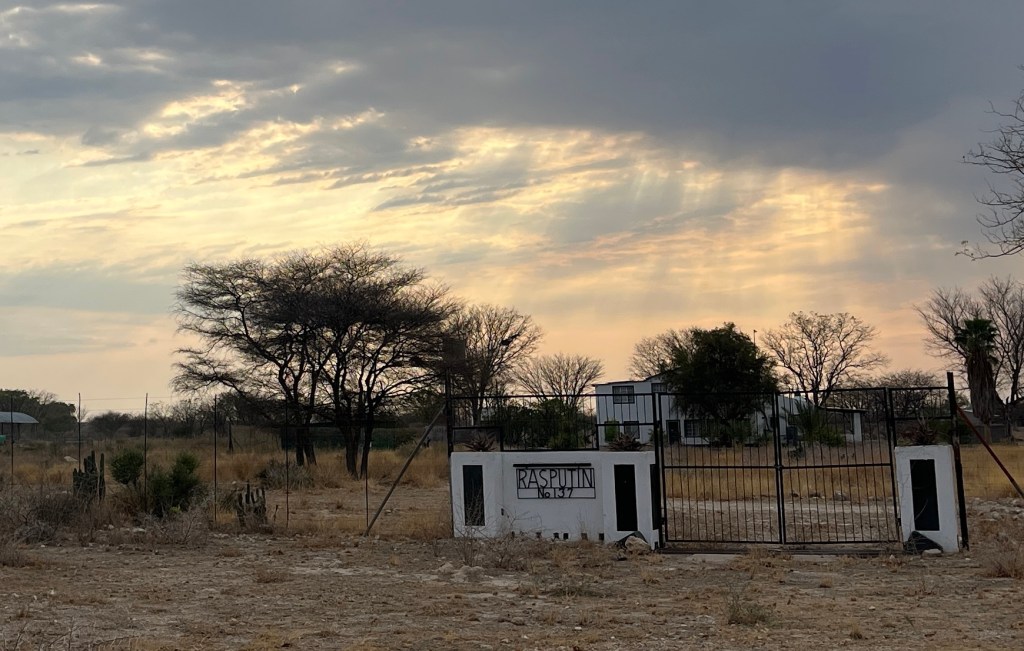
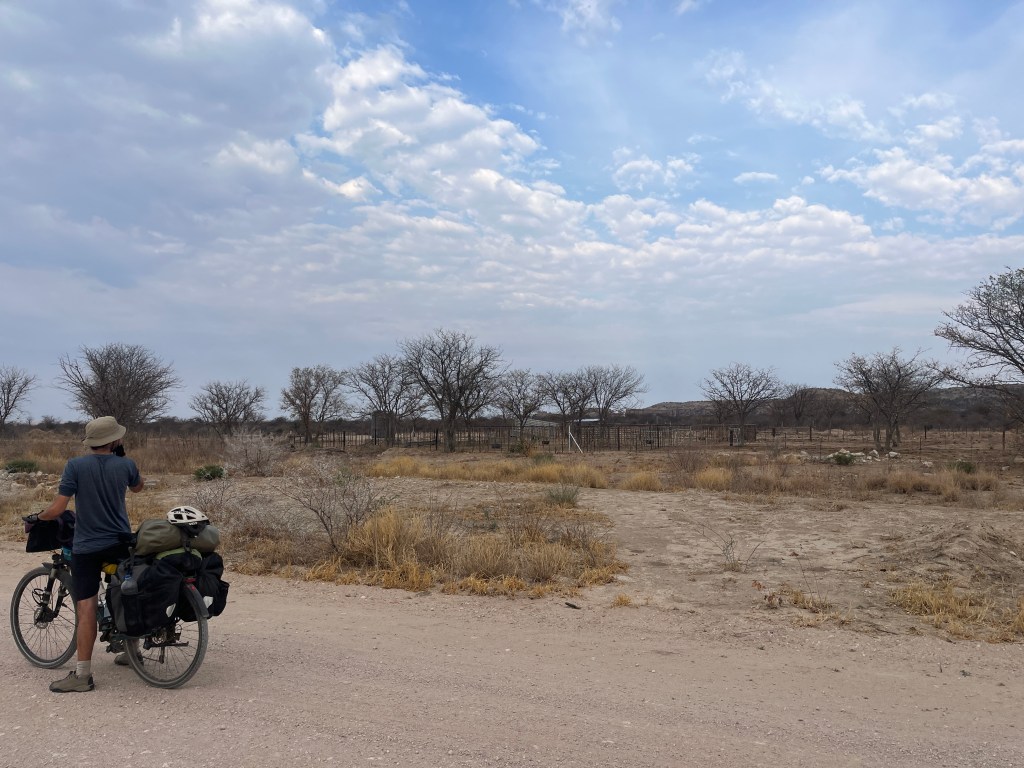
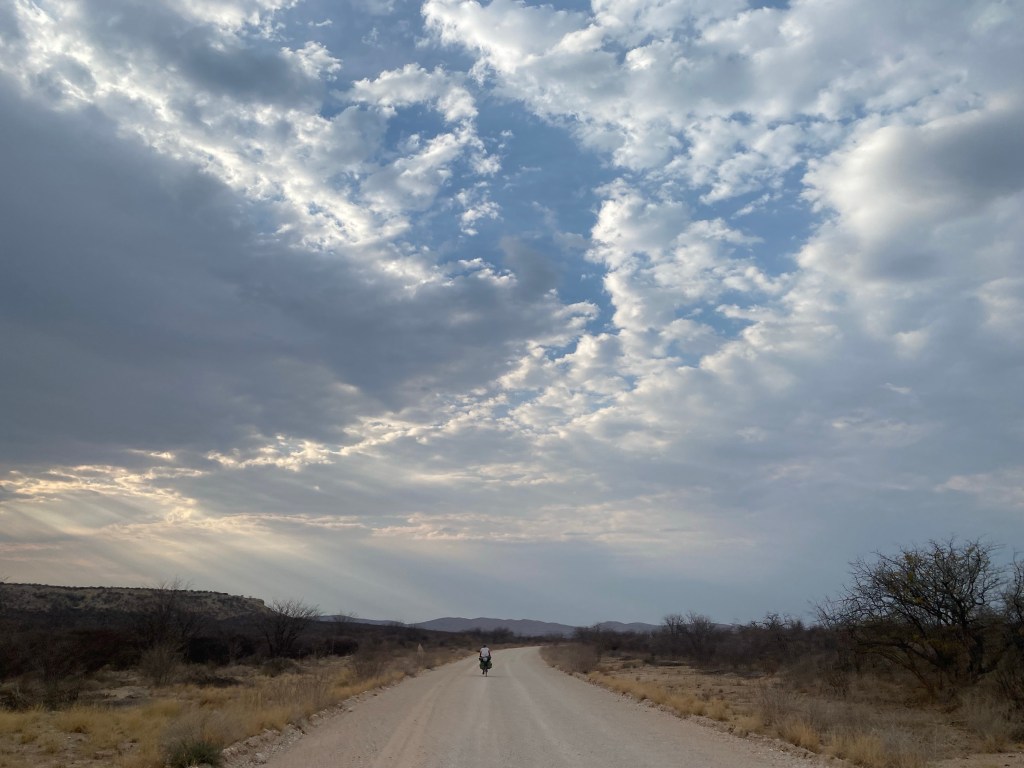
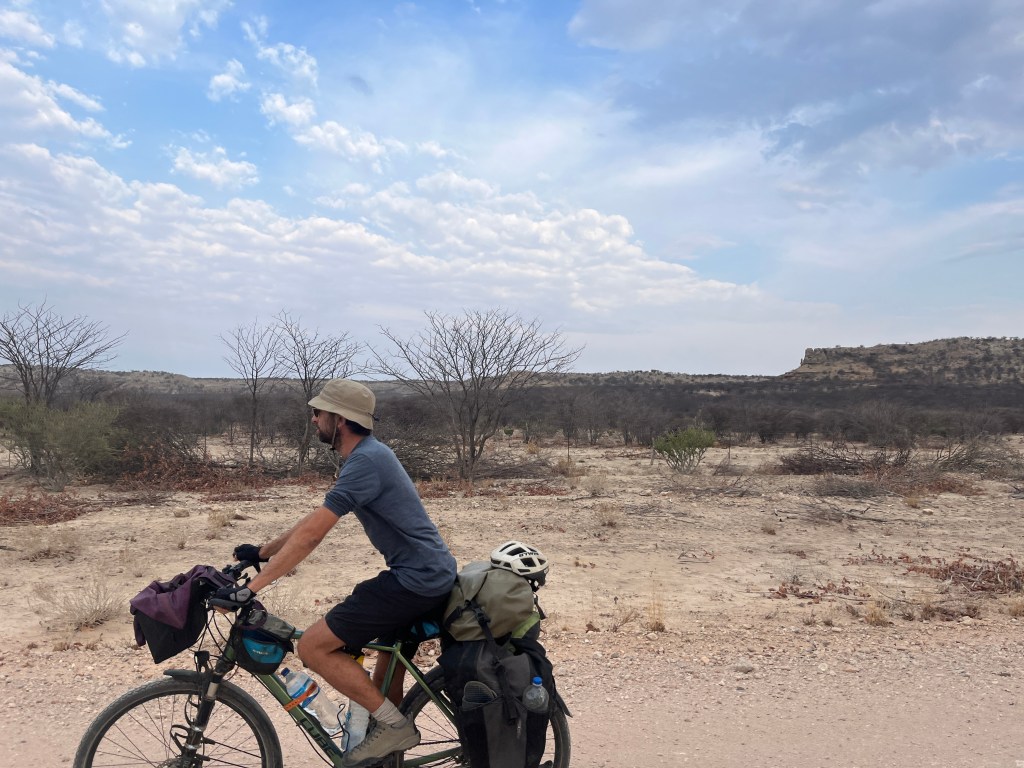
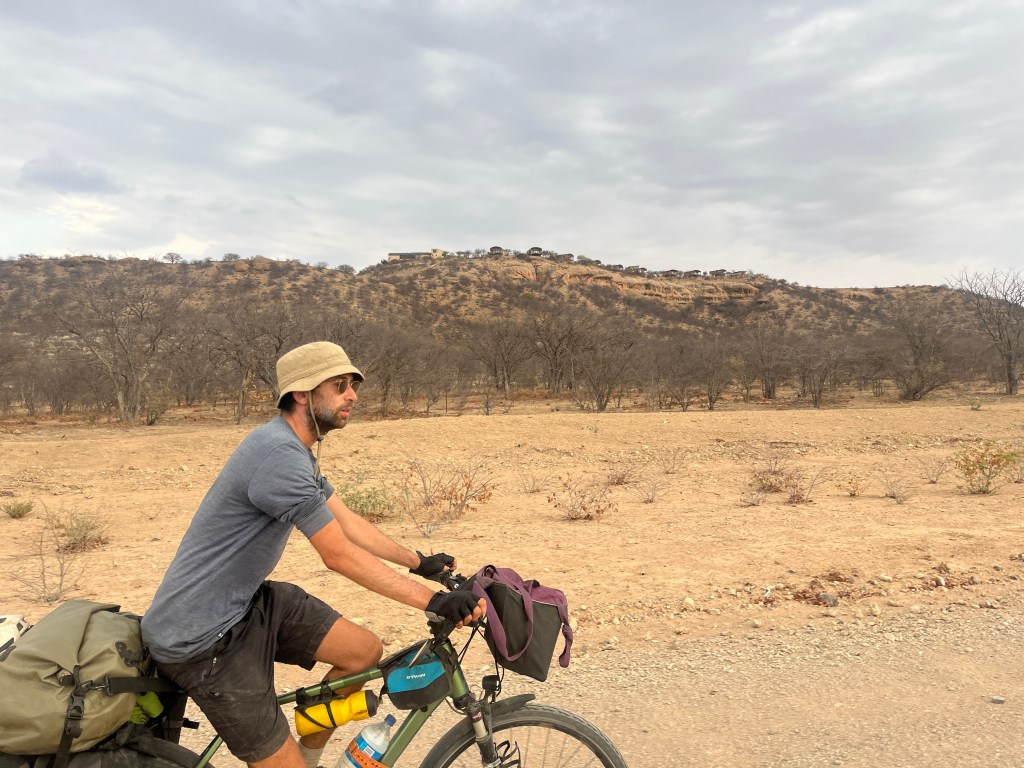
We leave under a refreshing covered sky which feel much nicer to ride under. Unfortunately it doesn’t take long for the rays of sunshine to pierce through the clouds in a beautiful manner, however leaving us soon (again) under the merciless sun. The dirt road is actually quite OK, one can see it experiences little traffic and that not so much sand deposits on it, what makes it need little maintenance. Despite that, the majority of the land is still fenced. But we start seeing very particular rock canyons that over-excite us. We leave the road to see them from closer. Erosion has shaped perfectly round towers on them, and we love every single bite of it. We ride 2 km towards the canyon, push the bikes up steep roads until we find a spot to make a nice go pro video.
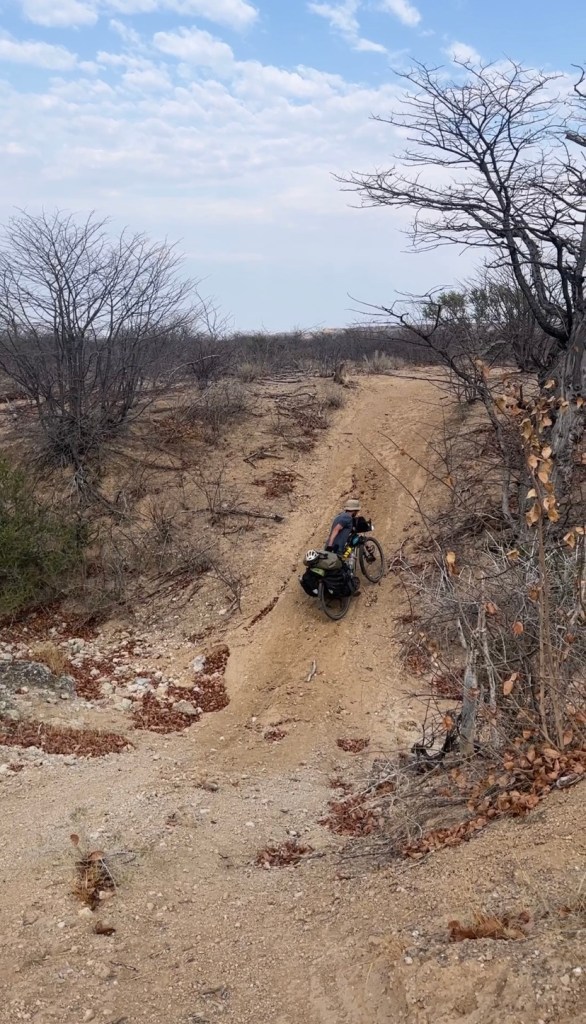
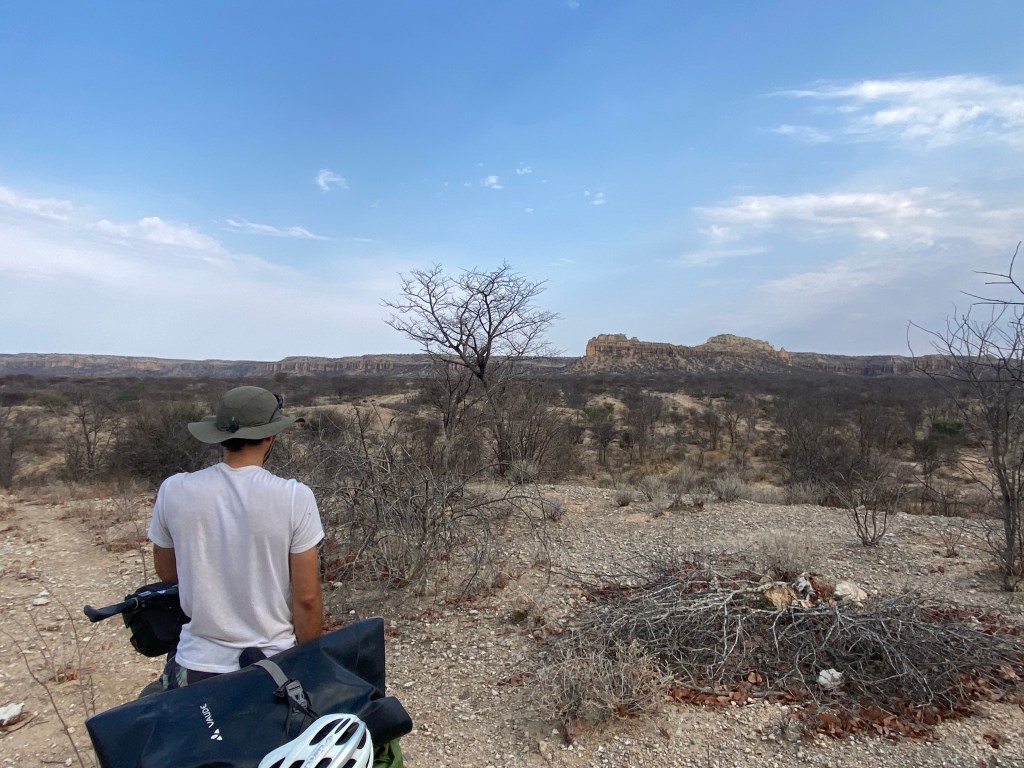

Ah, offroads are beautiful, aren‘t they?…. Time for issues. Javi has a flat. Initially we laugh, almost like saying, „it was about time, but hey, what is there easier than that?“. It may be a bit of Karma, since Javi had been recently bragging that he was close to complete 10‘000 km in Africa without a single flat, taking the opportunity to altruistically promote the Schwalbe Marathon Mondial Evo tyres.
In any case, there is no shade around and it‘s 11:30 AM, so we better hurry up. We find one metal and one sharp wooden piece in the tire (double puncture), remove them, change the punctured tube for a brand new tube, and start pumping. Something is wrong, the tube doesn‘t really inflate, and our shitty small pump works very poorly. Bingo, we punctured the new tube when inserting it, because it‘s too big for the tyre side. Decathlon was over ambitious with the suggested tyre range. Cheap ends up being expensive, lesson learned. Third time removing the tire by now…


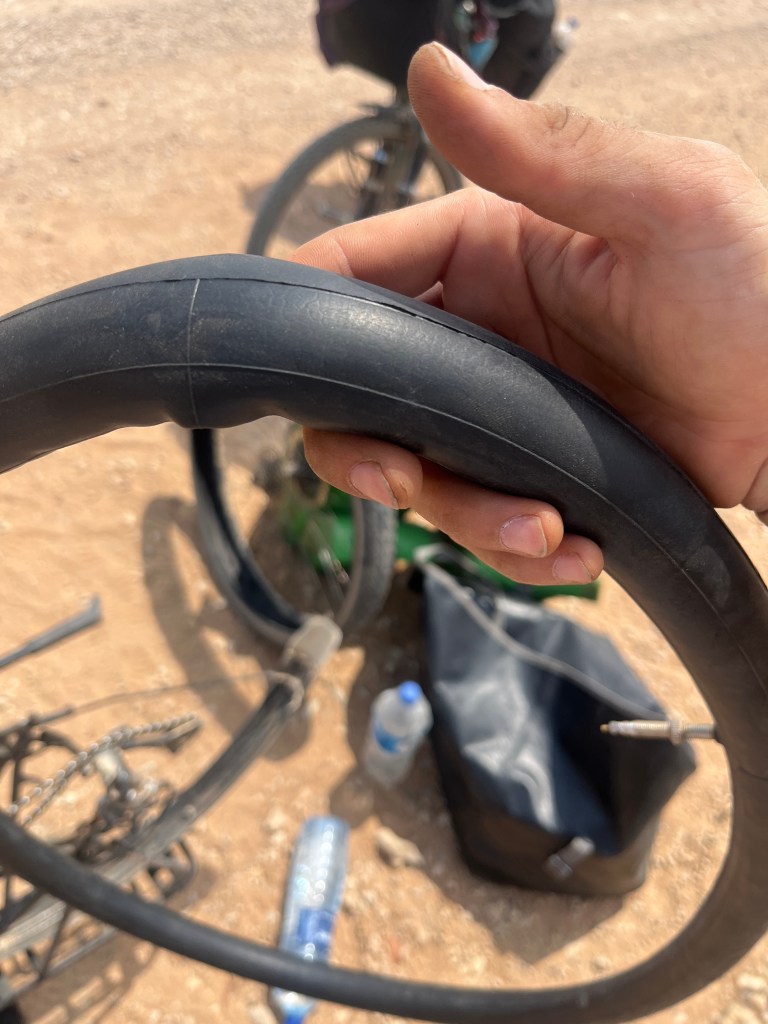
We take one of the brand new tyres, put it again, and start relentlessly pumping to realize that this tube was puncture from before. We don‘t know how we managed to bring a punctured tube on the expedition, but, the fact is that it happened.
So by now we have an assortment of 4 punctured tubes, all with different issues. We are dehydrating under the sun, and we have no place (nor water or bucket) where to check precisely for small leaks. So we patch one as well as we can, and spend good 10 minutes pumping it to the maximum of our strengths. The pump is really bad, and we are running low on patience, particularly when we see that the tube doesn‘t fully inflate, there must be a very small leak that prevents full inflation but allows for half.
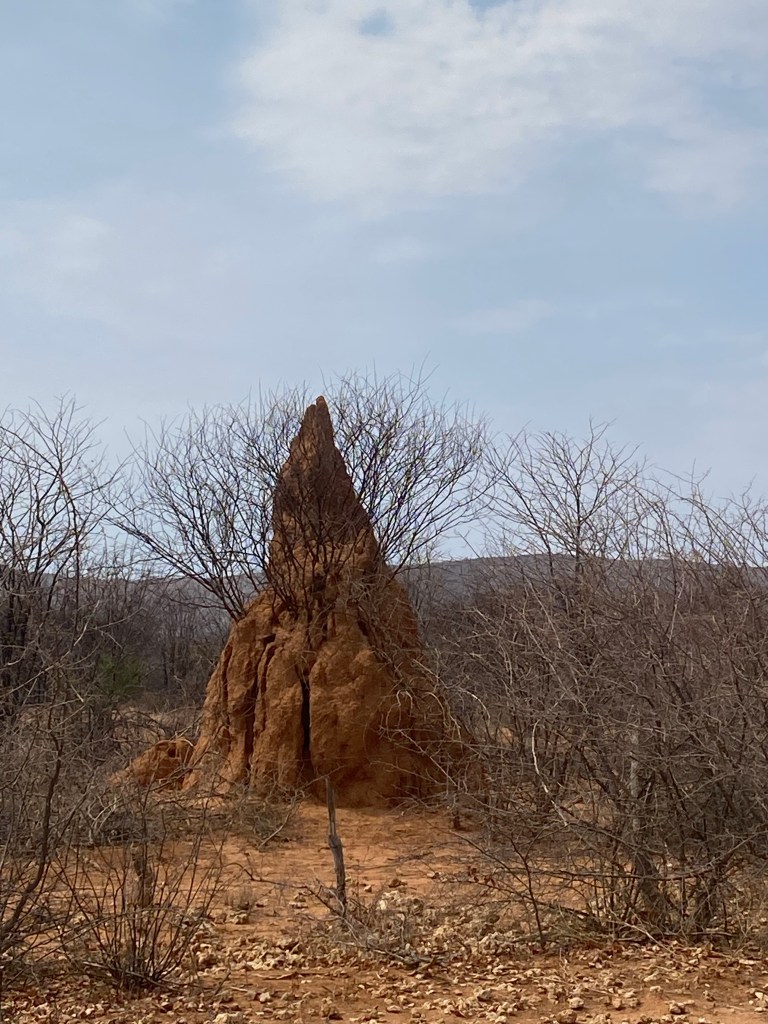
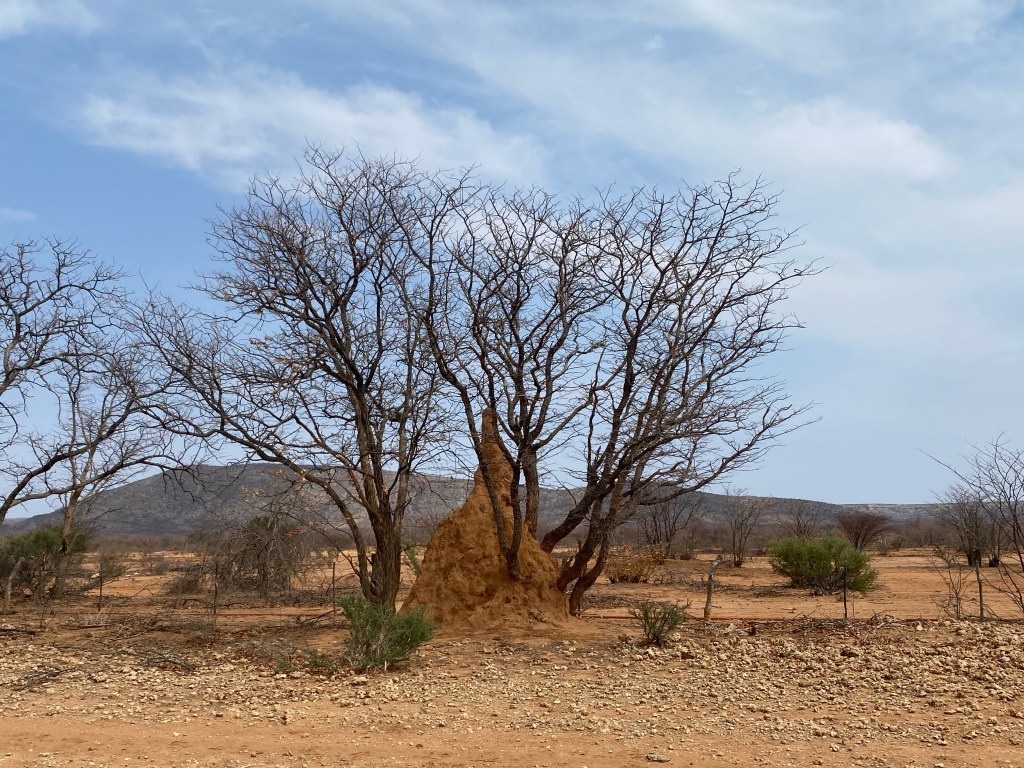
We are fed up, and just want to get going, so we give a try with the half inflated, fully loaded, back wheel, and since it works, we push it very delicatedly. Luckily, the landscape is beautiful enough to reduce the impulse to start burning all tubes in a bunfire, and it manages to distract Javi. Psicodelic towers and table mountains pop up like mushrooms, and sudden changes in the geology of hills and towers await at every corner. We feel like some cowboys on our horses through Arizona.

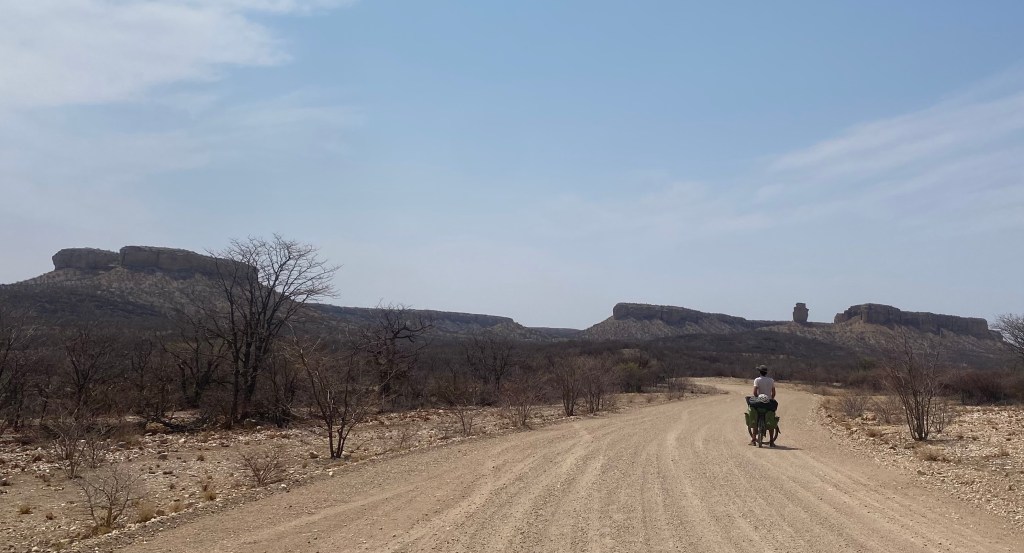

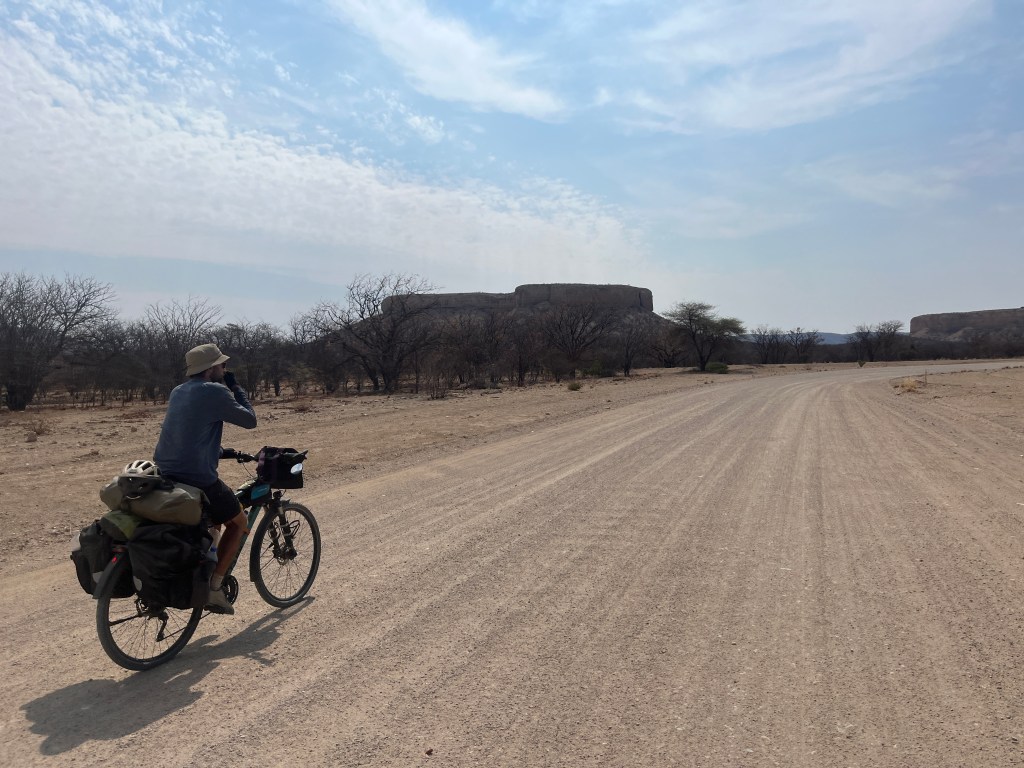
Exhausted, thirsty, we arrive to the Vingerklip, a standing-alone 10 m tall, 5 m radius cylinder, and head to the only lodge around, where we hope to be allowed to camp and enjoy a view from the rocky hill above it. But there is no camping premises, and the merciless manager doesn‘t pay attention to the explanations of our issues. „No camping is no camping, sorry, I must be strict“. To be honest we knew that there wasn’t any camping but were hoping to sleep far away from the lodge but within its premises. The luxurious lodge has converted the nearby plateau into a restaurant with a breathtaking 360 view on the surroundings. Or at least this is how we imagined it. It is 5pm and we must start looking for a camping spot and don’t have time to do the climb to the plateau. At least, her husband lets us use the compressor to pump up the tyre to the maximum, since our hand pump is unable. We leave to at least check the Vingerklip, a large circle with a diameter of 44m standing still 35 m above the ground. Its a testimony of of the erosion of the mountains in the area. After 5 minutes we leave it behind us to look for a camping spot only to realize that now the tube is fully deflated. The extra pumping must have opened up the hole, we can‘t identify without stopping again. It‘s 5:30 PM and we are done with the day. We jump the fence of one of the farms and get some meters into camp in the bush, hoping that all this fenced terrain is leopard and lion free.
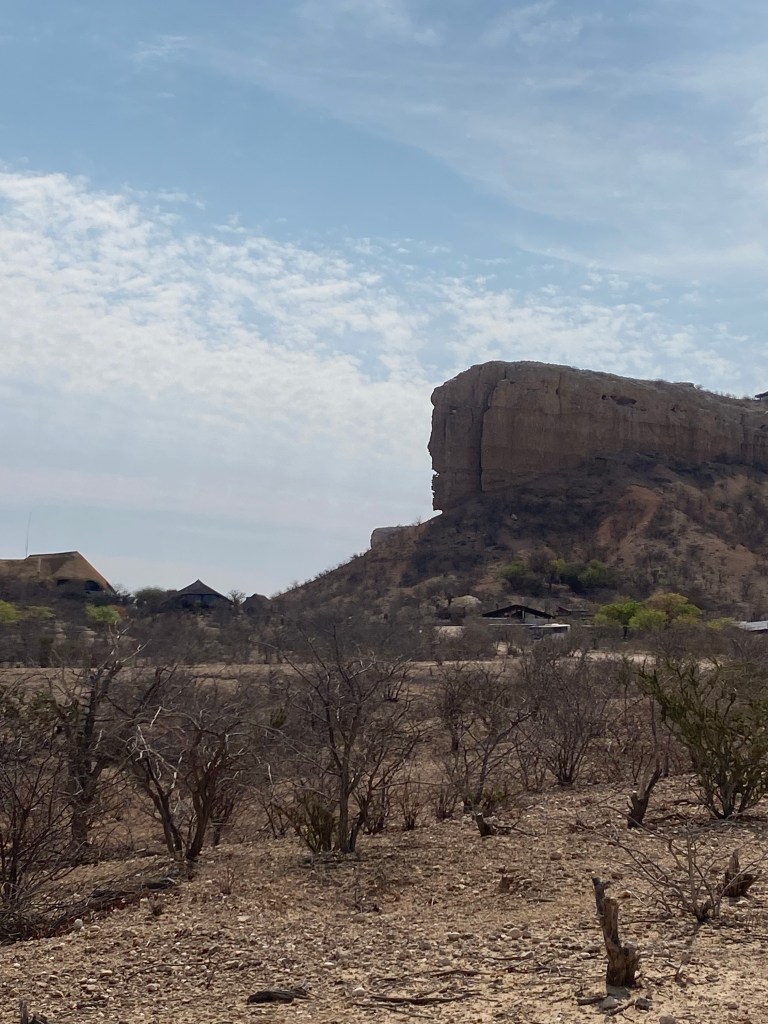
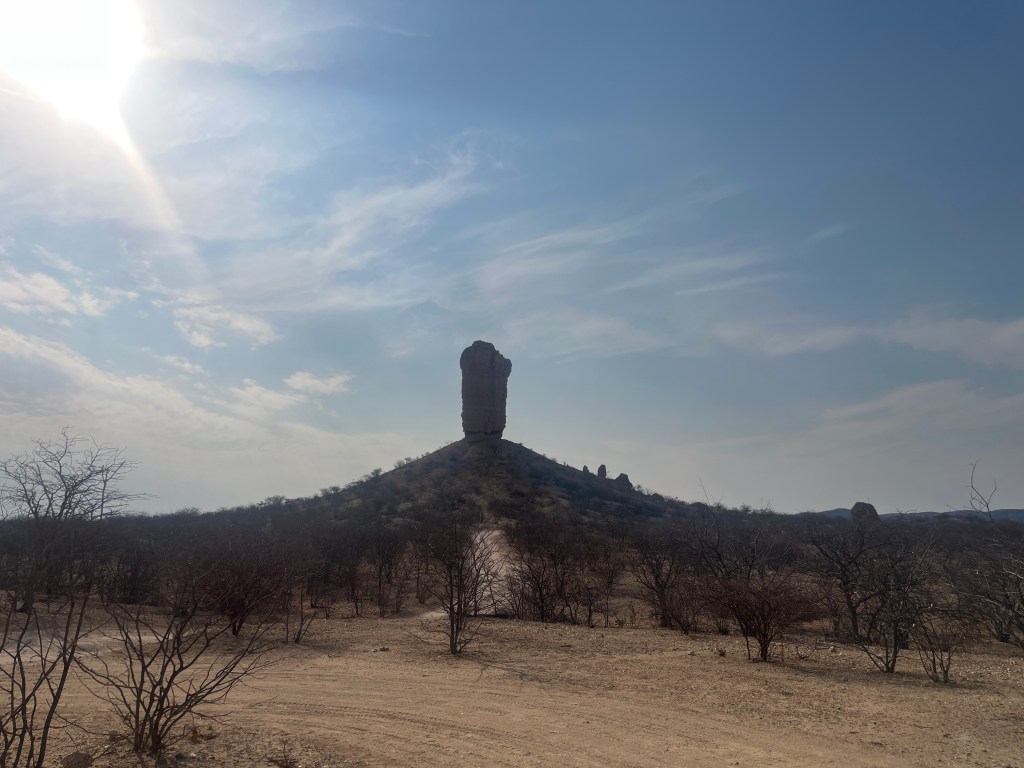
We see dozens of monkeys observing us on the distance, and we spend a good 20 minutes clearing the ground of spiky grasses that can puncture our inflatable mats. We can’t afford more punctures (specially during the night while wild camping). We are pretty done, but the homework is not over, we have now to fix finally the tube.
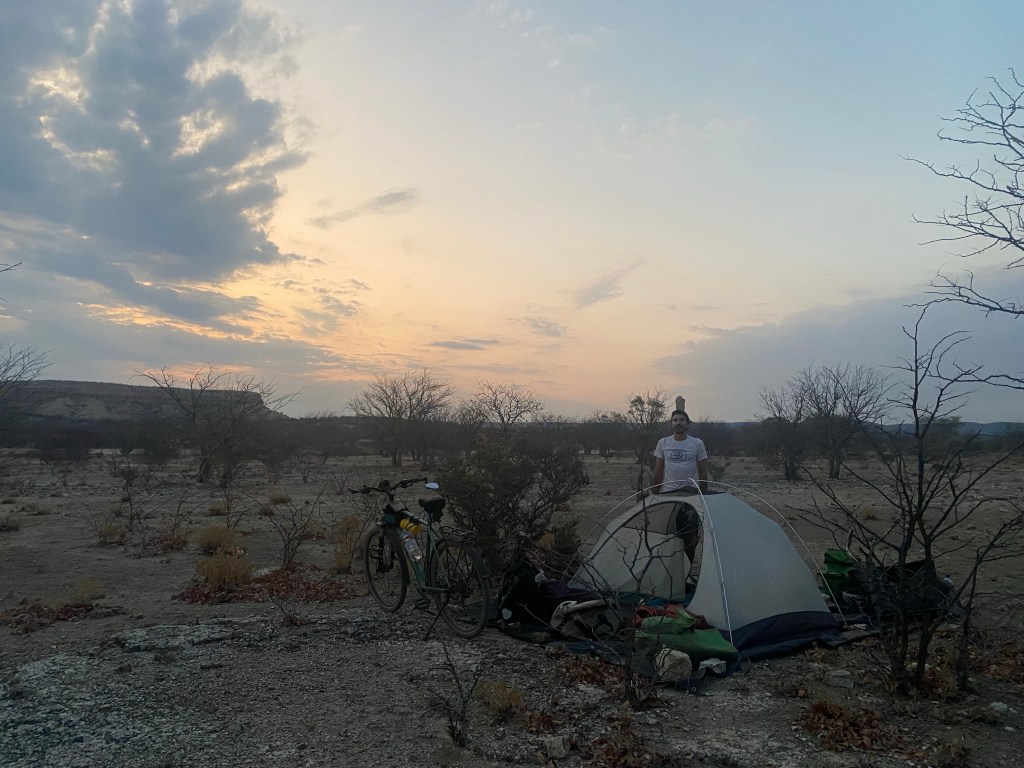
While Gaspard cooks, Javi decides for his previous tube, and passes it through a small cup of water, finding the two microscopic leaks caused by the two metal and wooden intruders. By logic, patching these should end up the situation. So he does so, and gives his last energy pumping the wheel until he can‘t more. He leaves it one hour, and it‘s still at the same pressure. God, finally. The prize for the effort is slowing down surrounded by sandstone towers that burst on fire with the colors of the sunset. As usual we leave all the food in the dry bag far away from the tent. We farewell with a brief „Bone nuite, mec“ hoping the monkeys don‘t steal anything from us.
11/10 – Vingerklip – Petrified Forest. 118 km, 500m+
Time to wake up. Like a psycopath, Javi‘s first thing is to check his tyre. It‘s again freaking half deflated. We can‘t believe it, we can‘t understand. We passed it twice through water, and checked it one hour after. The leak must be incredibly small. Still, the tire is pumped enough to be able to cycle. We were planning to do 62 km off-road to reach the town of Khorixas. However this leak forces us to rejoin the tar road again, 20 km away, as we are low in water, with a punctured tire, and cannot afford to get stuck on a road without traffic. The goal is to reach a gas station in Khorixas to ease the process of fixing the tires using a compressor and a water bucket to find those annoying leaks. We are 70 km aways from the Town of Khorixas, and with a lot of will power and inspiration by the still majestic landscape, we make it to town, not before repumping the tire again half-way.

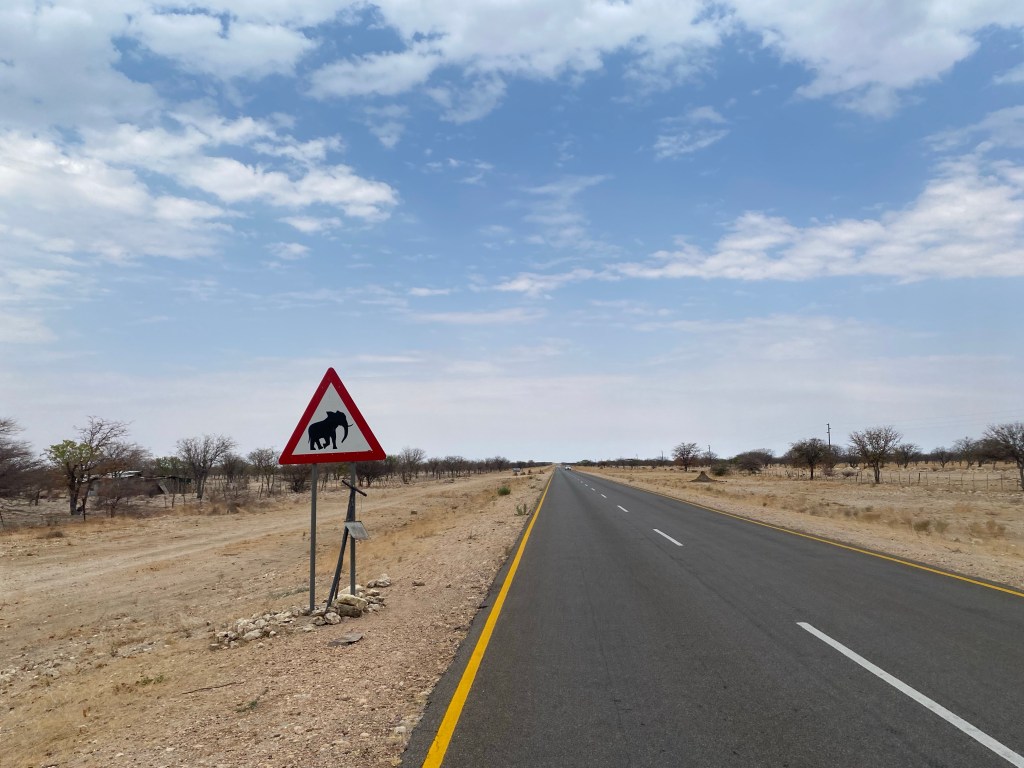
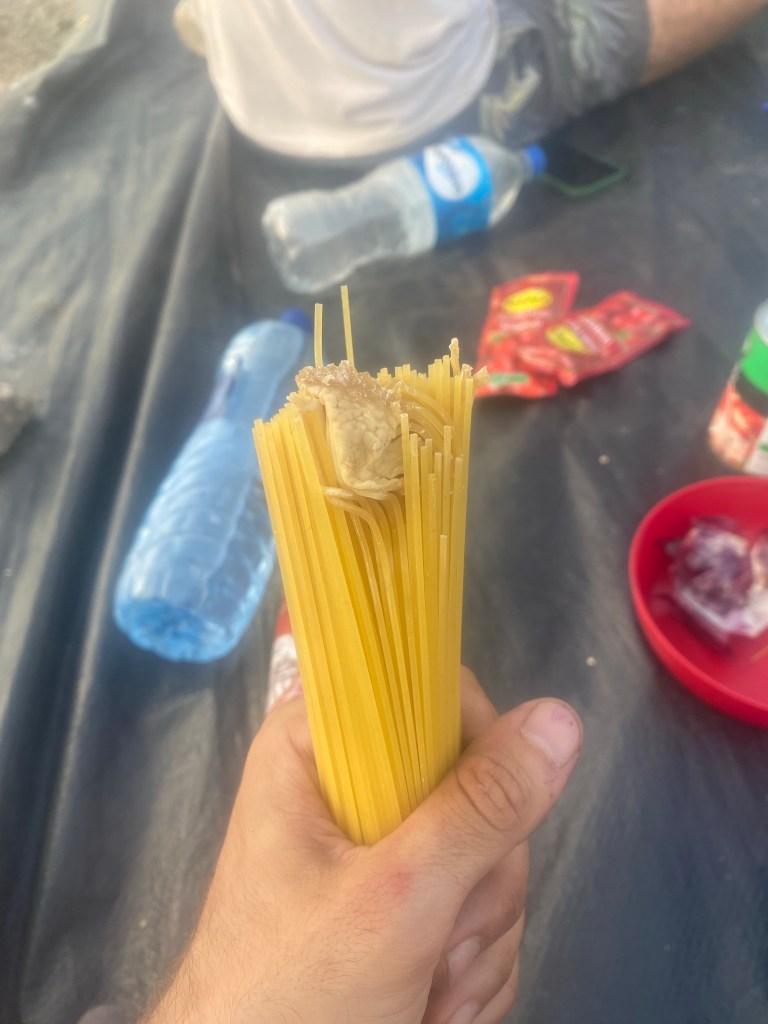
Destroyed by the effort, we first visit the Choppies supermarket, where we get the biggest meat and pasta portion of the take-away, plus a liter of coke for both. As usual at the entrance of supermarkets, beggers ask us for money, or try to sell us overpriced crafts. The artists are trying a new technic on us: asking for our names and already engraving it in some piece of arts to justify that now we should buy it. No thanks, this time we are short in patience, and luckily, the security guys order them to leave, unfotunately with bad manners. They call the gas station nearby to ask if they have a compressor and to inform them that we are going with the tire issue. They even give us the name of a guy working there that you help us. Great guys.
We arrive and one of the crew members is already waiting for us. Luckily, he is a cyclist himself and, although we know what to do, he is so enthusiastic and ready to help that we let him do. We pass through water the tube and find the freaking leak in the valve. It‘s ridiculously small, even smaller with the lid closed, what explains that the deflation is only noticeable after multiple hours.
We all agree that the best option is to replace it with the old tube of Gaspard, who has very visible punctures. But, just to be safe, we patch and check in water the other 2 tubes. The 4th one, we give it to the guy that helped us, together with a coke and a generous tip for his enthusiasm and professionalism.
We are delayed in our schedule, so time to continue. We are heading towards the Twyfelfontein area, home of many natural and historic wonders. We are hopping to reach Haisra tented camp, 55km away. And now, the tar is officially over: the main road is also a dirt one.

As we have experienced these days, afternoon wind is coming from the West, what means that is face facing for us, making the last 50 km very difficult and slow. The road is also quite ridden, what makes it often sandy and annoying. To make things more exciting, Javi‘s mud-guard collapses due to all vibrations and we have to remove the back wheel once again to re-fit the screws. We can‘t stress enough how often shit happens at the end of the day or of the journey. We eat some kudu jerkies, handful of peanuts and many Oreos before going again, in an attempt to get as much energy as possible.
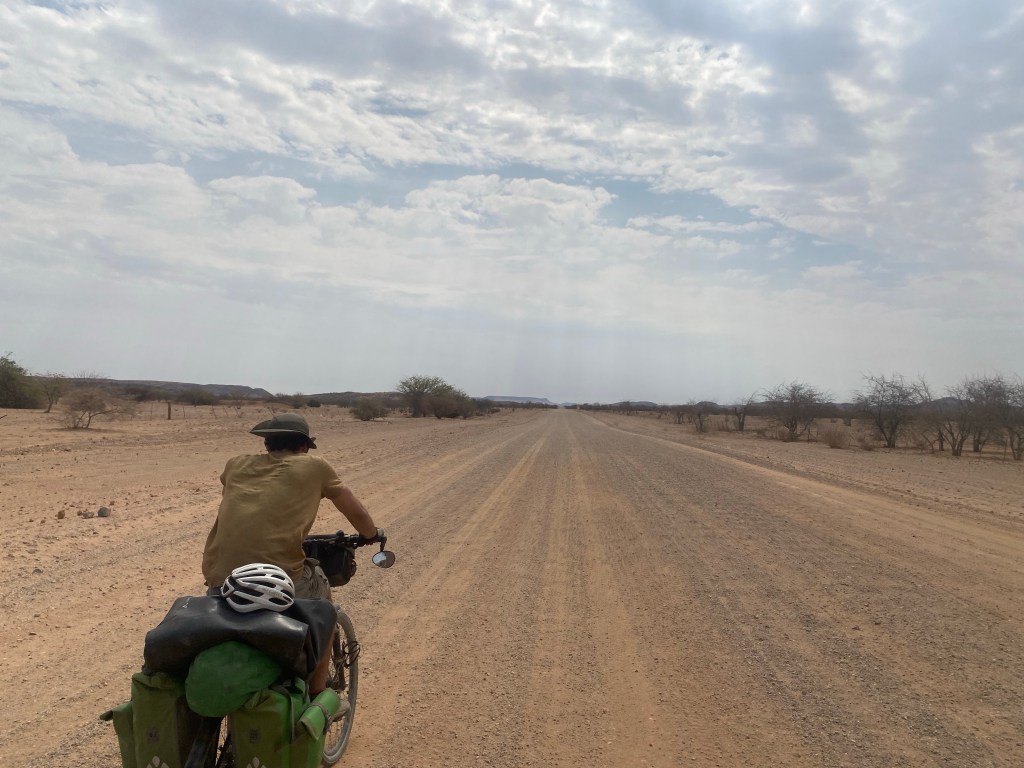

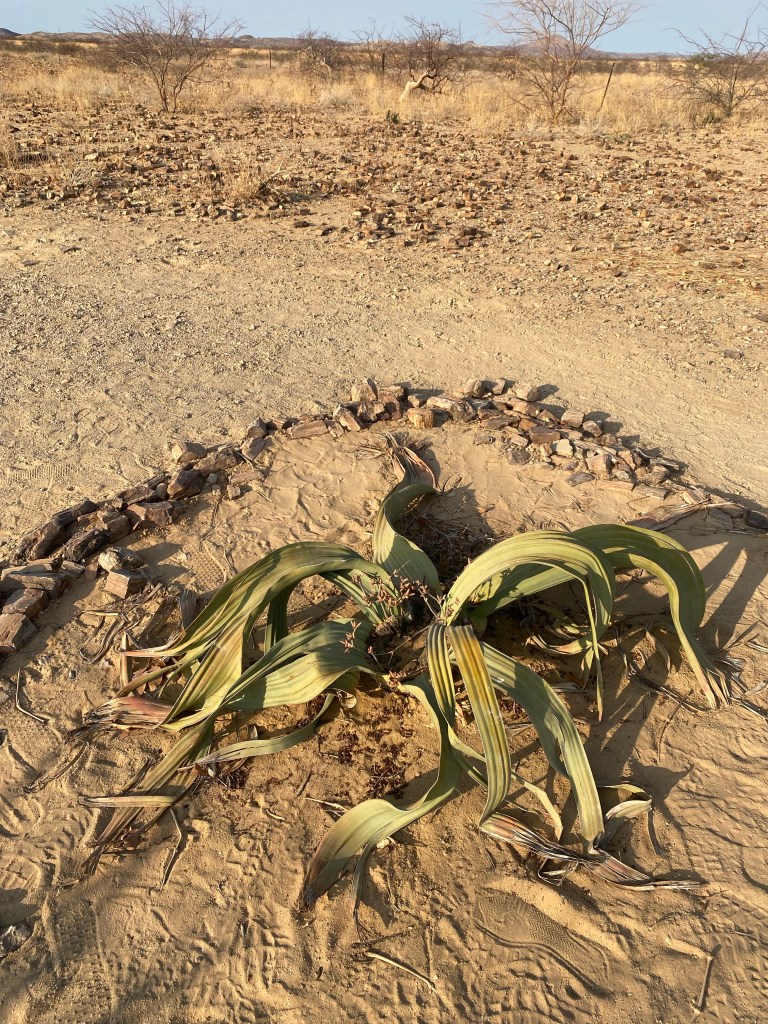
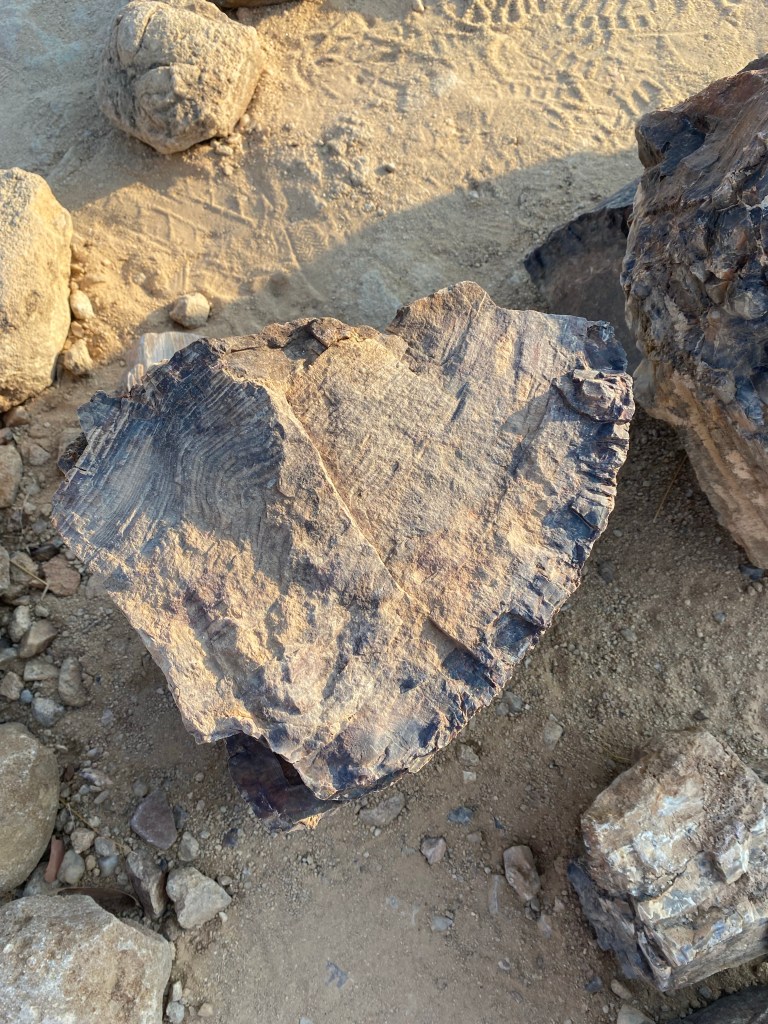
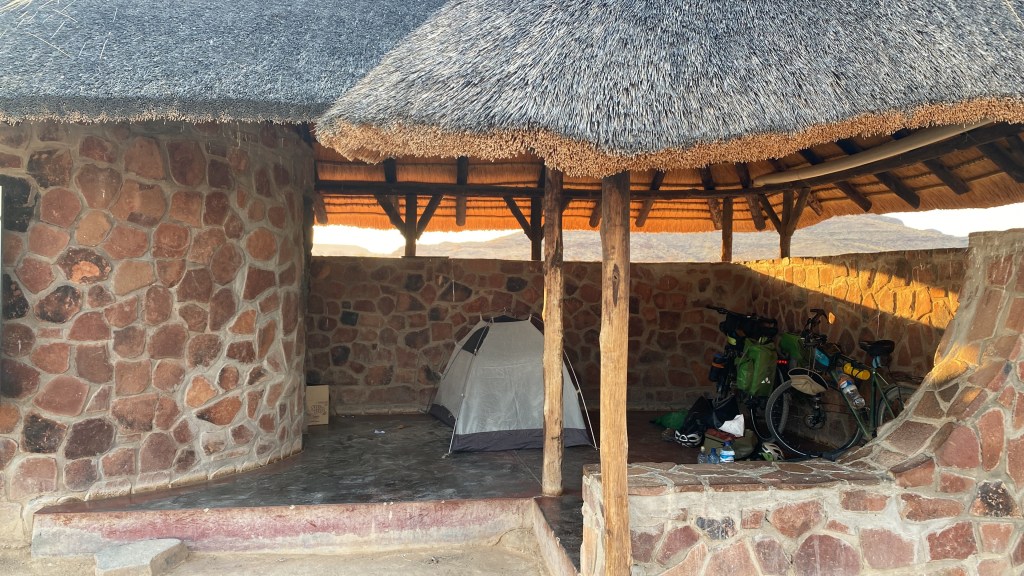
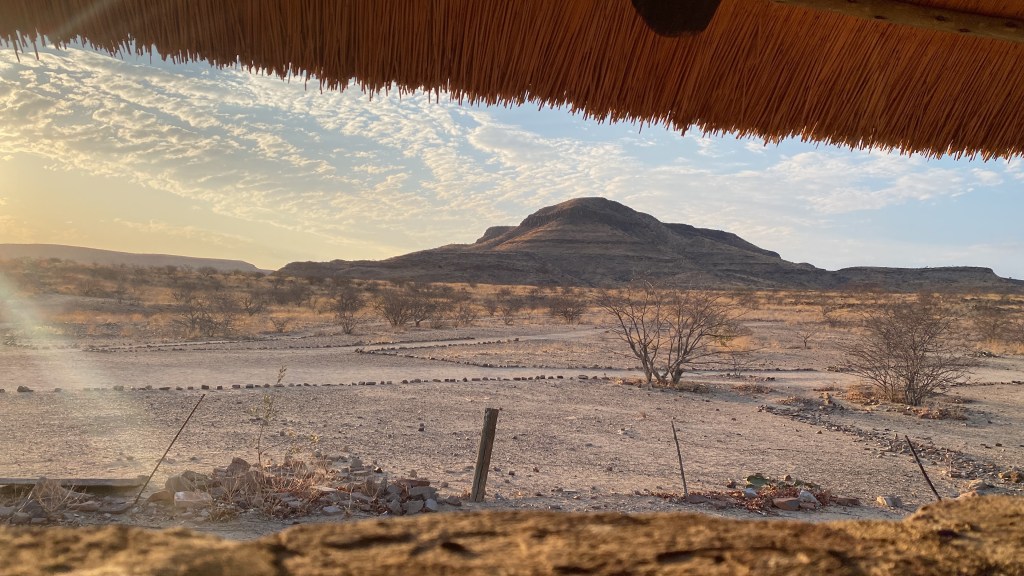
It‘s again 5 PM and we are pretty exhausted. We realize we won‘t make it to the next camp, still 10 km away (our average speed must be now 12 km / hour), so we ask for camping at the Petrified Forest National Site. The site manager lets us camp and, despite the ticket office being closed, he takes us on a tour to the site, where 250 Million year old tree fossils can be seen. Additionally, the area is rich in Welwitschias, a very particular plant with just two leaves, growing 1 cm per year. They can be as old as 2000 years, and they roots make it 4 meters deep. It is the national plant of Namibia. We have three in front of us: two males and one female. This is probably the only plant I know with separated sex. The male cones are salmon coloured, covered with pollens, whereas the female cones have a blue-green colour. female only
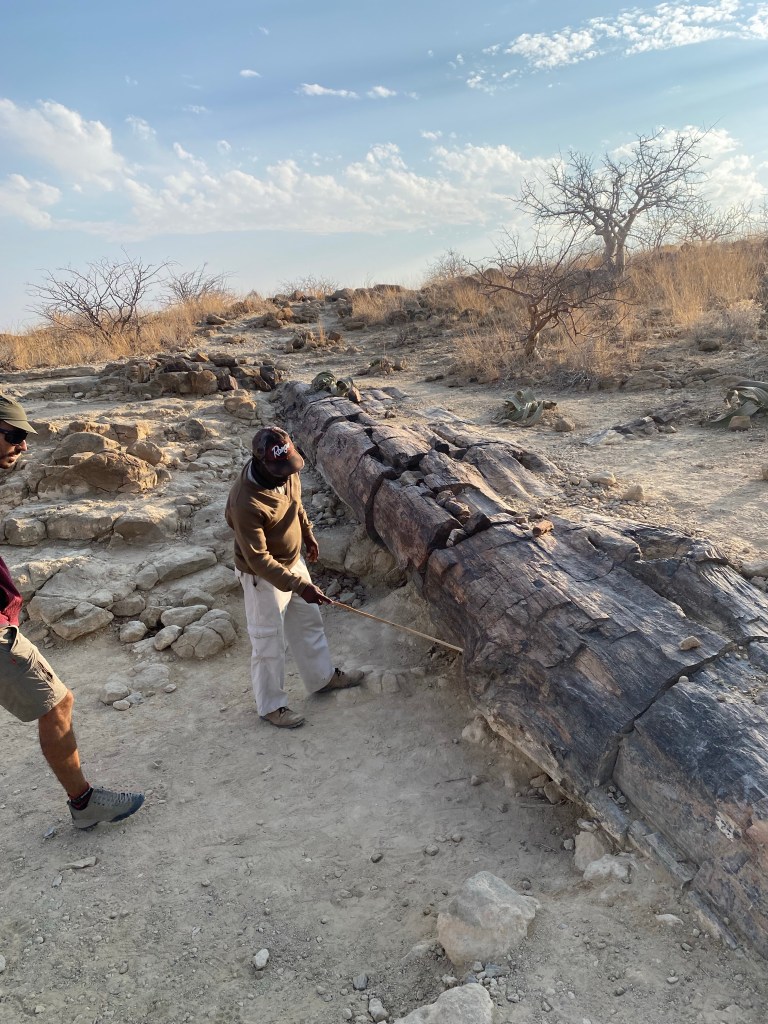
Back to the fossilized trees, they were formed when trees fell in the rivers lying between continental plaques, when all continents were united and known as Gondwana. No one is allowed to dig them out of the ground to prevent thieves. As a results every year after the heavy rain washes the ground some new parts emerge. They are truly impressive (and heavy), but the 12 Euro entrance for the 20 minute tour seems quite excessive. As a results Anyways, no complains as we will camp for free on the site, and the site manager brins us to a local home nearby so we have enough water, before he leaves walking 4 km to his own house.
12/10 – Petrified Forest – Madissa Camp. 113 km, 800m+
The last days have paid a hard physical toll on us, particuclarly on Javi, who cycled 90 km with a half-deflated tire. But at this stage of our trip, there is no room for unplanned rest days, and to some degree, we are enjoying the final epic that the mechanical issues and the physical challenge are bringing to us. We have another long day ahead of us, another day with the wind picking up at lunch time, again not favouring us. As a results, and because we are in a safe place, we wake up before sunrise, at 5:15 to start as early as possible. It is very cold at night in the desert, and due to the mountains the sun does not hit us directly so we are starting the day with a wind stop.

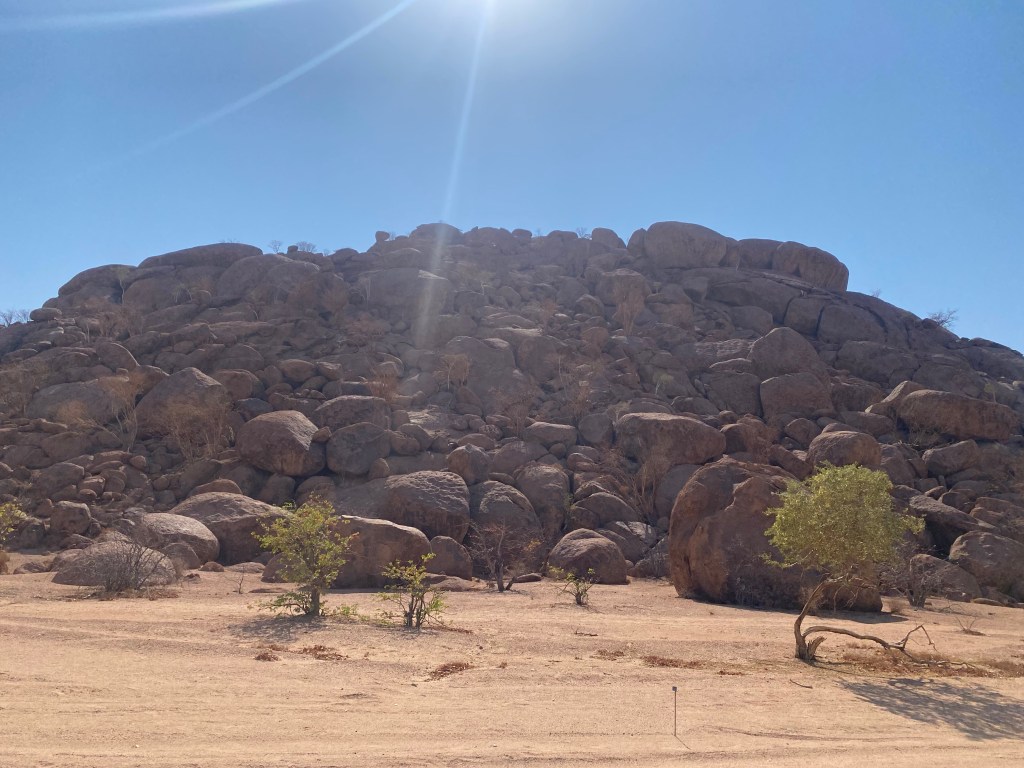
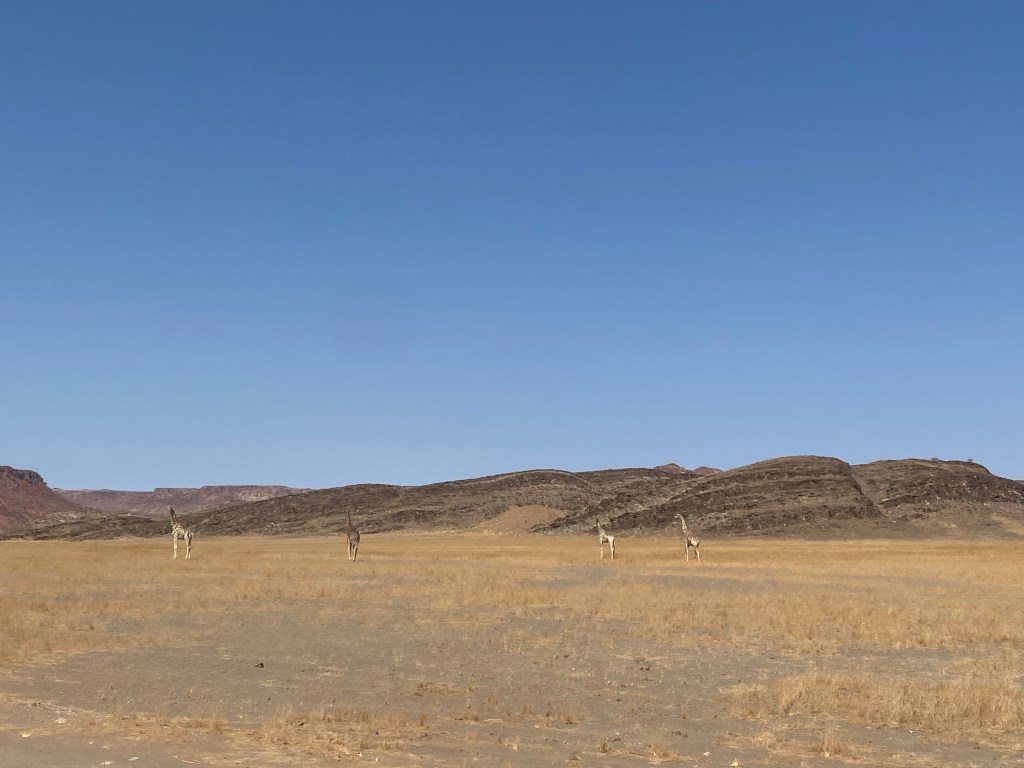
Landscape keeps being fantastic, resembling how we imagine the moon, with dozens of small pointy hills made of round boulders popping up everywhere. We want to stop at every corner to take a video as the scenery is definitively part of the most beautiful things we have seen. On our way to the Twyfelfontein archeology site, a tower of giraffes (yes, that’s how you call a group of giraffes), appears running in the distance, and we get to cycle on their side, them being much faster. Obviously, a tourist car had to appear and, by getting excessively close to the giraffes, he annoys them and splits them in two groups, one giraffe getting lost. It’s quite sad how stupid we become when the anxiety to get the best picture and the best experience takes over us. A good tip if you get lost, follow the girafes as they need to drink everyday and know the places with water.
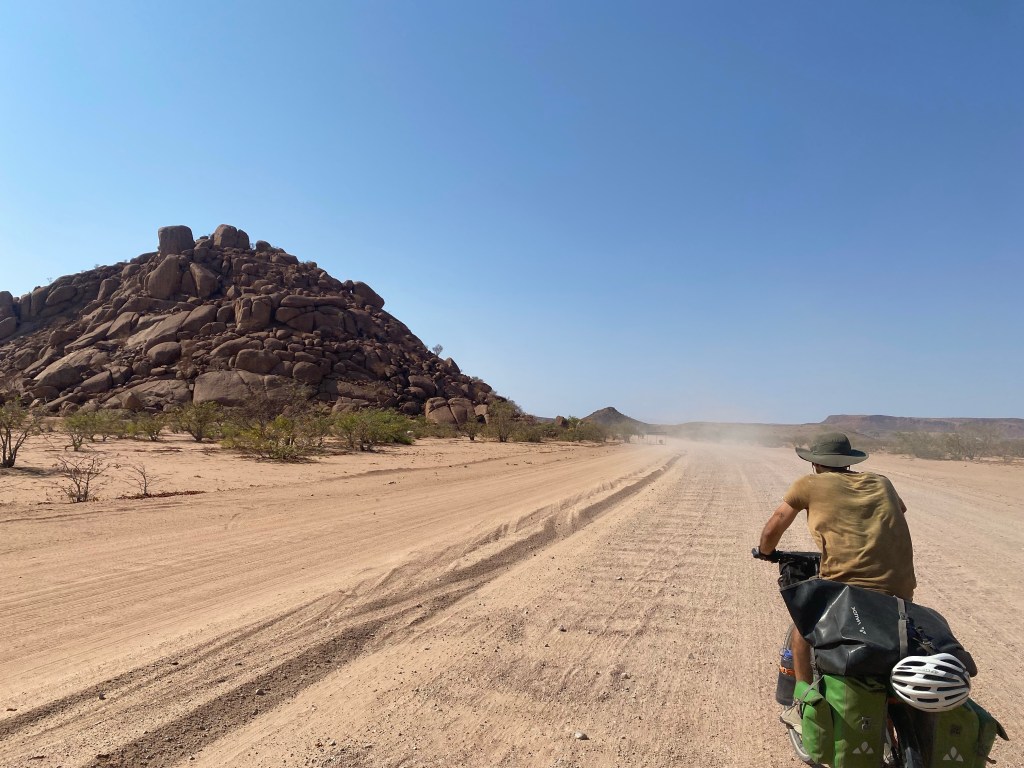


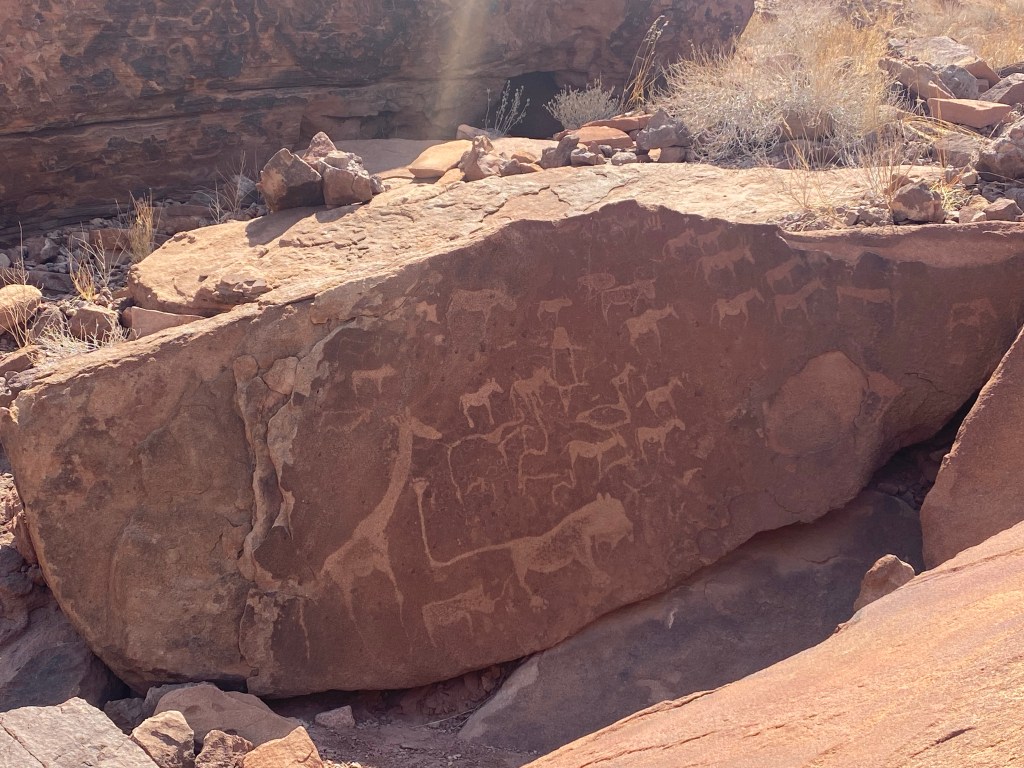
4 kilometers of difficult-to-navigate sand wait for us, before arriving to the archeological site. The site is an open-air collection of the biggest rock engravings in Southern Africa, some of them being as old as 6’000 years. The place is inside a canyon, crossed by a dry but green river, and full of huge boulders on both sides. It seems that the Khoisan, the native population of Africa before the Bantu migrations, where looking for shelter among them.
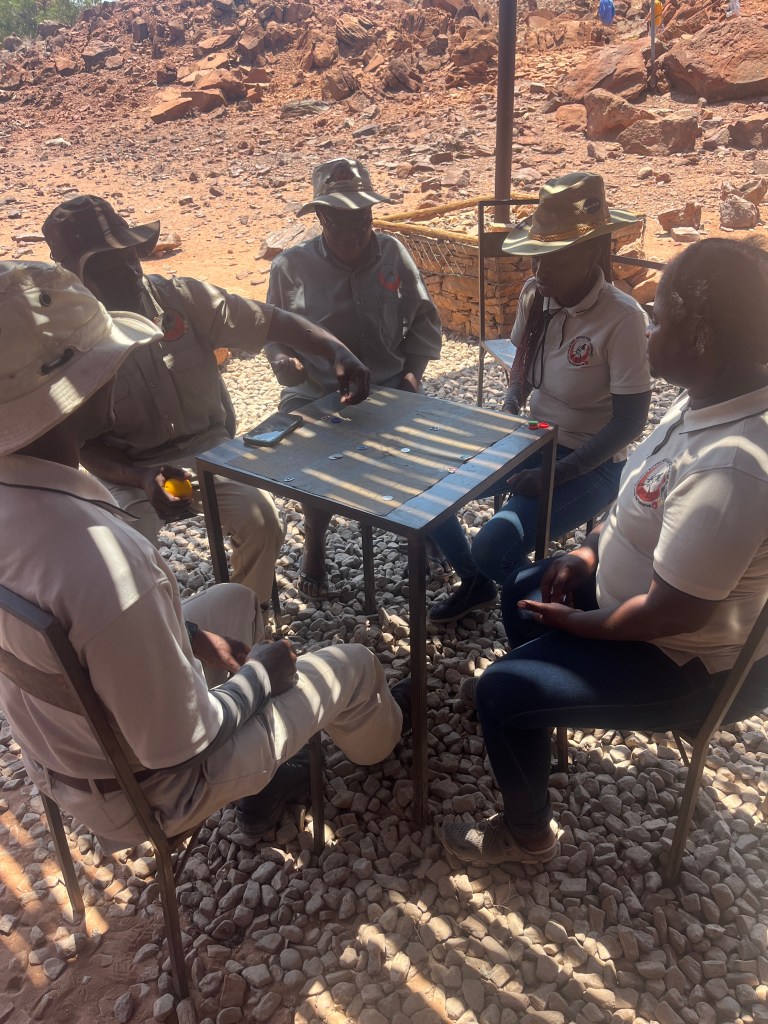
The site is UNESCO world heritage since a dozen years, and despite that title, it is not crowded, althoug we aren’t alone either. We pay again 12 Euro per person, and we get assigned a government guide, who shows us the engravings and explains the different purposes. On the one hand, they had a spiritual purpose, where shamans would identify with engravings. Some of the animal engravings have human features, like a lion that has 5 toes. On the other hand, engraved boulders were the school classroom of Khoisan people. The elderly would explain the youth how to distinguish the footsteps of animals with engravings, or how to hunt them. They would also explain them who are sacred, or the position of boreholes. Those were the giraffes, since they thought that their long neck allowed them to communicate with the stars. Some engravings of penguins are the proof that these tribe went to sea to get some salt and some penguins. Many tourists are stopping us asking “are you the guys on the bike? We saw you three times on the road. Can we take a photo with you?” Which at least feels more polite than the people not talking to us and taking photos as if we were a safari.
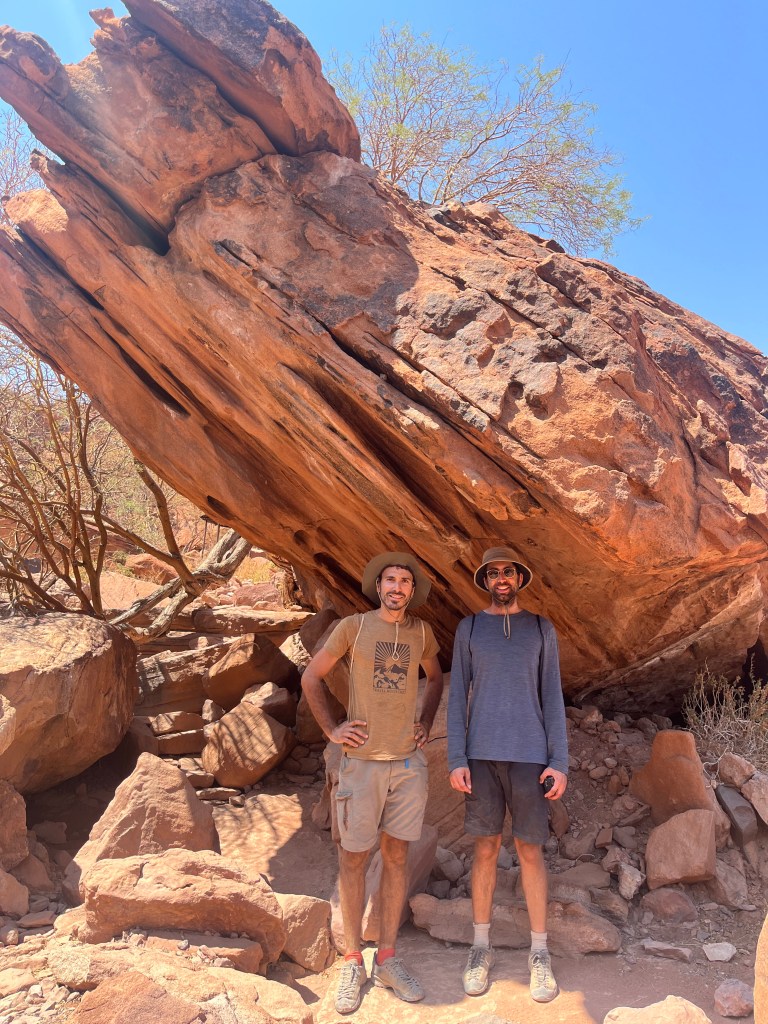
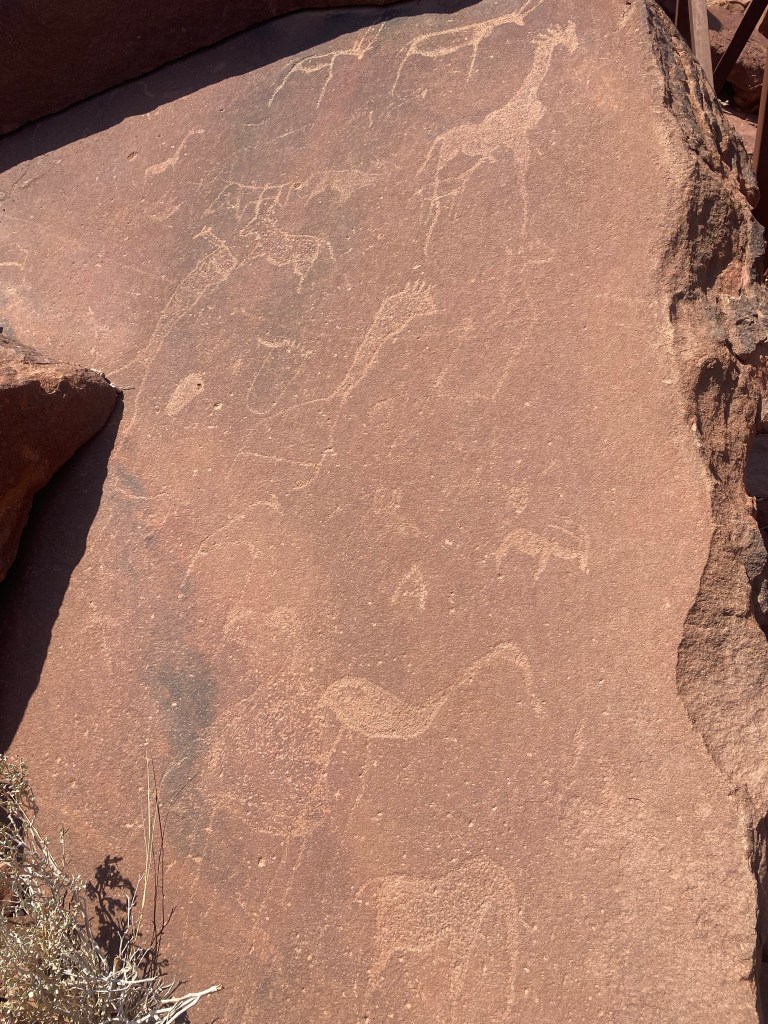
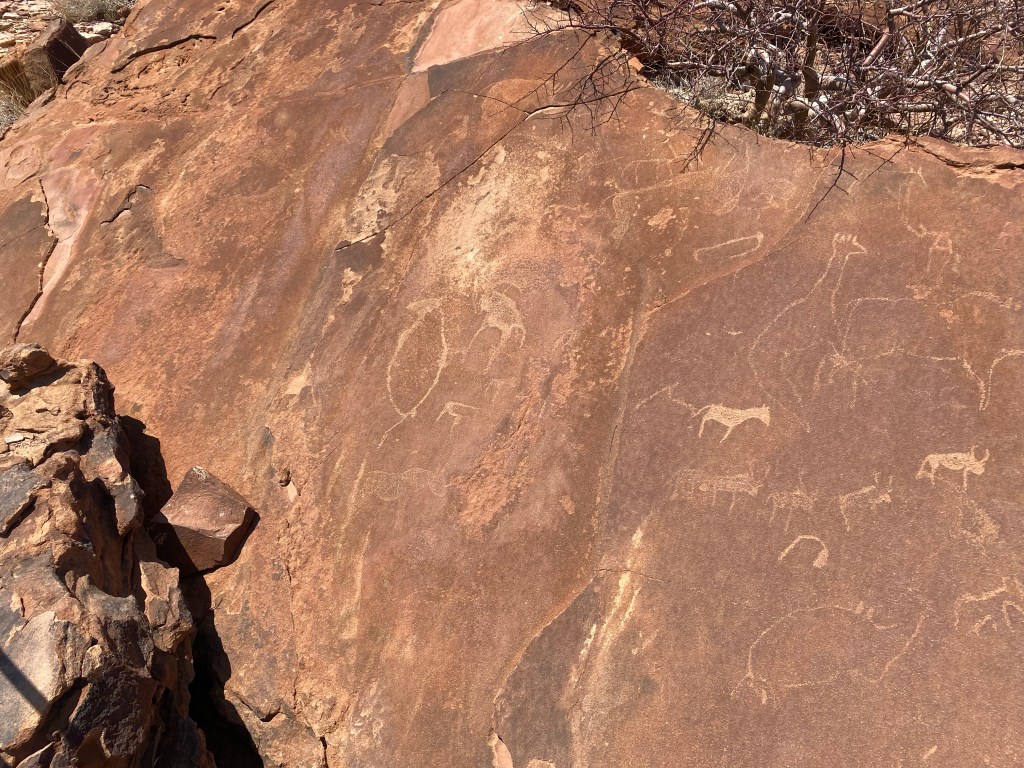

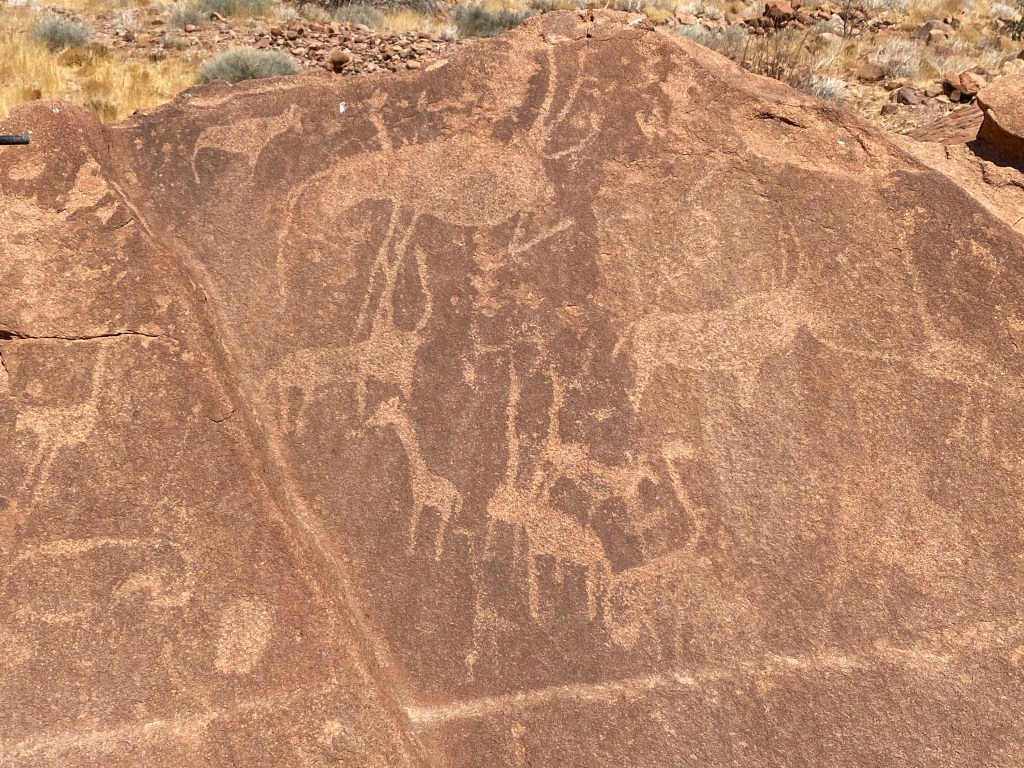

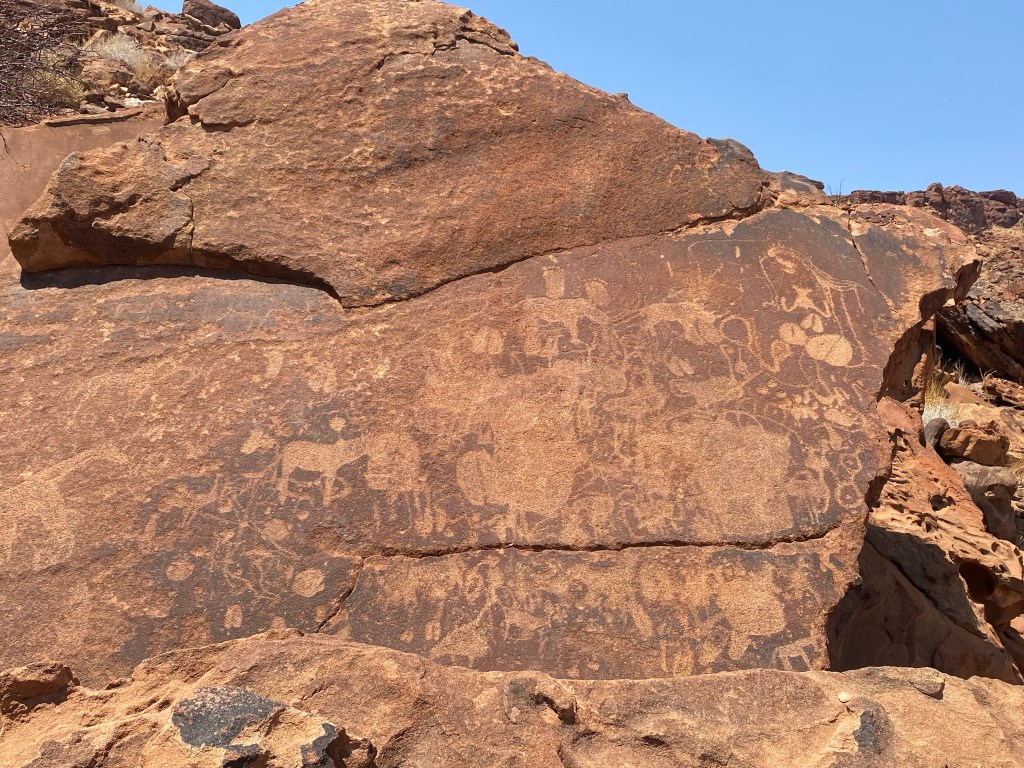
The place is truly fantastic and our guide, Cecilia, is very friendly and talkative. She can’t believe we came all the way from Tanzania with the bike, and she will only believe it when she sees our bikes. She joins us for our famous instant noodles for lunch, and we get a colletion of random facts about Namibia from her. The average Namibian woman spends 40 Euro a month on her hair, who she decorates with beautiful thin dreadlocks made of natural hair of other women and synthethic. But salaries won’t probably allow every woman to do so, she mentions that a supermarket cashier must earn around 100 Euro per month, while teachers, who work for the government, can earn up to 1000. Big inequality here too, but good that the government is prioritizing education, we guess.
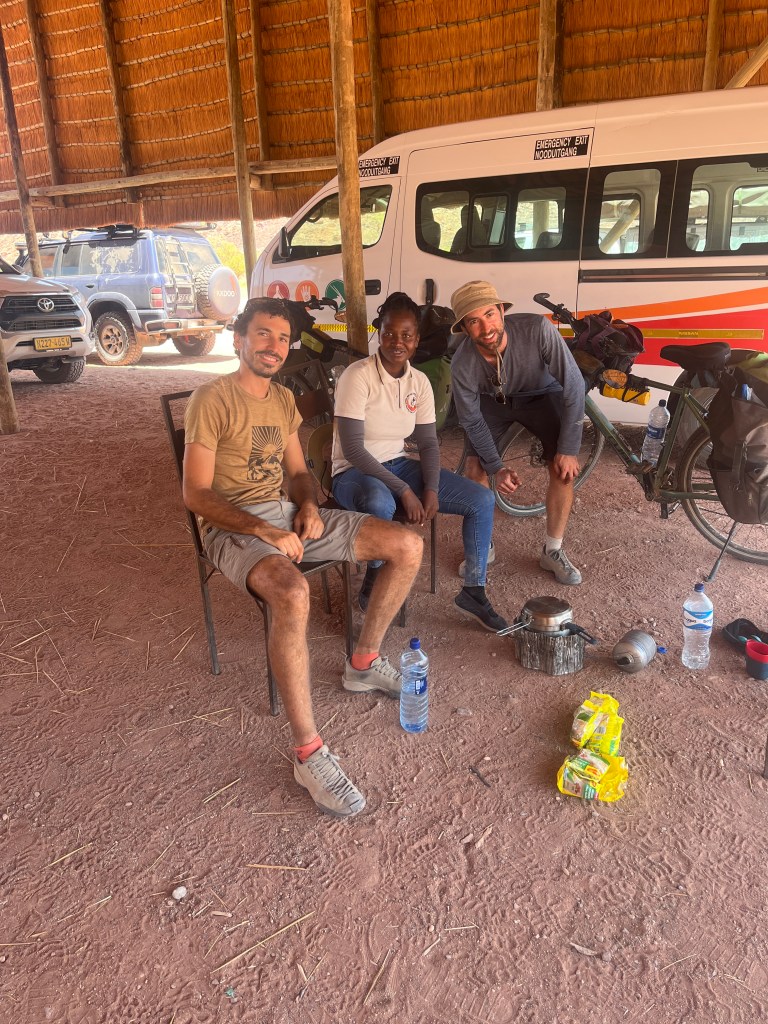
We say bye to Cecilia and retake the cycling under the merciless sun. The next camp is still 60 km away, what means that we won’t be able to visit the Organ pipes rock formations nearby, as we are running late. A nice 25 km unexpected tar section surprises us, which makes the cycling very enjoyable, together with the unreal moon landscape, with piles of boulders creating towers and hills all around.

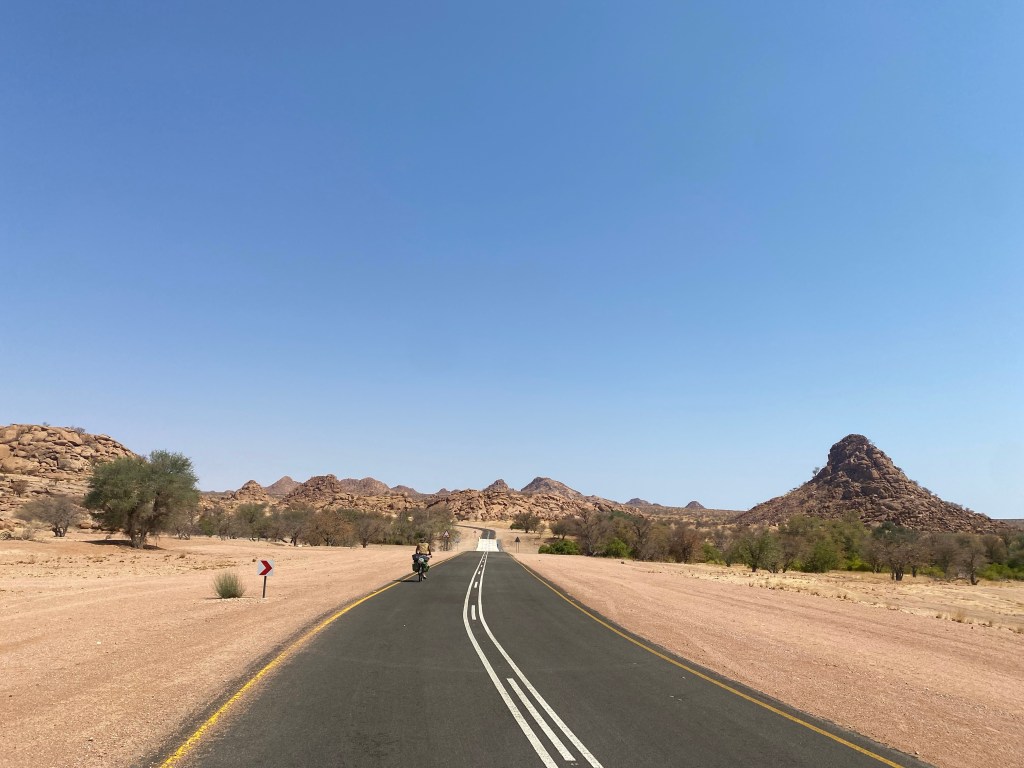
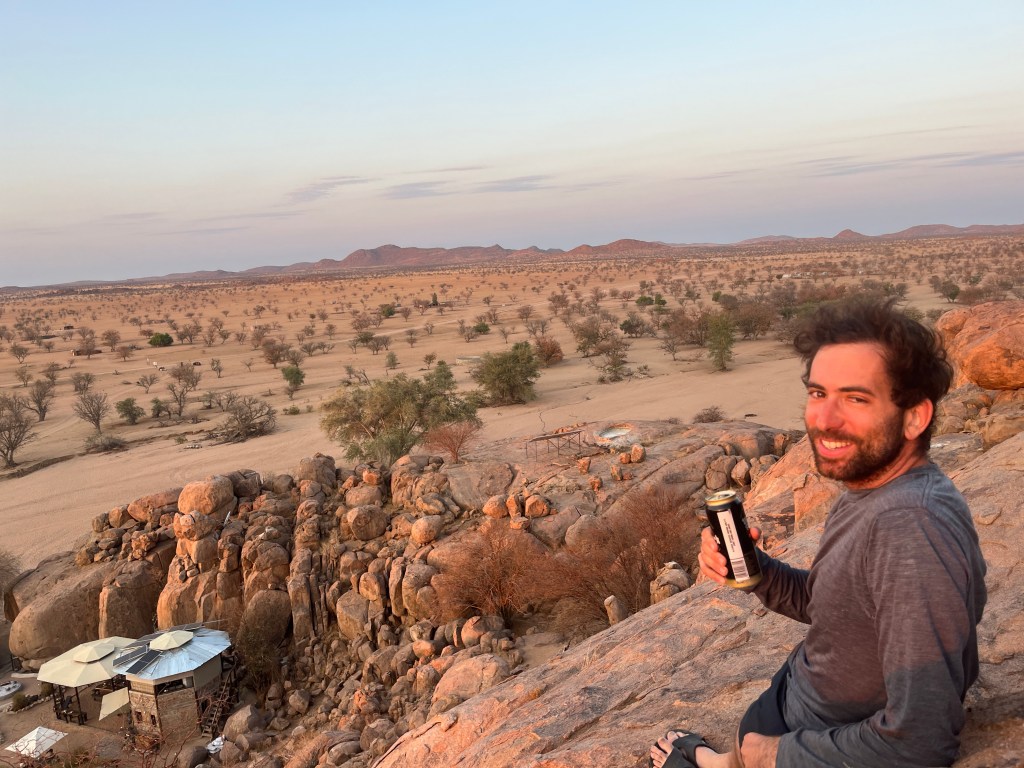
The fun stops when the sand starts again, and our speed reduces to 12 km/h. Tourist cars pass now and then and cheer us up by hitting the claxon, but a bit of cold, liquid support from their full fridges would be even better. Some french people stop us to ask us where is our support van. Amused, we ask them if they don’t think the humongous bags we carry are enough. Anyways, we push it in one of the hardest days of the trip, to arrive to the camp we wanted to at 5:30 PM, early enough to still enjoy a swim in the pool, a warm shower and a cold beer in the bouldery hill on top the camp watching the sun set.
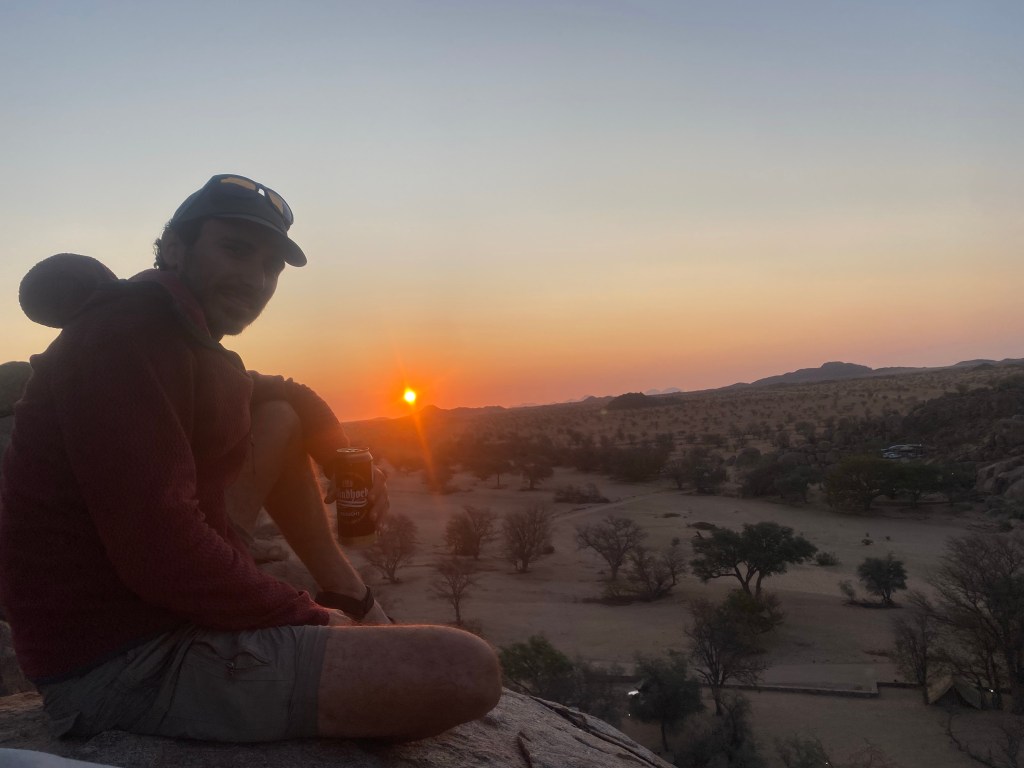
After so many days of miseries, we treat ourselves with the buffet of the camp. Today there is kudu steak and a selection of fantastic dishes, ruined by a very poor gelatine for dessert. Anyways, we empty the buffet, and Gaspard even fills a third plate, thing that he will regret in a couple of hours.

Some swiss nearby make us wonder their canton of origin, and when we ask, we both were right, they are also from Zurich! But, like last Zurichois, they don’t seem to share the enthusiasm. Funnily, we have connected much better with swiss people from the country side, who are often unfairly labeled as a bit xenophobic.
We decide to not set the tent, so we can enjoy the unreal sky full of stars, where the milky way is perfectly enough and one sees shooting stars if one is patient enough. Gaspard’s stomach starts to struggle with his abuuse of the buffet, as it happened last time. He seems to be incompatible with electronic devices and all you can eat buffets.
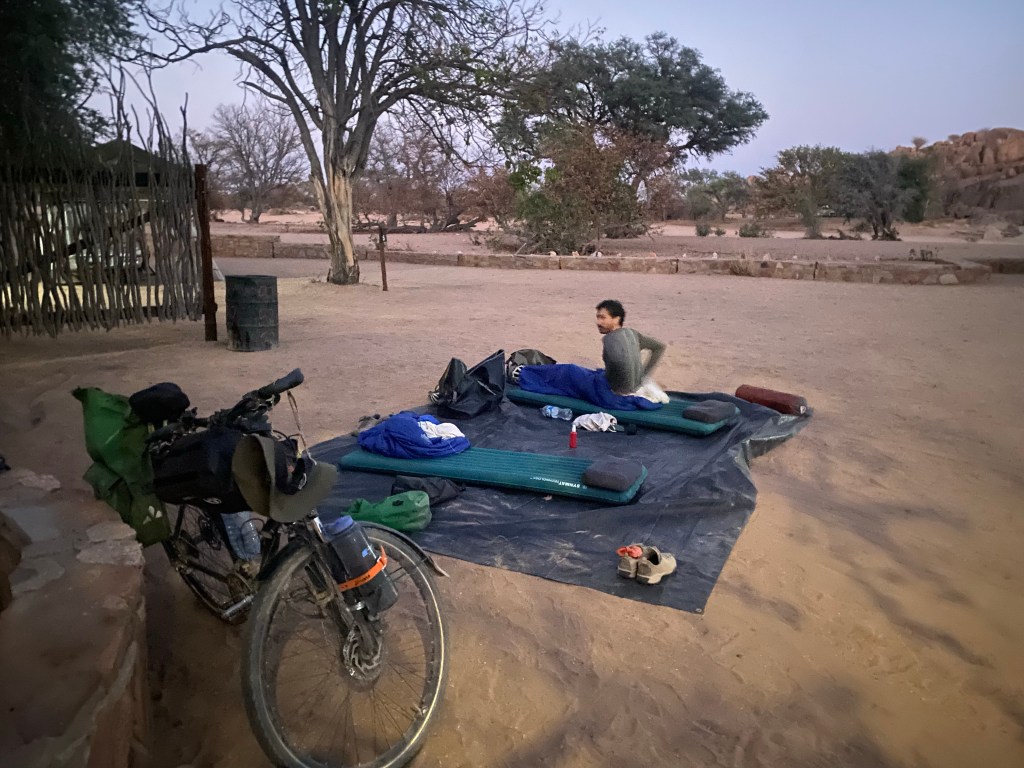
13/10 – Madissa Camp – Uis. 89km, 750m+
Gaspard wakes up promising he will never abuse an open buffet again. We struggle eating our traditional peanut butter with cookies, and we hit the road again. The borehole water of the camp is pretty salty, but we still refill our bottles with it because, well, there is no alternative. At what point salty water stop hydrating you is unclear but if local people survive on it so should we.
We continue cycling towards Uis, our end destination for today, among an arid landscape that slowly flattens, except for one mountain, the enormous Brandberg, a vast mountain group with a circle-shape, where Namibia‘s highest mountain is hidden, among desert elephants and millenary rock engravings and paintings.

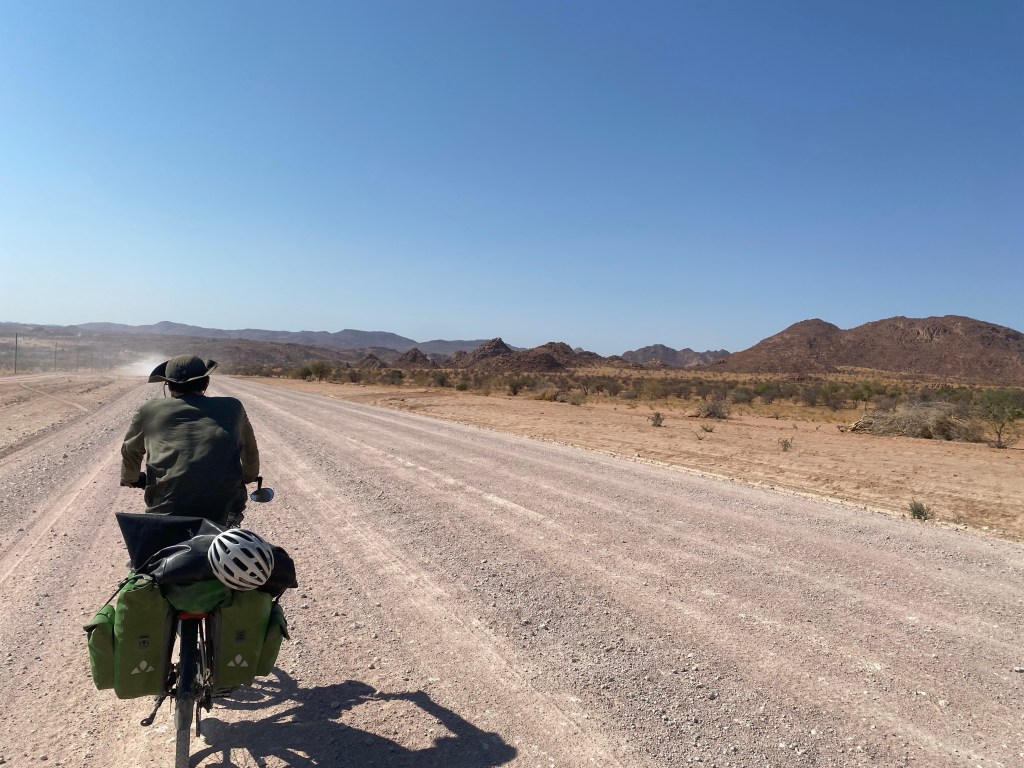
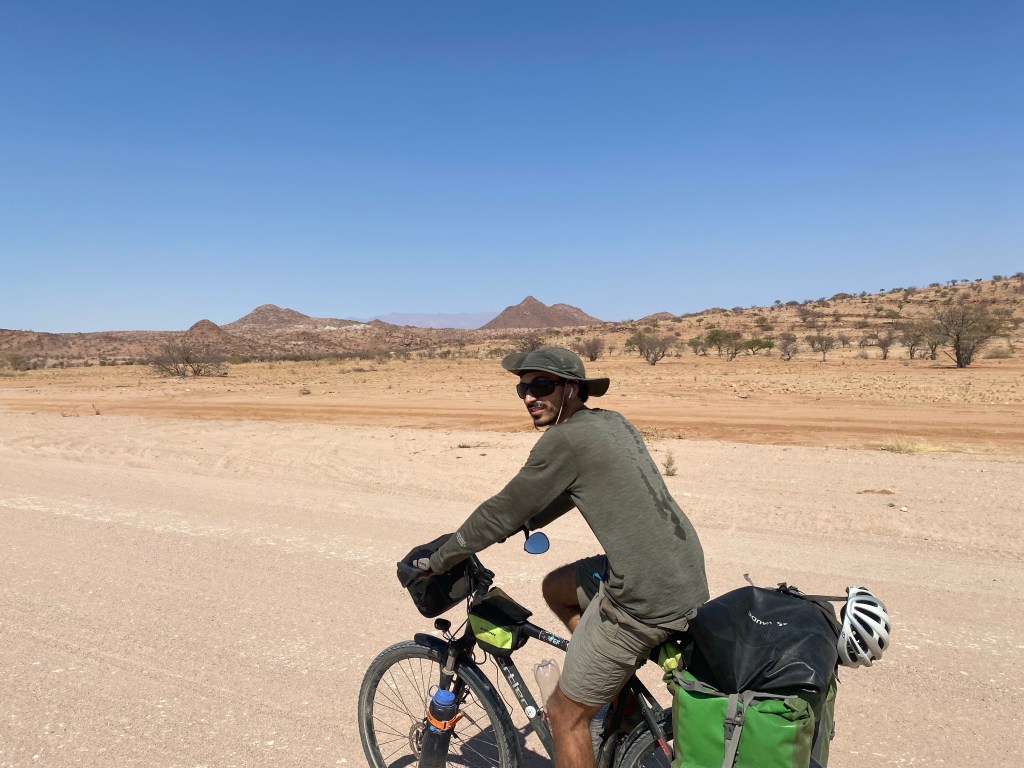
The road, which is still very rock and sandy combines prolonged up and downs. Gaspard is following javi closely despite his wheel throwing many small rocks. Gaspard is thinking: “how great is it to have sunglasses to protect my eyes from these projectiles”. This is when the impossible happened and a rock ended up in Gaspard’s nose. We stop and javi couldn’t believe it, what are the odds! After laughing too hard, the rock was expulsed of the nastral so we had to recreate the scene to immortalise it.
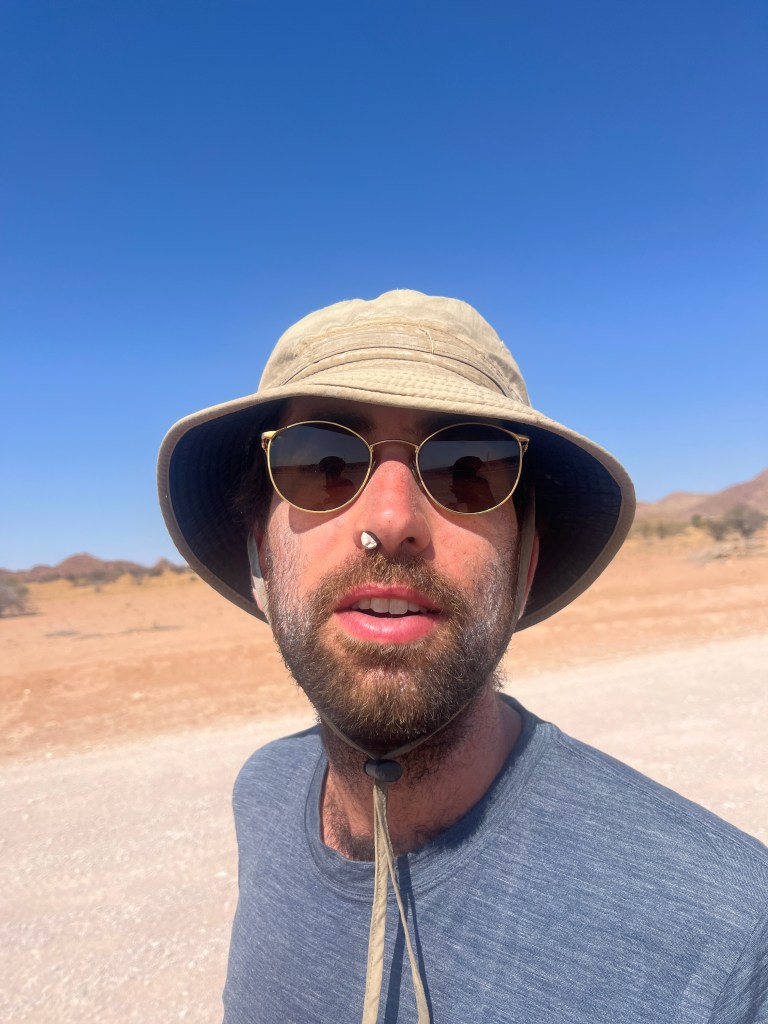
We keep moving and in one of the up and downs, Javi, who is following Gaspard maybe a bit too close, doesn‘t manage to avoid a stone the size of a beer can, and… boom! We can‘t believe it, another flat again. We stop to fix it, which in Namibia is unfortunate as you will immediately get surrounded by dozens of flies.

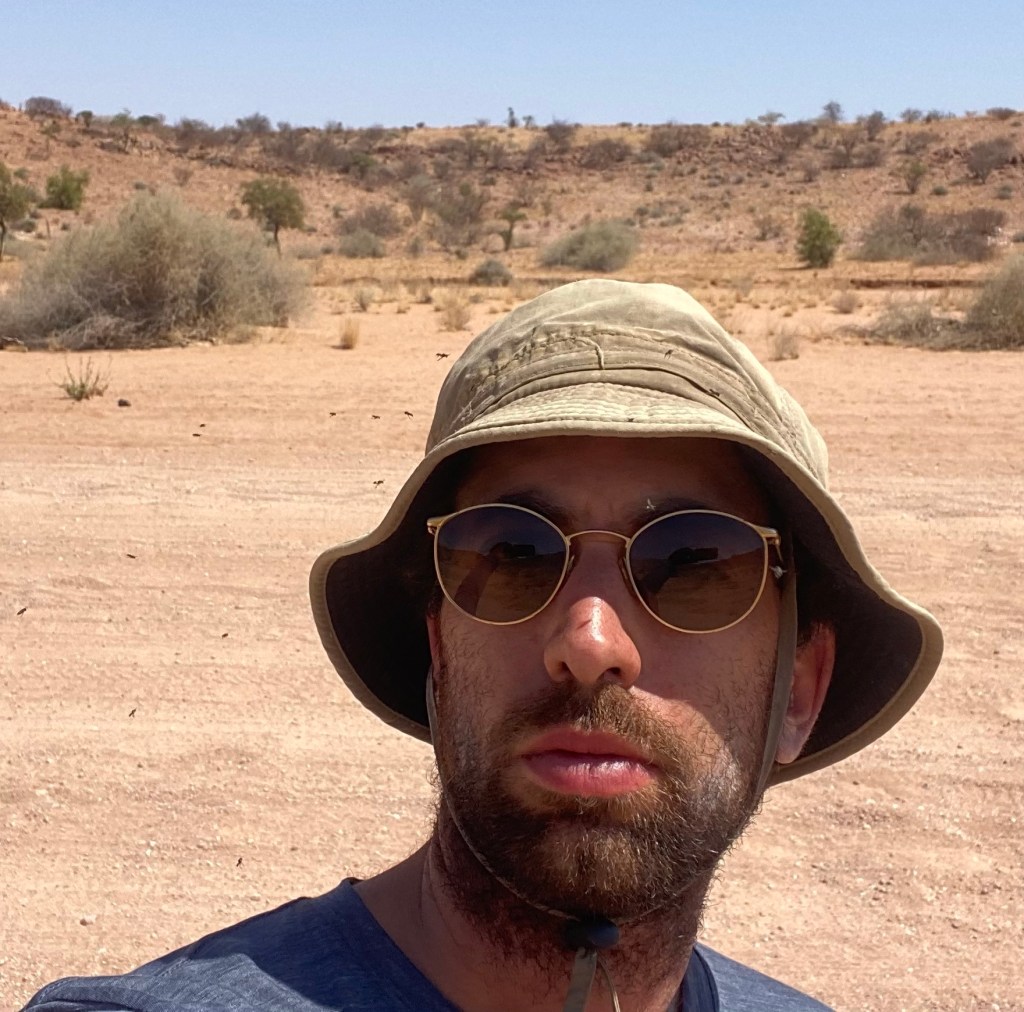
We thank the Universe for having taken the time to repair all other tubes. The sun is strong and there is no shadow option, so we better be fast. And, just when we are refitting the tube, a tourist car with Italian guests stops to offer us help.
The guide has a compresor that we can use, what saves us the miserable step of inflating the tube with a malfunctioning hand pump. We get lucky, after all.
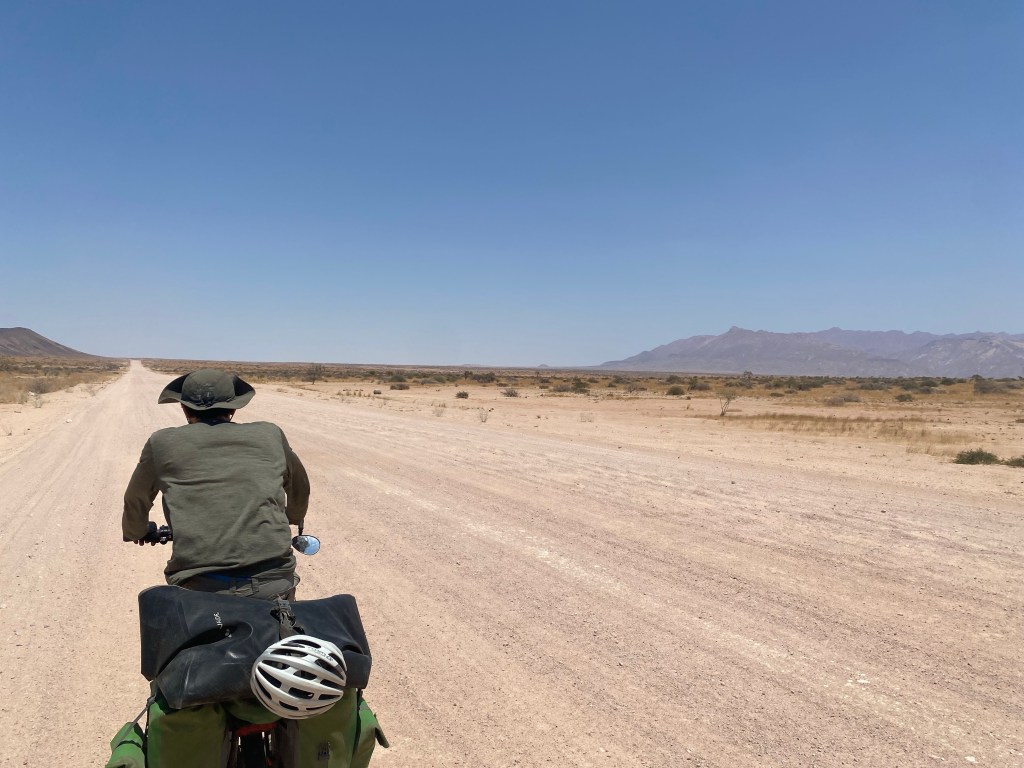
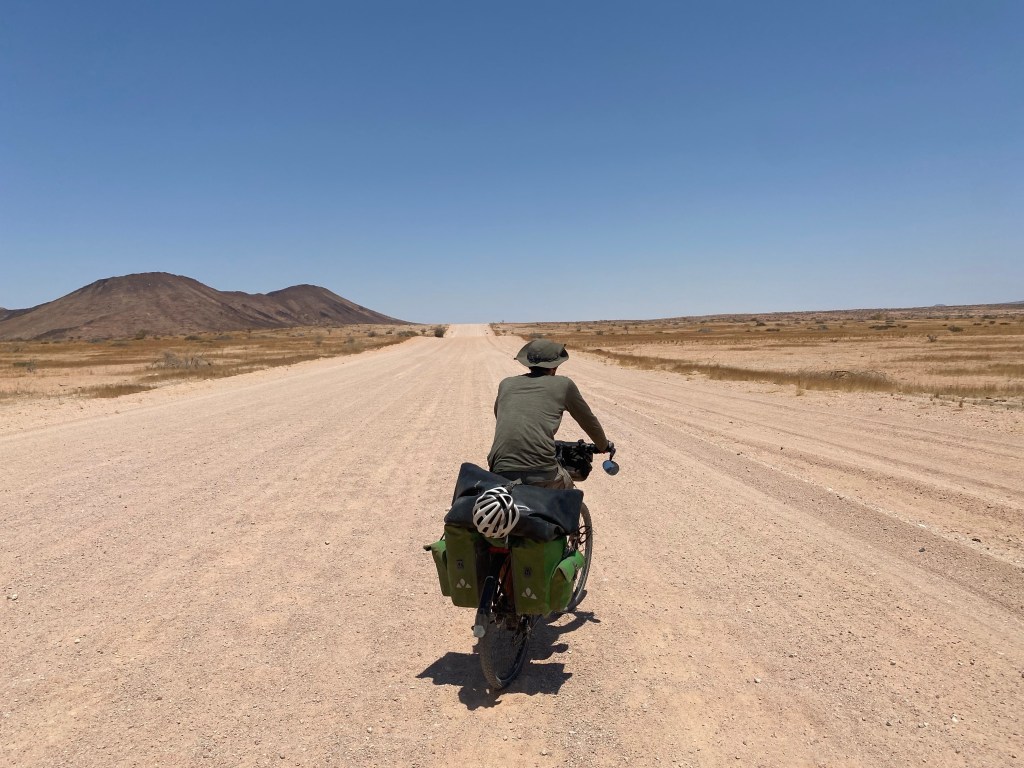
But that‘s not all. After proceeding with the journey, this time with enough distance to be able to dodge rocks, 2 tourist cars stop to offer us water. We really appreciate it, since our salty water is by now way too warm, and we are even wondering if it really hydrates us.
But not only us are thirsty. We pass around 5 Himba families lying by the road under a wooden roof, asking for water while they try to sell handcrafts, with the women and kids dressed in traditional clothes. The fact that the women don‘t cover their breast makes us somehow uncomfortable, to be honest. You can imagine these shops as shops in the desert. We politely refuse the handcrafts, which unfortunately are nothing special, but we do give our salty water to all of them, as they are all asking for it. The Himbas have incredible hair rituals according to their ancestors’ rules which reflect marital status, age, wealth and rank within the group. They create a paste called “Otjize” consisting of a mixture of butterfat, and ochre pigment, and apply it on their hair and skin.
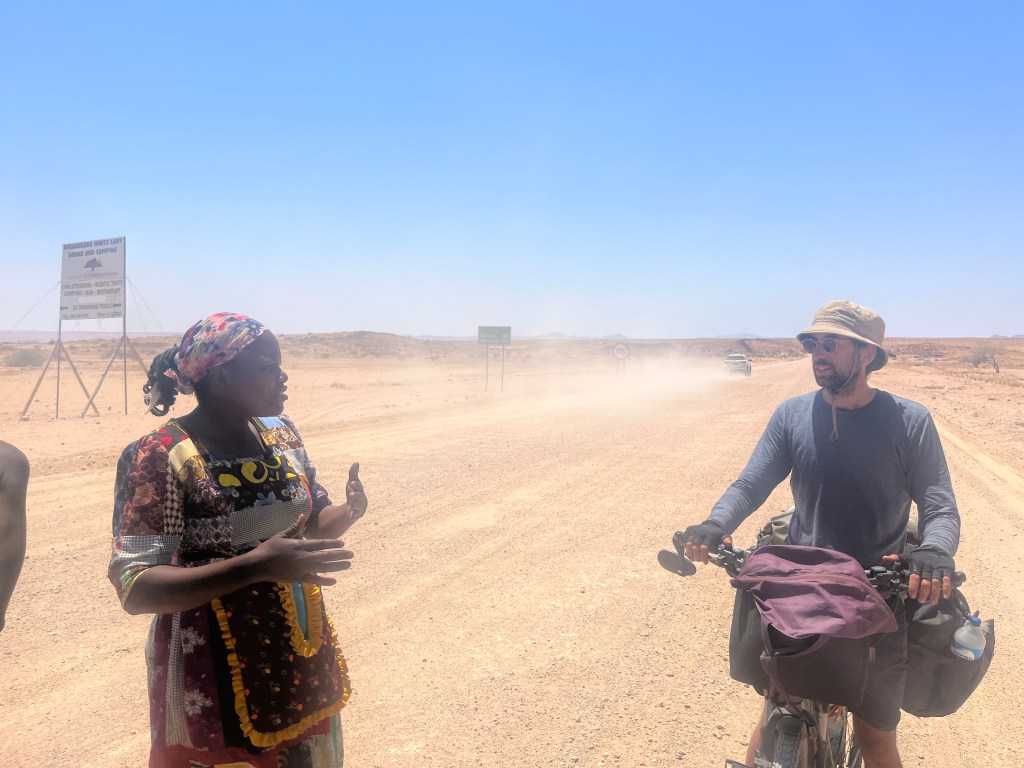

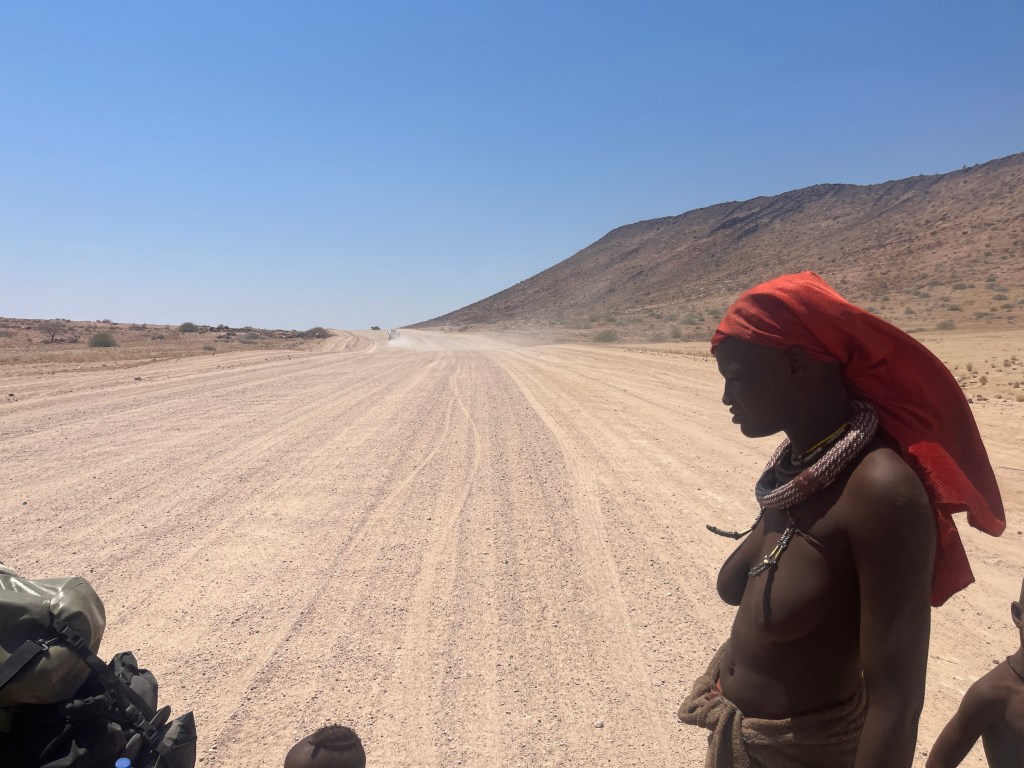
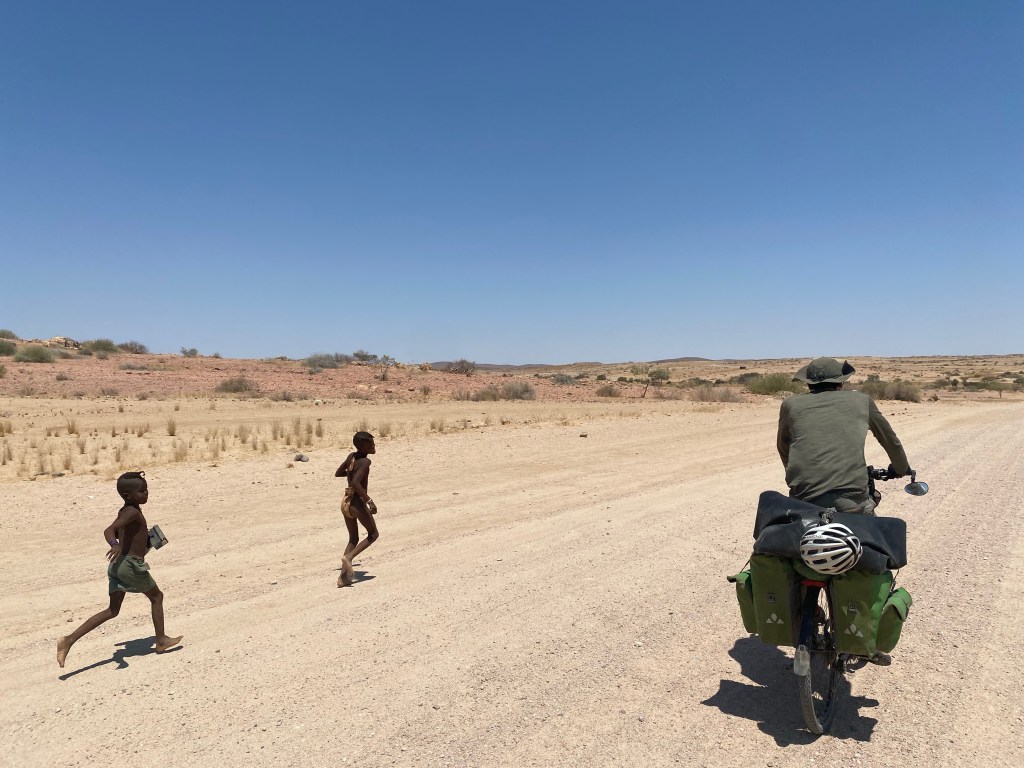

The fact that we get cold, bottled water from the tourist cars, and that the locals get our 2nd tier, borderline water, makes us feel terrible. We really hope the other cars are sharing their bottled water with them. But we do wonder how can they manage to live nearby there if they need water from the tourists on the road.
We also wonder if all this traditional clothing is authentic or not. We have read that Himbas have sadly given up with their hunter gatherer lifestyle to focus on tourism, asking money for pictures. It’s also very suspicicous that only women wear traditional clothes, and they all seem to have phones. But the majority don’t speak a word of English, what makes us believe that they do live quite apart from society, and that they just combine sepherding and hunting with touristic word, as it’s their only access to money. In any case, these tribe members seem to live in an absolute poverty level, totally disconnected from the Namibian mainstream society.

We finally arrive in Uis at 3pm, and go immediately to the restaurant nearby the camp, where we swallow a Eland steak for 7 Euro, like if it was the last food on earth. Again, forget about finding local food, braai style food is the only option.
At the campsite “Brandberg”, which is very fairly priced, we meet the owner, an old Afrikaners that tells us about Uis. Uis became quite a ghost town after the South Africans retired due to the international sanctions on Apartheid on their 90s. The only activity now is a Teng mine, but many more mining exploitations are being explored.
In that context, we meet Lehan and Deram, 2 South Africans in their thirties staying at the camp (in a room, unlike us), who have been the last months doing some prospections on Lithium for a Chinese company. They are very friendly, and we enjoy a beer together. Unfortunately, they have to leave for a dinner with their Chinese customers. There are other white people working on mining prospections that are also staying at the camp. We agree to meet later for a drink, and treat ourselves with a home made curry with chickpeas. As the end gets closer we start treating ourselves a bit more. We wait for them at the bar until 9:30 but their dinner seems to be extending. Since tomorrow the wind will start blowing against us heavily after 12 pm, we decide to go to bed and miss them, as an early start is required. Good thing we didn’t wait as they came back very late!
14/10 – Uis – Henties Bay. 126 km, 250m+
We leave Uis and start surrounding the Brandberg mountain in direction to the sea. The landscape is by now fully desertic, with very few desert bushes now and then, reminding us from the Sahara. After 60 km, the South Africans of yesterday overtake us on their way to the airport. One of them is running a marathon tomorrow in Cape Town, but the dinner with the Chinese ended up with everyone drunk in the pool until 4 AM, so he is scared of his performance. Damn, we would be scared of dying, to be honest. We exchange numbers, hoping to see each other in Cape Town, as Javi will be there with his girlfriend, and let them continue.
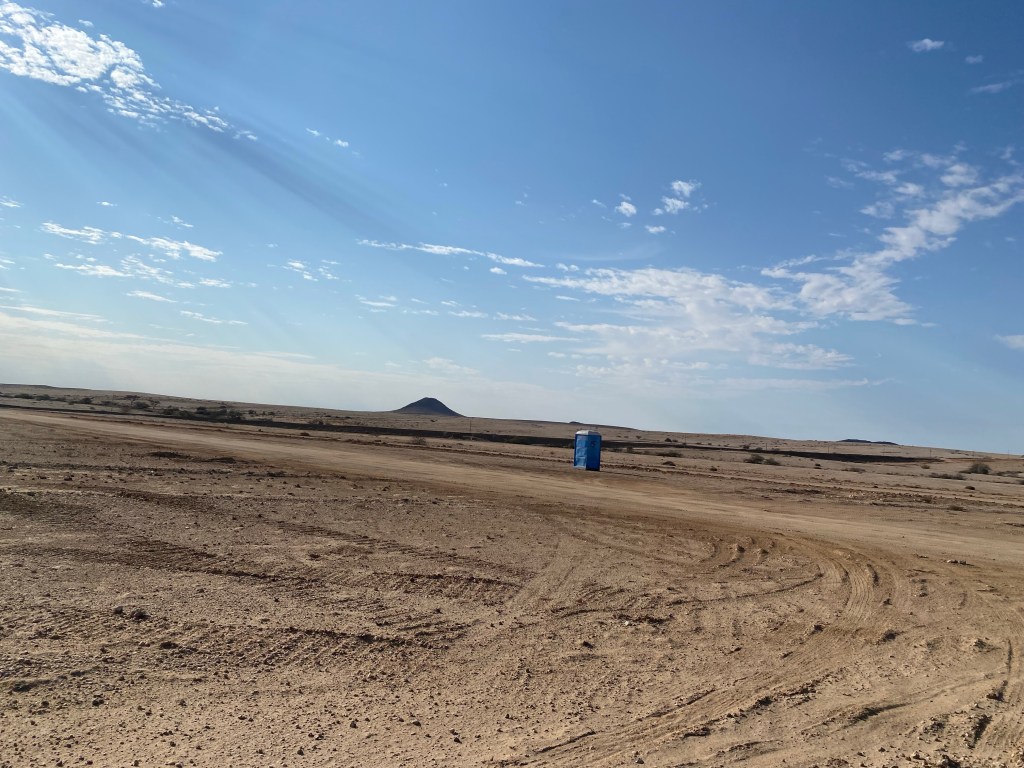
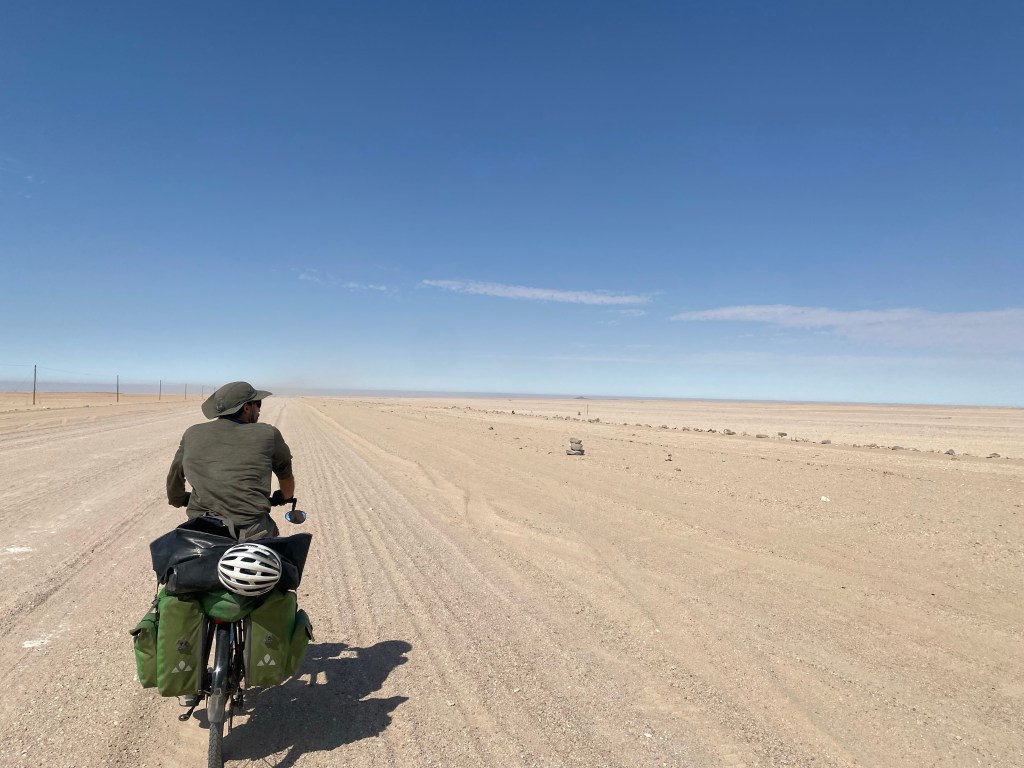
We heard that the second half of the 120 kms of today is tarred, but we are by now by km 70 and no tar is visible, although the road is in construction. We only make it to the tar in km 83, what is not 50% tarred, but 31%. For desperately tired cyclists, that’s an important difference.
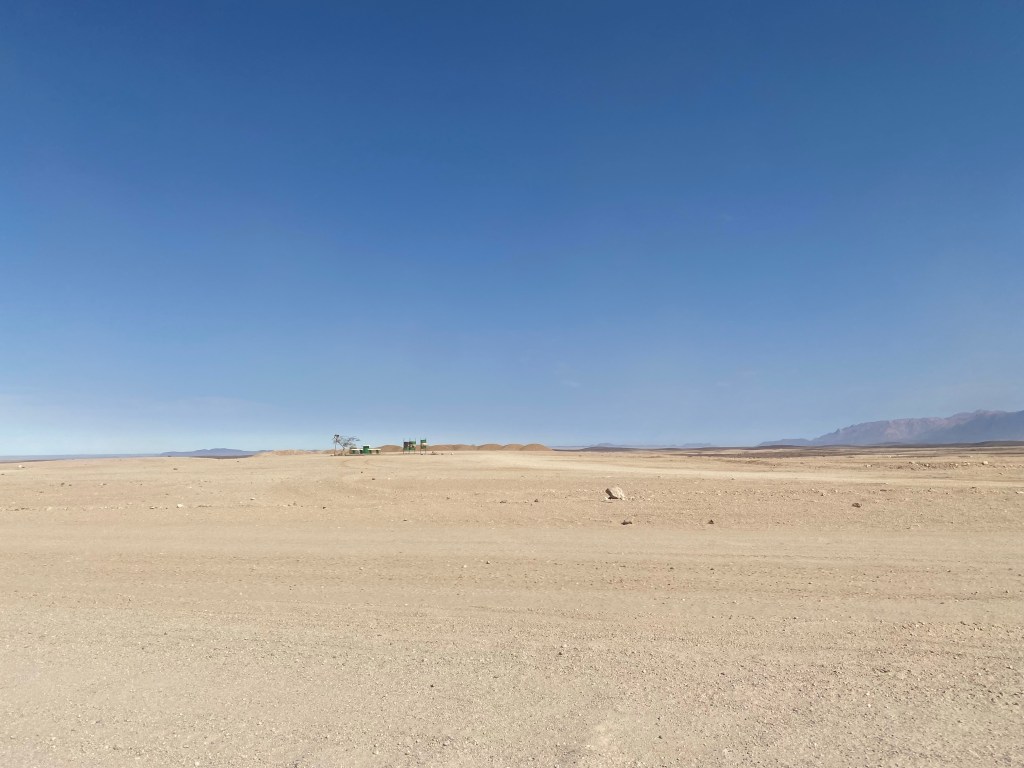
It’s now 12 PM and the wind show starts. We have to take 10 km turns to cover each other from the wind. We also put our wind jackets, as the temperature is dropping fastly, being now probably at 14 degrees, compared to the 40 we had yesterday before Uis. However, the road is still refracting in the horizon, what prevents us from distinguishing the sea far away. But we can smell the salt in the wind – we are not far!
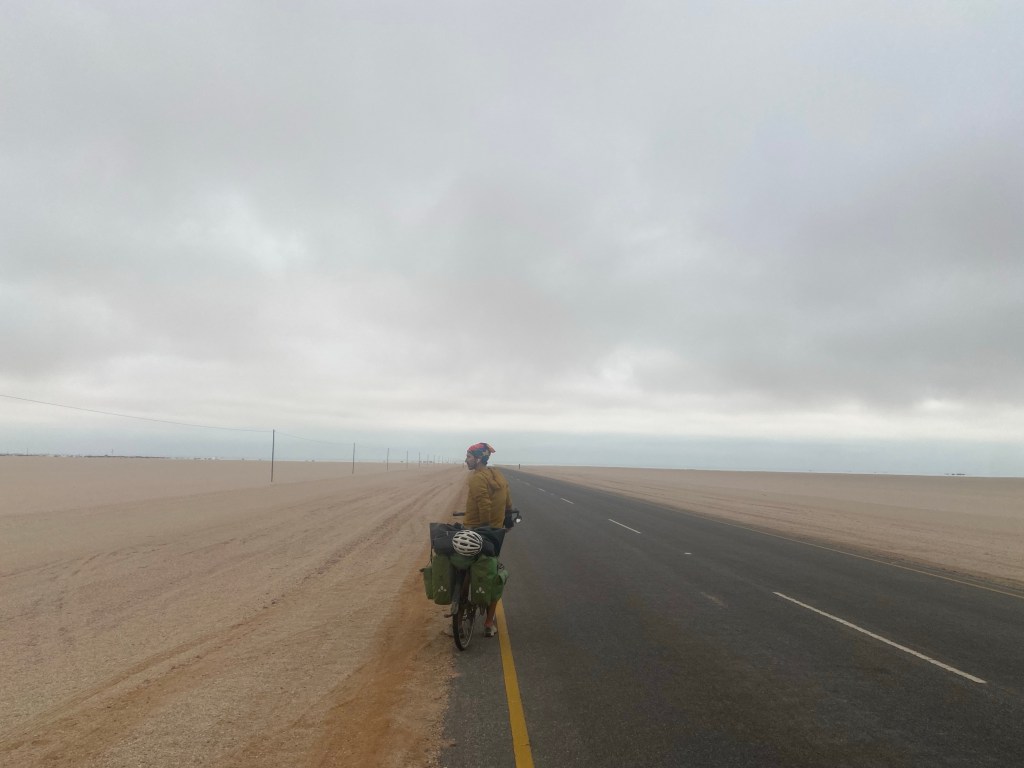
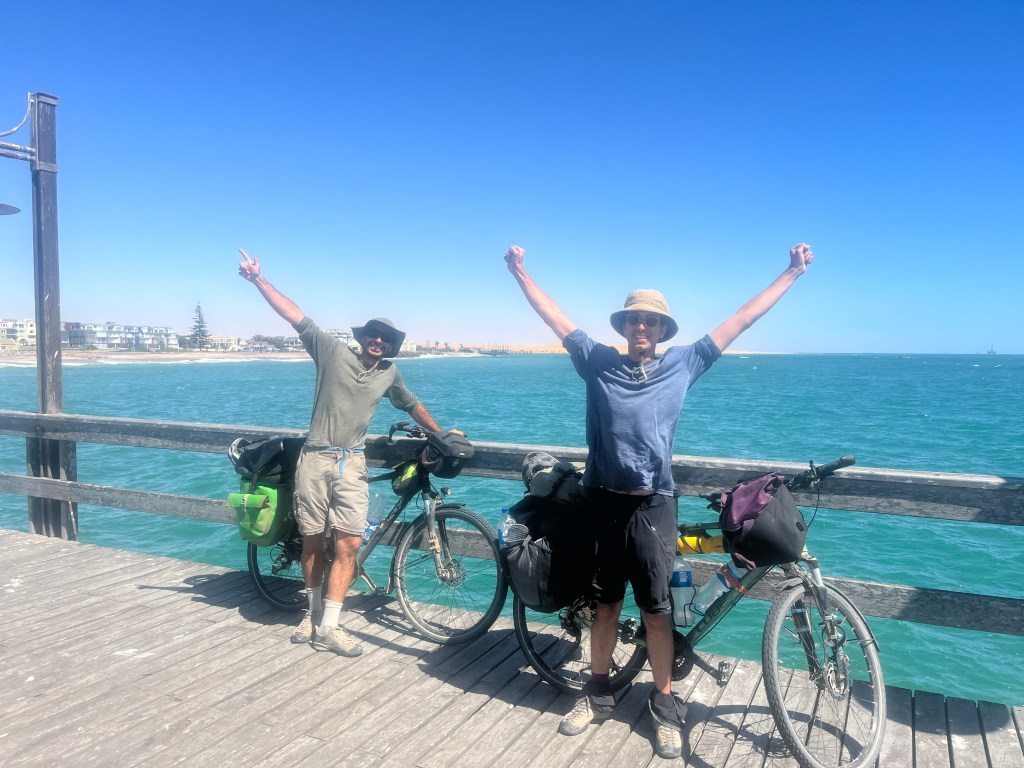
So we keep asking ourselves whether is sea or refraction, until we start appreciating the Ocean naking itself out of the blurry horizon. A bit more and “voila”, we are there. The Atlantic Ocean, 83 days after having left the Indian. One could imagine we would start to cry, jump, and hug each other. But nothing like that. We are cold and hungry, and the wind is only going to get worse. So we turn left towards Hentis Bay, where we plan to end the day. We can celebrate there!
A couple of tourist pickups with some kind of antenna in front pass us. We are really confused about them, until we realize they are fishing rodes. Stupid of us. Fishing tourism seems the main industry in this small, ghosty, cold and humid town.
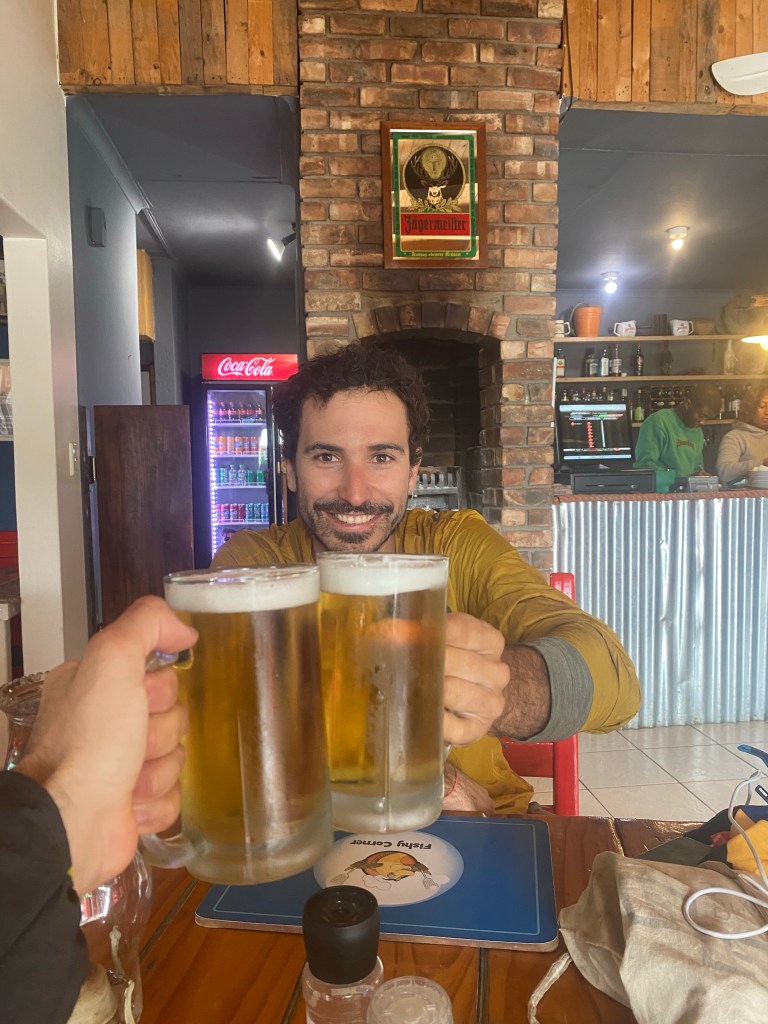
We find a nice restaurant where we get a local fish with calamari, and the biggest draught beer. Now yes: time to celebrate! Fish is pretty good, and we are finally warm and satisfied.
With this cold, which prevents the sweat of our clothes from drying, camping is not an option, so we go to what according to ioverlander is the cheapest hotel in town, De Duine, where we get a nice double room for 18 Euro each. We strall a bit aroun the sea side, which is very prominent and offers a nice view, and confirm that we have a warmshower stay for tomorrow in our very final destination, Swakopmund!
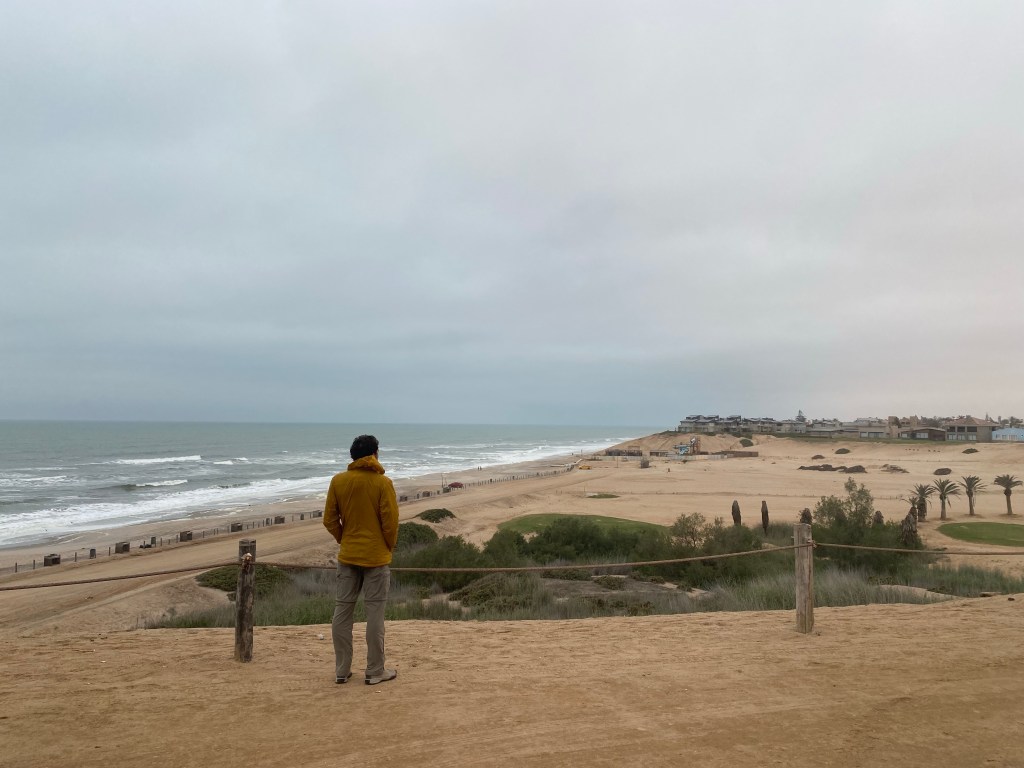
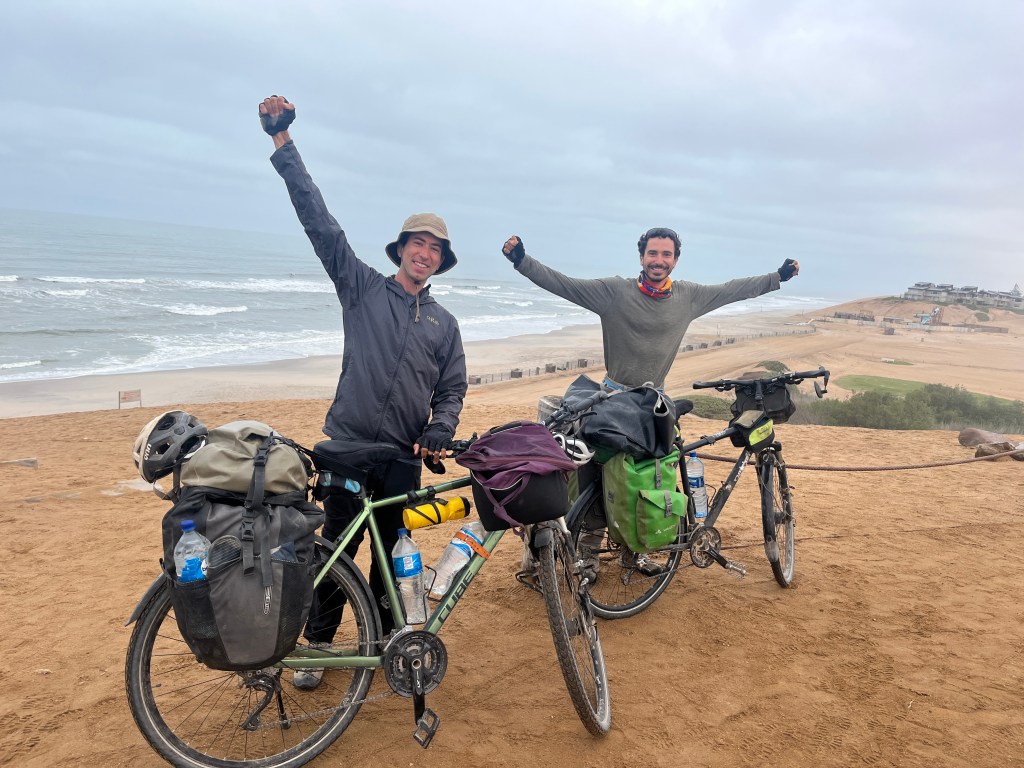
We eat in the hotel, slowly submerging ourselves in western prices and menus (thus getting ready for the visit of our girls, who don’t really want to be travelling monks like us). Time to go to bed!
15/10 – Henties Bay – Swakopmund. 91km, 272m+
The cold of the morning invites us to have breakfast in the room. Again treating ourselves with some muesli and milk as we cannot see these biscuits with peanut butter. Our clothes are still wet from the sweat of yesterday, what doesn’t particularly invite to cycle. While leaving, we meet an 80 year old local white man, who tells us with passion his life story: he has worked in mines all around the country, and now he is retired here. We hit the road and notice stronger than predicted side wind, what forces us to take us turns protecting each other in parallel. This earns us multiple complains from angry white drivers, who seem to not be able to afford to decelerate briefly to overcome us, in the very few sporadic cases in which two vehicles come in opposite direction. We observe a ship wreck in the distance, where we are approached by quite desperate Damara people attempting to sell stones to us. We are committed to help, but not with multple one-time charities, which we have the feeling don’t solve any issue. We rather are planning other opportunities in which the money is used for a recurring benefit for communities, such as health or education. Despite it hurts, we keep disciplined and politely refuse. More news to come regarding how we will give back.
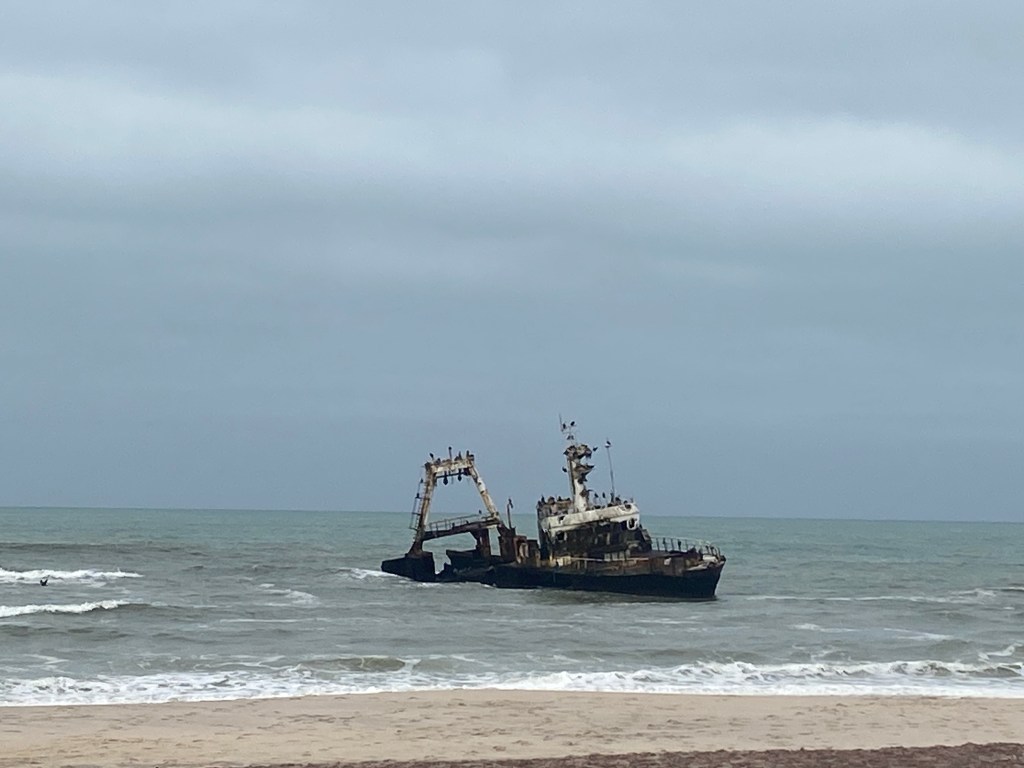
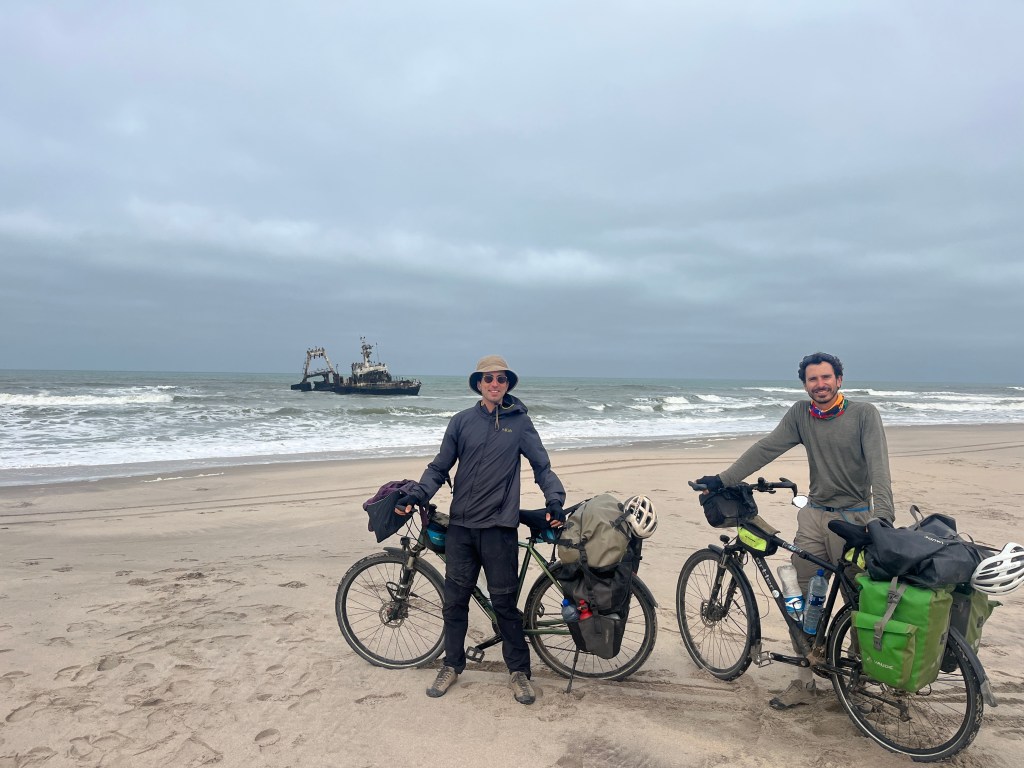
The shipwreck is an old Angolan fishing boat that got in trouble and tried to get us close to land as possible. As usual, the owner has ignored his duties to take care of the ship, so the ship is there, waiting until Namibian government will decide to do something with it. One must say it has it charm, as it is home to a handful of sea birds. The dead seal stranded in front, however, is rather sad to see. The ocean water is so cold here that there are many seals. Apparently there is a big colony on the north, but this one we will also have to leave it for the time the girls are here, since we are heading south.

We enter Swakopmund, and now the complains of retired angry white drivers coming from fishing and golfing force us to stop our wind protection strategy. Funny how we see golfing in the desert bad, however they are our bicycle driving next to each other worst. Not a nice welcome, but whatever. Swakopmund is a funny place, rich in German neo-colonial buildings from early XXth century, with a beautiful beach, and lots of vacation houses with a salad of construction styles, making the essence of the town very inconsistent. Some builldings remind us of public buildings of an average industrial German town in the 80s (not so nice). But the beach area has its touch, and the population combines Herero and Damara people with many Germans (both born and settled recently) and also some Afrikaners. But the de-facto language remains English.
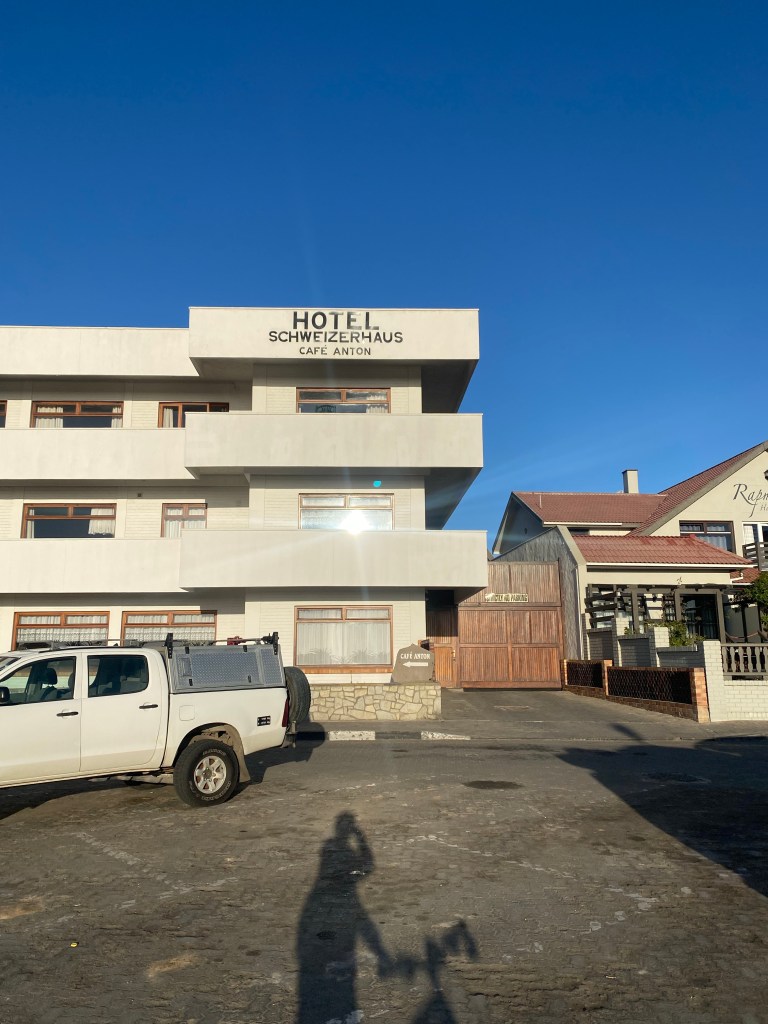
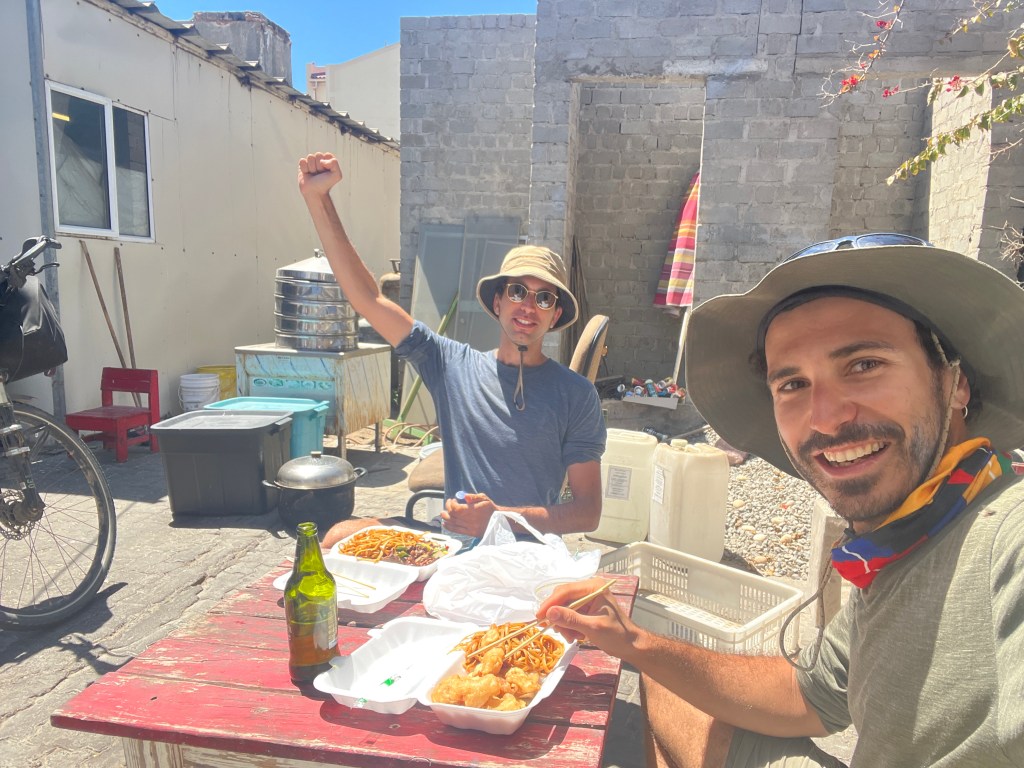
We go directly to the chinese restaurant recommended by the South Africans of Uis, where we got some delicicous fried noodles. As the restaurant hall is closed we started to eat our food sitting in the street. When the staff saw us, they took us to t in the backyard of the restaurant, since the dining hall is already closed. And now it’s time to head to our Warmshower host house. Jasana, Herero woman who is a super host both in Couchsurfing and Warmshowers, has told us that today is her birthday, so we find appropriate to buy her a present. We decide for a book, and we go to her home. She leaves in Mondesa, the township of Swakopmund. Suddenly, whites are gone and we can only see black people and also quite some colored. The town has a vibrant atmosphere: there are quite some shops and lots of people around, doing things on the street: kids playing, women chatting sitting on chairs, some men grilling on their porsche. We actually like it.
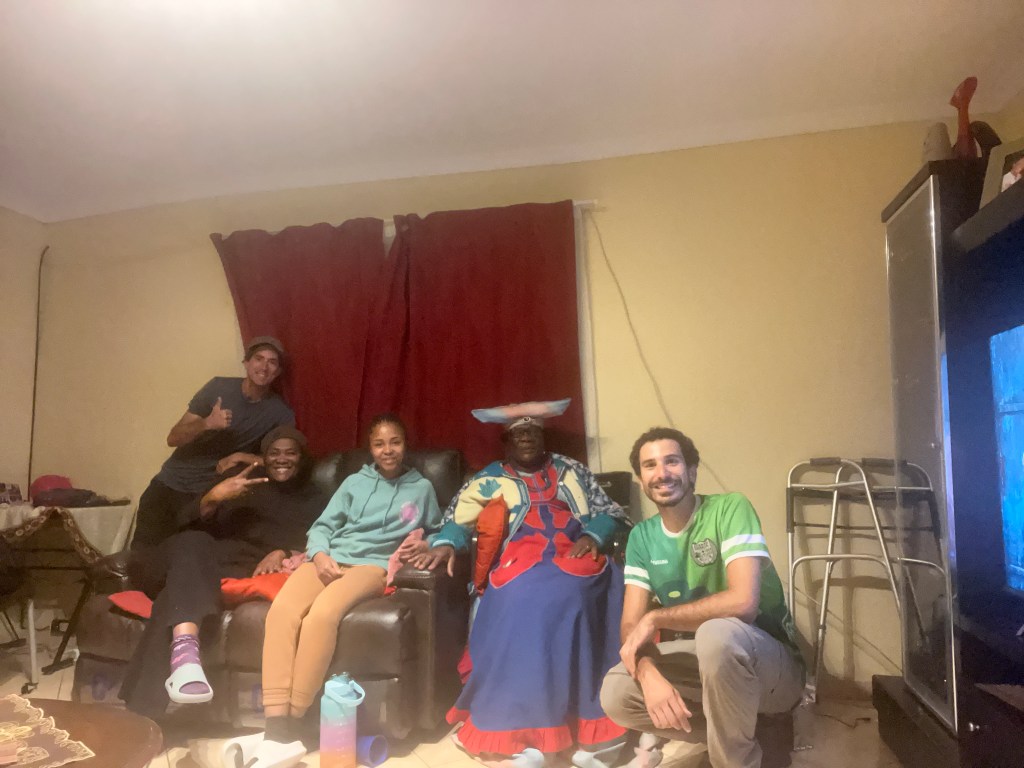
Jasana is waiting for us in her very nice living room together with her 80 year old mother, dressed in beautiful Herero clothes, who saws non-stop and looks curiously to us. She is a teacher at a local school, and her husband is a technician in the nearby Uranium mine, unsurprisingly controlled by the Chinese. They have a very friendly 13 year old daughter, and despite the house looks simple from outside, it is quite modern and well equipped inside. She has a spacious double bed room for us, what we really appreciate!
We agree that we will cook for them tomorrow, as today they look tired, and we feel like checking Swakopmund a bit better. We also want to watch the rugby world cup quarter final between France and South Africa at a local pub, despite our total ignorance of the sport.
So we cycle back to town, and enjoy a beer and some delicious fresh calamari at what looks like one of the best restaurants in town, who also has a superb view of the peer and the sun descending into the ocean. Now we are really celebrating! Now we are really celebrating. Mixed feelings of satisfaction and relief come to the surface. We are very happy to have completed safe and sound, with any major issues, a journey that one wouldn’t guarantee success for. We slowly try to order our thoughts and conclusions about the vast variety of cultures, people, wildlife, landscapes and experiencecs that we have come across. But this willl take some days, and a separate blogpost for that is probably best.
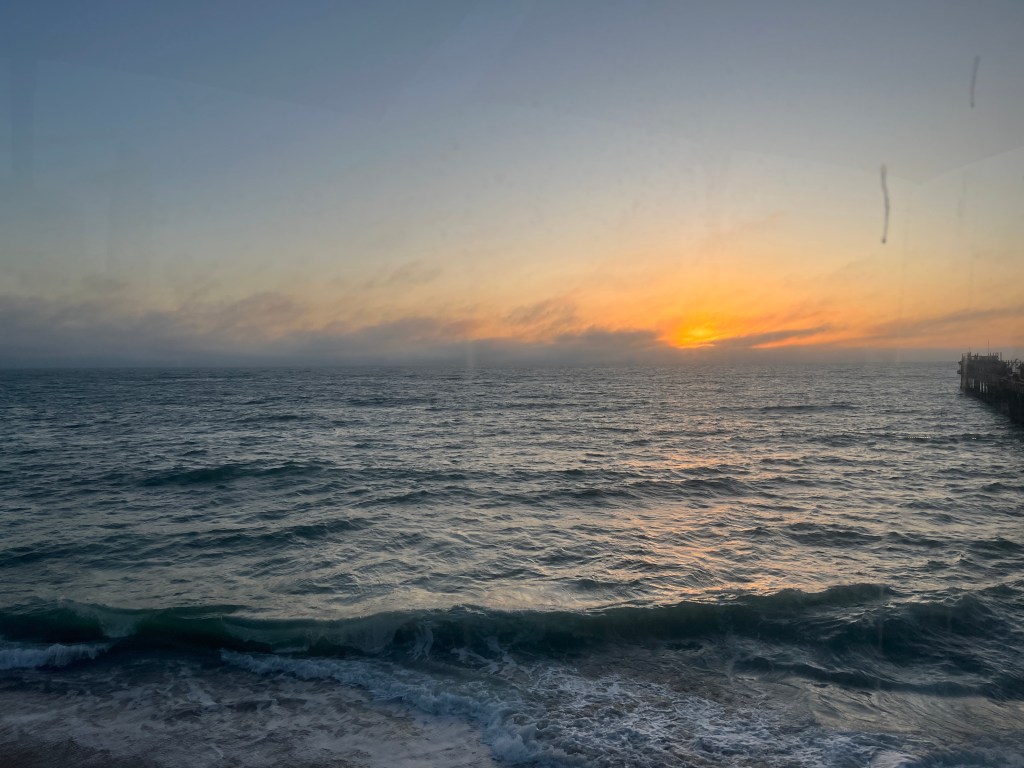
Anyways, once the last ray of sun hides in the Atlantic, we go again to the chinese for a second round of oriental food. The audience is almost exclusively Chinese, with a lot of reserved private rooms, which makes it quite authentic. Food is again delicious, and it´s time to go to the bar.
The pub is full of fans of the Springboks (the nickname for South African rugby team). Most of white Namibians have a big sympathy for South Africa. In fact, since Namibia only became independent from South Africa in the 90s, many of Namibians still hold South African passports. The game is vibrant, with a very tight score ,and Gaspard disimulates his enjoyment for the french essays, despite the atmosphere is far from aggressive like footbal in Europe. We don’t get all the rules and feel a bit lost, but the German retired group on our right looks much more lost. We talk to them in German, but they reply in a broken English. Either our German is worse, or Germans are always avoiding talking their own language for some irrational shyness, or both. Most likely both, actually.
We promised Jasana that we would be home before 11 PM, since she works tomorrow and she has to set the alarm up, but it’s 10:45 PM, there are 5 minutes left and the score is 29-28 for South Africa. We cycle home while checking online the live updates, only to confirm that France is out. Desoleé, Gasp.
We silently get in bed, ready to sleep without alarm clock. The next days will be quite bureaucratic, preparing everything for 2 week car road trip with our girlfriends, who arrive in 4 days. But by now, so many unknowns that were in the beginning have been revealed, quite some dreams have come true, and deep inside us there is a feeling of peace, fulfillment and satisfaction. Which we hope it lasts for long, as long as the memories about this journey, which will be hard to forget.
See you on the road, Africa, one day
Days cycling in this post (total, and final): 7, out of 84
Kilometers cycled in this post (total, and final): 715 km, out of 5484 km
Elevation gained in this post (total, and final): 3070m+, out of 38750m+
 Cycling Pirates
I have somehow missed this last post, found it only now.
A big applause of admiration for your grand African crossing from the Indian ocean to the Atlantic – on the bicycles!!! Hats off.
I hope our paths will cross again in the future, preferably somewhere on the African continent.