
Song while writing: Shay Unsane – African Swing
26/09/23 – “Rest” day in Maun. Safari in Moremi National Park
As expected, the bare 6 hours of sleep are not enough and we wake up pretty tired at 3:45. We prepare the sandwiches for the day, and get relieved when the taxi driver is telling us he is already on the way for the pickup time at 4:30 AM. He arrives with another guy in the car, something weird for such a time of the day. We meet our colleagues Erwin and Venanzi on time, like good Swiss, at 5 AM at the reception of their hotel, which is further down the river, quite apart from town, where most of lodges are. Given the long distance for the taxi, we were already suspecting that there was going to be an issue with the price we negotiated the day before (40 pula, around 3 Euro), but the 2nd guy in the car, who seems to own the car, gets a bit mad saying is way too little. We try to make him understand that the driver asked us to suggest a price and we agreed on 40, but he says that must have been a misunderstanding. Since it’s true that 40 would be way too little, we end up agreeing on 100 (7.5 Euro), and split ways.
Once in the car, we soon realize that Erwin has no time to lose. He drives fast, yet solid, dodging the potholes with mastery. But the speed and the corrugation pay a higher toll to us sitting in the back, and a slight car sickness starts to merge with the lack of sleep.
On the road leading to the main gate we already see many herds of elephants and antilopes. We are getting excited about what moremi has to offer and barely stop as we got spoiled with too many elephants.
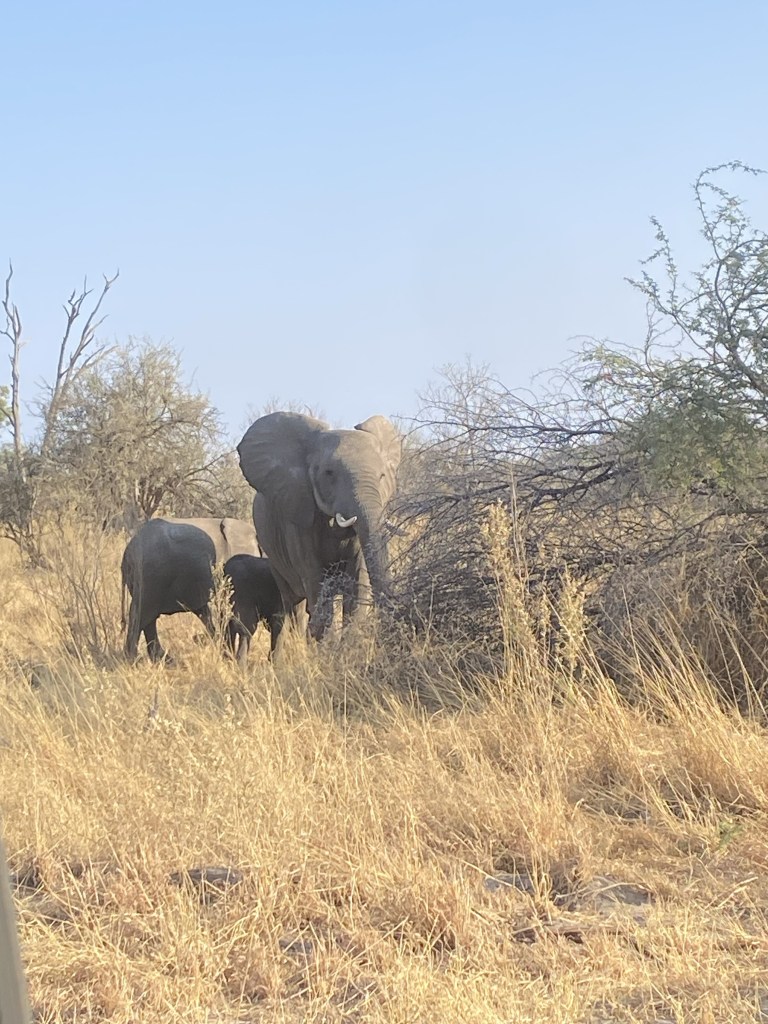
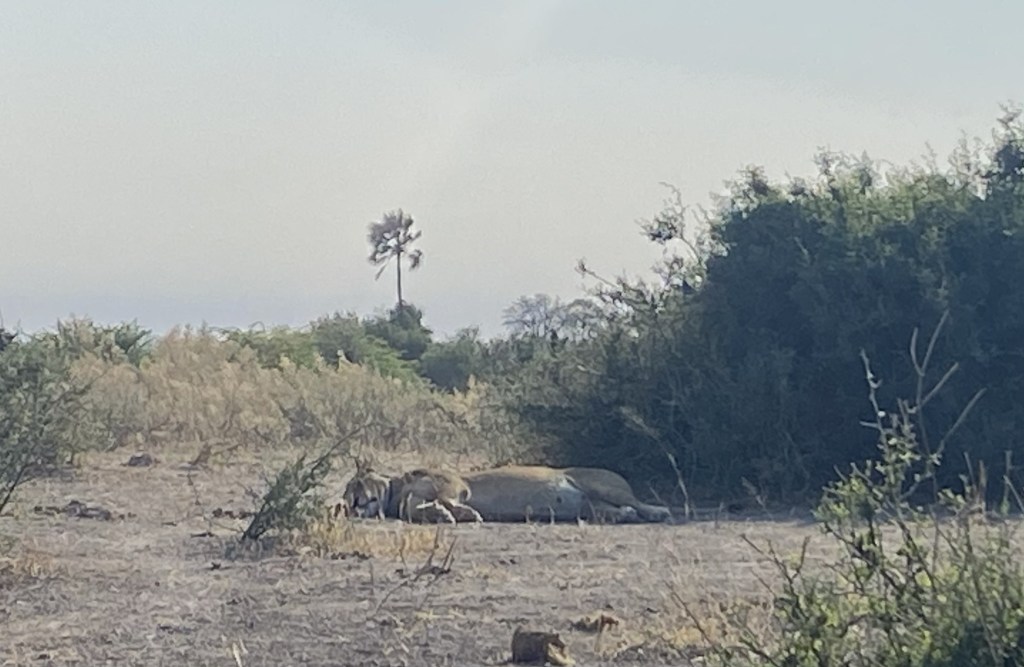
After a 2h drive we make it to the main gate as planned, at 7 AM, and without much hesitation, we start to tour around. Erwin seems to have a very clear plan of what to do, and he doesn’t bother to ask the jeeps we cross for insights of where the leopards, lions, or rhinos are (the hardest ones to see). His plan is to first head to the black pools, then heading back in the direction of third bridge and finally returning back to the gate when we are tired. We do not object as they are taking us in their car and we did not do any research on the topic. By now we have seen dozens of elephants, giraffes, gnus, zebras and specially antelopes, but in safari drives you always want to see the difficult ones. We start making jokes about paying beers to whoever stops the first big cat. We first see isolated animals but not much later, Venanzi shouts excited “Ein Loewe da!!”.
A lioness sleeps placidly under the enjoyable morning sun, 5 meters away from the car. If her belly wouldn’t move periodically, one could think she is dead. We continue, excited for what is yet to come.


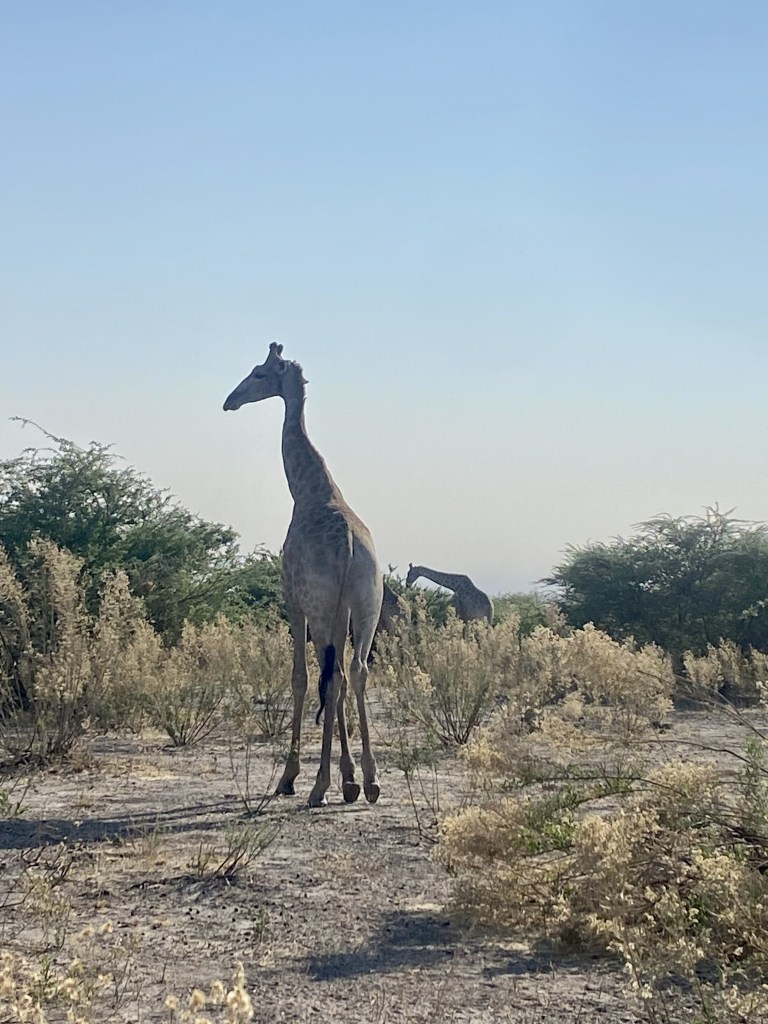
To our disgrace, what is yet to come is very little game and very sandy terrain, what shakes the car abruptly, as Erwin keeps a high pace. Sometimes we are concerned about Venanzi, who at his 77 years of age is grabbing the upper hand hold like if we were sinking. We hesitate to ask for a more placid driving, since we have joined their car with their plan, and we don’t feel we want to condition the plan.
We visit multiple drinking holes, but they are are miserably dry. The park is invaded with impalas, who at some point we start completely ignoring. We reckon we could have seen a thousand impalas on the day, some times a hundred in one shot. We do get a privileged shot of a ant-eating-bear, something not so common to see, and some colourful, elegant, big birds called secretaries. But the roads are far from well marked, and at some point, we realize Erwin is struggling to locate himself. We start using Maps.me, which happens to have the tracks of the park, and, funnily enough, end up again at the main gate, but coming from outside the park.

The park crew looks confused at us. Apparently we have gotten in a private game reserve, what could be punishable by law, but we didn’t see any sign of “not trespassing”. Gaspard and I ask for some insights on areas known to have cats, and we set direction towards the Kimi lagoon. There is a bit of water leftovers, with some hippos and crocs around, but no sign of cats. An organized safari driver asks us if we saw any, and he tells us an area where in the morning a lion was having a zebra for breakfast. But Erwin thinks that the lion is probably long gone, so we go towards the Third Bridge area.


By now we all need a break, and we find an open space where we can enjoy our sandwiches out of the car, without fear that we wiill be the sandwich of a lion. It’s already 12:00 and we all seem to be pretty tired except Erwin. But we all want to give a last push to try to find cats.
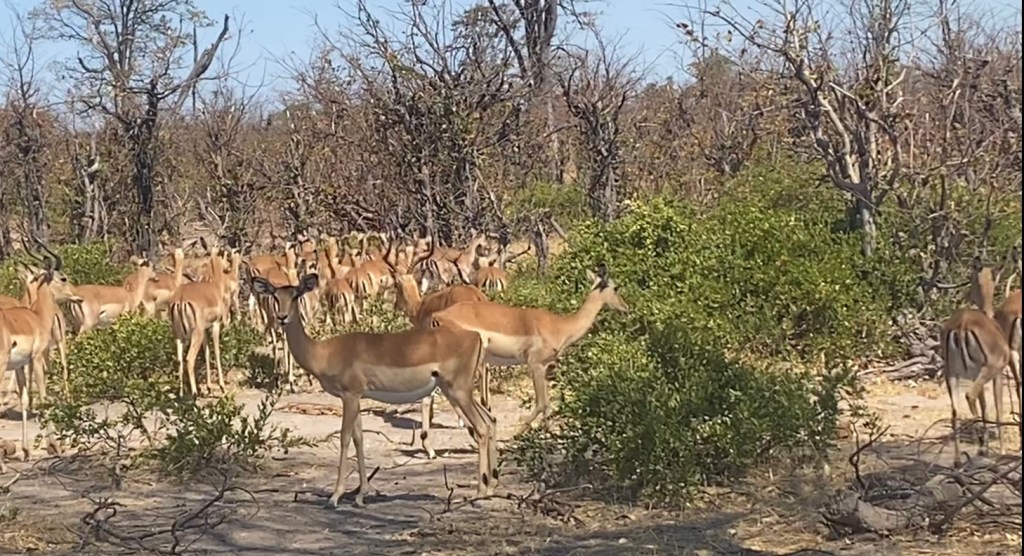
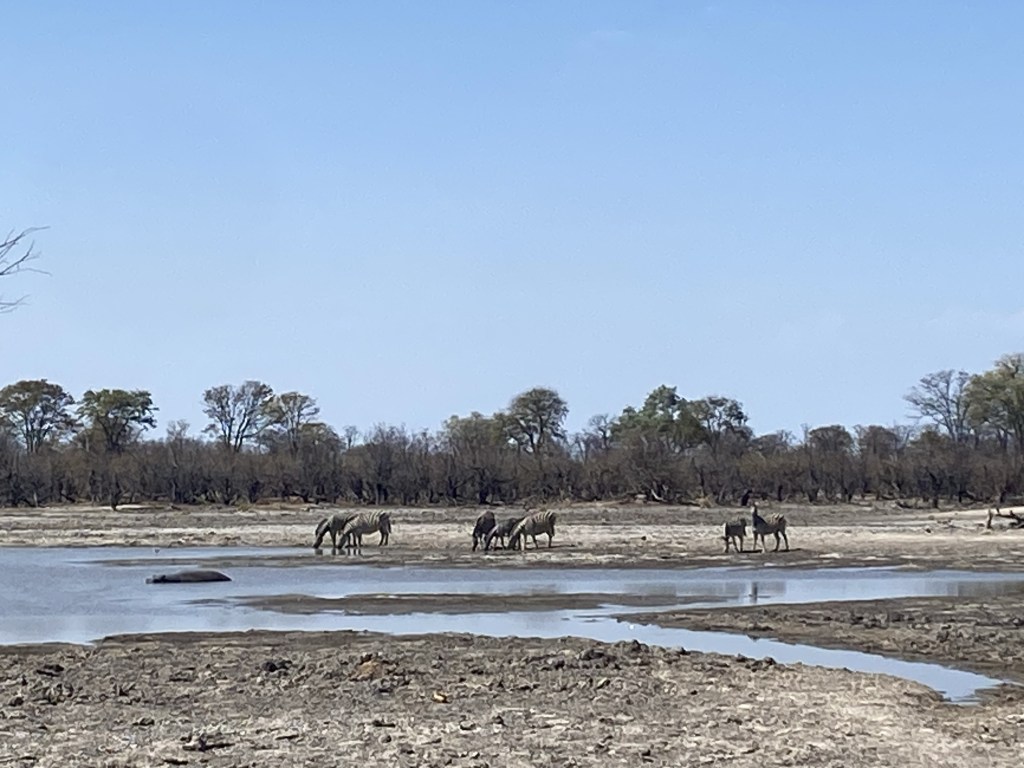
However, although the north of the park does have many lagoons and more signs of survival options for the fauna, we don’t manage to find any lions or leopards and, a bit saddened, agree on head towards Maun again. The highlight is a river crossing that Erwin masters perfectly but makes the car lose its plate, as we will realize later.
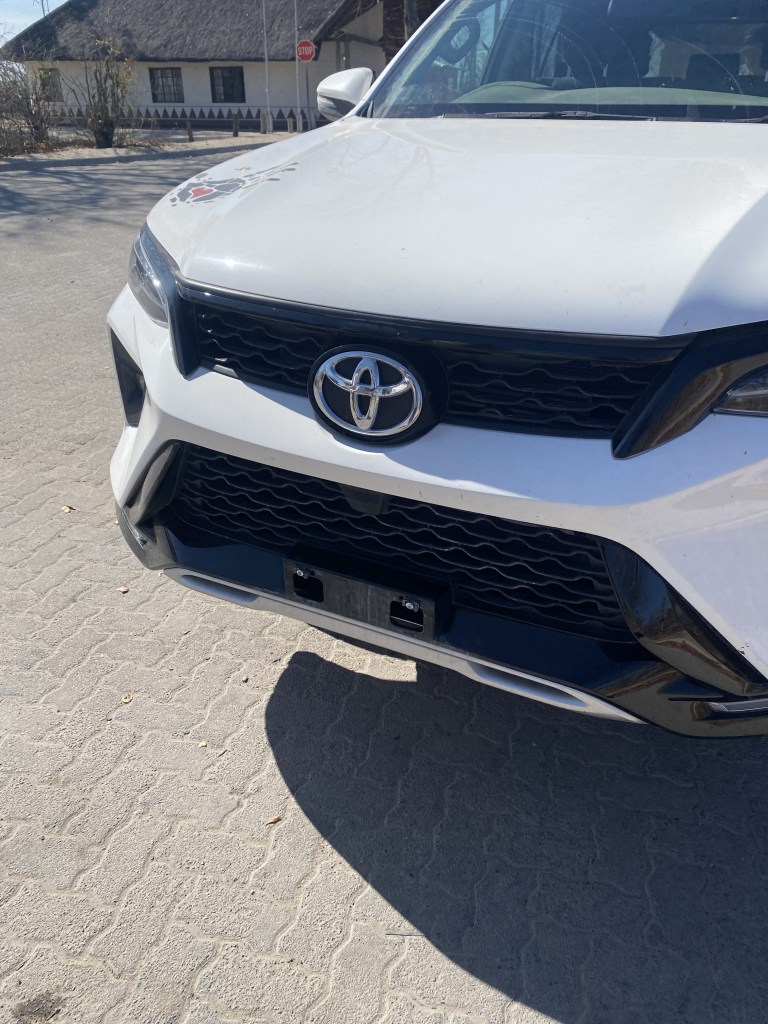
Once out of the park, we insist on paying their entrance fees as a gesture for their kindness, which they finally accept. Venanzi takes over driving, and, despite his advanced age, his experience as truck driver, snow machine driver, and post bus driver, proves he is far from retiring. He takes over all slow cars, and points out the mistakes that the other drivers do.
Once in Maun, we decide to have a beer on the terrace of our Airbnb to farewell our joint expedition. Our roommates Sandra and Fiona are around, and after a bit of chit chat, Venanzi and Erwin leave us, after exchanging numbers and planning to pay them a visit in their lovely Surselva area of Grisons.
By now, Gaspard and I are in a rather catatonic state, since we have been vibrating in the back of the jeep for the last 13 hours. We confirm Sandra and Fiona that we are keen on joining them for a mokoro canoing trip in the Okavango Delta tomorrow, which they have managed to negotiate with different agencies, and find quite affordable transportation to the starting point. Since the alarm clock is set for 5:15 tomorrow, we rather go in bed already, so we can recover a bit.
27/09/23 – “Rest” day in Maun. Mokoro canoeing in the Okavango Delta
Sandra arranged the mokoro trip directly with the Community trust that does all Mokoro tours in the Okavango. They employ local population and seem to operate like a cooperative. By booking through them you save the commission of the agency. But you have to go by yourself there, which requires a skilled driver. After 5 years of developing travelling skills, no doubt that Sandra found one: the boyfriend of the sister of the owner of the Airbnb.
The guy pick us up at 6 AM, so we can be there at 8, the time that the trust has asked us to be there. The road is indeed sandy, and the driver has to go in long range twice, but it’s not even close as bad as the road in Moremi. We arrive a bit earlier, but the community trust will only arrive at 9, what makes us all a bit impatient. We could have rested more … Some few tourists arrive from multi day trips with Mokoros full of luggage, while not many more are waiting with us to be embarked in a tour.

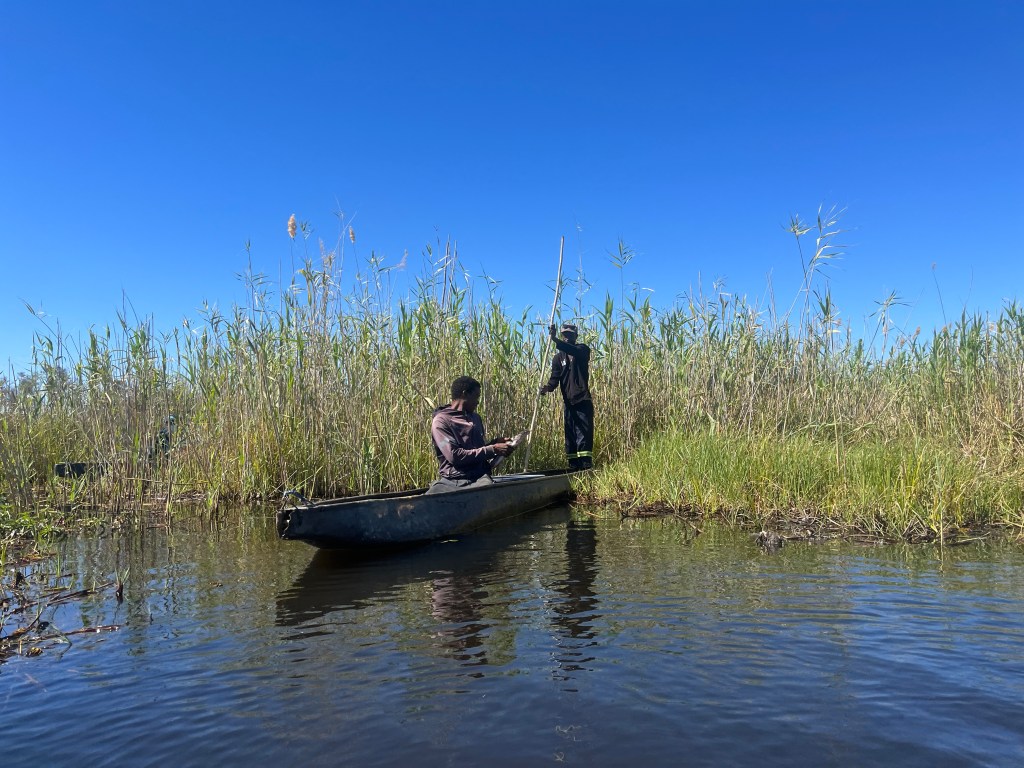
Once the community trust people arrive, they assign drivers to different groups, and we go with a young man named Lex, who has just started working, and a more veteran, who likes to be called Papillon, butterfly in French. Butterfly is shorter than most men due to his half bushmen origin. Bushmen are a different ethnicity with distinct physical characteristics: they are smaller than Tswana and have a brigther skin colour. More about them later. A maximum of 2 passengers can go on each Mokoro, with the driver standing at the back, pushing with a long wooden stick from the bottom of the river to move through the channels. The mokoros are traditionally made out of a single wood log such as jackalberry, ebony, mangosteen or sausage trees, however due to deforestation, they have started using fiber glass.
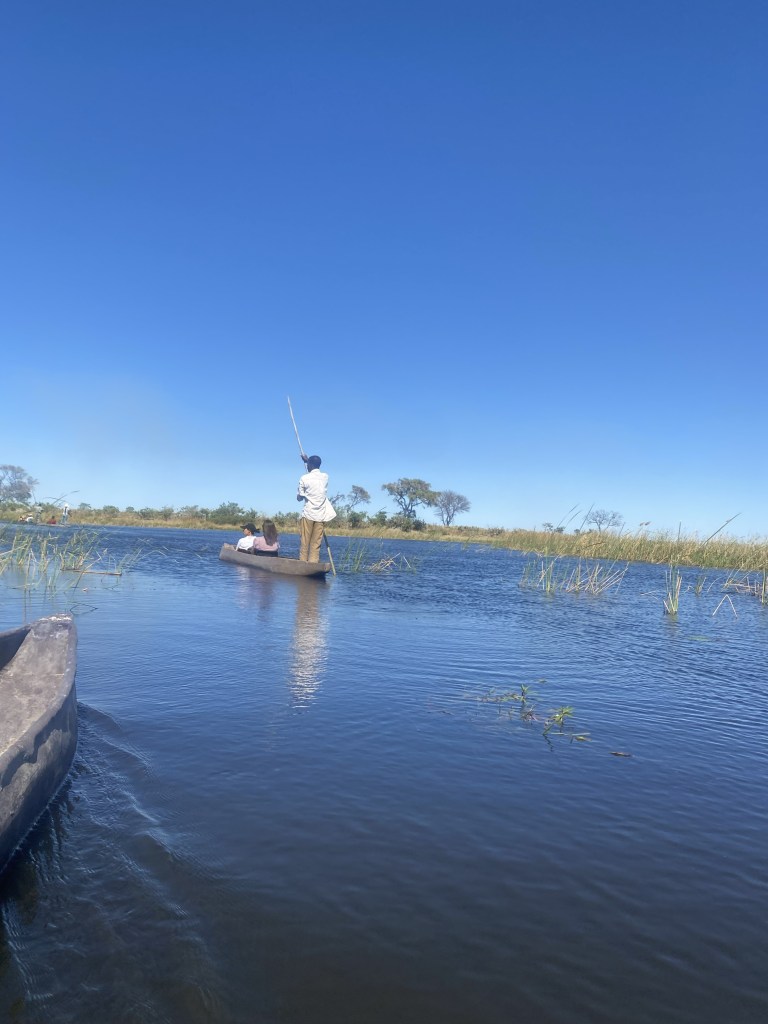
As the ride starts, we are a bit sad that we are just sitting and don’t have to paddle or anything. But later in the day we will get our chancce to drive the mokoro, and will realize is not so easy. The water is deep blue and very clean, and we cross a system of small lakes, connected with thin channels made by the hyppos. We see hyppos submerged in the water, and rely on the skills of the driver to not get too close. Mokoro are still used as the main load of transportation by local people as a mean of transportation (taxi) as well as to go finishing.

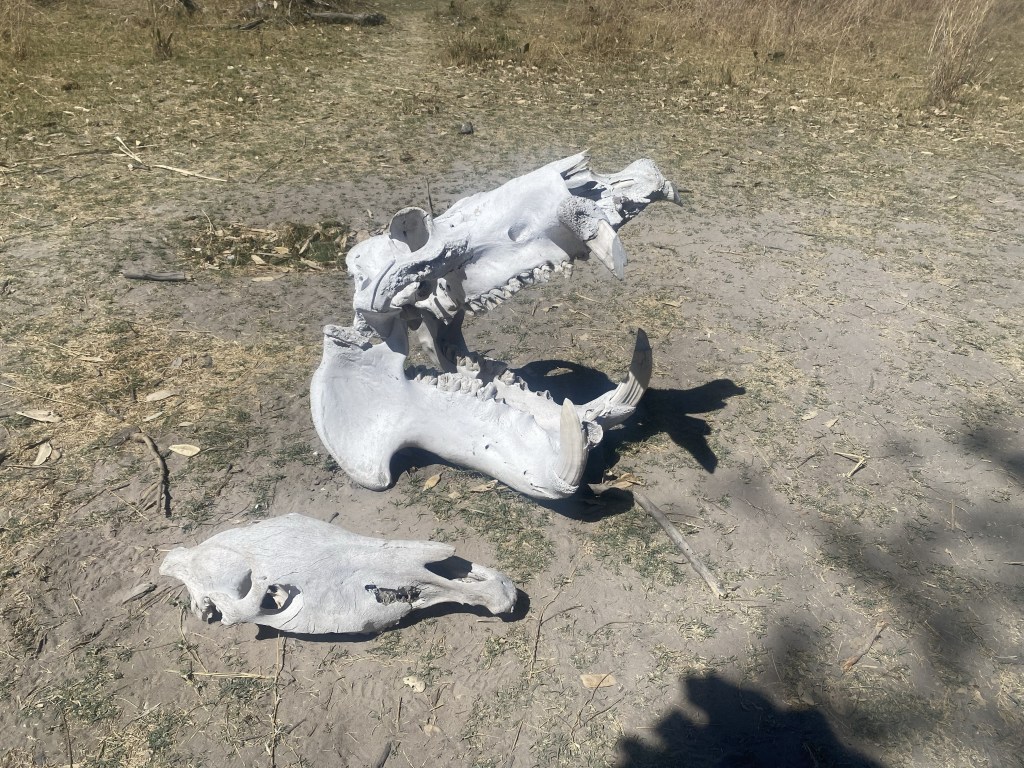
After one and a half hour of comfortably being driven through these shallow waters, we arrive at the stop, where the walking safari starts. We really wonder how they manage to do multi-day trips, since the water level is so low, and we don’t see any way further. Next to the place we stopped to drop our bags there is the skull of a male hippo. Males can be recognised by the four large teeth they have, two at the top two at the bottom, contrary to the females who only have the bottom ones.


The walking safari allows us to get pretty close to zebras, gnus and antelopes, who populate the grassfields offered by the level reduction out the delta. We get to see a dead buffalo decomposing, and more and more hippos. The fact that most of the skin of the buffalo wasn’t eaten confirms that they are no lions in this part of Botswana and that the buffalo is most likely dead of natural causes. Hyenas ate the meat as well as small bones but left the spine and ribs untouched. If they were to starve they would drag the carcass in the water and let it seat for a few days to soften the bones. Afterwards they would come back to feast on the bones.


Back to the mokoro, after a lunch break, we all try to learn the ropes of mokoro driving, with different success levels. We all manage to somehow manoeuvre it however going in a straight line is incredibly hard. Let alone spotting bubbles from hippos and avoiding running into them. The guys obviously don’t trust us for the whole return proccess, and take over again.
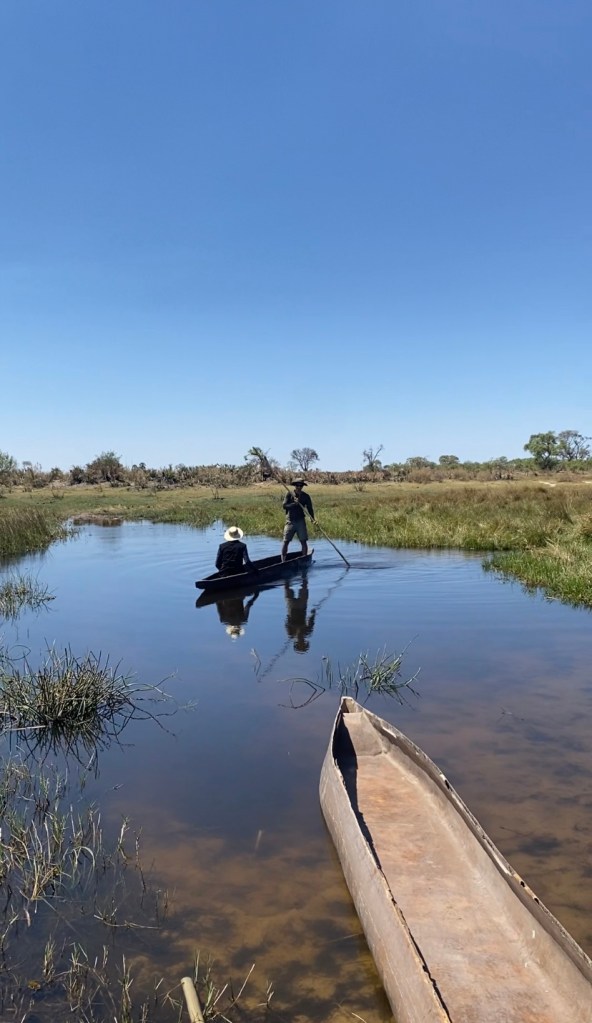
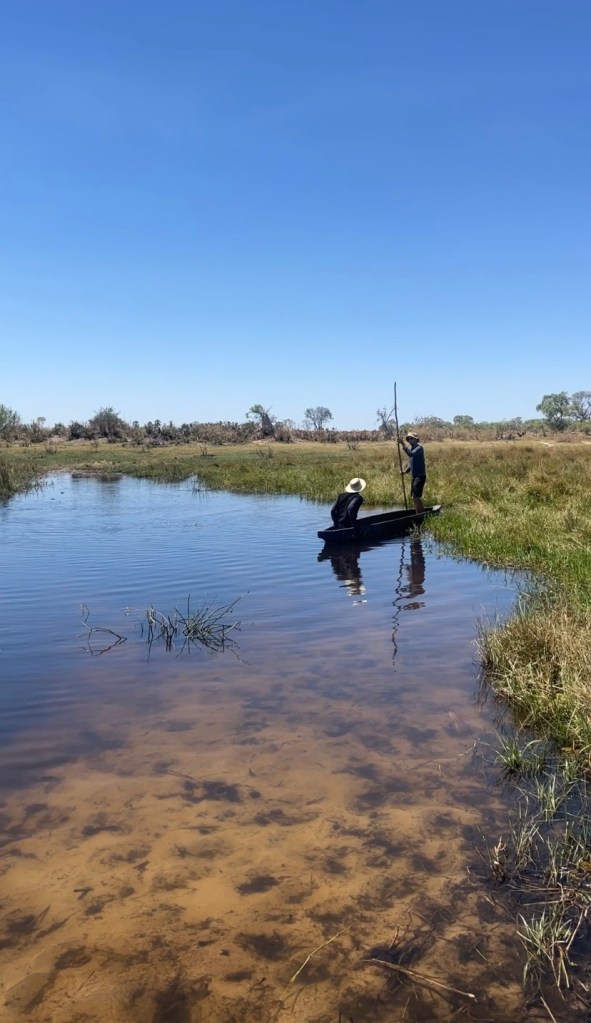
All in all, an interesting experience, wildlife definitely not being a highlight during a one day trip. Something tells us that one can get more by deepening in the delta when the water level is higher. One of the highlights of the day is the bonding with our roomies, whom by now we know pretty well. We really get along well and, most importantly, have fun together!
Back in the Airbnb, we all eat leftovers from yesterday’s stew, while Gaspard and I decide to stay one day more, so we can plan the lest leg of Namibia properly.
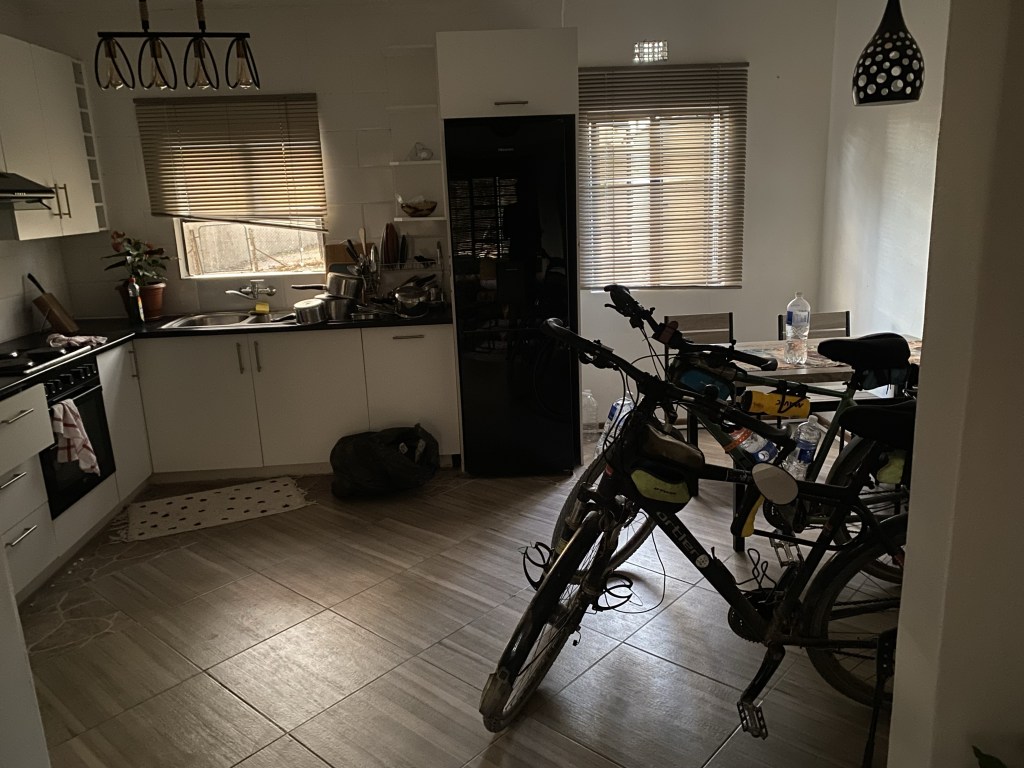
The bad news of the day is that we read in the Cycling in Africa whatsapp group that a swiss guy got his bike and passport stolen in Maun, the same town we are at. Poor guy, his trip seems over, or paused for a while. We offer him our help and take our bicycles inside the house, scared of ruining the trip now that we are so close to finish.
28/09/23 – Real rest day in Maun.
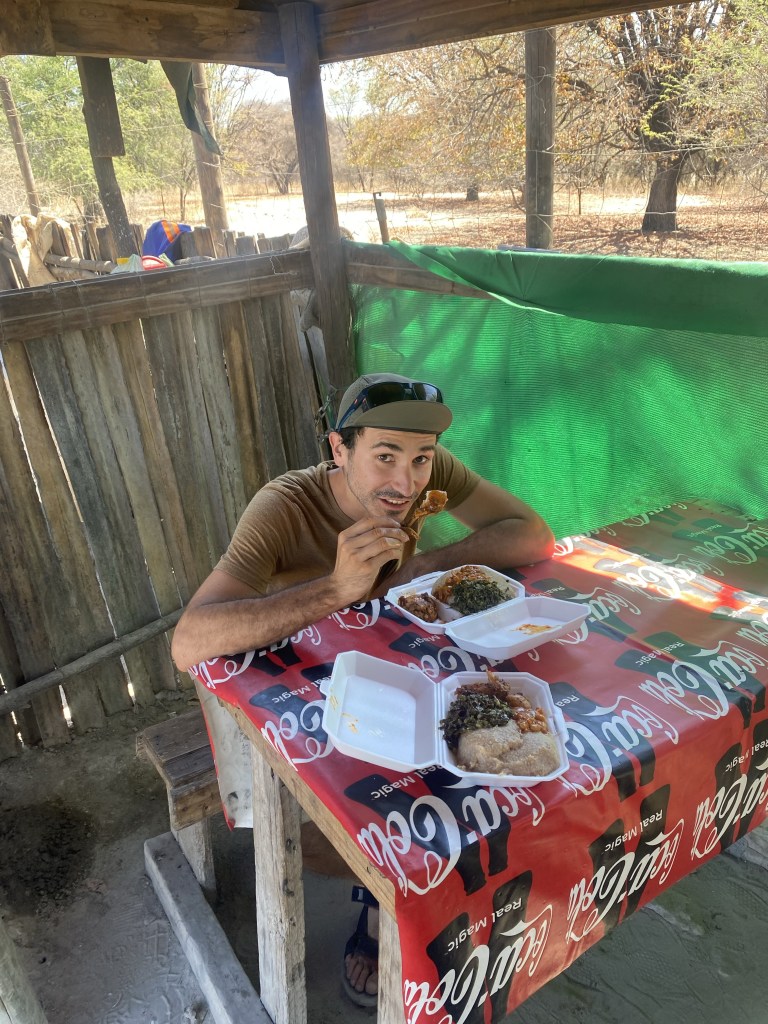
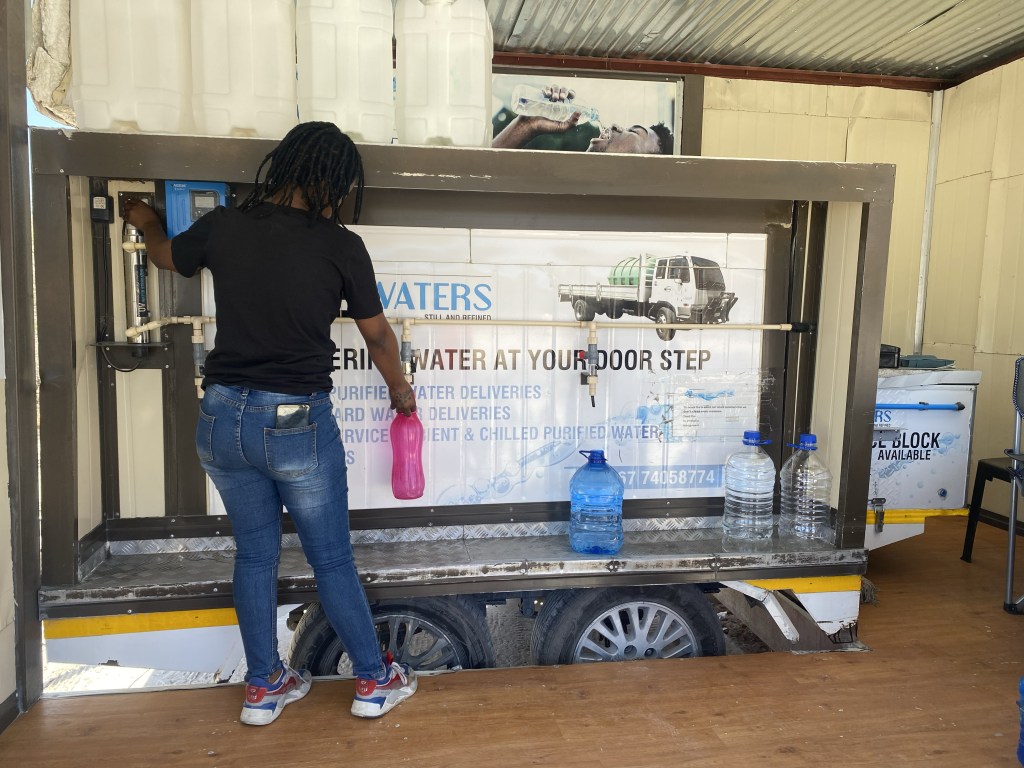
We finally enjoy a real rest day, meaning no sport, no travelling, no activities, no partying. We do buy all the supplies we need for the next few days, stock up water in the water station, and get a taste of local food for the usual 2€. By now we are expert in the supermarket as we only buy instant noodles for lunch, rice or pasta for dinner. The new discovery are cans of spicy beans or tofu which transform our cooking. Tap water in most Botswana is very salty and local people either buy water from the shop or in large town go to refill station. Compared to other city we didn’t see any borehole on the road.
Javi gets his hands on the blog and, once he is done with post 9, he accidentally deletes it. 1 hour and a half of writing to the rubbish. No multiple control+z in notes of iOS, so no chance to recover it. Thanks Apple for your minimalism. Luckily, Javi had done yoga and meditation in the morning, so manages to put his anger together and rewrite it.
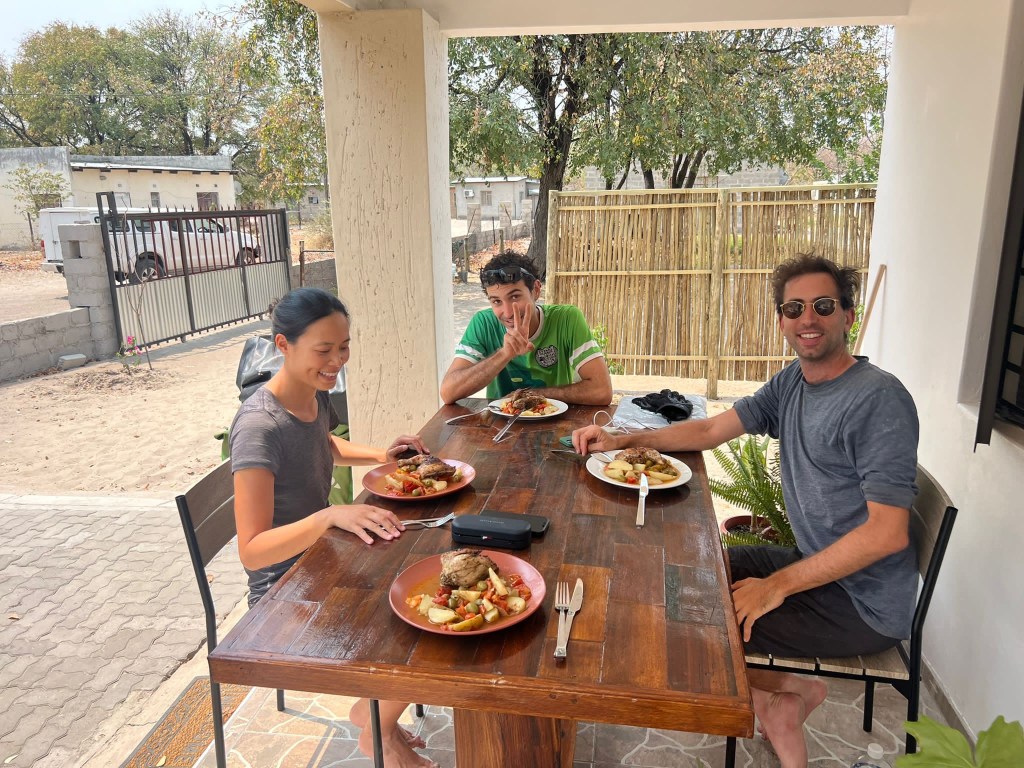
We enjoy a last drink on our terrace with the girls who start to ask many question about our better half, first date and future plan. We also learn about the start of their relationship: a four days first date and a week holiday as a third date.

For the final dinner with the girls, who are also leaving tomorrow, Sandra cooks us a fantastic bolognese pasta, with a Greek salad as starter and iced lemon sorbet, and pineapple for dessert. Really funny how Sandra and Gaspard compete for the best cook award while Javi and Fiona profit from the competition.
29/09/23 – Maun – Sehitwa. 104 km.
We say bye to the girls, with whom we have shared 3 entertaining and relaxed day. We wish them the best on their impressive journey and hope that roads connect us again in another corner of the world.
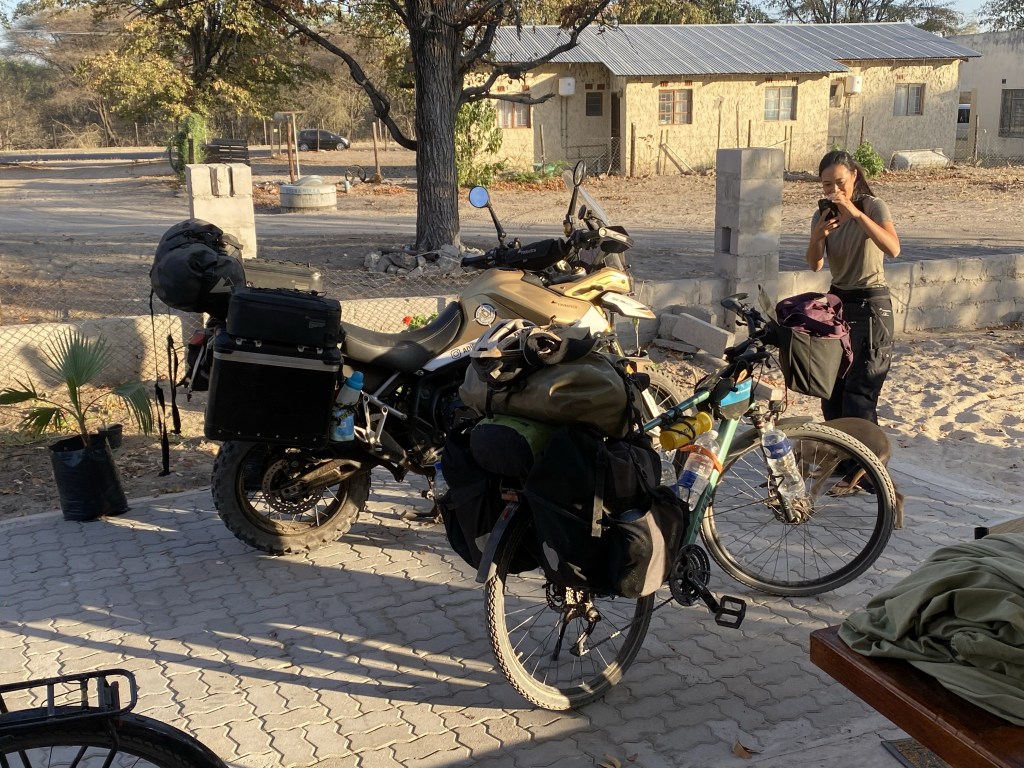
We also slightly regret leaving the town just now, as in two days is Botswana’s independence day and a big party seems to be about to start. But after a prolonged break of 3 days, our bodies, so used to moving daily, are asking us to continue our own sport party.
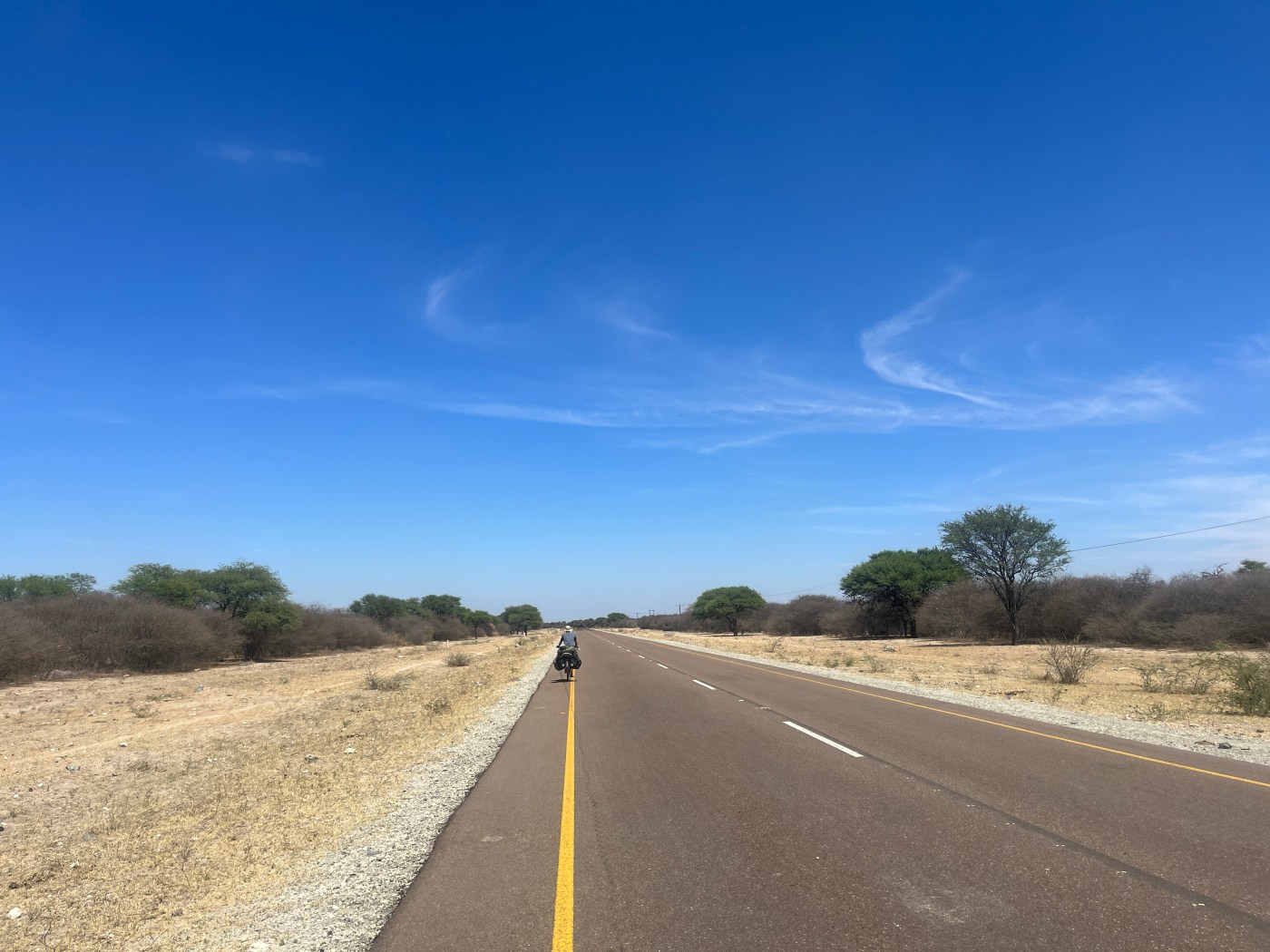
So we kick off the cycling, and soon we are out of Maun. The landscape remains the same as before: bushy, flat and dry, but the difference is that, instead of wild animals, we mostly see cattle on the sides of the roads. We will learn that Tswanan families typically have 4-5 cows and some dozens of goats, and they let them roam around their villages. We however struggle to pass through villages, so we pressume they are in the inside. Somehow not being on high alert due to elephants make the day less interesting. Despite the beginning of the rain season, not a single drop has fallen in Botswana and the 38 degrees without clouds force us to finish our day by lunch time to survive.
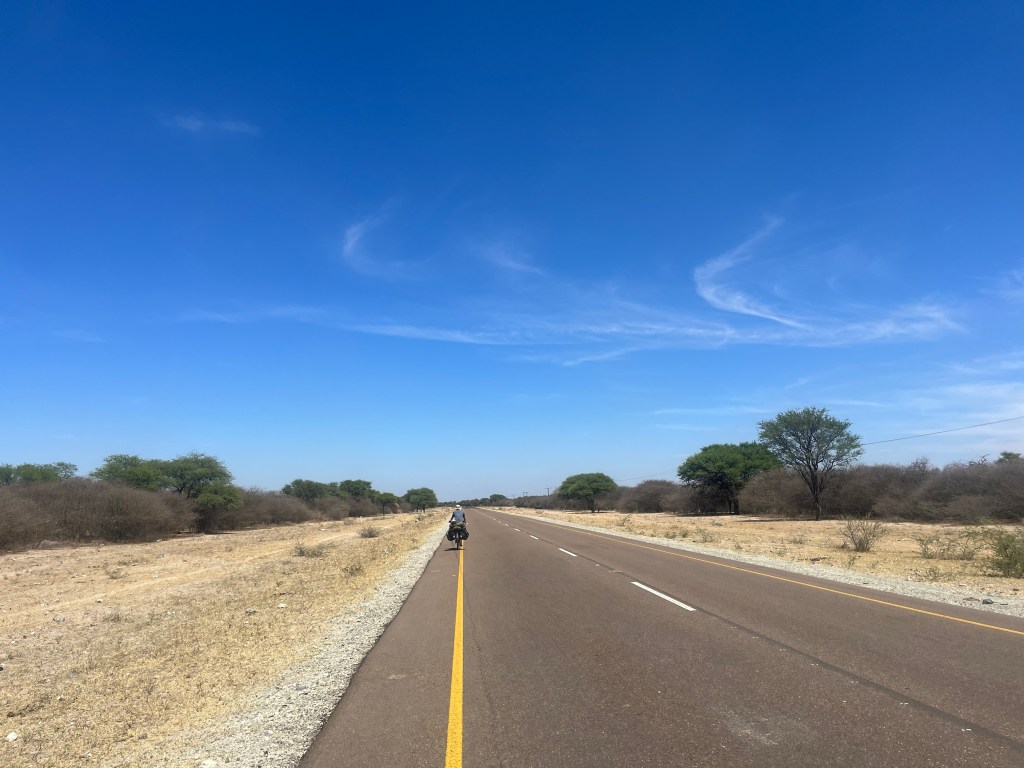
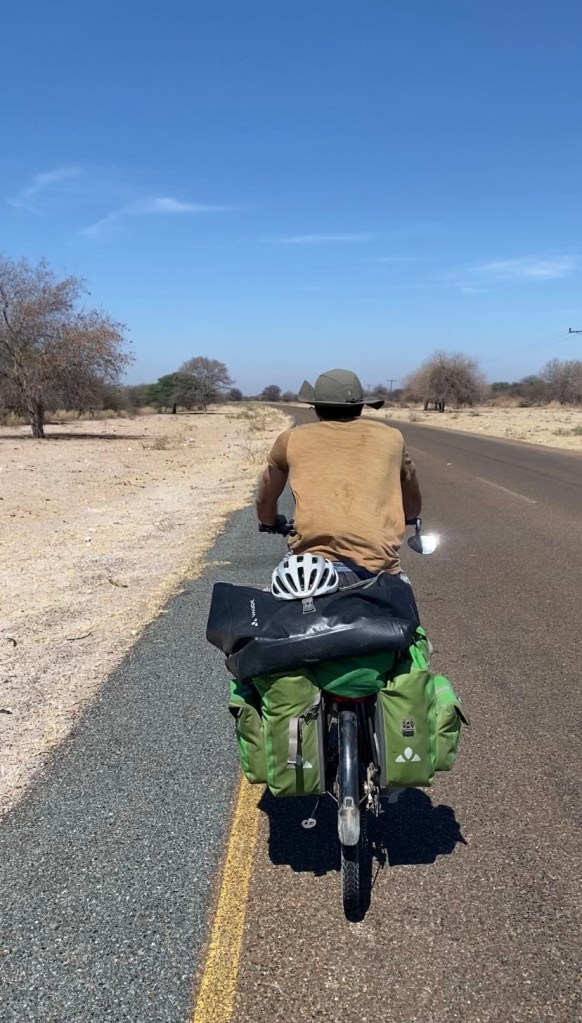
After a monotonous journey of around 6 hours with mild wind, we make it to the town of Sehitwa, where we find a local restaurant serving a filling meal of rice, chicken and vegetables for 30 Pula (2.5 Euro). Next door from the restaurant is a bar with extremely loud music. Many of the men around the bar are drunk: one sleeping in the shade under a table, another one walking with a plastic bottle cut in half and used as a wine glass (holding it from the narrow part where the lid is). The remaining men in the bar playing pool (a very popular sport as many small villages have pool tables).

The town is mostly composed of modern-like houses, in a quite good state compared to other countries. The streets are very spacious and it gives the feeling of a town of the wild west of the US. In the map, there should be a lake, which makes us curious given the drought conditions, so we go check it to realize that it’s actually a green forest, where local authorities plan to set up a nature reservoir.
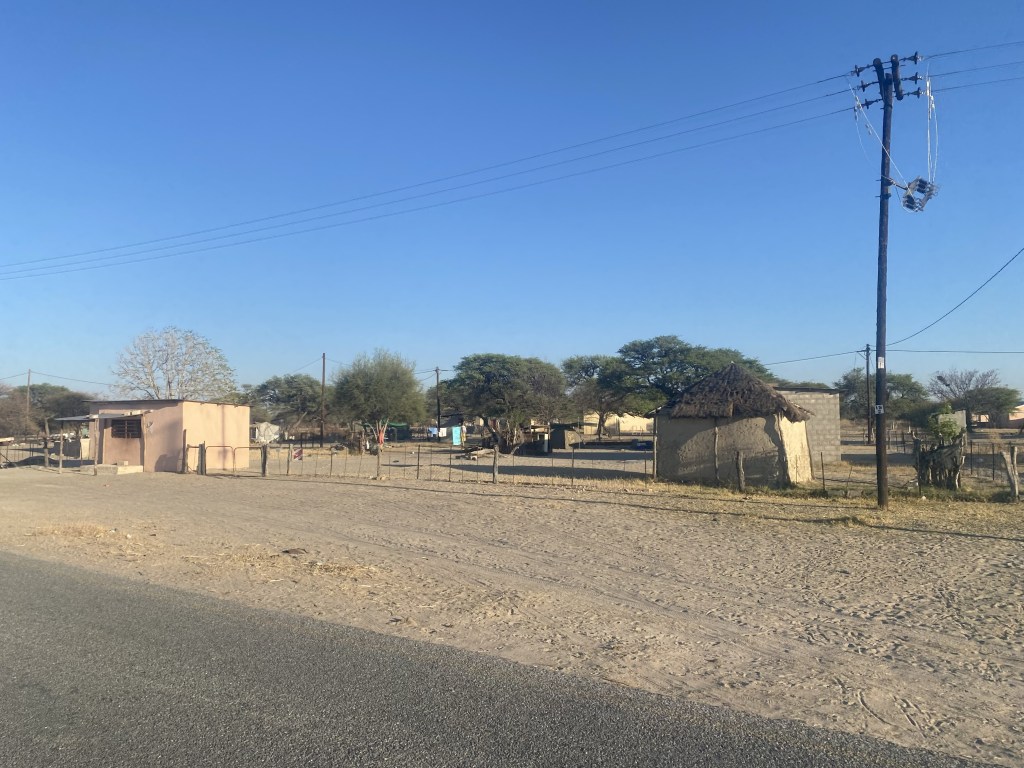
We go to the local school to ask for camping, aware that it’s holidays at the moment due to independence festivities, and the school should be relaxed – i.e. without many kids. The ward is very relaxed about our proposal, and doesn’t even check with the school master. He does ask us to buy him a coke when, a bit later, we go to a bar nearby to ask for tap water, which seems to be drinkable and safe in the area. The school as well as all the houses in the area are fenced which make us wonder: is it because of two legs Homo sapiens or four legs animals…
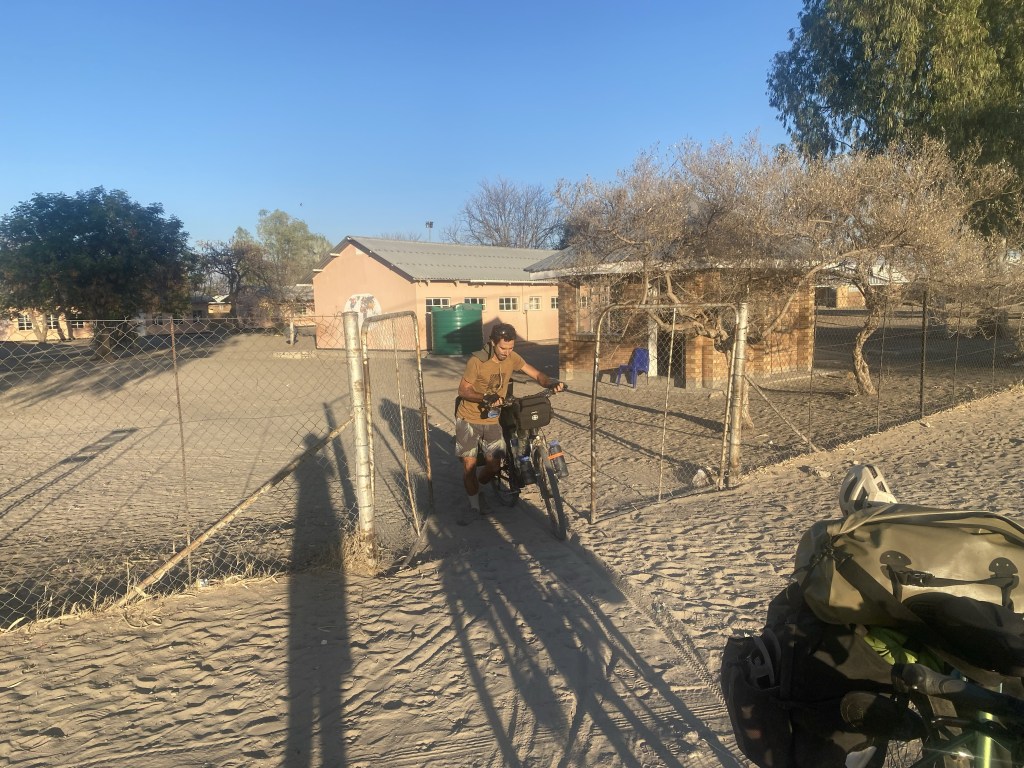
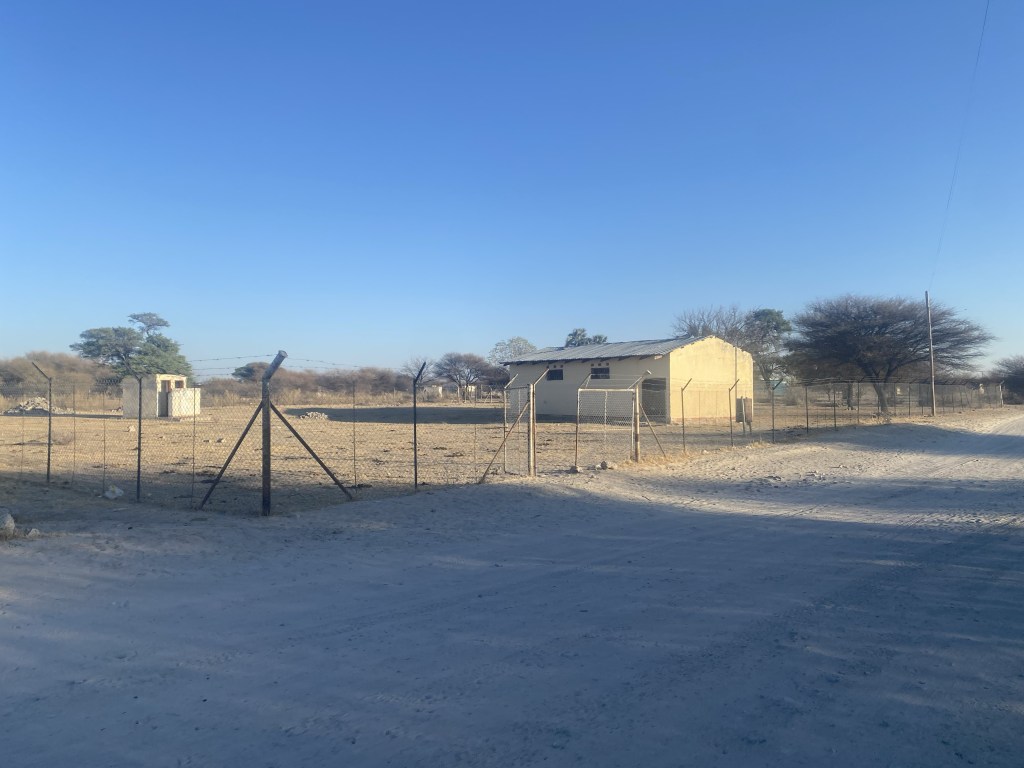
The bar blasts unpleasantly loud music, as usual. We were considering to relax there for a bit but, after the local drunk audience starts to ask us for a beer and complain that because of us they have lowered the music, we decide that we will relax better by the school.
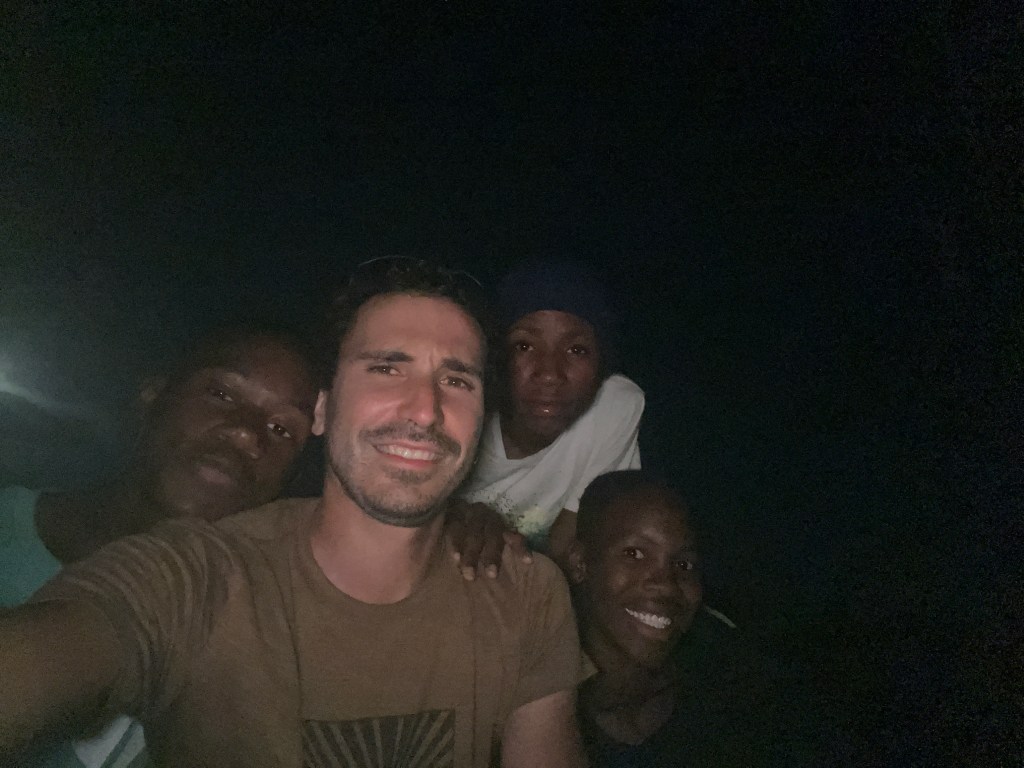
At night, some teenager children of the teachers, who, as usual, live on the school premises, pass by to take pictures with us and learn from the trip. Javi finds surprising how touchy one of them is, something we haven’t experienced before. He is the son of the school master and is of Namibian origin. Interestingly enough, we will meet a lot of people of Namibian origin in Botswana until arriving to the border, many more than Botswanans themselves.
30/09/23 – Sehitwa – El Fari Camp. 127km, 360m+
Today is a hard day and we now it. 130 kms separate us from the next possible camping spot: El Fari Camp. There are some villages before but way too early. We arrive at the first one at 11 am, where we see locals preparing for the independence day. The heat makes us (particularly Javi) crave for sugar in the form of Coke. We find it in the 3rd shop we ask, with children looking at us while a drunk man tries to get some Pula out of us. We realize how many of the kids have particular ethnic features: brighter skin, like if they were mixed, and rather sharpen, Asian-like eyes, with very dense, thick, yet short, curly hair.
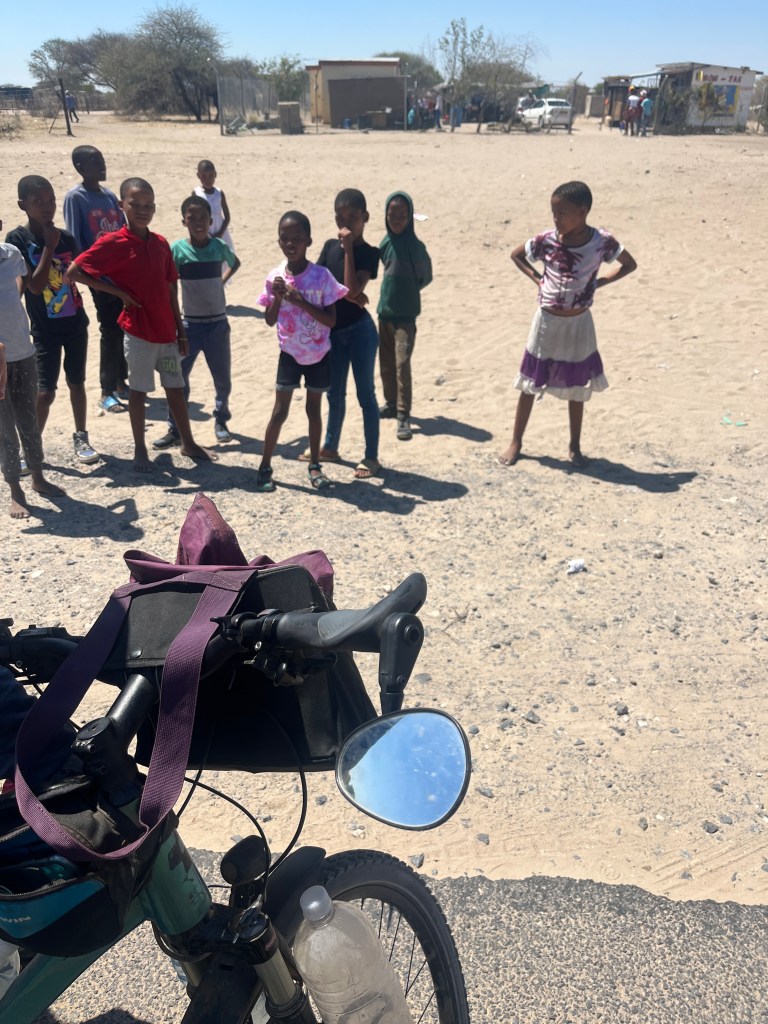
They are San, the original inhabitants of Southern Africa. Until not long ago, they were leaving in the bush, living like hunter gatherers, hence their nickname of bushmen. They look mysterious and beautiful, although we will learn that the too-fast jump from stone age to industrial society has been very harsh on them: they are very poor and struggle with sedentary living, not least because the Botswanan government has evicted them from their ancestral land in the Central Kalahari, so diamond mines and game reserves can be erected.
The last 20 kms of the 130 km that we have on the menu today prove particularly hard. We arrive at the junction for the camping, where a disgusting kilometer and a half of sand waits for us, forcing us to push the bike under a horrible sun. This make us hate our life.
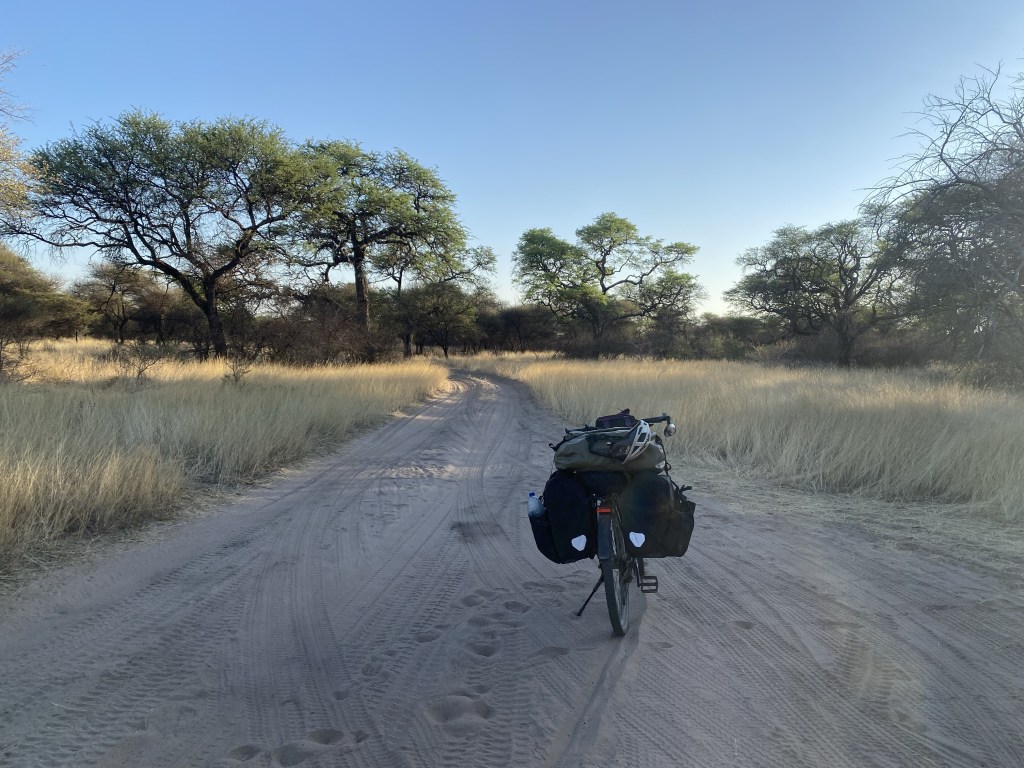
The small camping belongs to an Afrikaans cattle-farmer family that lives in a simple house in front. The showers and toilets (here they call them ablutions) are as clean and modern as one can imagine, but before cleaning we swallow half a kilo of pasta with tomato sauce, in the case of Javi topped with a tuna can (Gaspard likes tuna as much as eggs: i.e. nothing at all). The daughter of the owner brings us a huge bag our ice cubes to fill our bottle and get enjoyable water and give us the cyclist discount for camping 50 pula (3.5€) instead of 150 pula.
We talk a bit with the daughter and her mother, the owner. They seem to live a simple, work-oriented life. We realize that the fact that we are without a t-shirt seems to disturb them (the mother avoids looking at us while talking), so we suspect they are very religious. They are however very nice to us and we learn a bit about the area. We do note a slight air of superiority when talking about black people (“their understanding of farming is not like ours”, or “Why did they have to change the name of that town from “Kalkfontein” to “Tsootsha!”). They also warn us about snakes, since there are quite some black mambas around, a snake breed whose bite takes 10 minutes to kill you. Surprisingly, they live without antidote, despite the black mambas kill now and then some of their cattle. They say that for some reason cows follow them, unaware that they are following to their own death.
We have some time to spare so we do a yoga session (Gaspards join for the first time), before cooking dinner and falling immediately asleep.
01/10/23 – El Fari Camp – Crossroad antenna. 115 km, 200m+
Our objective today is to arrive early to Ghanzi, a mid-size town of 20’000 inhabitants, 70 km away, where we hope to catch up with the independence celebration. Wind is pushing us making us arrive at 10:45 in Ghanzi.
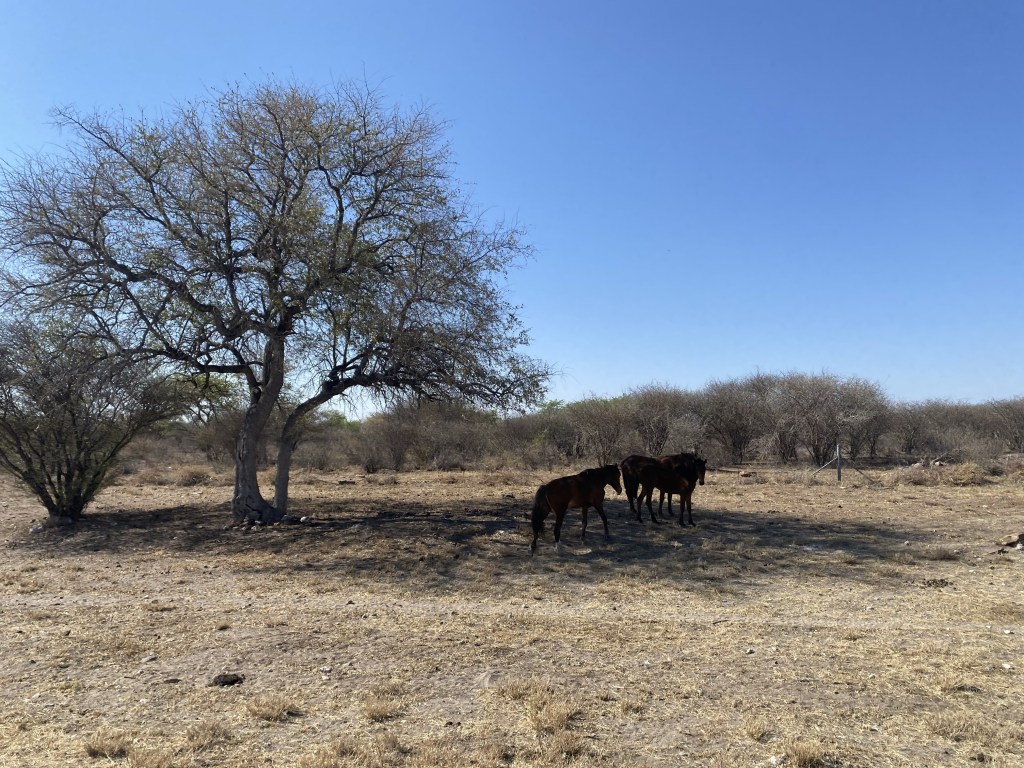
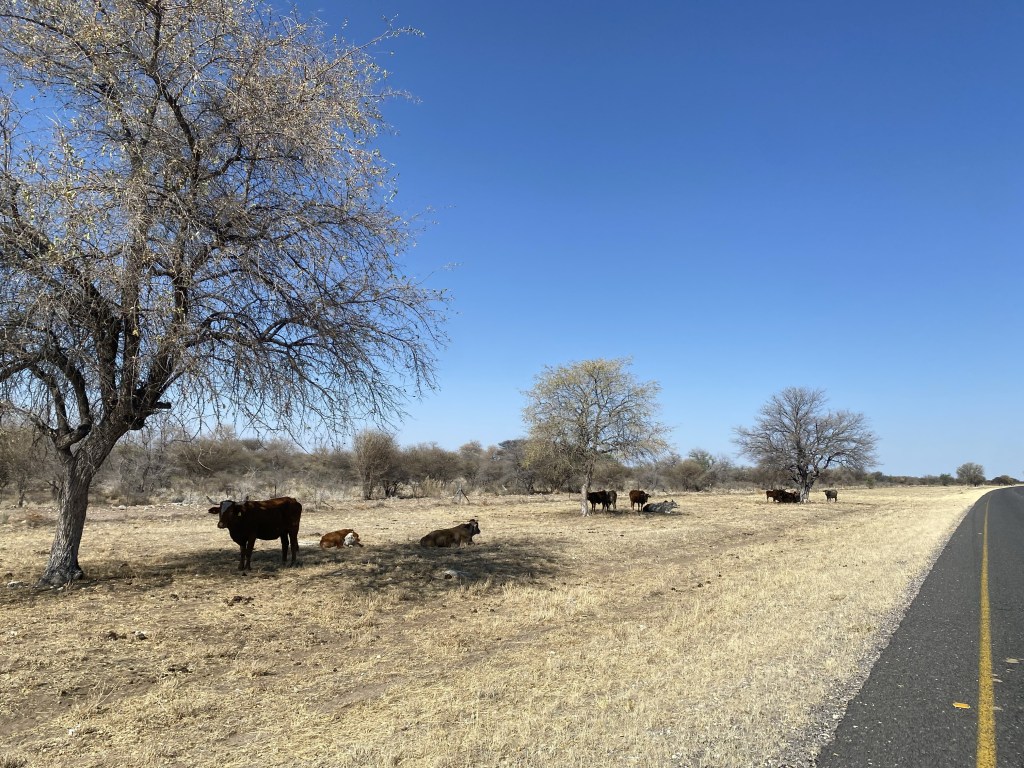
Bad luck: when we arrive, the receptionist of the main lodge tells us that the celebration was actually yesterday. Someone misinformed us, but we can’t remember who. Since the town doesn’t have much to offer, we decide that we will continue after a shopping session in the local Choppies, the competitor of Shoprite. We buy water, supplies and take away food, since it doesn’t seem to be local restaurants around. It’s funny how when asking people for a local restaurant they very often point us to the take away of the supermarket.
At the entrance of the supermarket, many San people, mostly kids, beg for money, whispering in an almost unintelligible way, in a language we can’t understand. Botswanans tell us that they have their own language, and they struggle even with Tswanan. The worst is yet to come: when we finish our take away chicken and pasta, eating on the floor in the street under the shadow of a corridor, we throw the plate in the bin. The kids go immediately to the bin to pick the plates, and split the chicken bones among them. It hurts us so much to witness the scene, while the kids seem to not care at all, they seem in fact happy. What a cruel world we live in.
After checking the wind forecast, we realize that, if we continue 40 km south, until the road cross where we have to go west for 500 km until Windhoek, we will profit heavily from the wind tomorrow, as there are up to 28 km/h coming from the east. So we continue until the cross road, where there is an ioverlander wild camping spot marked. As we have been surrounded by cattles for the past 300 km we feel very safe not to land in a lion infested area.
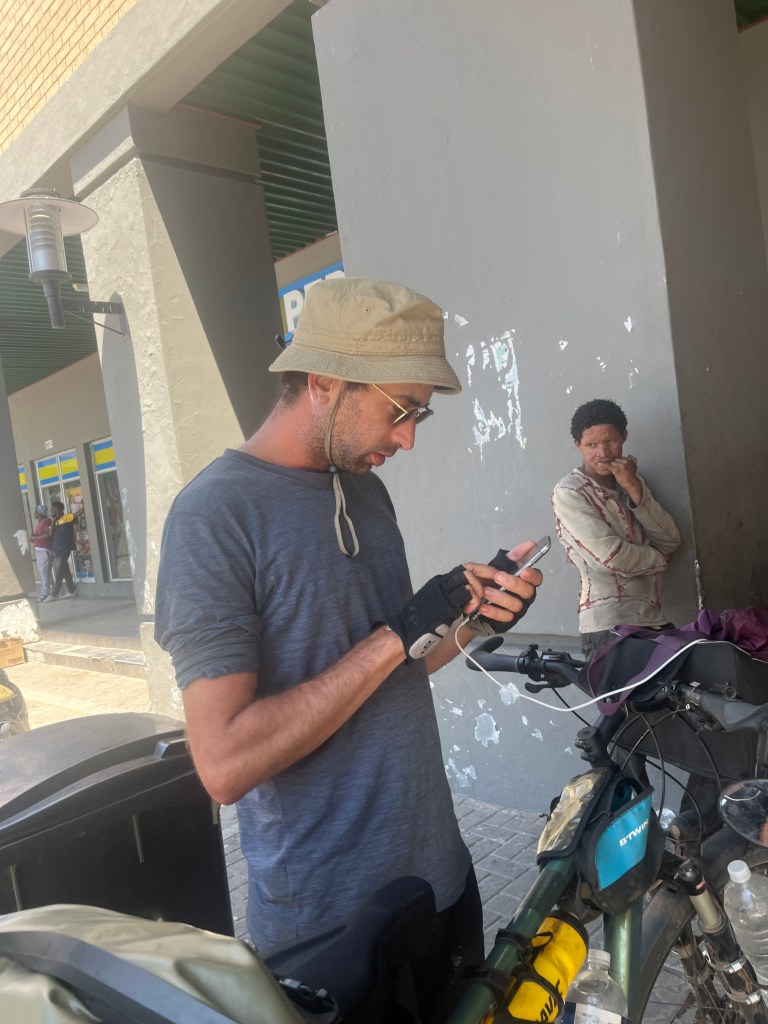
Unfortunately, the ioverlander spot looks deep in the bush, following 700m of deep sand. We don’t want to push sand anymore, so we decide to try our luck in an antenna that we can see on the horizon. And we do find our luck: apart from the security ward, the antenna is hosting 10 workers of a boreholing company, that are digging for water in an area nearby. While they stay here, they are sleeping in some solid camping tents. They are extremely friendly, and it takes less than 30 minutes for us to be sharing beer, cider and food with the manager and other guys. The antenna is similar to the previous one with its solar panel, backup generators roaring at night, and security drying his meat in the sun (which is from cows this time). The security made it feel like a small village, hosting a family of chicken and roosters (which will obviously wake us up at 4 am).
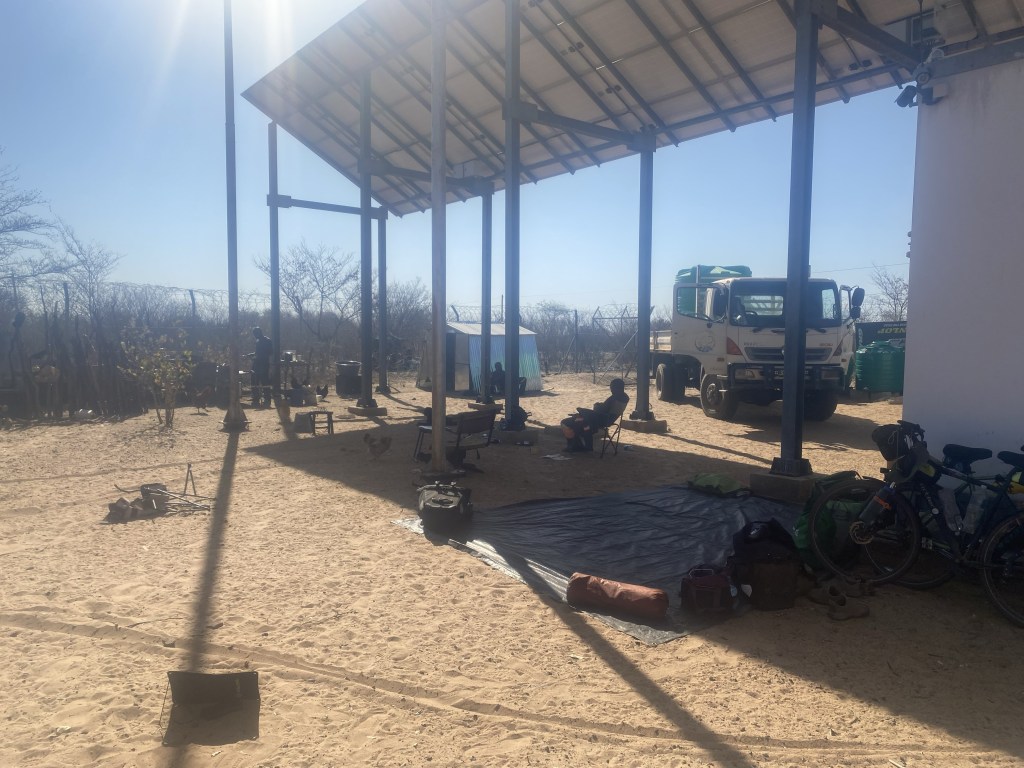
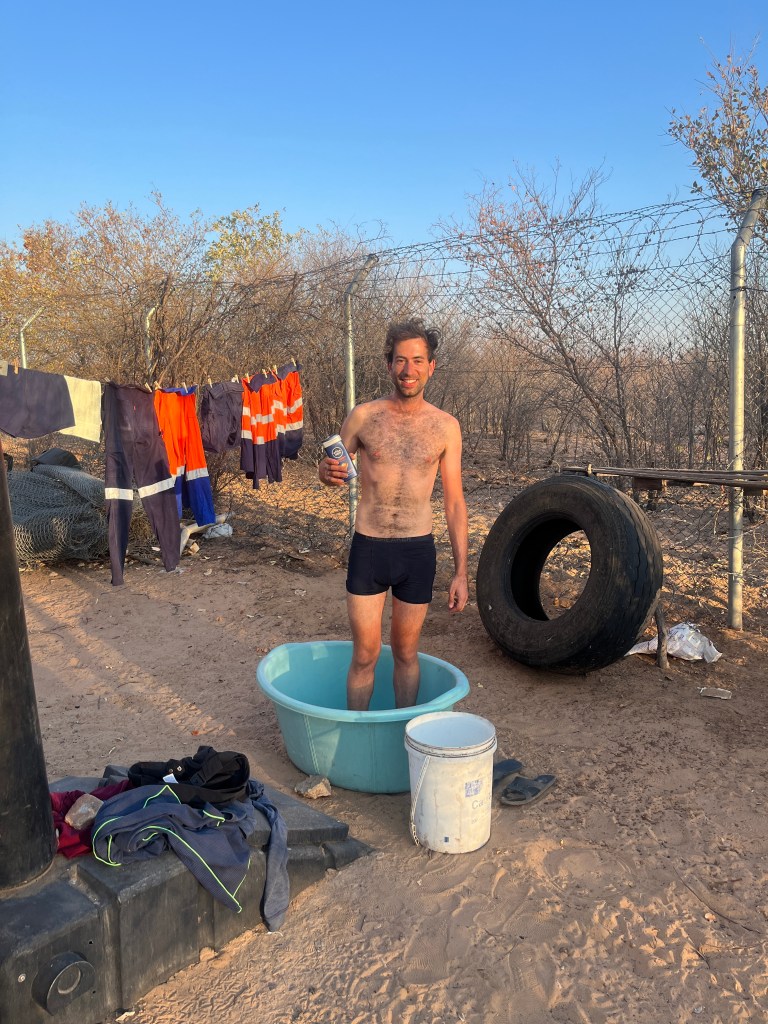
Most of the workers are from Gaborone, some from Francistown, Botswana’s 2nd biggest city. They are playing african township jazz in the radio, and they are definitely enjoying themselves. Specially the manager, who is slowly getting drunk. We learn a lot about Botswana through them. The company is run by the brother of the manager, and they are earning up to 6 Million Pula (450’000 Euro) for this project, which is around 1-2 months of work. They work every day though, although Saturdays and Sundays only half. However, they seem very happy with their salaries, and it’s no suprise: unqualified workers earn 12’000 pula (900 Euro), and qualified machine workers up to 22’000 (1’600 Euro). This is by far the highest we have heard of so far in all Africa.
We talk a lot about football with them. They know every La Liga and Premier clubs, including many players we don’t even know. They offer us some fresh beef from a cow they bought and killed yesterday, and invite us to go to Ghanzi to play snook and “meet” some girls, and offer we surprisingly don’t take long to refuse.


After some pictures, laughters and fun, we go to bed within the antenna premises, happy to have met such fantastic local people. The laugh of the manager will rock us.
02/10/23 – Crossroad antenna – Border. 181km, 450m+
We wake up excited: it’s one of the first days where we are going to have consistent backwind. We say bye to our friends from the antenna, and wish them the best. What a bunch of great guys. After 70 km we do our first break by a filling station also hopping to get some more water from the shop. Unfortunately they only have 1L water which are expensive so we take 1L each and hope to find some more on the road. Nevertheless the taste of cold water from the fridge is amazing.

The wind starts soon to do its work, and by 11 am we have done 100 km, with 60 more missing until the border post with Namibia. We decide to take a lunch break at a small town, one of the 4 that we will pass by in 160 kms of tar. They don’t have restaurant service at the shop, but they do let us cook, use the tap water and most importantly, they have cold Coke.
We continue without hesitation, eager to arrive at the border post and achieve an all-time distance record: the longest we did before was from Mauritania to St. louis in Senegal: 161 km in a day. The landscape continuous impassive, although the amount of fenced properties slowly increases. fenced lands belong in the rule to white farmers, who have bigger cattle exploitations that make them want to fence the property to avoid losses and issues.
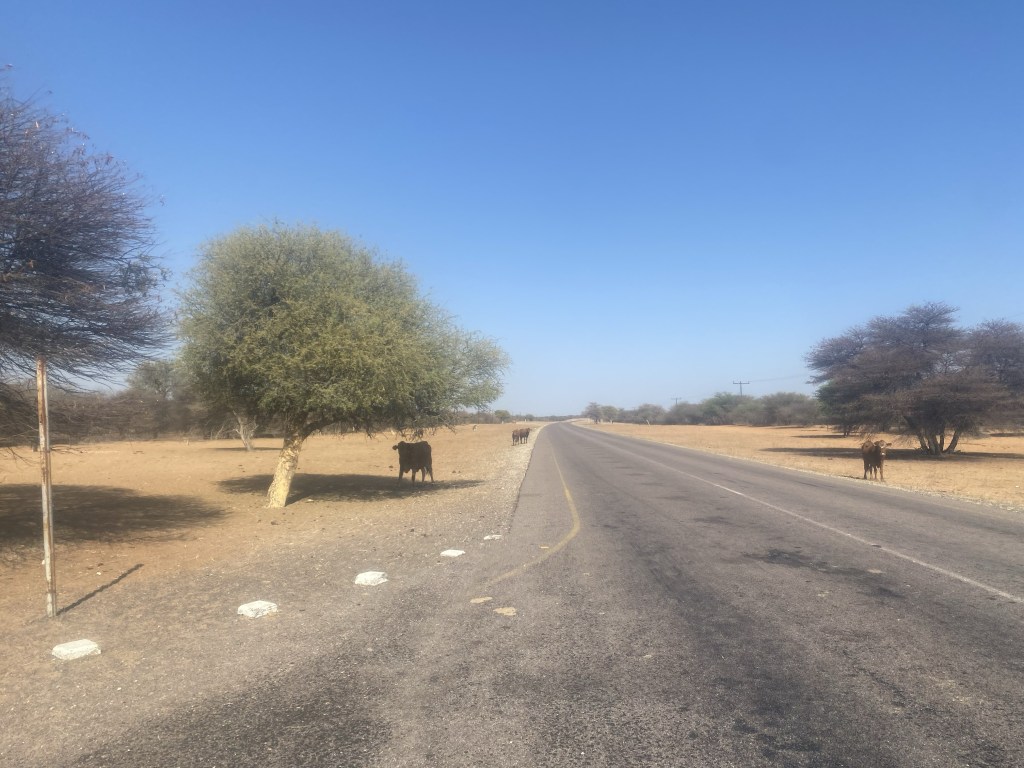
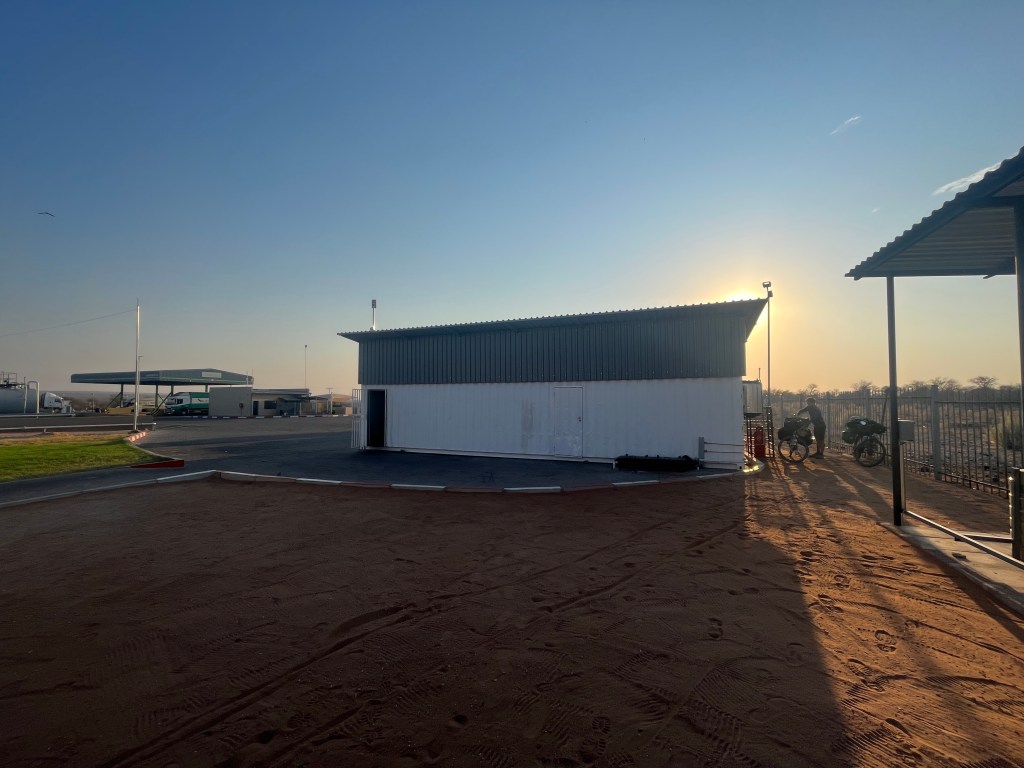
Although the wind stops helping us for the last 40 kms, we arrive at the border at last, where we plan to ask for camping permission at a truck fueling station. The woman at the office has to call her manager for approval, who accepts but asks us to camp in a place where the security cameras can’t see us. That place will be behind the small restaurant, where we buy a Coke for the kind lady, and a 2nd sugar dose for us, this time in the form of Fanta. The 2 cooks of the restaurant are very nice, and we spend some time talking to them. We can use the showers for free, like any driver, what is a very kind service, particularly because they are very clean. For clean water, however, we have to go 6 kms back to the nearest town (so an additional 12 km return).
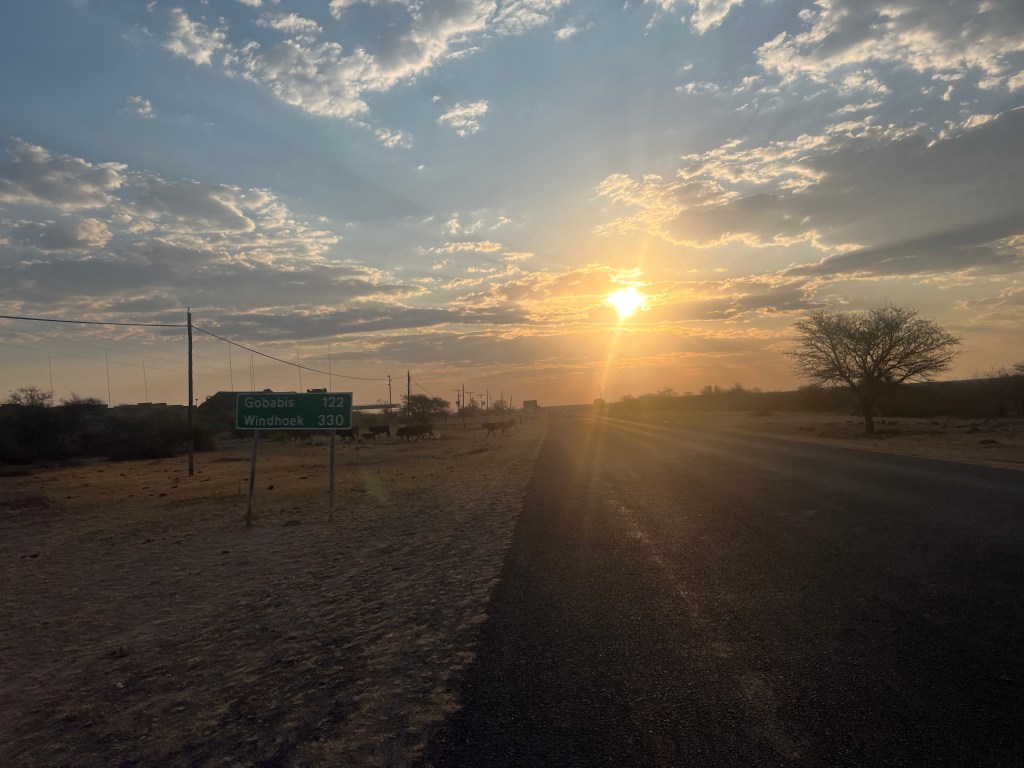
We flip a coin to see who has to go, and obviously that’s Javi, since Gaspard is the luckiest guy on earth – any other friend of his will confirm this hypothesis -. So Javi increases the record up to 181 km, and takes the opportunity to spend the last pulas in chips, beers, muesly and milk, so that we don’t get ripped off with border exchange rates, like it happened to us in Malawi.
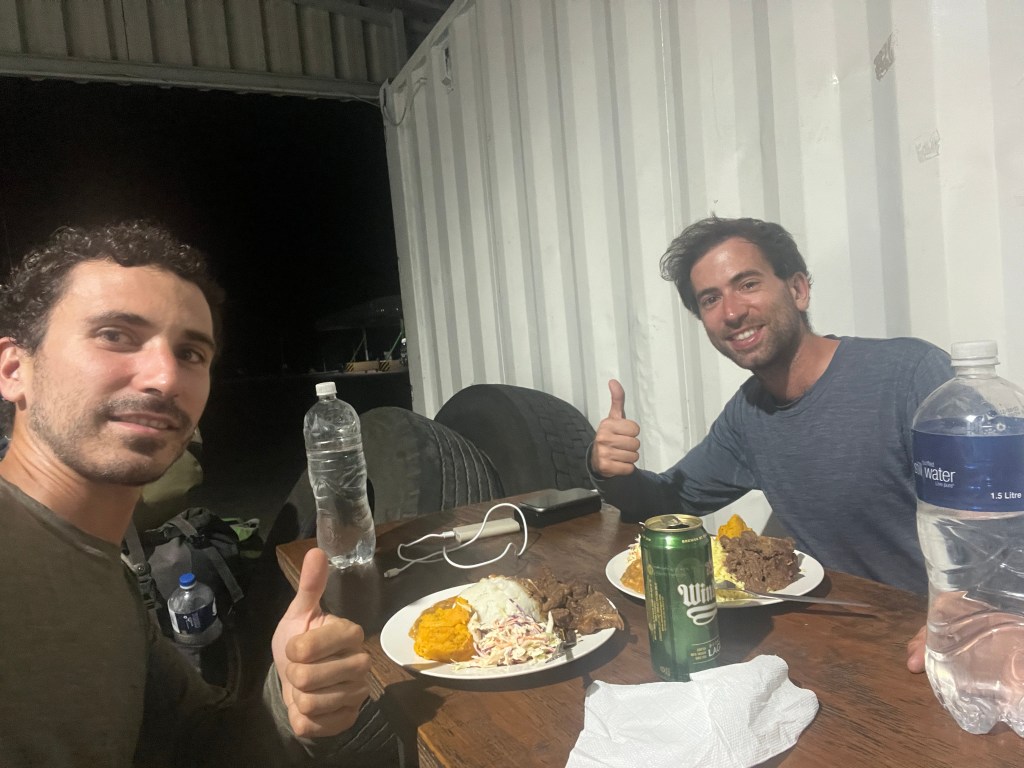
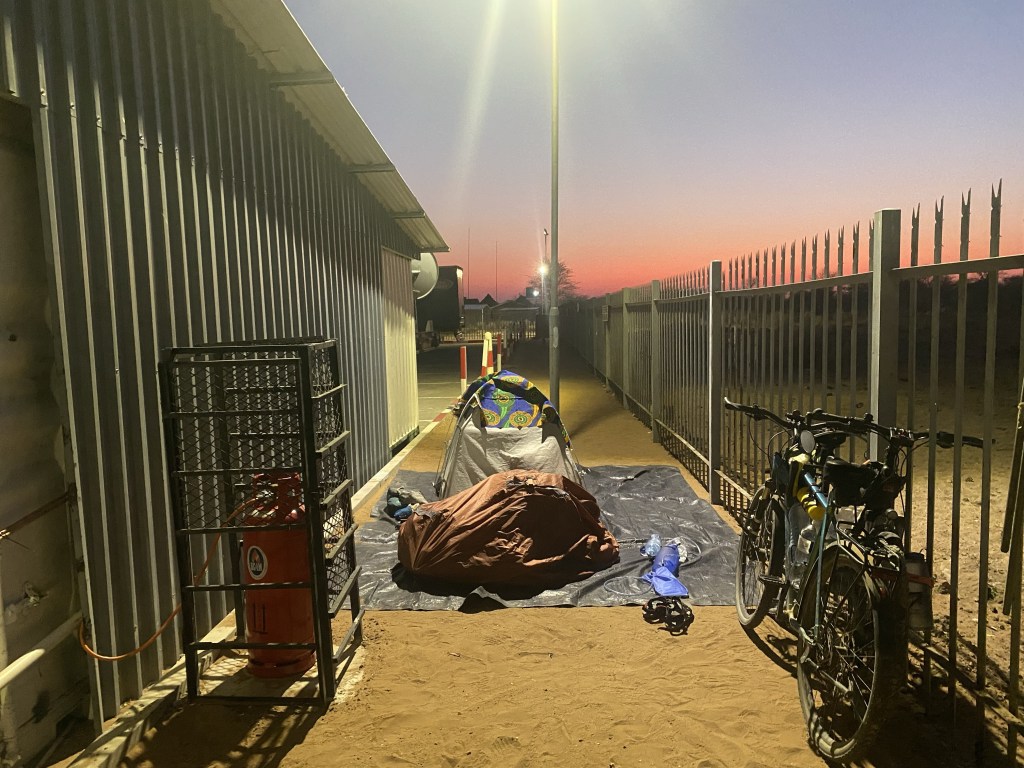
After a nice dinner at the gas station restaurant, we set our tent behind it and inform the security guy, who warns us about snakes. The camping spot is located below a street light shining into our tent, and next to the door holding the tgv from the bar. Not the ideal spot But we are too tired to care, so we get in the tent for our final sleep in Botswana, a country that, despite not being the most exciting one to cycle, given its flat and simple nature, has tested us with a merciless heat and heaps of elephants, and has offered us unconditional support by locals and other tourists. As of tomorrow, we will enter Namibia, the last country of our 2023 journey.
Days cycled in this post (total): 7, out of 61
Kms cycled in this post (total): 530 km, out of 4424 km
Elevation gained in this post (total): 1170m+, out of 34000m+
 Cycling Pirates
With every installment of your blog, I’m more amazed by your progress. And meeting you only briefly on this yourney, I’m certainly not surprised about your genuine encounters with the locals and fellow travelers.
Funny how small this world of ours is. You mentioned passing through Ghanzi. As it looks now, we will be spending this Christmas evening in Ghanzi, before our adventure through Central Kalahari, Mkadigadi and Nxai Pan national parks.
Good like with your final leg through Namibia!
Hvala, Jurij! Indeed, those encounters are what makes this type of travelling special! 🙂 Wish you great fun in Namibia, we would have loved to get to know the San culture better around Ghanzi, looking forward to learning it deeper in your blogpost! 🙂
Oh, and BTW, as I see I was posting the above as anonymous – it was Jurij from Slovenia (or, should I say, from Nyika Plateau?). 😉
Just reading with very great pleasure the two Botswana narratives… 😘😘😘 and dream I could have met the Sans, seen the elephant’s herds, cook with Sandra and most of all meet with you on the way ! Bravo Gaspard et Javi, quelle merveilleuse expérience 😎😓🤭🤔🥵
Sylvain
Sylvain wrote the preceding message 🤔
Sylvain wrote the preceding message 🤔